Clarification Questions in English: Asking for Confirmation

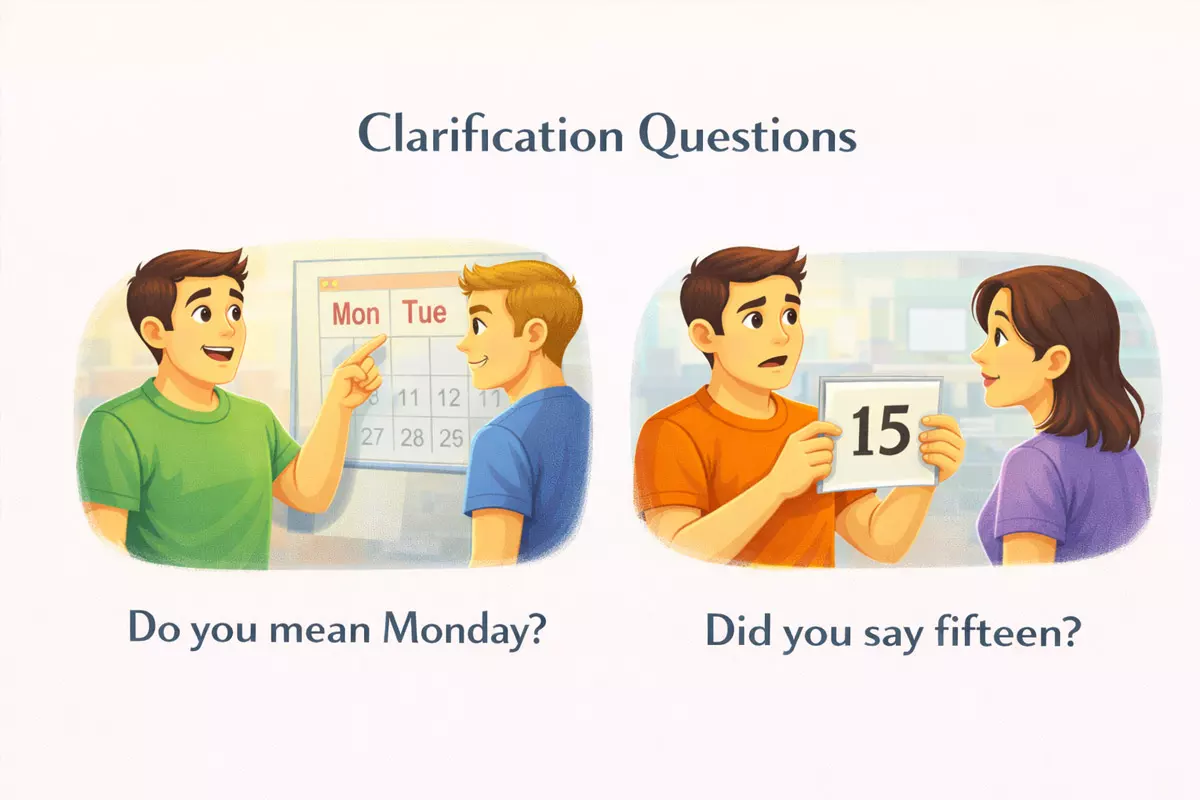 Here we what clarification questions are and when to use them. It details common question patterns, intonation, WH-words, polite strategies, frequent learner mistakes, and includes practice exercises for self-assessment.
Misunderstandings often happen during conversations, making it important to know how to politely ask for clarification or confirm details. By learning how to seek reassurance in a respectful way, you can avoid confusion and make your communication more effective. Developing these skills not only helps you better understand others but also allows you to express yourself more clearly, leading to more successful and comfortable interactions in English.
What Clarification Questions Are
Clarification questions are a type of inquiry used to confirm understanding or to make a statement clearer. When someone is unsure about what was said, or if a message seems ambiguous, asking for clarification helps to avoid confusion and ensure everyone is on the same page. These questions play a key role in effective communication, especially in English conversations where details might be missed or misunderstood.
Typically, these questions are brief and direct. They invite the speaker to repeat, rephrase, or confirm information. Rather than introducing new topics, they focus on confirming what has already been said. This can be especially important in classrooms, meetings, or everyday discussions where accuracy matters.
Common Purposes of Clarification Questions
- To check if you heard something correctly
- To confirm details or facts
- To ask for repetition of information
- To resolve misunderstandings
- To encourage the speaker to provide more details
Typical Phrases for Asking Clarification
- Could you repeat that, please? → Sure, I said the meeting starts at 9 a.m.
- Did you mean the deadline is tomorrow? → Yes, it has to be finished by tomorrow.
- So, are you saying that we need to change the plan? → Exactly, the current plan won’t work.
- Just to make sure I understand, is it due on Friday? → Yes, Friday is the correct date.
- Sorry, I didn’t catch that. Can you say it again? → Of course, I’ll repeat it more slowly.
- Could you clarify what you meant by “flexible schedule”? → It means you can choose your own working hours.
- Do you mean we should submit the report online? → Yes, please upload it to the platform.
- Are you saying that the event has been canceled? → No, it has only been postponed.
- Can I check if I got this right? → Yes, go ahead.
- Let me see if I understand you correctly. → Sure, tell me what you understood.
- Did I get that right? → Yes, that’s exactly what I meant.
- Is this what you mean? → Yes, that’s a good summary.
- Could you explain that a bit more? → Certainly, I’ll give you more details.
- What do you mean by “user-friendly”? → I mean it’s easy to understand and use.
- Can you give me an example? → For example, you can reset your password in one click.
- Is it correct to say this feature is optional? → Yes, you don’t have to use it.
- Do you mean to say the price will increase? → Yes, it will go up next month.
- Am I right in thinking this applies to everyone? → Yes, it applies to all users.
- Can you clarify that point? → Sure, I’ll explain it again.
- Could you be more specific? → Yes, I’m referring to the last section of the report.
Clarification vs. Other Question Types
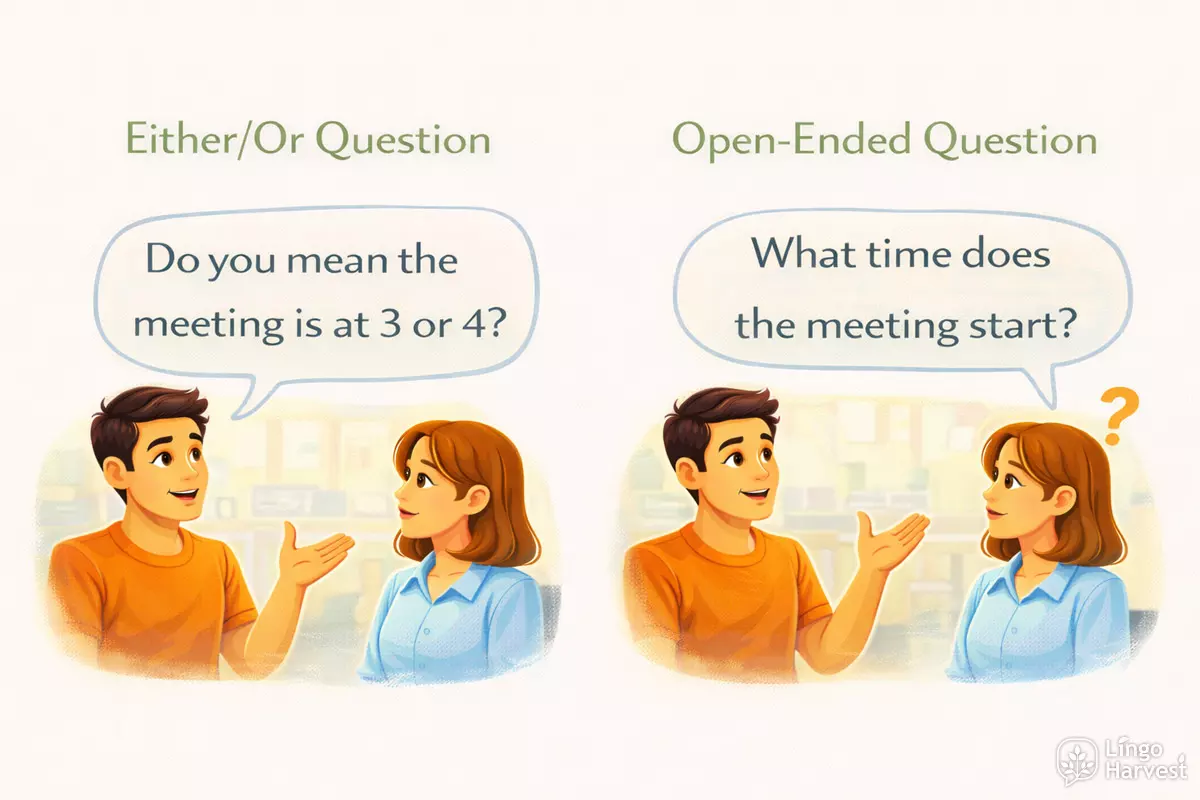
While clarification questions are about confirming or understanding, there are other types of questions in English that serve different purposes, such as gathering new information or making requests. Here’s a comparison to help distinguish them:
| Type of Question | Main Purpose | Example |
|---|---|---|
| Clarification | Confirm or clarify what was said | “Do you mean the meeting is at 3 or 4?” |
| Information-seeking | Request new information | “What time does the meeting start?” |
| Confirmation | Check if something is correct | “Is the meeting at 3?” |
| Request | Ask someone to do something | “Can you send me the agenda?” |
In summary, using clarification questions ensures that communication is accurate and misunderstandings are minimized. They are an essential tool for both language learners and fluent speakers, helping to keep conversations clear and effective.
When Clarification Is Needed
Unclear communication often leads to misunderstandings, so it’s important to recognize situations where you might need to ask for more information. This can happen in both spoken and written English, especially when details are missing, instructions seem ambiguous, or someone uses unfamiliar vocabulary. Being aware of these moments helps you respond appropriately and ensures both sides are on the same page.
Common Scenarios Requiring Clarification
- Someone gives instructions that are vague or incomplete.
- You hear unfamiliar words, slang, or technical terms.
- Information is delivered too quickly or quietly, making it hard to catch details.
- There are multiple possible interpretations for what was said.
- Contradictory statements appear in a conversation or message.
- You’re unsure about the speaker’s intention or the next steps.
- Details are missing that are necessary for you to proceed.
- Accents, background noise, or poor audio make it hard to understand.
- Written instructions contain typos or confusing phrasing.
- You want to confirm your understanding to avoid mistakes.
Typical Signals That Clarification May Be Needed
- You hesitate before responding because you’re not sure what was meant.
- You notice other people also look confused or ask follow-up questions.
- You realize your answer might not match the question that was asked.
- The topic shifts suddenly and you’re not sure why.
- You feel lost during a group discussion or meeting.
Examples of Clarification Questions
Using direct but polite questions helps you get the information you need without causing offense. Here are some common ways to ask for confirmation or more details:
- Could you slow down a bit when you explain this? → Sure, I’ll explain it more slowly.
- What exactly happens after this step? → After that, the system saves your changes automatically.
- How does this affect the final result? → It directly changes the outcome of the process.
- What is the main point you want me to focus on? → The key point is meeting the deadline.
- Why is this detail important here? → Because it affects the overall accuracy.
- What should I do first in this situation? → Start by checking the instructions.
- How is this different from the previous option? → This version is faster and more flexible.
- What do you recommend in this case? → I recommend choosing the safer option.
- Is there an alternative way to do this? → Yes, you can also do it manually.
- What happens if this doesn’t work as expected? → Then we’ll try a different approach.
- Which part should I pay attention to most? → Focus mainly on the final step.
- How much time do we have to complete this? → We have about two hours.
- What problem does this solution solve? → It helps prevent future errors.
- Who is responsible for this task? → The project manager is in charge.
- What should I do if I have more questions later? → You can contact me anytime.
- Does this apply to all situations or only this one? → It applies only in this specific case.
- What is the next step after we finish this? → Next, we’ll review the results.
- Is there anything else I should know before starting? → Just make sure you follow the guidelines.
Comparing Direct and Indirect Clarification Questions
| Direct Question | Indirect Question |
|---|---|
| What do you mean? | Could you explain what you mean? |
| Is that right? | Would you mind confirming if that’s correct? |
| Say that again. | Could you please repeat that? |
| Who are you referring to? | I’m not sure who you are referring to—could you clarify? |
Not every situation calls for the same level of formality. Choose a direct or indirect approach based on your relationship with the other person, the context, and how sensitive the topic might be. Being polite and specific will help you get the information you need and keep the conversation positive.
Common Clarification Question Patterns
When you’re unsure about what someone has said, English offers a number of useful ways to ask for confirmation or further explanation. These forms help maintain clear communication, prevent misunderstandings, and show that you’re actively engaged in the conversation. The phrasing you choose can be influenced by formality, context, and your relationship with the speaker.
Typical Sentence Structures
There are several standard approaches to requesting clarification. Some ask for repetition, others check understanding, and some request more details. Here are some of the most common structures:
- Yes/No Clarification: “Did you say…?”, “Is it correct that…?”, “So, you mean…?”
- Repetition Requests: “Could you repeat that?”, “Sorry, can you say that again?”
- Rephrasing for Confirmation: “Let me check if I understood: …”, “Just to confirm, …”
- Specific Detail: “Which one do you mean?”, “Are you referring to…?”
- Open-ended Clarification: “What do you mean by…?”, “Can you explain what you meant when you said…?”
- Polite Checks: “I’m not sure I follow. Could you clarify?”, “Would you mind explaining that?”
- Tag Questions: “You said it starts at 8, right?”, “We’re meeting tomorrow, aren’t we?”
- Echo Questions: Repeating a word or phrase with a questioning tone: “Tomorrow?” “By noon?”
- Requesting Examples: “Could you give me an example?”, “For instance?”
- Request for Spelling/Details: “How do you spell that?”, “Which address did you mean?”
- Clarifying Pronouns or References: “Who is ‘they’ in this case?”, “Does ‘it’ refer to the meeting or the report?”
- Checking Sequence: “So first we finish this, then we call the client?”
Sample Patterns and Their Use
The table below summarizes some common question types and gives examples of how they might be used in conversation:
| Pattern Type | Example Question |
|---|---|
| Checking Understanding | “So, if I understand correctly, we submit it by Friday?” |
| Requesting Repetition | “Sorry, could you say that again?” |
| Confirming Details | “Did you mean the main office or the branch?” |
| Clarifying Reference | “When you say ‘they’, who are you referring to?” |
| Seeking Examples | “Could you give an example of what you mean?” |
| Tag Question | “You’ll send the email, won’t you?” |
| Echo Question | “By noon?” |
Using these patterns allows you to clarify meaning without sounding abrupt or rude. Adjust your language for context and always aim for a tone that encourages open communication. Remember, asking for clarification or confirmation is a sign of careful listening, not a weakness.
Using Intonation for Clarification
How you say something in English can be just as important as the words you choose, especially when you need to check your understanding. Intonation—the rise and fall of your voice—plays a major role in signaling that you are asking for confirmation or clarification. By altering your pitch or stress, you can turn a statement into a question or show uncertainty, which helps your listener recognize that you’re seeking more information or checking details.
Recognizing Question Intonation Patterns
Rising intonation is commonly used when asking for confirmation. Your voice goes up at the end of the sentence, making it clear that you expect a response. This is different from the falling intonation usually heard in statements, which signals certainty and completeness. By intentionally varying your pitch, you can make even simple phrases work as clarification questions.
- “You’re meeting at six?” → Yes, the meeting starts at six.
- “This is the right address?” → Yes, that’s the correct address.
- “So, you finished the report?” → Yes, I finished it this morning.
- “We need to bring our own lunch?” → Yes, lunch isn’t provided.
- “It’s upstairs?” → Yes, it’s on the second floor.
- “You said Thursday, not Tuesday?” → That’s right, Thursday.
- “The blue folder?” → Yes, the blue one on the desk.
- “You mean the main entrance?” → Yes, use the main entrance.
- “We’re supposed to call first?” → Yes, please call before you arrive.
- “You want it emailed?” → Yes, email it to me.
- “The meeting’s at noon?” → Yes, it starts at twelve.
- “You need a copy, too?” → Yes, I’ll need a copy as well.
- “We don’t have to sign in?” → No, signing in isn’t required.
- “She’s on vacation now?” → Yes, she’s away this week.
- “This is the correct form?” → Yes, that’s the right form.
- “They already left?” → Yes, they left about ten minutes ago.
- “It’s not urgent?” → No, it can wait.
- “You’ve finished already?” → Yes, I’m done.
Comparing Statement and Question Intonation
The difference between a statement and a question can often be subtle in English. Below is a comparison to illustrate how intonation changes the meaning, even when the words stay the same.
| Statement (Falling Intonation) | Clarification Question (Rising Intonation) |
|---|---|
| You’re coming tomorrow. ✅ | You’re coming tomorrow? → |
| This is the right key. ✅ | This is the right key? → |
| The meeting starts at ten. ✅ | The meeting starts at ten? → |
| You finished the project. ✅ | You finished the project? → |
Tips for Practicing Intonation
- Record yourself saying both statements and questions to hear the difference.
- Listen carefully to native speakers in conversations or media and notice how their pitch changes when clarifying.
- Practice with a language partner by reading sentences as both statements and questions.
- If unsure, exaggerate the rise in your voice at first; you can adjust as you become more confident.
Mastering the use of pitch and stress helps you communicate more naturally and ensures your clarification requests are easily understood. It’s a skill that improves with consistent attention and practice.
Clarification with WH-Words
When you need to check details or understand something more deeply in English, WH-questions (who, what, when, where, why, and how) are especially useful. These question forms help you gather the specific information you’re missing, rather than just confirming yes or no. Using WH-words for clarification is common in both casual and professional conversations, and mastering these patterns will make your communication clearer and more effective.
Common WH-Question Forms for Clarification
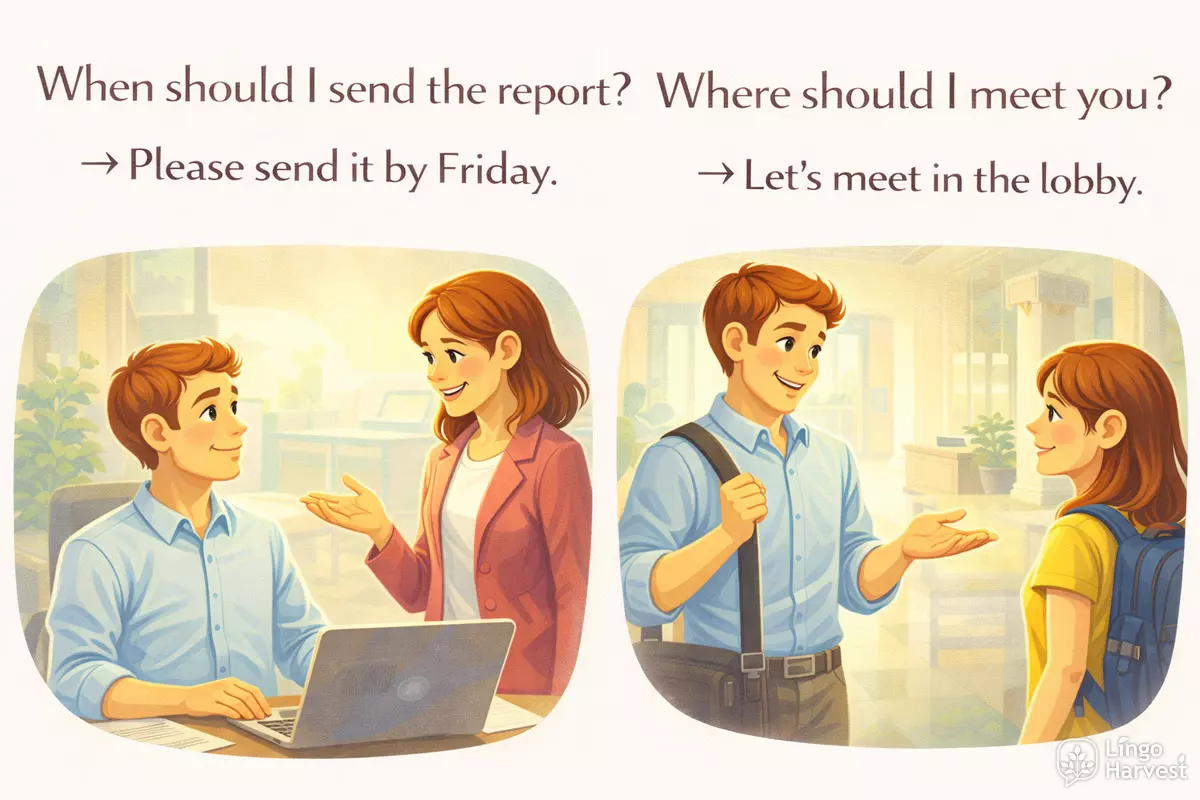
If a statement is unclear or incomplete, use a WH-word to ask for the missing detail. Here are typical ways these questions appear in requests for clarification:
- Who did you mean? → I was referring to the project manager.
- What exactly are you referring to? → I’m talking about the latest update.
- When should I send the report? → Please send it by Friday.
- Where should I meet you? → Let’s meet in the lobby.
- Why is this important? → Because it affects the final decision.
- How does that work? → It works by automatically syncing the data.
- Which document are you talking about? → The one titled “Project Overview.”
- Whose turn is it? → It’s your turn.
- What kind of help do you need? → I need help with the presentation.
- How many people will attend? → About twenty people.
- How much time do we have? → We have roughly two hours.
- Where exactly is the meeting? → It’s in Conference Room B.
- When did you say the deadline is? → I said it’s next Monday.
- Why do you think that? → Because the data clearly supports it.
- How often should I check in? → Once a week is enough.
- Who else is involved? → The design and marketing teams.
- Which one do you prefer? → I prefer the second option.
- What do you mean by “urgent”? → I mean it needs to be done today.
Comparing Yes/No and WH-Word Clarification
While yes/no questions confirm information, WH-questions uncover specifics. The table below shows the difference:
| Yes/No Clarification | WH-Word Clarification |
|---|---|
| Is that correct? | What do you mean by that? |
| Did you say Monday? | When exactly should I come? |
| Is this the right file? | Which file do you need? |
| Should I call you? | How should I contact you? |
WH-word questions invite fuller responses, so they’re ideal for situations where you want someone to elaborate or clarify. This approach not only solves misunderstandings but also encourages more precise and open communication.
Polite Clarification in Conversation
Misunderstandings can happen easily, especially when speaking a second language or communicating in noisy environments. To keep conversations smooth and respectful, it’s important to know how to ask for clarification without sounding abrupt or rude. Using gentle language and certain phrases helps maintain a positive tone and encourages open communication.
Common Polite Phrases for Clarifying
When you’re unsure about what someone said or meant, try using softening expressions. These phrases signal that you are interested in understanding, not challenging or interrupting the speaker.
- Sorry, could you repeat that, please? → Of course, I said the deadline is Friday.
- I’m not sure I understood you correctly. Did you mean the meeting was postponed? → Yes, it has been moved to next week.
- Could you clarify what you meant by “flexible hours”? → It means you can choose when to start and finish work.
- Just to make sure I got it right, you’re saying we should submit it today? → Yes, it needs to be sent today.
- Pardon me, what was that again? → I said we’ll discuss it after lunch.
- Would you mind explaining that a bit more? → Sure, I’ll explain the process step by step.
- I’m not certain I follow. Could you elaborate? → Let me give you some more background.
- Let me check if I understood: are you saying the budget was reduced? → Yes, we have less funding now.
- Did I hear you correctly that the project is finished? → Yes, it’s already completed.
- Do you mean we should wait until tomorrow? → Yes, waiting until tomorrow would be better.
- So, if I understand you right, you’re suggesting a different approach? → Exactly, I think another approach would work better.
- Am I right in thinking that this applies to everyone? → Yes, it applies to the whole team.
- Could you give me an example? → For example, you could start with a short introduction.
- Could you go over that one more time? → Sure, I’ll explain it again.
- Sorry, I missed that part. What did you say about the schedule? → I said the schedule will be updated later today.
- Can I just confirm what you said? → Yes, go ahead.
- I want to make sure I understand. Are you saying the plan has changed? → Yes, we’ve made a few changes.
- Could you say that in a different way? → Sure, I’ll rephrase it.
- Did you mean to say the price will increase next month? → Yes, it will go up next month.
Tips for Maintaining Politeness
- Use “please” and “thank you” to soften your requests.
- Keep your tone friendly and avoid sounding impatient.
- Smile or nod if face-to-face, to show positive intent.
- Preface questions with a brief apology, like “Sorry” or “Excuse me.”
- Express appreciation for clarification, for example, “Thanks for explaining.”
Comparing Direct vs. Polite Clarification
| Direct Form | Polite Alternative |
|---|---|
| What? | Sorry, could you repeat that? |
| Say that again. | Would you mind saying that again, please? |
| I don’t get it. | I’m not sure I understand. Could you explain? |
| What do you mean? | Could you clarify what you mean by that? |
| Repeat. | Could you go over that one more time, please? |
Choosing the right words and tone makes a significant difference in how your request is received. Polite clarification not only helps you understand better but also strengthens mutual respect in any conversation.
Common Learner Mistakes
Learners often struggle with the correct use of clarification questions and confirmation requests in English. These challenges can lead to misunderstandings or awkward interactions. Below are some typical issues and patterns to watch out for when practicing these skills.
Overusing Direct Questions
Many students rely too heavily on direct questions like “What?” or “Repeat?” instead of using more polite or natural clarification forms. This can sound abrupt or even rude in English, especially in formal settings.
- Forgetting to use softeners: e.g., “Could you repeat that, please?” instead of just “Repeat?”
- Using incomplete phrases: e.g., “What mean?” instead of “What do you mean?”
- Mixing up confirmation and clarification: e.g., “Do you mean…?” when actually just asking for repetition.
Misusing Tag Questions
Tag questions are often used to check understanding or seek confirmation, but learners sometimes use the wrong auxiliary or pronoun, making the sentence confusing.
- Incorrect: “You are going, isn’t it?”
- Correct: “You are going, aren’t you?”
- Incorrect: “She can drive, can she?” (when confirming; should be “can’t she?”)
Confusing Clarification with Agreement
It’s easy to mix up asking for clarification with simply agreeing. For example, answering “Yes” to “Do you understand?” without actually understanding the message.
- Saying “yes” just to move the conversation forward
- Nodding without verbal confirmation or further questions
- Not asking follow-up questions when unsure
Common Faulty Patterns
Certain mistakes appear repeatedly among English learners. Here’s a comparison of incorrect and correct ways to ask for clarification or confirmation:
| Incorrect Form | Natural Alternative |
|---|---|
| What? | Sorry, could you say that again? |
| Repeat! | Would you mind repeating that, please? |
| You mean…? | Do you mean that…? |
| Is it OK? | Is that correct? |
| This right? | Is this correct? |
| Understand? | Did I understand you correctly? |
| You say…? | Are you saying that…? |
| He will come, isn’t it? | He will come, won’t he? |
Neglecting Context and Tone
Finally, it’s common to forget that the politeness and formality of clarification depend on the situation. Using overly formal language with friends, or being too casual in a business meeting, can both feel out of place.
- Using “Excuse me, may I inquire…” in casual conversation
- Using “What?” or “Huh?” in professional contexts
Paying attention to these typical pitfalls helps learners sound more fluent and avoid confusion. Practicing a variety of confirmation and clarification patterns in different contexts is key to improvement.
Practice Exercises and Self-Check
To build confidence in using clarification strategies, try these activities. They will help you recognize, form, and respond to different confirmation requests in English conversations. Practice both creating and identifying clarification questions, and check your understanding with the answer key provided.
1. Identify the Clarification Question
Read each exchange and decide which sentence is the clarification question.
- A: "I’ll meet you at the station at five."
B: "Sorry, did you say five or six?" - A: "Can you finish this report by Friday?"
B: "Just to confirm, you mean this coming Friday?" - A: "We need three copies of the document."
B: "Three copies, right?" - A: "The meeting starts at noon."
B: "At twelve o’clock, correct?" - A: "Please email the file to everyone."
B: "You want it emailed to the whole team?" - A: "Let’s meet outside the main entrance."
B: "The main entrance, not the side door?" - A: "She’ll join us after lunch."
B: "After lunch, not before?" - A: "The room is on the third floor."
B: "The third floor, right?" - A: "You should submit the form online."
B: "Online submission only?" - A: "We need to leave early tomorrow."
B: "Early tomorrow morning?"
Show answers
- B: "Sorry, did you say five or six?"
- B: "Just to confirm, you mean this coming Friday?"
- B: "Three copies, right?"
- B: "At twelve o’clock, correct?"
- B: "You want it emailed to the whole team?"
- B: "The main entrance, not the side door?"
- B: "After lunch, not before?"
- B: "The third floor, right?"
- B: "Online submission only?"
- B: "Early tomorrow morning?"
2. Make Your Own Clarification Questions
Rewrite each statement as a clarification question. Use polite or natural-sounding forms.
- "You want the blue folder."
- "We’re meeting at the restaurant."
- "The deadline is next Monday."
- "She asked for two tickets."
- "The report needs to be printed."
- "He will call you later."
- "The class starts at eight."
- "They booked the small conference room."
- "You should update the document."
- "The payment is due today."
Show answers
- "Do you mean the blue folder?" or "You want the blue folder, right?"
- "Are we meeting at the restaurant?" or "So, we’re meeting at the restaurant?"
- "Is the deadline next Monday?" or "Next Monday is the deadline, correct?"
- "Did she ask for two tickets?" or "Two tickets, is that right?"
- "Do you mean the report needs to be printed?" or "The report needs to be printed, right?"
- "Will he call me later?" or "You’re saying he’ll call later?"
- "Does the class start at eight?" or "Eight o’clock, correct?"
- "Did they book the small conference room?" or "The small conference room, right?"
- "Do you want me to update the document?" or "You want the document updated?"
- "Is the payment due today?" or "Today is the payment deadline, correct?"
4. Match the Situation to the Clarification Question
Match each situation with the most appropriate clarification question.
| Situation | Clarification Question |
|---|---|
| You didn’t catch the meeting time. | Is it in Room B or Room C? |
| You’re not sure which document to send. | Did you say 2:00 or 3:00? |
| You want to double-check the address. | Do you want the PDF version or the Word version? |
| You think someone asked for help, but aren’t sure. | Is the address 45 Main Street? |
| You’re unsure which room the meeting is in. | Did you want me to help with that? |
| You didn’t hear the correct name. | Sorry, did you say Anna or Emma? |
| You’re unclear about the deadline date. | Just to confirm, is it due next Monday? |
| You’re not sure whether to email or print the document. | Should I email it to you or print a copy? |
| You don’t know how many copies are needed. | Do you need two copies or three? |
| You didn’t catch which link to use. | Which link should I use, the first one or the second one? |
Show answers
- You didn’t catch the meeting time. → Did you say 2:00 or 3:00?
- You’re not sure which document to send. → Do you want the PDF version or the Word version?
- You want to double-check the address. → Is the address 45 Main Street?
- You think someone asked for help, but aren’t sure. → Did you want me to help with that?
- You’re unsure which room the meeting is in. → Is it in Room B or Room C?
- You didn’t hear the correct name. → Sorry, did you say Anna or Emma?
- You’re unclear about the deadline date. → Just to confirm, is it due next Monday?
- You’re not sure whether to email or print the document. → Should I email it to you or print a copy?
- You don’t know how many copies are needed. → Do you need two copies or three?
- You didn’t catch which link to use. → Which link should I use, the first one or the second one?
5. Self-Check: When to Use Clarification Questions
Consider these situations. Decide if a clarification question is needed (✅) or not (❌).
- You didn’t hear what someone said. (✅)
- You fully understood the instructions. (❌)
- You want to confirm an important detail. (✅)
- You already know the answer for sure. (❌)
- Something sounded confusing or ambiguous. (✅)
Keep practicing these patterns and try to use them in real conversations. The more you use clarification questions, the easier it will be to communicate clearly and avoid misunderstandings.