Mini Test: Articles in Daily Routines

 The article reviews daily routine vocabulary and guides you on selecting the correct articles in context. It also features a gap-fill test, a sentence rewrite activity, and a section to help you evaluate your progress with articles.
Everyday habits often involve the use of words such as "a," "an," and "the," and mastering their correct usage can be more challenging than it appears at first glance. This brief quiz is designed to help you assess and strengthen your understanding of these common articles as they naturally occur in regular conversations and daily routines. By participating, you will have the opportunity to identify any areas that might need improvement and gain more confidence in using these essential parts of English grammar accurately in your everyday speech and writing.
Review of daily routine vocabulary
Understanding the key terms and expressions used to describe daily activities is essential for success with exercises on articles in everyday routines. Below, you’ll find a practical overview of commonly used vocabulary, organized to help you recall and apply these words in context.
Essential verbs for daily actions
- wake up
- get up
- take a shower
- brush teeth
- wash your face
- get dressed
- have breakfast
- make the bed
- go to work
- commute
- study
- eat lunch
- do homework
- relax
- cook dinner
- clean up
- read a book
- watch TV
- check emails
- go for a walk
- go to bed
Useful nouns and phrases for routines
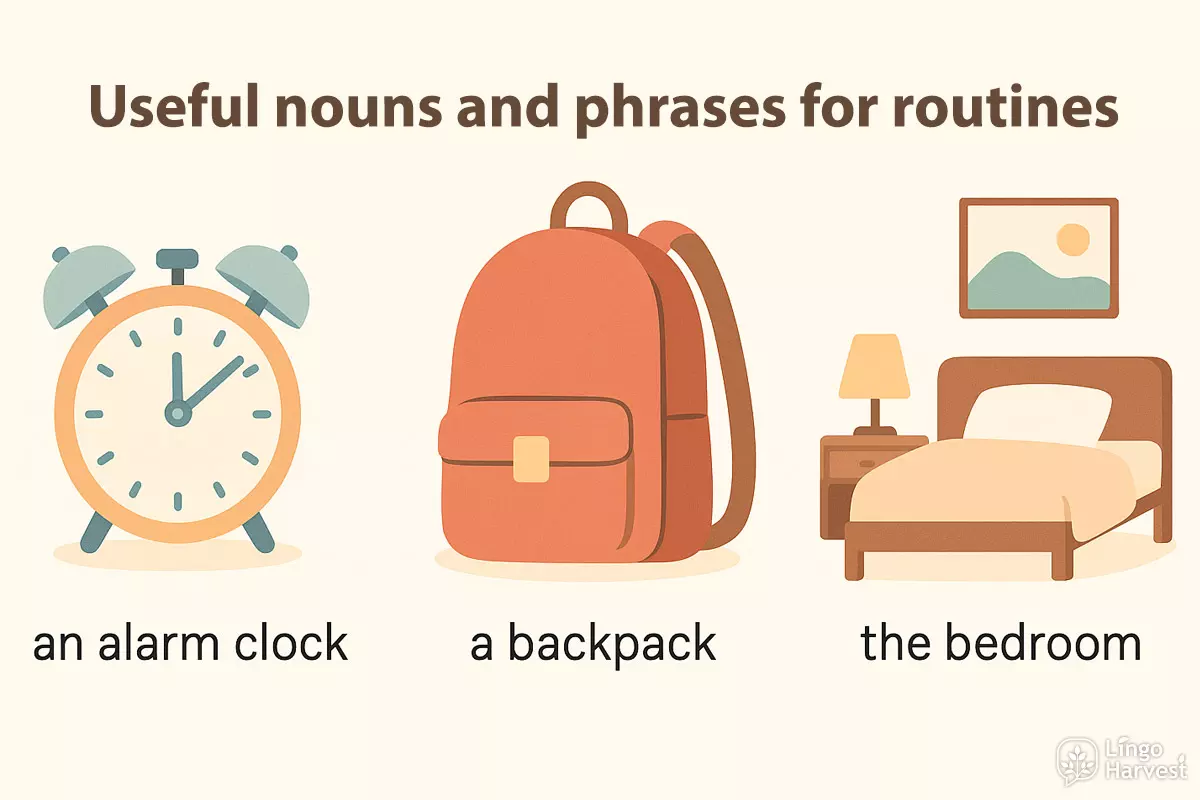
- an alarm clock
- a cup of coffee
- the bus
- a meeting
- the gym
- a shower
- the kitchen
- a newspaper
- the evening
- a snack
- the bathroom
- a friend
- the office
- a walk
- a water bottle
- the living room
- a backpack
- a lunch box
- the bedroom
- a notebook
Examples: Articles in daily routine phrases
Notice how articles like a and the are used with routine vocabulary. Here are some examples comparing their usage:
| With "a" | With "the" |
|---|---|
| I drink a cup of tea every morning. | I turn off the alarm clock at 7 a.m. |
| She takes a shower after jogging. | He reads the newspaper before breakfast. |
| They have a meeting every Monday. | She washes the dishes after dinner. |
| He grabs a snack in the afternoon. | We walk the dog in the park. |
Practice: Identify the correct article
- I usually eat ___ apple before lunch. (a/the)
- She takes ___ bus to work every day. (a/the)
- He forgot to lock ___ door last night. (a/the)
- We have ___ meeting at 9 o’clock. (a/the)
- Did you see ___ movie we talked about? (a/the)
- My father bought ___ new car yesterday. (a/the)
- Please hand me ___ salt, please. (a/the)
- They live in ___ house on the corner. (a/the)
- She has ___ cat and ___ dog. (a/the)
- He broke ___ glass in the kitchen. (a/the)
Show answers
- a
- the
- the
- a
- the
- a
- the
- the
- a, a
- the
Reviewing these phrases and patterns helps you use articles correctly in routine contexts. Practice using these words and expressions in your own sentences to build confidence and fluency.
Choosing correct articles in context
Understanding which article to use—a, an, or the—depends on meaning, context, and whether a noun is specific or general. In daily routines, these small words help listeners know if you mean something in general or something particular. Paying attention to the surrounding information makes your sentences clear and natural.
General rules for article selection
- Use "a" or "an" when talking about something for the first time, or when it's not specific. Example: "I have a meeting today."
- Use "the" for something specific or already mentioned. Example: "The meeting starts at 9 AM."
- Omit articles with plural or uncountable nouns when speaking generally: "I drink coffee every morning."
- "A" vs. "an": Use "an" before vowel sounds, and "a" before consonant sounds. Example: "an apple," "a banana."
Common patterns in daily routines
Here are some typical sentence fragments from everyday activities. Notice how the choice of article changes the meaning:
- Take a shower (any shower, not specific)
- Feed the cat (your specific pet)
- Have breakfast (no article needed)
- Read the newspaper (a specific one you usually read)
- Go to the gym (a particular place you visit)
- Send an email (any email, not yet specified)
- Listen to music (general, uncountable)
- Take the bus (a specific bus or route)
- Eat a snack (not specific, any snack)
- Wash the dishes (the specific ones used)
- Prepare lunch (no article for meals in general)
- Set an alarm (any alarm, not specific)
- Answer the phone (the phone that is ringing)
Article usage comparison
| Sentence | Explanation |
|---|---|
| I need a pen. | Any pen, not a particular one. |
| Where is the remote? | The specific remote everyone knows about. |
| She drinks coffee every morning. | No article—talking about coffee in general. |
| He caught the bus to work. | The specific bus he usually takes. |
| Please open an email from HR. | Any one of several emails from HR. |
Short gap-fill test
Practicing the use of articles in everyday activities can help you internalize when to use "a," "an," or "the." The following short activity focuses on sentences about typical daily routines. Each sentence has a blank where an article may be needed. Read each statement carefully, and decide which article fits best—or if no article is required.
Fill in the blanks: Articles in daily routines
Insert a, an, the, or leave the gap empty if no article is needed.
- I usually have ___ cup of coffee before I go to work.
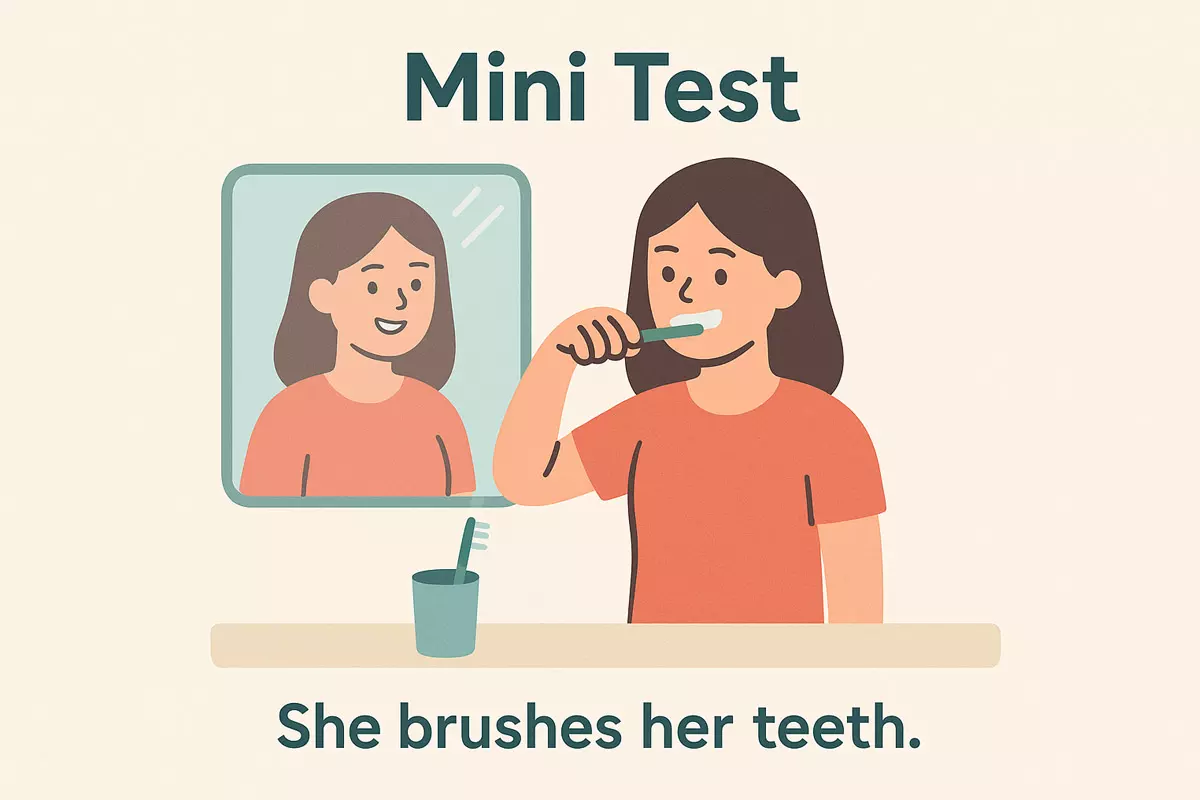
- She brushes her teeth in ___ morning and at night.
- After ___ breakfast, we walk to ___ bus stop together.
- Tom takes ___ shower every evening.
- My sister feeds ___ cat before she leaves home.
- Do you read ___ newspaper on weekdays?
- He listens to ___ radio while making breakfast.
- We often have ___ dinner at 7 p.m.
- Anna goes to ___ gym twice ___ week.
- ___ sun rises at six o’clock in summer.
Show answers
- a
- the
- —, the
- a
- the
- the
- the
- —
- the, a
- The
Common article usage in daily routine phrases
- take a shower / have a bath
- go to school / go to work
- make the bed
- walk the dog
- have breakfast / have lunch / have dinner
- catch the bus
- read a book / read the newspaper
- feed the pets
- do the laundry
- listen to the radio
- go to the gym
- set the alarm
- brush your teeth
- leave the house
- go to bed
Sentence rewrite activity
Practicing how to rephrase sentences is a powerful way to internalize the correct use of articles in everyday routines. By transforming sentences, you become more attentive to context and the natural patterns of English. Below, you’ll find a set of exercises and tips to help you recognize when to use "a," "an," or "the" in typical daily activities.
Instructions
Read each sentence carefully. Rewrite it by changing the article or adding an appropriate one where necessary. This will help you focus on precision and fluency in common situations.
Rewrite Examples
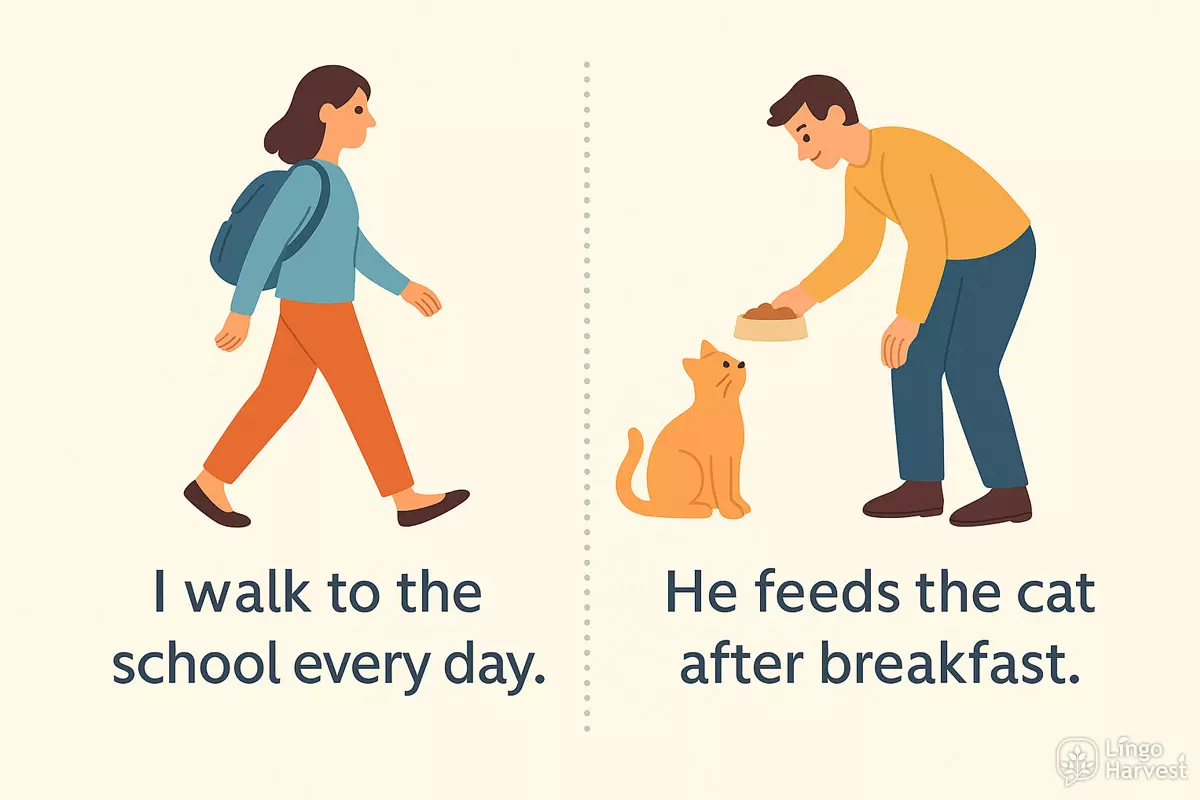
- She drinks coffee in the morning. → She drinks a coffee in the morning.
- I walk to school every day. → I walk to the school every day.
- He feeds cat after breakfast. → He feeds the cat after breakfast.
- We have lunch at noon. → We have a lunch at noon.
- She reads book before bed. → She reads a book before bed.
- I take bus to work. → I take the bus to work.
- They watch movie every Friday. → They watch a movie every Friday.
- He listens to radio in the car. → He listens to the radio in the car.
- We go to park on weekends. → We go to the park on weekends.
- She makes egg for breakfast. → She makes an egg for breakfast.
<
Practice: Rewrite These Sentences
- I eat apple every day.
- He goes to gym in the morning.
- We have dinner at restaurant.
- She takes shower before work.
- They read newspaper at breakfast.
- He bought umbrella yesterday.
- She fed cat before leaving.
- We visited museum last weekend.
- I need pen to write this.
- She watched movie we talked about.
Show answers
- I eat an apple every day.
- He goes to the gym in the morning.
- We have dinner at a restaurant.
- She takes a shower before work.
- They read the newspaper at breakfast.
- He bought an umbrella yesterday.
- She fed the cat before leaving.
- We visited the museum last weekend.
- I need a pen to write this.
- She watched the movie we talked about.
Common Article Patterns in Routines
Familiarize yourself with typical article usage in daily activities by reviewing these patterns:
- Have a (meal): have a snack, have a coffee
- Go to the (place): go to the gym, go to the store
- Take a (shower/break): take a shower, take a break
- Listen to the (radio/news): listen to the radio
- Read the (newspaper): read the newspaper
- Feed the (pet): feed the dog, feed the cat
- Watch a (movie/show): watch a movie
- Catch the (bus/train): catch the bus
- Cook an (egg/omelet): cook an egg
- Go for a (walk/run): go for a walk
By regularly rewriting sentences and noting these patterns, you can sharpen your grasp of article use in everyday English.
Evaluate your progress
After completing a mini test on articles in everyday activities, it’s important to check your understanding and see where you can improve. Start by reviewing your answers carefully. Consider not only which items you got correct, but also why any mistakes happened. This reflective approach helps reinforce patterns and rules regarding the use of articles in common routines.
Common article usage in daily routines
To help you analyze your responses, here are some typical phrases involving articles. Notice how “a,” “an,” and “the” are used in different situations:
- Have breakfast (no article, as it’s a general meal)
- Take a shower
- Read the newspaper
- Go for a walk
- Catch the bus
- Make a cup of tea
- Feed the dog
- Listen to the radio
- Brush your teeth (possessive, so no article)
- Start the day
- Prepare lunch (no article when speaking generally)
- Take an umbrella (when it’s raining)
- Go to the gym
- Check the emails
- Have a meeting
Self-assessment checklist
Ask yourself these questions as you review your results:
- Did you remember when to omit articles (meals, places, some activities)?
- Were you consistent with definite and indefinite articles?
- Did you pay attention to general versus specific references?
- Can you explain why an article was or wasn’t used in each case?
Typical mistakes and corrections
| Incorrect Example | Corrected Version |
|---|---|
| I have a breakfast every morning. | I have breakfast every morning. |
| She goes to gym after work. | She goes to the gym after work. |
| He reads newspaper at night. | He reads the newspaper at night. |
| They took umbrella with them. | They took an umbrella with them. |
| We walked dog in the park. | We walked the dog in the park. |
By comparing your answers with these examples, you can pinpoint which article rules need more practice. Reviewing both your correct and incorrect responses will help you internalize how articles function in daily routine contexts. Over time, this targeted reflection leads to greater accuracy and confidence in your English usage.