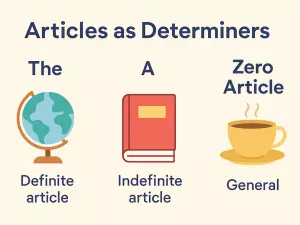
Zero Article in English: General vs Specific Meaning

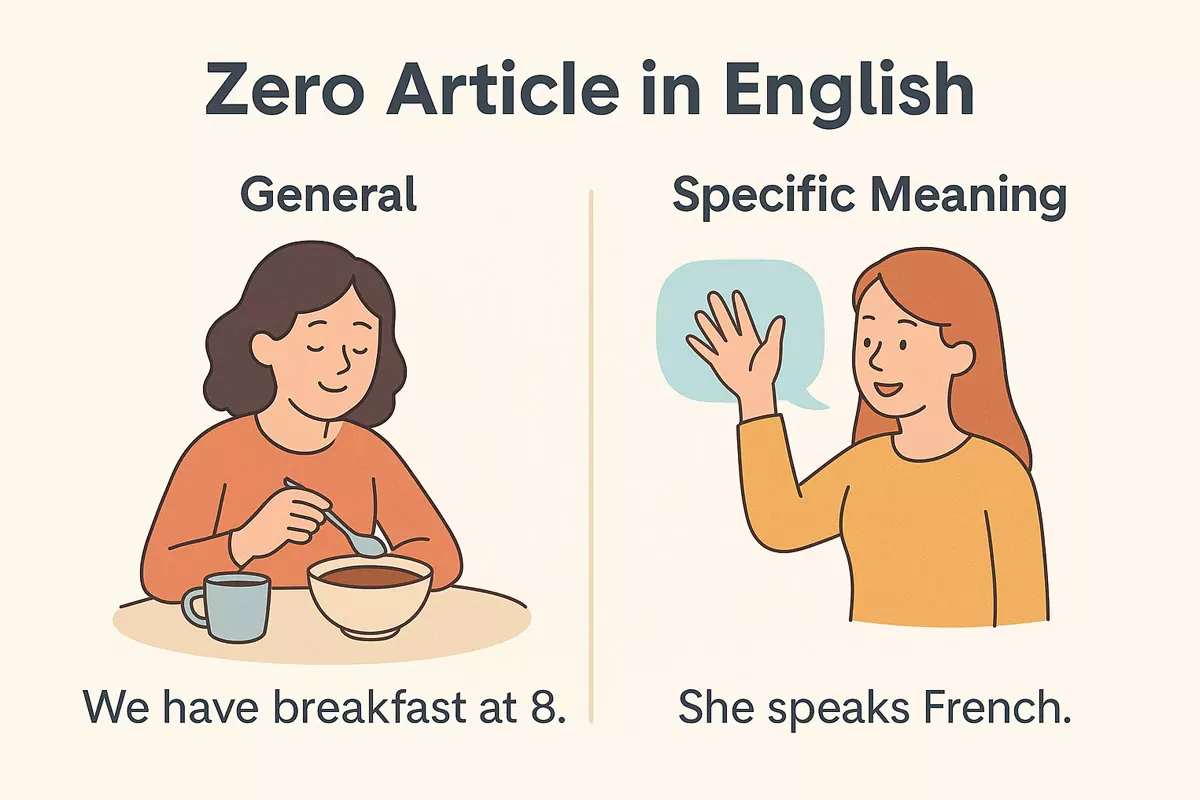 This article explains what the zero article means in English, how it shows general ideas, and how a or the signal something specific. It covers usage with plural and uncountable nouns, contrasts examples, and includes practice exercises.
Knowing when to omit articles in English can be challenging, as it significantly affects whether your meaning is general or specific. Mastering this aspect of grammar allows you to communicate your thoughts more precisely, making it clear if you are referring to something in a broad sense or pointing to a particular example. Developing this skill is essential for effective English communication, as it helps avoid confusion and ensures that your intended message is accurately conveyed to your audience.
What zero article means in English
In English, the term "zero article" refers to situations where no article ("a," "an," or "the") is used before a noun. This concept is essential for learners because omitting the article can change the meaning of a sentence or indicate a more general or abstract idea. Unlike languages that always use an article, English sometimes leaves the noun without one, depending on context and meaning.
When do we use zero article?
You often see the zero article with plural and uncountable nouns when talking about things in a general sense. For example, "Books are useful" (not "The books" or "A books") or "Water is essential for life." Proper nouns—names of people, most countries, and cities—also usually appear without an article: "Alice is from Canada."
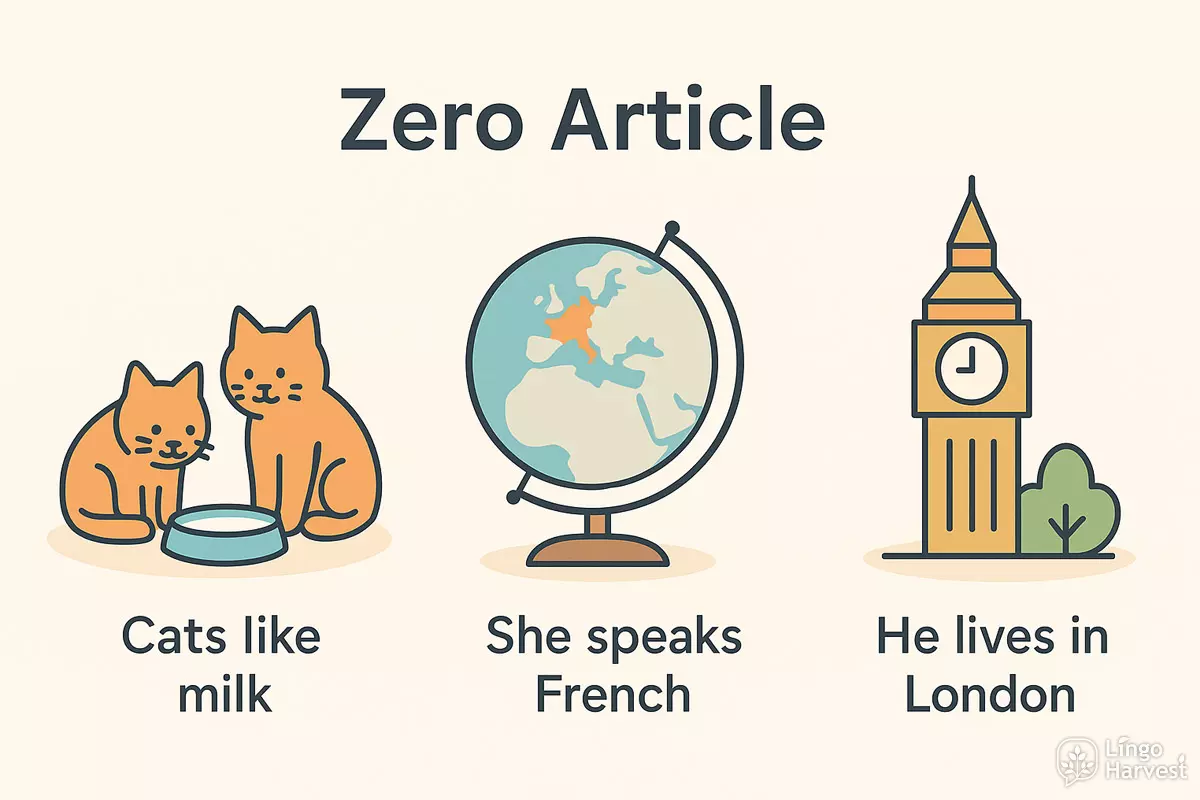
- Plural countable nouns (general): Cats like milk.
- Uncountable nouns (general): Information is power.
- Meals: We have breakfast at 8.
- Languages: She speaks French.
- Most countries and cities: He lives in London.
- Names of people: Maria is here.
- Subjects: I study math.
- Sports: Do you play tennis?
- Days and months: See you on Monday.
- Transport by means: We go by bus.
- Institutions (with general meaning): She goes to school.
- Illnesses (some): He has flu.
- Abstract concepts: Love is important.
- Materials (general): Gold is expensive.
- Festivals: Christmas is in December.
- Most shops and places (general use): She is at work.
General vs. specific meaning
The absence of an article often signals that we're talking about all members of a group or an idea in general, not a particular example. For instance, "Children need sleep" means children in general. Adding "the"—"The children need sleep"—would refer to specific children already known to the speaker and listener.
| General (Zero Article) | Specific (With Article) |
|---|---|
| Dogs are friendly. | The dogs in the park are friendly. |
| Music helps people relax. | The music you played was relaxing. |
| Students study hard before exams. | The students in my class study hard. |
| Bread is made from wheat. | The bread on the table is fresh. |
Understanding when to use the zero article helps you sound more natural and clear in English, especially when expressing general ideas or talking about things in a broad sense.
How zero article signals general meaning
In English, omitting the definite and indefinite articles (the so-called "zero article") often points to a general, non-specific interpretation. This usage is especially common with uncountable nouns, plural countable nouns, and some abstract ideas. When the zero article is used, the listener or reader understands that the statement is about all members of a group or the concept as a whole, not a particular instance.
Common contexts for using the zero article generically
- With plural countable nouns to refer to things in general: Dogs are friendly.
- With uncountable nouns for broad categories or substances: Water is essential for life.
- When talking about activities in a general sense: People like music.
- With names of meals: We have lunch at noon.
- With languages: She speaks Spanish.
- With most games and sports: Children play football after school.
- With academic subjects: Mathematics is interesting.
- With institutions when used for their primary purpose: Children go to school.
- With means of transport (by + noun): He goes to work by train.
- With seasons and days (sometimes): Spring is beautiful.
Zero article vs. articles: General and specific meaning
The absence of an article distinguishes generic reference from a particular case. Consider these examples:
| Without Article (General) | With Article (Specific) |
|---|---|
| Cats hate water. | The cats next door hate water. |
| Tea is popular in Britain. | The tea you made is delicious. |
| Children need attention. | The children in this class need attention. |
| Books can be expensive. | The books on the table are expensive. |
| Information is valuable. | The information you gave me is valuable. |
Why use the zero article for general meaning?
Using no article helps speakers and writers express statements about categories or concepts as a whole, rather than about one or more identifiable examples. In this way, the zero article acts as a signal that the statement should be interpreted in a broad, non-specific way. This pattern is one of the most efficient ways English distinguishes between talking about something in general and talking about a particular instance. Understanding when to leave out the article is key to sounding natural and making your meaning clear in English conversations and writing.
When a/an or the show specific meaning
Articles like a, an, and the are used to indicate that a noun refers to something specific, rather than something general. In contrast, the zero article (no article) is often used for generalizations or when speaking about things in a non-specific way. Understanding when to use these articles helps clarify whether you’re talking about a particular item or any member of a group.
How articles signal specificity
Using a or an typically introduces something for the first time, or refers to any one of a group. The, however, points to something already known to both the speaker and listener, or something unique in the context. This distinction is crucial for clear communication.
- A/an: introduces an unspecified or typical example.
Example: She wants a sandwich. (any sandwich, not a particular one) - The: refers to a specific or previously mentioned thing.
Example: She ate the sandwich you made. (a particular sandwich already identified)
Common contexts for specific meaning
Here are situations where articles highlight a particular reference:
- When the listener knows which item is meant: "Please close the door."
- After something has been introduced: "I saw a cat. The cat was black."
- With unique objects: "The sun is bright today."
- When a phrase limits the noun: "The book on the table is mine."
- With superlatives: "She is the best student."
- With ordinal numbers: "He was the first person to arrive."
- For objects known by both speaker and listener: "Turn off the lights."
- When referring to something already mentioned: "I bought a pen. The pen writes well."
- With countries or groups with specific names: "The Netherlands," "The United States"
- Before adjectives describing a unique group: "The rich should pay more taxes."
- For places in a town: "She went to the bank." (a specific bank)
- With musical instruments: "He plays the piano."
- For inventions: "The telephone changed the world."
- With time expressions: "I'll call you in the morning."
- With parts of the body: "He hurt the leg."
- With public institutions when specified: "He visited the hospital." (as a visitor, not a patient)
- With geographical features: "The Amazon," "The Alps"
- For families: "The Smiths are coming over."
Comparing general and specific meaning
| General (Zero Article) | Specific (a/an, the) |
|---|---|
| Cats are playful. (all cats in general) |
The cat on the sofa is playful. (a particular cat) |
| Books are useful. (all books) |
A book on the shelf is mine. (one specific book) |
| Children like ice cream. (children in general) |
The children at the party liked the ice cream. (particular group and specific ice cream) |
| Music relaxes people. (music in general) |
The music at the concert was amazing. (specific music) |
Zero article with plural and uncountable nouns
When talking about people or things in general, English often omits the article before plural countable nouns and uncountable nouns. This means we do not use "the," "a," or "an" in these situations. Instead, we refer to the group or substance as a whole, not to specific items or instances.
General meaning: No article needed
Leaving out the article signals that we are making general statements. For example, "Books are important" refers to all books, not particular ones. Similarly, "Water is essential" means water in general, not a specific glass or bottle.
- Children like sweets.
- Cars pollute the air.
- Money can't buy happiness.
- Information is valuable.
- Teachers work hard.
- Rice grows in Asia.
- People need food.
- Music helps me relax.
- Ideas change the world.
- Apples are healthy.
- Technology advances quickly.
- Air is invisible.
- Dogs make good pets.
- Experience comes with age.
- Computers are everywhere.
- Patience is a virtue.
- Students study for exams.
- Love conquers all.
Contrast: General vs. specific
The presence or absence of an article changes the meaning. Using "the" with plural or uncountable nouns usually refers to something specific or previously mentioned. Without any article, the statement is general.
| General (No Article) | Specific (With "the") |
|---|---|
| Dogs are friendly. ✅ All dogs in general |
The dogs are friendly. ❌ Only particular dogs (e.g., the ones here) |
| Milk is nutritious. ✅ Milk in general |
The milk is on the table. ❌ Specific milk (e.g., the one you poured) |
| Students must study. ✅ All students |
The students in this class are smart. ❌ Particular group of students |
| Time flies. ✅ Time in general |
The time is 8 o’clock. ❌ A specific moment |
Common mistakes and tips
Remember, if you mean something in general, do not use "the" or "a/an" before plural or uncountable nouns. However, if you are talking about a specific group, amount, or context, "the" might be necessary. Practice by checking if your sentence means "all" or "any" (general), or "those ones" (specific). This small detail can change the meaning of your message.
Contrast pairs: with article vs without article
One of the clearest ways to see the difference between using an article and omitting it is by looking at sentences side by side. Articles in English (a, an, the) can change the meaning from general to specific, while the absence of an article (zero article) often signals a more general or abstract idea. Let’s explore how these small words—or their absence—affect meaning.
General vs. Specific: Typical Patterns
- With article: Refers to a particular thing or group, or something already known to the speaker and listener.
- Without article (zero article): Refers to things in general, categories, or concepts, not a unique object.
Common Contrast Pairs
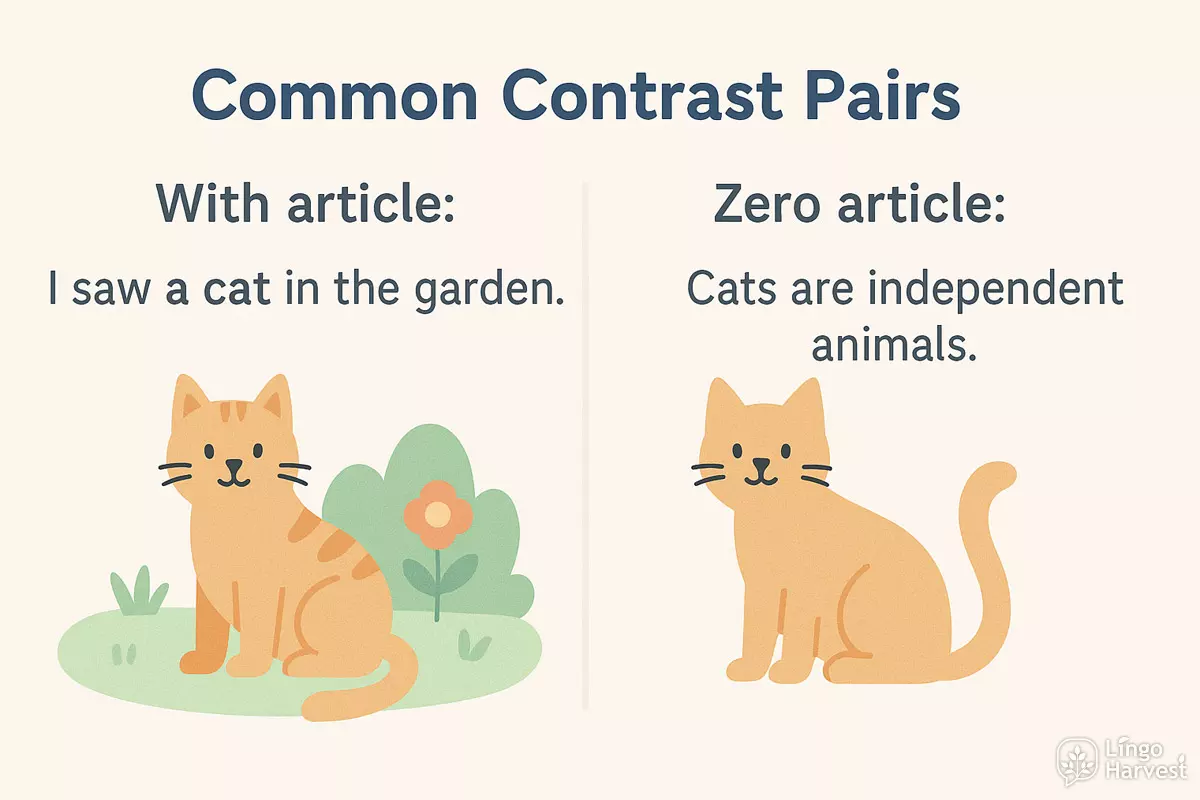
- With article: I saw a cat in the garden.
Zero article: Cats are independent animals. → (all cats in general) - With article: She went to the hospital (as a patient).
Zero article: He works in hospital (not standard in American English; in British English, sometimes used in certain professional contexts). - With article: I love the coffee you make.
Zero article: Coffee is popular worldwide. → (the drink in general) - With article: The life of a sailor is hard.
Zero article: Life is unpredictable. → (the concept as a whole) - With article: The dogs next door bark all night.
Zero article: Dogs are loyal pets. → (all dogs) - With article: The music at the party was loud.
Zero article: Music soothes the soul. - With article: She is an engineer at a tech company.
Zero article: Engineering is a challenging field. - With article: I read the book you recommended.
Zero article: Books can open new worlds. - With article: He enjoys the freedom of remote work.
Zero article: Freedom is a basic human right. - With article: The water in this glass is cold.
Zero article: Water covers most of the Earth's surface.
Summary Table: Meaning Shift with and without Articles
| With Article | Zero Article |
|---|---|
| I saw a dog in the park. (one specific dog) |
Dogs are friendly animals. (all dogs in general) |
| She likes the tea from India. (particular tea) |
Tea is grown in many countries. (the category of tea) |
| He visited the university last week. (a specific university) |
University can be expensive. (the idea of higher education in general) |
| We discussed the history of Rome. (Rome’s specific history) |
History teaches us lessons. (the subject in general) |
When deciding whether to use an article or not, think about whether you mean something specific or if you are referring to an entire category, activity, or concept. Articles help focus meaning, while omitting them often signals a broader, more general idea.
Practice: rewrite sentences with and without zero article
Understanding how omitting the article in English can change a sentence’s meaning is essential for mastering general and specific references. Let’s explore how sentences shift when the zero article is used versus when “the” or “a/an” is added. This exercise focuses on spotting the difference between talking about things in general and referring to something specific.
Examples: General vs Specific Meaning
Below are pairs of sentences. In each pair, one uses the zero article for a general meaning, while the other uses an article for specific reference.
- Children like chocolate. (all children, general)
- The children like chocolate. (specific children, e.g., those in this room)
- Water is essential for life. (all water, in general)
- The water in this glass is cold. (specific water)
- Cats are independent animals. (all cats, general statement)
- The cats next door are noisy. (specific cats)
- Music helps me relax. (music in general)
- The music at the party was too loud. (specific music)
- Books can be expensive. (all books, general idea)
- The books on the shelf are new. (specific books)
- Life is unpredictable. (life in general)
- The life he leads is stressful. (specific lifestyle)
- Students must study hard. (all students, general rule)
- The students in this class are diligent. (specific students)
- History teaches us important lessons. (history in general)
- The history of this town is fascinating. (specific history)
- Dogs are loyal animals. (all dogs, general fact)
- The dog that barked last night kept us awake. (one specific dog)
- Breakfast is the most important meal. (breakfast in general)
- The breakfast we had was delicious. (specific breakfast)
Rewrite Practice: Transforming Sentences
Try rewriting the sentences below by adding or removing the article to change the meaning from general to specific, or vice versa.
- __ Tea is popular in England.
__ tea I bought yesterday is from India. - __ Computers have changed our lives.
__ computers in the lab are new. - __ Art inspires creativity.
__ art in this gallery is modern. - __ People should exercise regularly.
__ people I met at the event were friendly. - __ Music can improve your mood.
__ music they played at the party was too loud. - __ Water is essential for life.
__ water in this bottle tastes fresh. - __ Birds migrate every winter.
__ birds in our backyard built a nest. - __ Science helps us understand the world.
__ science they teach at this school is excellent. - __ Happiness comes from simple things.
__ happiness I felt that day was unforgettable. - __ Students need motivation to learn.
__ students in my class are very hardworking.
Show answers
- Tea is popular in England. / The tea I bought yesterday is from India.
- Computers have changed our lives. / The computers in the lab are new.
- Art inspires creativity. / The art in this gallery is modern.
- People should exercise regularly. / The people I met at the event were friendly.
- Music can improve your mood. / The music they played at the party was too loud.
- Water is essential for life. / The water in this bottle tastes fresh.
- Birds migrate every winter. / The birds in our backyard built a nest.
- Science helps us understand the world. / The science they teach at this school is excellent.
- Happiness comes from simple things. / The happiness I felt that day was unforgettable.
- Students need motivation to learn. / The students in my class are very hardworking.
Summary Table: General vs Specific Reference
| General (Zero Article) | Specific (With Article) |
|---|---|
| Coffee is my favorite drink. | The coffee on the table is cold. |
| Birds can fly. | The birds in this park are noisy. |
| Patience is a virtue. | The patience he showed was impressive. |
| Cars are expensive to maintain. | The car you bought looks great. |
| Science explains many things. | The science project won first prize. |
Practicing with these examples helps clarify when to use or omit articles in English, making your meaning clear in both general and specific contexts.