The Definite Article “the”: Reference and Shared Knowledge

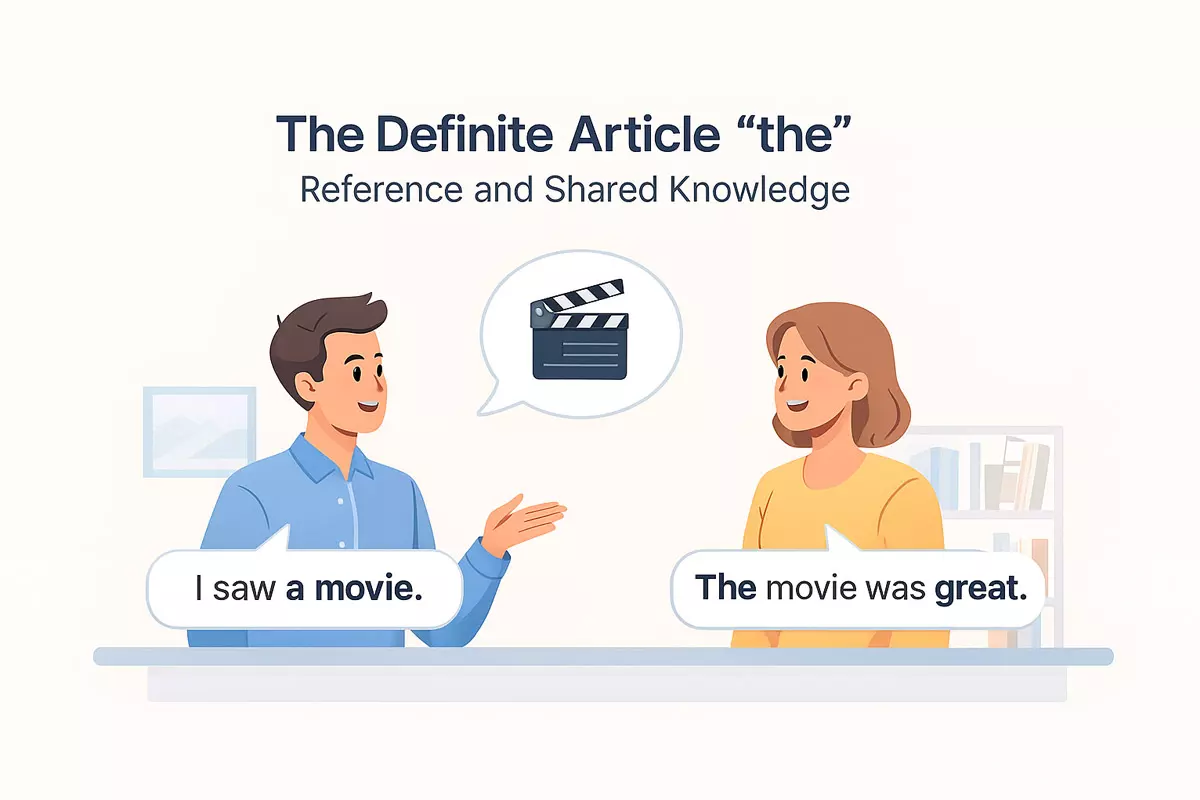 Here we how to use "the" with first, second, and shared references, when to use it for known or obvious things, and its use after first mention. It also discusses common mistakes and includes practice choosing "the" or zero article.
In English, the use of definite articles plays a crucial role in making our meaning clear to listeners by indicating that we are referring to something specific and familiar. This small but important word, such as "the," helps us point to shared knowledge or previously mentioned topics, ensuring that our conversations are precise and easily understood. Without definite articles, it would be much harder to signal exactly what we are talking about, potentially leading to confusion or misunderstandings among speakers.
Types of reference: first, second, and shared
Understanding how “the” is used depends on the way speakers and listeners identify what is being discussed. Linguists often describe three core reference types: first, second, and shared. Each describes a different relationship between the speaker, the listener, and the knowledge they have about the noun in question.
First Reference: Introducing New Entities
First reference happens when a noun is mentioned for the first time in a conversation or text. Here, the item is new to the listener. The definite article “the” is generally not used; instead, speakers use “a” or “an” for singular count nouns, or no article for plural and uncountable nouns. For example:
- I saw a dog in the park.
- She bought some bread.
The listener is not expected to know which specific dog or bread is meant.
Second Reference: Referring Back
Second reference occurs when a noun has already been introduced, and both the speaker and listener now know which entity is meant. In this case, “the” becomes appropriate:
- I saw a dog in the park. The dog was chasing a ball.
- She bought some bread. The bread was fresh.
This use relies on shared context established earlier in the conversation or text.
Shared Reference: General Knowledge and Uniqueness
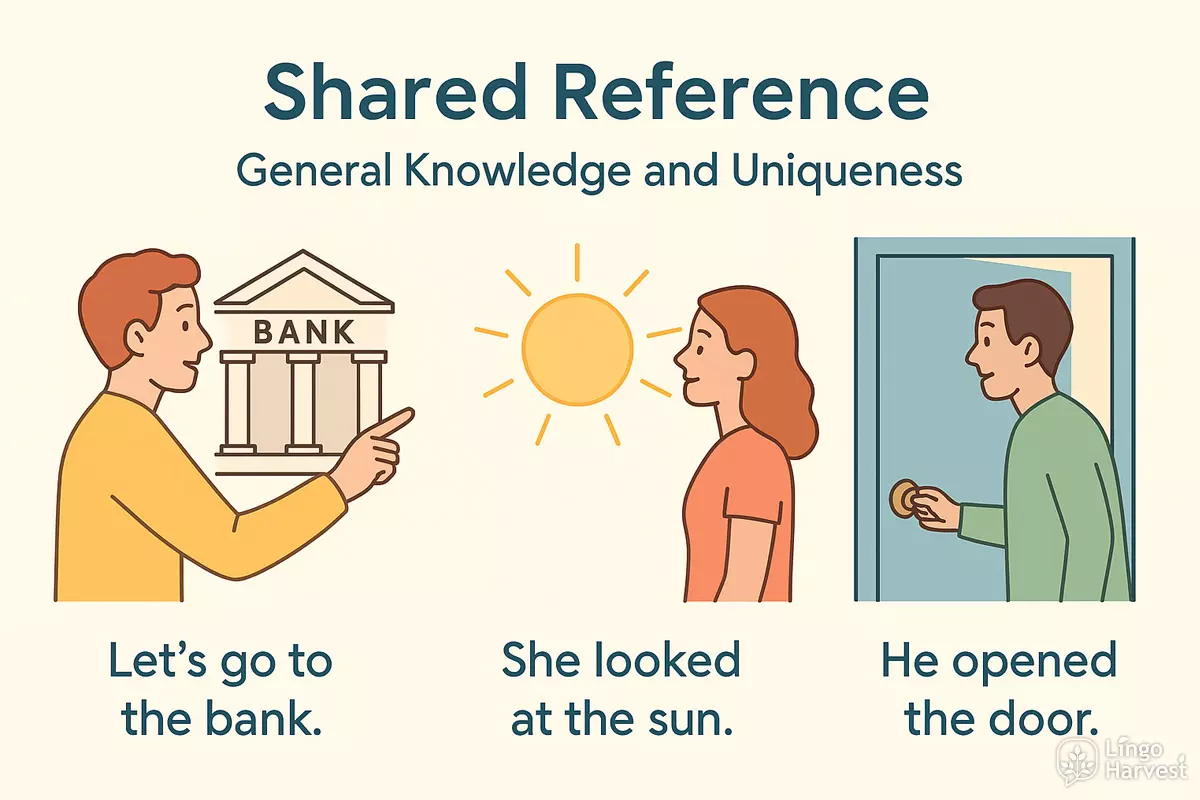
Sometimes, both parties are assumed to share knowledge about something, even if it has not been mentioned before. This often applies to unique or well-known entities. The definite article signals this shared understanding:
- Let's go to the bank.
- She looked at the sun.
- He opened the door.
Here, “the” indicates that the listener can identify which specific object is intended based on common knowledge or situational context.
| Reference Type | How “the” Is Used | Example |
|---|---|---|
| First Mention | Not used; “a/an,” “some,” or no article appears | I found a key. |
| Second Mention | “The” refers back to something already mentioned | The key opened the door. |
| Shared Knowledge | “The” refers to something unique or obvious to both | He went to the hospital. |
Summary List: Common Triggers for “the”
- Second mention of a noun
- Unique entities (the sun, the president)
- Shared local context (the kitchen, the bus stop)
- Superlatives (the best, the only)
- Ordinal numbers (the first, the last)
- By-phrases (the man by the door)
- Specific groups (the students in the class)
- Institutions (the police, the government)
- Natural phenomena (the moon, the weather)
- Geographical features (the Alps, the Amazon)
- Famous buildings (the Eiffel Tower)
- Musical instruments (play the piano)
Recognizing these patterns helps clarify why “the” is used differently depending on whether something is being introduced, referred back to, or is already part of shared knowledge.
When “the” points to known information
English speakers often use the to indicate that something is already familiar to the listener or reader. This familiarity can come from earlier mention, shared experience, or common knowledge. By using the, the speaker signals that both parties recognize the specific item or idea being discussed.
Referencing Previous Context
If something has already been introduced, the is used when mentioning it again. This creates a clear link between the earlier reference and the current statement, helping avoid confusion.
- I saw a movie last night. The movie was exciting.
- She bought a cake. The cake was delicious.
- He found a wallet. The wallet belonged to his neighbor.
- There’s a dog in the garden. The dog is barking.
Shared Cultural or Situational Knowledge
Sometimes, the definite article is used for things that both speaker and listener naturally know about, even if they haven’t been mentioned yet. This includes unique objects, well-known places, or parts of a shared environment.
- The sun rises in the east.
- Did you lock the door?
- I’ll meet you at the station.
- Pass the salt, please.
- She’s in the kitchen.
- Turn off the light.
- Let’s go to the park.
- The president gave a speech.
- He’s at the bank.
- They visited the museum.
Comparison: “a/an” vs. “the” for Information Status
| First Mention (a/an) | Later/Shared (the) |
|---|---|
| She saw a cat in the garden. | The cat was sleeping. |
| He bought a car yesterday. | The car is blue. |
| I need a pen. | Did you find the pen? |
| Let’s find a restaurant. | The restaurant was crowded. |
Using the for known information helps keep conversations and texts clear and efficient. It relies on context—either from the conversation itself or from a shared understanding of the world.
Situational use: things obvious in the context
When we use "the" in English, sometimes it's because everyone in the situation knows exactly what we mean, even if we've never mentioned the object before. This function is about shared context: the listener can easily identify the referent based on the situation, location, or cultural expectations, not because it was previously discussed.
Common scenarios where context makes things clear
Often, definite articles refer to objects, people, or places that are unique or clearly understood in the specific setting. For instance, if you’re in a classroom and someone says, “Close the door,” it’s obvious which door is meant—no need to specify further. Similarly, in a restaurant, “Can you pass the salt?” works because there’s usually only one salt shaker on the table.
Examples of situational reference with "the"
- At home: "Turn off the lights." (the lights in this room/house)
- At the airport: "Where is the restroom?" (the restroom for this terminal)
- In a car: "Open the window." (the car window)
- At work: "Did you see the boss?" (the boss of this workplace)
- In a theater: "Let’s find the seats." (the seats assigned to us)
- On a train: "The conductor is coming." (the one working this train)
- At a party: "Where’s the food?" (the food prepared for the party)
- In a shop: "Ask the cashier." (the one at this counter)
- At a hotel: "Take the elevator." (the elevator in this building)
- On the phone: "Can you hold the line?" (the phone line for this call)
- At a concert: "The band is late." (the band performing tonight)
- In a meeting: "Let’s start the presentation." (the planned presentation)
- At a wedding: "The bride looks beautiful." (the bride of this wedding)
- In a hospital: "Call the nurse." (the nurse on duty here)
- In a park: "Let’s sit on the bench." (the nearby or usual bench)
- On vacation: "We went to the beach." (the local or expected beach)
- In court: "The judge entered." (the judge presiding over this case)
- At school: "The bell rang." (the school bell)
- In a library: "Put the book on the shelf." (the relevant shelf here)
Why context matters for definite reference
The power of shared context means speakers don’t need to give extra information. Both parties are aware of the setting, so "the" efficiently signals something specific without repetition or lengthy explanations. This is a core part of how the definite article works in real conversations and everyday English.
Quick comparison: context vs. previous mention
| Reference Type | How "the" is used |
|---|---|
| Contextual (Situational) | “Can you open the window?” (everyone knows which window because of the shared environment) |
| Previous Mention | “I saw a dog. The dog was brown.” (“the dog” refers to the one already introduced) |
| General Knowledge/Uniqueness | “The sun is shining.” (there’s only one sun for us, so it’s clear) |
| Specific Situation | “Pass me the menu.” (the menu for this table/restaurant) |
Using “the” after first mention in a text
When introducing a new noun or concept in writing, the indefinite articles “a” or “an” are often used. Once that noun has been identified, English typically switches to the definite article “the” for all subsequent references. This shift signals that both the writer and reader now share knowledge of the specific item being discussed, turning it into a familiar topic within the context.
Why does this switch occur?
The main reason for changing to the definite article is clarity. After a noun is introduced, repeating “a” or “an” would suggest a different, possibly unknown item. Using “the” after the first mention shows you are talking about the same thing, making your text coherent and easier to follow.
Examples: First and Subsequent Mentions
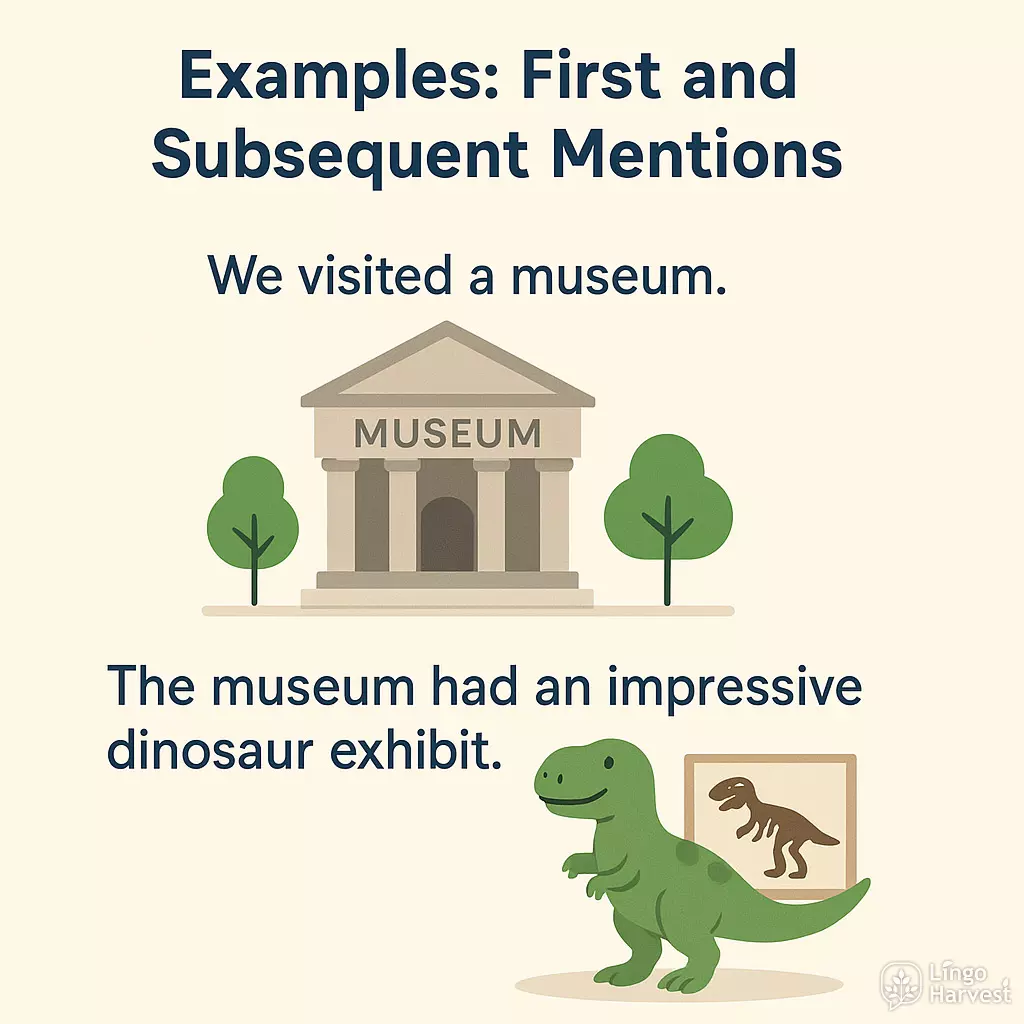
Consider these example sentences:
- I saw a dog in the park. The dog was chasing a ball.
- She bought a book. The book is about gardening.
- We visited a museum. The museum had an impressive dinosaur exhibit.
- He found a wallet on the street. The wallet contained some cash.
- There is a restaurant near my house. The restaurant serves Italian food.
- They adopted a cat. The cat is very playful.
- I bought a new phone. The phone has a great camera.
- We rented a car for our trip. The car was very comfortable.
- She met a musician at the party. The musician plays the violin.
- He drew a picture for his mom. The picture made her smile.
Common Patterns and Variations
Writers sometimes introduce a noun with “a/an” or a possessive, then switch to “the” to continue referencing the same item. This pattern helps maintain cohesion and avoid ambiguity.
When to avoid “the” after first mention
Not every noun should be followed by “the” after its introduction. For example, if you are speaking about a general class of objects, or if a new instance is meant, the indefinite article may be used again. Additionally, plural nouns without specification often don’t require “the” unless you mean a specific group.
- General: I like apples. (Not specific, so no definite article.)
- Different instance: I saw a cat in the morning, and a cat in the afternoon. (Two different cats.)
- Non-specific plural: Cats are curious animals. (All cats, not specific ones.)
Summary Table: Article Use After First Mention
| First Mention | Subsequent Mention |
|---|---|
| I saw a bird in the tree. | The bird was singing loudly. |
| She bought a cake. | The cake looked delicious. |
| We visited a castle. | The castle was built in the 12th century. |
| He found a key on the ground. | The key opened an old door. |
| They adopted a puppy. | The puppy quickly became a family favorite. |
Key Takeaways
- Switch to the definite article to refer to a previously mentioned noun.
- This practice enhances clarity and signals shared knowledge.
- Do not use “the” if you are referring to a new or different instance.
- Plural or general references often do not require “the.”
Making this switch is a subtle but important feature of natural, fluent English writing.
Typical errors with overusing or missing “the”
Many English learners struggle with the definite article, often using it when it is not needed or leaving it out where it is required. Understanding when “the” is appropriate relies on context, shared knowledge, and whether a noun is specific or general. Below, we’ll look at common mistakes and clarify usage patterns.
Frequent mistakes with unnecessary “the”
Sometimes, learners insert “the” before nouns that are general, abstract, or uncountable, resulting in awkward or incorrect sentences. This typically happens due to direct translation from languages where articles function differently or don’t exist at all.
- Incorrect: I love the nature. ❌
- Correct: I love nature. ✅
- Incorrect: She goes to the school every day. (when “school” is meant in a general sense) ❌
- Correct: She goes to school every day. ✅
- Incorrect: The water is important for life. (when speaking in general) ❌
- Correct: Water is important for life. ✅
Omitting “the” when it’s needed
Another common error is dropping the definite article before nouns that refer to something specific or previously mentioned. This can make sentences sound vague or grammatically incomplete.
- Incorrect: Please close window. ❌
- Correct: Please close the window. ✅
- Incorrect: Sun rises in east. ❌
- Correct: The sun rises in the east. ✅
- Incorrect: I left book on table. ❌
- Correct: I left the book on the table. ✅
Comparison of correct and incorrect article usage
| Incorrect Example | Corrected Example |
|---|---|
| He went to the bed early. | He went to bed early. |
| The Mount Everest is the highest mountain. | Mount Everest is the highest mountain. |
| I have the homework to do. | I have homework to do. |
| She is in the hospital. (when visiting) | She is in hospital. (BrE, as a patient) |
| He is best player in team. | He is the best player in the team. |
Quick tips to avoid mistakes
- Use “the” for something specific or already mentioned.
- Omit “the” with general, abstract, or plural nouns when speaking generally.
- Fixed phrases (go to bed, go to school) usually do not take “the.”
- Geographical names can be irregular: “the United States,” but “France.”
- Titles and meals rarely need “the”: “President Lincoln,” “have breakfast.”
Careful attention to context and meaning helps prevent these frequent pitfalls with the definite article.
Practice: choose “the” or zero article in short texts
Understanding when to use “the” versus no article is a central challenge in English. Let’s explore some short texts and exercises that highlight the difference. These activities focus on recognizing when shared knowledge or specific reference calls for “the,” and when a general or unspecified meaning means omitting the article.
Quick Examples: Insert “the” or leave blank
Read each sentence. Decide if you need “the” or no article (zero article) in the blank. Consider if the noun is specific/known or general/unknown.
- ___ sun rises in ___ east.
- I saw ___ movie you recommended.
- She likes ___ classical music.
- ___ water in this glass is cold.
- After ___ lunch, we went for a walk.
- ___ children need attention.
- ___ Mount Everest is ___ highest mountain in ___ world.
- He plays ___ piano.
- ___ books on that shelf are new.
- They visited ___ museum in Paris.
Show answers
- The sun rises in the east.
- I saw the movie you recommended.
- She likes zero article classical music.
- The water in this glass is cold.
- After zero article lunch, we went for a walk.
- Zero article children need attention.
- Zero article Mount Everest is the highest mountain in the world.
- He plays the piano.
- The books on that shelf are new.
- They visited the museum in Paris.
Common Patterns: When to Use “the” or No Article
- With unique things (the sun, the moon, the sky)
- With superlatives (the best, the tallest, the oldest)
- When the listener/reader knows exactly what is meant (the car we bought, the meeting yesterday)
- With names of rivers, seas, oceans, and mountain ranges (the Nile, the Alps, the Pacific)
- No article with general ideas or plural nouns (Books are expensive. Children play outside.)
- No article with most meals (after lunch, before dinner)
- No article with names of most countries, cities, and streets (Germany, Oxford Street)
- No article with languages and academic subjects (She speaks Spanish. He studies mathematics.)
- With musical instruments (He plays the guitar.)
- No article with sports (She plays tennis.)
- With groups as a whole (The rich, the poor)
- No article with most singular, uncountable nouns used in a general sense (Water is essential. Honesty is important.)
Mini-Text Practice: Insert “the” or Zero Article
Read this short paragraph. Type “the” or leave the field empty (zero article).
Amazon River is one of longest rivers in world. Many people travel to rainforest to see wildlife. However, deforestation threatens area. Scientists say protecting environment is important for future of planet. Local communities depend on river for food and transport. If we ignore problem, damage may become irreversible.
Show answers
- the Amazon River
- the longest rivers
- the world
- the rainforest
- the wildlife
- deforestation (zero article)
- the area
- the environment
- the future
- the planet
- the river
- the problem
- the damage
Summary Table: Typical Uses
| Use “the” | Use Zero Article |
|---|---|
| Before unique nouns (the sun, the internet) |
With plural/general nouns (Dogs are friendly.) |
| With superlatives (the biggest, the only) |
With meals, languages (after breakfast, speaks English) |
| When both speaker and listener know what is meant (the meeting, the door) |
With most countries, streets, cities (France, Baker Street) |
| With musical instruments (plays the violin) |
With sports, academic subjects (plays football, studies history) |
Practicing with short texts and targeted examples helps you master the subtle differences between specific reference and general meaning in English article use.