Articles with Geographical Names: Rivers, Mountains, Countries

 The article details when to use articles such as "the" with geographical names, including rivers, seas, oceans, mountain ranges, countries, regions, cities, lakes, islands, and traditional names. It also provides practice with example sentences.
The use of articles with place names can be confusing because there are few clear rules and many exceptions. For example, we say the Nile and the Amazon for rivers, but just Everest or Kilimanjaro for mountains. Some countries, like the United States or the Netherlands, take an article, while most others, such as France or Brazil, do not. This inconsistency often depends on historical usage, language patterns, and whether the name is descriptive or unique. Learning these patterns takes practice and attention to context.
Overview of article use with place names
When referring to geographical names, the use of articles in English follows certain conventions that can sometimes be confusing for learners. Article usage often depends on the type of place, its naming structure, and historical or linguistic factors. For example, while we say “the Nile” for rivers, we simply say “Mount Everest” for mountains without an article. Understanding these patterns helps avoid common mistakes and makes speech and writing sound more natural.
General principles for articles with place names
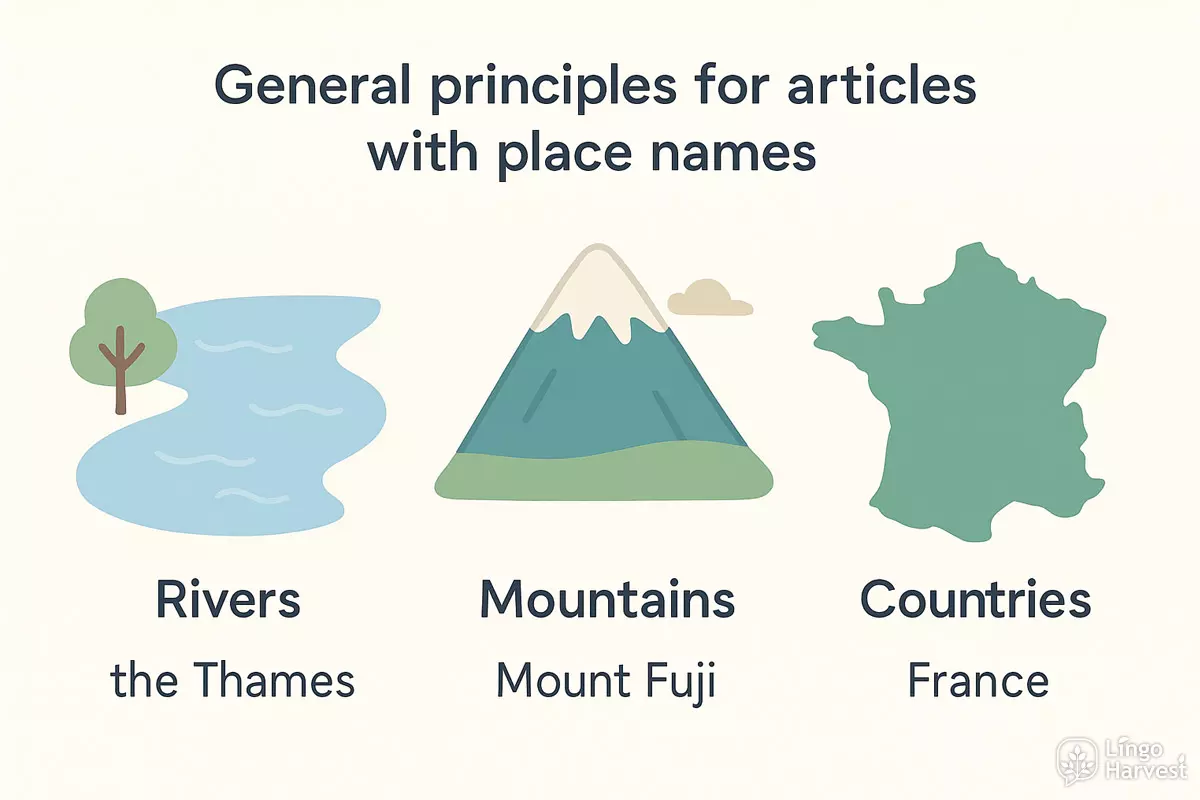
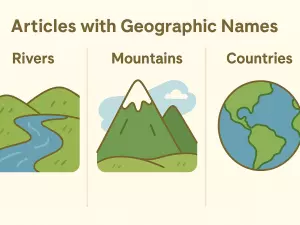
- Rivers: Usually take the definite article “the” (the Amazon, the Thames).
- Mountains: Single mountains generally do not use an article (Mount Fuji), but mountain ranges do (the Alps).
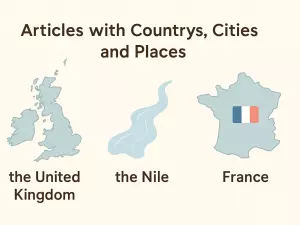
- Countries: Most countries do not take an article (France, Brazil), though there are exceptions (the Netherlands, the United States).
- Oceans and seas: Always use “the” (the Pacific Ocean, the Black Sea).
- Lakes: Usually no article (Lake Victoria), except for groups (the Great Lakes).
- Islands and archipelagos: Single islands typically omit the article (Madagascar), while groups take “the” (the Canary Islands).
- Deserts: Use “the” (the Sahara, the Gobi Desert).
- Peninsulas: Tend to use “the” (the Iberian Peninsula).
- Cities and towns: No article (Paris, Tokyo).
- Regions: Depends on naming; “the Middle East,” but “Central Asia.”
- Streets and squares: No article (Oxford Street, Trafalgar Square).
- Buildings and landmarks: Varies (the Eiffel Tower, Buckingham Palace).
- Continents: No article (Africa, Europe).
- Groups of countries or states: Often use “the” (the Balkans, the United Arab Emirates).
Table: Typical Article Patterns with Geographical Names
| Type of Place | Article Usage & Examples |
|---|---|
| River | Always “the”: the Nile, the Danube |
| Mountain (single) | No article: Mount Everest, Mount Kilimanjaro |
| Mountain Range | Always “the”: the Andes, the Himalayas |
| Country (single) | No article: Canada, Egypt Exceptions: the Netherlands, the Philippines |
| Ocean/Sea | Always “the”: the Atlantic Ocean, the Baltic Sea |
| Island (single/group) | No article: Sicily “the” for groups: the Bahamas |
| Desert | Always “the”: the Kalahari Desert |
| City/Town | No article: Berlin, Nairobi |
| Region | Often “the”: the Arctic, the Midwest Sometimes no article: Western Europe |
| Lake | No article: Lake Baikal “the” with plural: the Great Lakes |
Exceptions abound, and some place names defy the usual rules due to tradition or language origin. When in doubt, consult a reliable source or observe how native speakers refer to the location. Mastering these conventions is key to clear and accurate geographical references in English.
Rivers, seas, oceans, and mountain ranges
When it comes to geographical names, using articles correctly can be tricky, especially with bodies of water and long mountain chains. English has some clear patterns, but there are notable exceptions. Understanding these conventions helps make your writing more natural and accurate.
Article Use with Waterways and Ranges
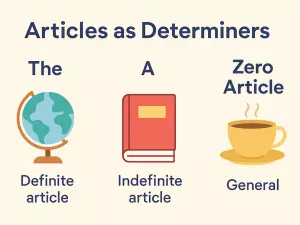
Most rivers, oceans, and seas are used with the definite article the. This is also true for mountain ranges (long chains of mountains), but not for individual peaks. The article “the” signals a specific, recognized entity—think of it as naming a unique feature rather than a generic one.
- the Nile
- the Amazon
- the Thames
- the Pacific Ocean
- the Atlantic
- the Mediterranean Sea
- the Alps
- the Himalayas
- the Andes
- the Rocky Mountains
- the Mississippi
- the Danube
- the Black Sea
- the Caspian Sea
- the Red Sea
- the Ural Mountains
- the Carpathians
- the Great Lakes
In contrast, individual mountains (not ranges) and most lakes do not take an article:
- Mount Everest
- Mount Fuji
- Lake Baikal
- Lake Victoria
- Lake Superior
- Kilimanjaro
Comparison Table: Article Use Patterns
| Type of Geographical Name | Article Usage Example |
|---|---|
| River | the Amazon, the Seine |
| Sea | the North Sea, the Baltic Sea |
| Ocean | the Indian Ocean, the Arctic Ocean |
| Mountain Range | the Pyrenees, the Rockies |
| Individual Mountain | Mont Blanc, Mount Elbrus |
| Lake | Lake Michigan, Lake Geneva |
Remember, these rules help clarify meaning. Using “the” with rivers or ranges indicates a specific, well-known landmark, while omitting it for lakes or single mountains keeps your English idiomatic. Some names (like “the Netherlands” or “the United States”) follow their own logic—these are covered in other sections.
Countries and regions: when we use “the”
When talking about nations and areas of the world, English sometimes uses the definite article “the” and sometimes does not. This can be confusing, as the rules aren’t always obvious. Generally, most country names do not require “the,” but there are notable exceptions, especially with certain types of names and geographical groupings.
When to use “the” with country and region names
The definite article “the” is used with:
- Countries with plural or descriptive names: These often include words like “kingdom,” “states,” “republic,” or are in the plural form.
- Groups of islands or regions: Collections of islands or areas with geographical descriptors usually take “the.”
- Some historical or conventional names: A few countries use “the” due to tradition or historical reasons.
| Use the | Do not use the |
|---|---|
| the United States (of America) | France |
| the Netherlands | Canada |
| the United Kingdom | Japan |
| the Philippines | Brazil |
| the Czech Republic | Norway |
| the Maldives | Italy |
| the Bahamas | Argentina |
| the United Arab Emirates | Egypt |
| the Dominican Republic | Russia |
| the Gambia | India |
Other common patterns
- Use “the” before regions: the Middle East, the Arctic, the Balkans.
- Do not use “the” with most one-word country names: China, Peru, Greece.
- Use “the” with areas described by adjectives or geographical terms: the Pacific Northwest, the Riviera.
- Continents and most large landmasses do not take “the”: Asia, Europe, Antarctica.
Cities, lakes, islands: article patterns
When discussing the use of articles with geographical names, certain patterns emerge for urban centers, bodies of water, and landmasses. Unlike rivers or mountain ranges, these types of proper nouns follow their own conventions in English.
Articles with city names
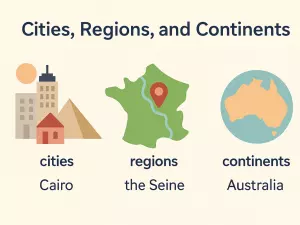
English almost never uses an article before the names of cities. For example, we say Paris, New York, and Tokyo without "the." There are a few exceptions, usually for historical or traditional reasons, such as The Hague.
- London (✅ correct, no article)
- The Hague (✅ correct, exception)
- The Cairo (❌ incorrect)
- Beijing (✅ correct, no article)
Usage with lakes
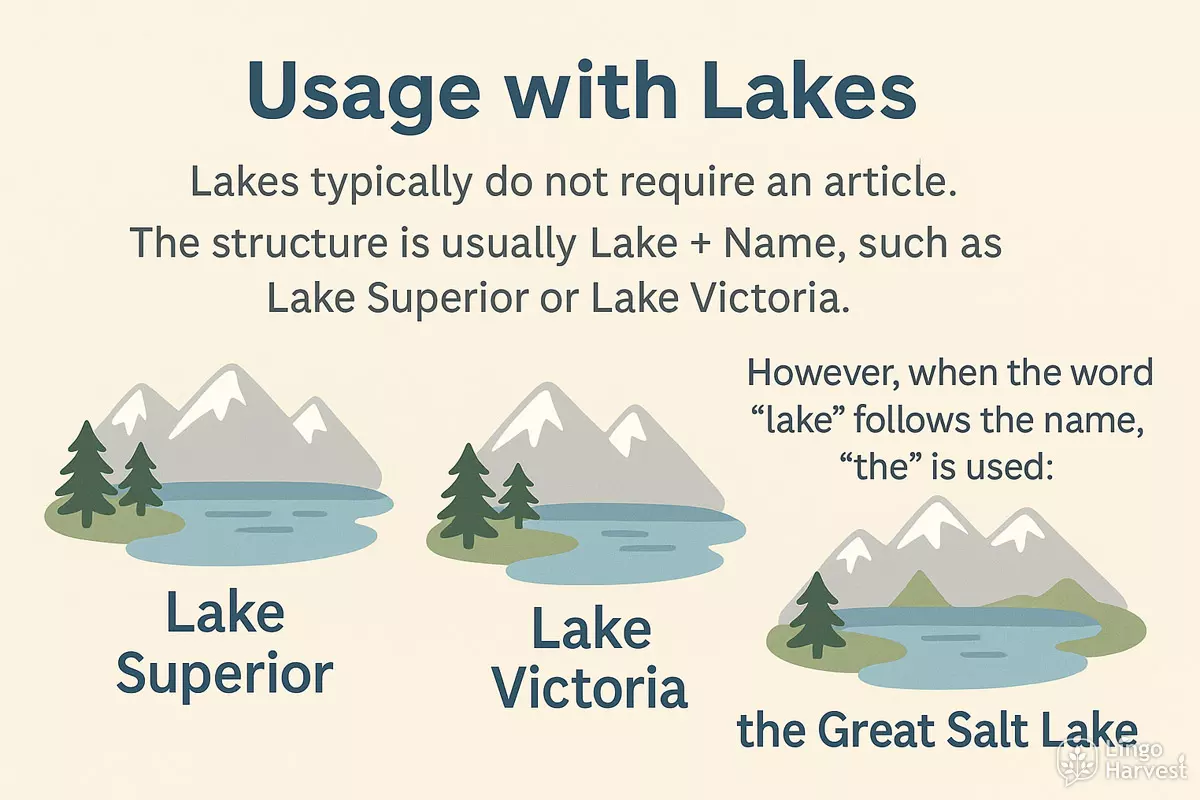
Lakes typically do not require an article. The structure is usually Lake + Name, such as Lake Superior or Lake Victoria. However, when the word "lake" follows the name, "the" is used: the Great Salt Lake.
- Lake Baikal (✅ no article)
- the Great Salt Lake (✅ with article, exception)
- The Lake Ontario (❌ incorrect)
Islands and island groups
For single islands, articles are not typically used: Greenland, Madagascar. But for groups or plural names, "the" is usually required: the Bahamas, the Canary Islands.
| Type | Article Usage Example |
|---|---|
| Single city | Berlin (no article) |
| City with "the" | The Hague (exception) |
| Single lake | Lake Michigan (no article) |
| Lake with descriptive name | the Great Salt Lake |
| Single island | Sicily (no article) |
| Island group (plural name) | the Maldives |
| Island group (with "Islands") | the Hawaiian Islands |
Summary of patterns
- Cities: generally no article, except rare historic cases
- Lakes: "Lake + Name" (no article); "the" with descriptive names
- Single islands: no article
- Island groups/plural names: "the" is required
- Never use "the" before standard city or single island names
- Descriptive or plural forms often take "the"
- Be attentive to exceptions, mostly based on tradition
Recognizing these conventions helps avoid common errors when referring to places in English, especially in formal writing or speech.
Special cases and traditional names
Some geographical names defy the usual rules for articles due to historic or linguistic reasons. While most countries, rivers, and mountains follow predictable patterns, there are notable exceptions and long-established names that learners should be aware of. These often stem from translation conventions, ancient naming, or evolving usage over time.
Geographical features with unique article usage
- The Netherlands → Always used with "the" due to its plural origin.
- The United States → "The" is required for this and other country names in plural or with descriptive phrases (e.g., "the Philippines," "the United Kingdom").
- The Congo → Used for both the river and the country, though "Congo" alone is also common for the country.
- The Alps → Mountain ranges usually take "the," unlike single peaks.
- The Amazon → Certain major rivers use "the" by tradition, even when the word "river" is omitted.
- The Sahara → Deserts commonly take "the," reflecting their status as regions.
- Mount Everest → Single mountains rarely use an article, except in phrases like "the summit of Mount Everest."
- Lake Victoria → Lakes do not take "the" when their name includes "Lake."
- The Ganges → Some rivers, especially in Asia, traditionally use "the."
- Ukraine → "The" is no longer used, though older sources may say "the Ukraine."
- The Bronx → This New York borough uniquely retains "the."
- Isle of Man → No article, despite being an island.
- The Bahamas → Archipelagos in plural form use "the."
- Greenland → No article, even though it's a large island.
- The Himalayas → Like other mountain ranges, always with "the."
- Lake Baikal → No article, follows the "Lake + Name" pattern.
- Rhine (the Rhine) → Major European rivers almost always use "the."
- Everest → Without "Mount," no article is used.
- The Thames → British rivers customarily take "the."
Summary of article usage in traditional names
| Type of Name | Article Usage |
|---|---|
| Country (singular, e.g., France, Japan) | No article |
| Country (plural/compound, e.g., the Netherlands, the United States) | Always "the" |
| Mountain (e.g., Mount Fuji, Everest) | No article |
| Mountain range (e.g., the Andes, the Alps) | Always "the" |
| River (e.g., the Nile, the Amazon) | Always "the" |
| Lake (e.g., Lake Superior, Lake Baikal) | No article |
| Desert (e.g., the Sahara, the Gobi) | Always "the" |
| Archipelago (e.g., the Maldives, the Bahamas) | Always "the" |
When in doubt, check if a traditional or widely accepted form exists for a place name—these may override general rules. Many exceptions have become standard through centuries of usage, making them essential for accurate communication about geography.
Practice: correct articles in geography examples
Understanding the use of articles with geographical names can be tricky, as different types of places follow different rules. Try the following exercises to test your knowledge and see common patterns. For each sentence or name, decide if it needs "the," "a/an," or no article.
Choose the correct article
- ___ Nile is the longest river in Africa.
- ___ Mount Everest is the highest mountain in the world.
- ___ United Kingdom consists of four countries.
- ___ Amazon flows through several countries in South America.
- ___ Russia is the largest country in the world.
- ___ Alps are a famous mountain range in Europe.
- She visited ___ Lake Baikal during her trip.
- ___ Netherlands is known for its windmills.
- They sailed across ___ Mediterranean Sea.
- ___ Sahara is the largest hot desert on Earth.
- We climbed ___ Mount Fuji in Japan.
- ___ Danube flows through many European capitals.
- ___ France borders several European countries.
- ___ Philippines is an archipelago in Southeast Asia.
- ___ Mississippi River runs through the United States.
- He lives in ___ Switzerland.
- ___ Andes stretch along the western edge of South America.
- ___ Black Sea lies between Europe and Asia.
- ___ Canada has two official languages.
- They went skiing in ___ Rockies.
Show answers
- The Nile
- Mount Everest
- The United Kingdom
- The Amazon
- Russia
- The Alps
- Lake Baikal
- The Netherlands
- The Mediterranean Sea
- The Sahara
- Mount Fuji
- The Danube
- France
- The Philippines
- The Mississippi River
- Switzerland
- The Andes
- The Black Sea
- Canada
- The Rockies
Quick reference: when to use "the," "a/an," or no article
| Type of Geographical Name | Article Used | Examples |
|---|---|---|
| Countries (most single names) | No article | France, Russia, Canada |
| Countries (plural or "of" names) | the | the Netherlands, the United States, the United Kingdom, the Philippines |
| Rivers, Seas, Oceans | the | the Nile, the Danube, the Mediterranean Sea, the Atlantic Ocean |
| Mountains (single peaks) | No article | Mount Everest, Mount Fuji |
| Mountain ranges | the | the Alps, the Andes, the Rockies |
| Lakes | No article | Lake Baikal, Lake Victoria |
| Deserts | the | the Sahara, the Gobi |
Reviewing these examples and rules will help you feel more confident when talking or writing about places around the world. Practice with your own examples to reinforce the patterns seen here.