Articles with Cities, Regions, and Continents

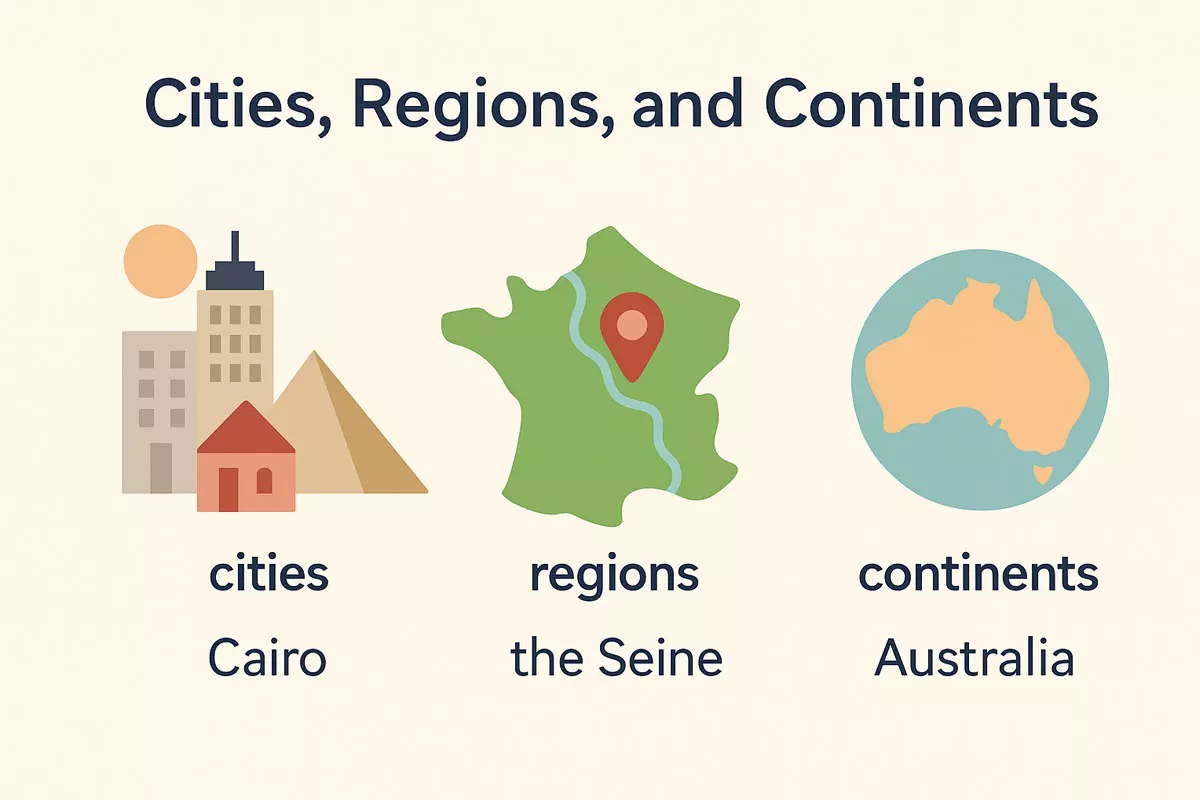 This article explains when to use or skip 'the' with place names, including cities, continents, regions, and exceptions like 'the Middle East' or 'the city center.' It also offers practice exercises to reinforce the rules.
Navigating the rules for using articles with geographical names can be tricky, especially when it comes to places like towns, regions, or entire continents. In English, we generally do not use articles with most country names, cities, or continents—for example, we say France, Tokyo, and Africa. However, we use "the" with certain geographical names, such as the Netherlands, the United States, the Alps, and the Sahara. Learning these patterns and exceptions will help your English sound more natural and accurate, making your communication clearer and more fluent.
Zero article with most cities and continents
When discussing cities and continents in English, the definite and indefinite articles ("the," "a," "an") are usually not used. This absence of an article is commonly called the "zero article." Most city and continent names function as proper nouns, and so they stand alone without any article before them.
Common patterns without articles
- I live in Paris.
- She traveled to Asia last year.
- They met in Berlin.
- Many animals are found in Africa.
- Business trips to London are frequent.
- He studied in South America for a semester.
- Our conference will be held in Rome.
- Her family moved from Melbourne to Toronto.
- The painting is from Europe.
- We took a cruise around Australia.
- She dreams of visiting New York.
- They explored Antarctica together.
- My cousin works in Madrid.
- He biked across North America.
- They are from Seoul.
- We flew over Asia at night.
Exceptions: When articles are used
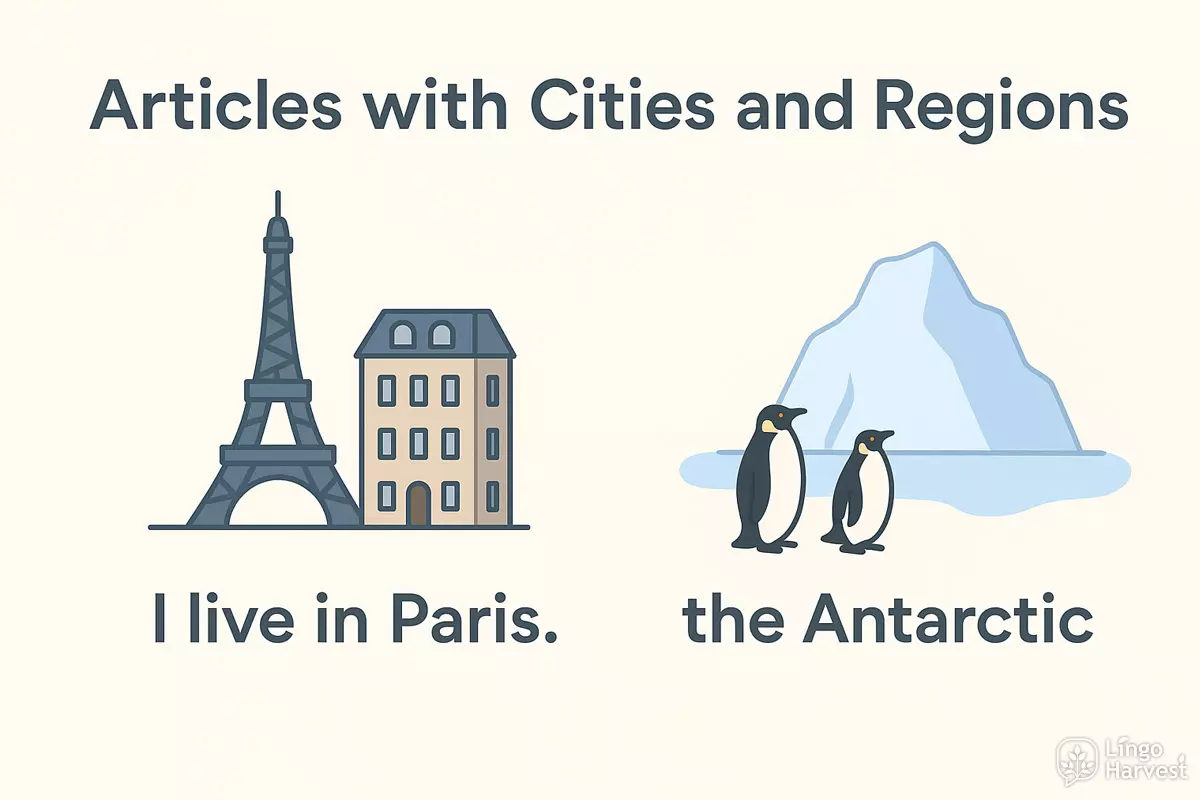
There are some regions, cities, and continents where an article is used, often for historical or grammatical reasons. This is not the rule for most names, but exceptions do exist.
| No article (✅) | With article (❌) |
|---|---|
| Tokyo | The Hague |
| Africa | The United States |
| Berlin | The Philippines |
| Europe | The Netherlands |
| Madrid | The United Arab Emirates |
As shown above, most city and continent names do not use an article, but certain countries, regions, or cities—especially those with plural forms or descriptive names—require "the." It's helpful to memorize these exceptions, as they are relatively few compared to the majority that follow the zero article pattern.
Quick tips for usage
- Use no article with almost all city and continent names.
- Add "the" for countries or regions with plural or descriptive names, e.g., the Netherlands.
- When in doubt, check a reliable reference or listen for common usage in English media.
When regions take “the”: the Middle East, the North
Certain regional names in English require the definite article “the,” while others do not. This distinction can be confusing for learners, so it helps to notice which types of regions typically use “the” and to learn common examples. Names for areas defined by geography, historical context, or cardinal direction often take “the,” especially when they refer to a recognized region rather than a specific administrative unit or country.
Common regional names that require “the”
- the Middle East
- the North
- the South
- the West
- the East
- the Far East
- the Balkans
- the Arctic
- the Antarctic
- the Caribbean
- the Sahara
- the Amazon (when referring to the region, not the river)
- the Midwest
- the Outback
- the Riviera
- the Pacific Northwest
- the Iberian Peninsula
- the Alps
- the Caucasus
Why “the” is used with these regions
We use “the” before regional names when referring to an area defined by physical or cultural characteristics, not a single political entity. For example, “the Middle East” describes a broad area spanning several countries, united by historical and geographic factors. Similarly, “the North” or “the South” often refers to a general part of a country or continent, not a precise administrative region.
Contrast: Regions and areas that do not take “the”
Some place names never use “the.” These tend to be names of continents, most countries, and some larger regions considered as proper names. For instance, we say “Asia,” “Europe,” “Scandinavia,” or “Siberia” without the article.
Patterns and exceptions
While many regional names follow this pattern, there are exceptions. Names with adjectives or descriptors (like “the Far East”) usually take the article, but some historical or traditional names do not. Always check with reliable sources or native usage if uncertain.
| Region Name | Correct Article Usage |
|---|---|
| the Middle East | the Middle East |
| Scandinavia | No article: Scandinavia |
| the Balkans | the Balkans |
| Asia | No article: Asia |
| the Arctic | the Arctic |
| Siberia | No article: Siberia |
| the Caribbean | the Caribbean |
| Europe | No article: Europe |
Remember: using “the” with regional names is not always intuitive, so pay close attention to common usage and patterns. Practice and exposure to authentic English will help reinforce the correct forms over time.
Areas inside cities: the city center, the old town
When talking about different parts of a city, two of the most common areas mentioned are the central district and the historical core. These zones often have distinct names, purposes, and cultural significance. The heart of a city is typically called the city center (or downtown in American English), while the oldest part is known as the old town or historic quarter. Each serves a different role, from business and commerce to tourism and heritage preservation.
Common vocabulary for city areas
- the city center / downtown
- the old town / historic center
- the business district
- the suburbs
- the industrial area
- the waterfront
- the residential neighborhood
- the shopping district
- the university quarter
- the financial center
- the park area / green belt
- the entertainment district
- the market square
- the government quarter
- the cultural district
- the railway station area
Typical descriptions and usage
Both the central and historic parts of a city attract visitors, but for different reasons. The main commercial zone is usually filled with shops, offices, and public buildings, while the older section features narrow streets, traditional architecture, and landmarks. When describing these areas, it is helpful to use precise language:
- "We stayed in the heart of Prague, near the old town square."
- "The city center is always busy, especially during rush hour."
- "Many cafés and museums are located in the historic district."
- "Public transport connects the suburbs to the downtown area."
- "The waterfront has been redeveloped into a vibrant quarter."
Comparing the city center and the old town
| Feature | City Center | Old Town |
|---|---|---|
| Main function | Business, shopping, administration | Tourism, culture, heritage |
| Typical buildings | Modern offices, malls, hotels | Historic houses, churches, squares |
| Atmosphere | Busy, commercial, contemporary | Charming, traditional, picturesque |
| Popular activities | Shopping, business meetings, dining | Sightseeing, guided tours, photography |
How to refer to parts of a city in conversation
When giving directions or describing locations, it is common to specify which part of the city you mean. For example: "Let's meet in the city center by the main train station," or "The best restaurants are in the old town." These phrases help listeners understand not only the geography but also the character of a place.
Understanding the distinctions between different areas within cities can enrich communication, whether you are traveling, studying urban geography, or simply learning how to use articles and prepositions with place names.
Administrative regions and states
Many countries organize their territory into divisions such as provinces, states, regions, or departments, each with varying degrees of autonomy and administrative responsibilities. These subdivisions help manage local governance, distribute public services, and reflect historical or cultural distinctions within a nation. The terminology and structure differ widely around the world, shaping everything from political representation to postal codes.
Common types of territorial divisions
The following list highlights some of the most frequently encountered forms of internal divisions used globally:
- States (e.g., United States, India, Brazil)
- Provinces (e.g., Canada, China, South Africa)
- Regions (e.g., France, Italy, Russia)
- Departments (e.g., France, Colombia, Senegal)
- Oblasts (e.g., Ukraine, Russia, Kazakhstan)
- Territories (e.g., Australia, Canada, United States)
- Governorates (e.g., Egypt, Iraq, Tunisia)
- Counties (e.g., United Kingdom, Ireland, Kenya)
- Autonomous Communities (e.g., Spain)
- Districts (e.g., Ghana, India, Switzerland)
- Prefectures (e.g., Japan, Greece, China)
- Cantons (e.g., Switzerland, Costa Rica)
- Emirates (e.g., United Arab Emirates)
- Municipalities (e.g., Mexico, Sweden, Turkey)
- Republics (e.g., Russia, Yugoslavia (historically))
- Islands as administrative units (e.g., Indonesia, Philippines, Maldives)
- Federal subjects (e.g., Russia)
- Wards (e.g., Kenya, Nigeria, Japan (as "ku"))
- Zones (e.g., Ethiopia, Nepal)
- Divisions (e.g., Bangladesh, Pakistan)
Comparison of selected administrative structures
Some countries use unique systems or combine several types of subdivisions. The table below outlines examples from different parts of the world, illustrating how terminology and governance structures vary.
| Country | Main Subdivision Type | Number of Units | Special Notes |
|---|---|---|---|
| United States | State | 50 | Each has its own constitution and legislature |
| France | Region | 18 | Includes overseas regions; subdivided into departments |
| Russia | Federal Subject | 89 | Includes republics, oblasts, krais, and more |
| India | State / Union Territory | 28 states, 8 UTs | States have elected governments; UTs are federally administered |
| Japan | Prefecture | 47 | Includes 1 metropolis (Tokyo), 1 circuit, 2 urban prefectures, 43 rural |
| Brazil | State | 26 + Federal District | States have significant autonomy |
| Canada | Province / Territory | 10 provinces, 3 territories | Territories have less autonomy than provinces |
| Spain | Autonomous Community | 17 + 2 cities | Significant legislative powers, especially in Catalonia and Basque Country |
Roles and importance
Local government units carry out tasks such as education, law enforcement, transportation, and healthcare delivery. Their powers can be highly centralized or, in federal systems, decentralized with substantial independence. Understanding these divisions is key for interpreting political, economic, and cultural differences across and within countries.
Names that break the usual patterns
Most city, region, and continent names follow predictable rules for using articles in English. However, there are several notable exceptions that don't fit the standard patterns and can cause confusion for learners. These outliers are important to recognize, since their usage is often based on history, tradition, or unique grammatical structures.
Examples of Unusual Article Usage
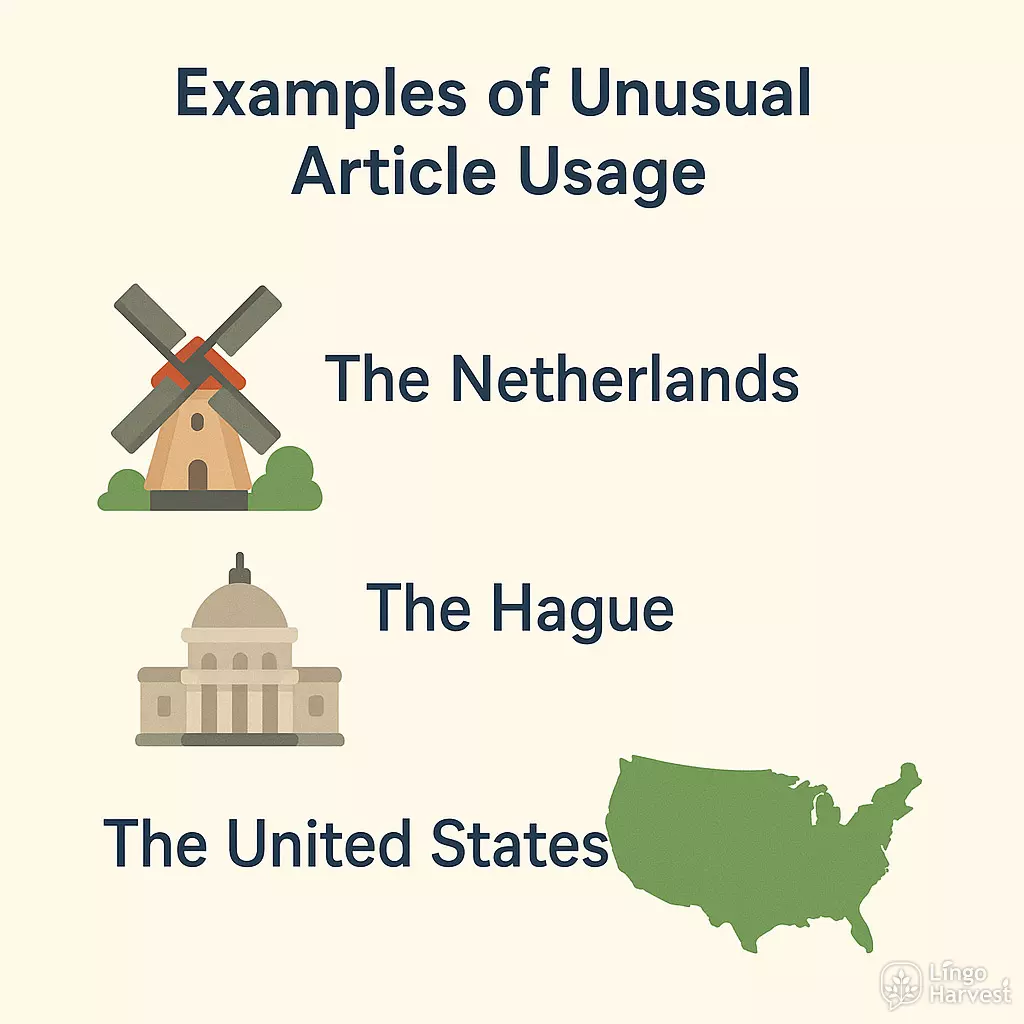
Some locations require an article when you might not expect it, while others omit one entirely. Here are several well-known cases:
- The Netherlands → Always includes the because of its plural form and historical meaning ("the low countries").
- The Hague → Includes the due to its original Dutch name ("’s-Gravenhage", meaning "the Count’s Hedge").
- The United States → Plural, so the is required.
- The Philippines → Plural, so the is required.
- The Gambia → The article distinguishes it from Zambia and refers to the river.
- The Sudan / The Ukraine → Traditionally took the, but now commonly used without it ("Sudan", "Ukraine").
- Central African Republic → No article, even though it's a compound name.
- Czech Republic → No article, despite being a descriptive title.
- The Bahamas → Plural, so the is standard.
- The United Kingdom → Officially requires the because of the full title.
- The Congo → Used for the river or region, but not always for the countries ("Republic of the Congo").
- The Bronx → A borough of New York City that always takes the.
- Ivory Coast → No article, though the French name (La Côte d’Ivoire) includes one.
- Isle of Man → No article, despite being an island.
- Comoros → Sometimes used with the, but both forms exist.
- The Vatican → Used colloquially, but officially "Vatican City" is without an article.
- Leicester → Not "the Leicester", even though some English place names take articles.
- Ukraine → Now used without the, reflecting its status as an independent country.
- Punjab → No article, though it refers to a region.
- Antarctica → No article, unlike "the Arctic".
Patterns and Their Exceptions
The presence or absence of an article often depends on whether the name is plural, describes a political entity, or refers to a geographical feature. But as the examples show, there are many exceptions that must simply be learned.
| Location Name | Typical Article Usage |
|---|---|
| The Netherlands | ✅ Always with "the" |
| Ukraine | ✅ Now used without "the" |
| Central African Republic | ✅ No article |
| The Bahamas | ✅ Always with "the" |
| The Bronx | ✅ Always with "the" |
| Antarctica | ✅ No article |
Mastering these exceptions is mostly a matter of memorization and exposure. When in doubt, consult reliable sources or observe native usage in context. These irregularities highlight the rich history and diversity of place names in English.
Practice: add or remove articles with place names
Understanding when to use articles with place names—such as cities, regions, and continents—can be tricky, especially because English has many exceptions and patterns. Below, you’ll find a series of exercises and explanations to help you practice inserting or omitting "the," "a," or "an" with geographical names.
Quick Tips for Articles with Geographical Names
- Most city names do not take an article: Paris, Tokyo, London.
- Continents are used without articles: Asia, Europe.
- Regions sometimes use "the," especially if they describe an area: the Middle East, the Balkans.
- Islands and mountain ranges often require "the": the Maldives, the Alps.
- Countries rarely take an article, except in certain cases: the United States, the Netherlands.
- With lakes and single mountains, omit "the": Lake Baikal, Mount Everest.
Exercise: Insert or Remove the Article
For each sentence below, decide if you need to add or remove an article ("the," "a," or "an") before the place name. Write the correct sentence.
- She visited ___ Paris last summer.
- We climbed ___ Alps during our trip.
- He is studying in ___ United Kingdom.
- They went to ___ Lake Superior for the weekend.
- My friend moved to ___ Netherlands.
- ___ Asia is the largest continent.
- They sailed across ___ Mediterranean Sea.
- We explored ___ Sahara Desert by jeep.
- ___ Amazon River flows through Brazil.
- She dreams of living in ___ New York City.
- Have you ever been to ___ Canary Islands?
- He hiked ___ Mount Kilimanjaro.
Show answers
- She visited Paris last summer. ✅
- We climbed the Alps during our trip. ✅
- He is studying in the United Kingdom. ✅
- They went to Lake Superior for the weekend. ✅
- My friend moved to the Netherlands. ✅
- Asia is the largest continent. ✅
- They sailed across the Mediterranean Sea. ✅
- We explored the Sahara Desert by jeep. ✅
- The Amazon River flows through Brazil. ✅
- She dreams of living in New York City. ✅
- Have you ever been to the Canary Islands? ✅
- He hiked Mount Kilimanjaro. ✅
Common Patterns: When to Use "the" with Place Names
| Type of Place | Typical Article Usage |
|---|---|
| Continents, most countries, cities | No article (Asia, Russia, London) |
| Countries with plural names or unions | Use "the" (the Philippines, the United States) |
| Mountain ranges, island groups, rivers, seas | Use "the" (the Alps, the Bahamas, the Nile, the Black Sea) |
| Lakes, single mountains, most streets | No article (Lake Victoria, Mount Fuji, Oxford Street) |
Challenge: Correct the Sentences
Find and fix the mistakes in article usage with place names.
- She has always wanted to visit the Japan.
- The Mount Everest is the highest mountain in the world.
- I took a cruise on Mediterranean Sea.
- They live in the Canada now.
- We are planning a trip to the Alps.
- The Nile River is longer than Amazon River.
- He dreams of climbing the Kilimanjaro one day.
- We spent our vacation on the Bali.
- The Lake Victoria is one of the largest lakes in Africa.
- She studied abroad in the United Kingdom for two years.
Show answers
- She has always wanted to visit Japan.
- Mount Everest is the highest mountain in the world.
- I took a cruise on the Mediterranean Sea.
- They live in Canada now.
- We are planning a trip to the Alps.
- The Nile River is longer than the Amazon River.
- He dreams of climbing Kilimanjaro one day.
- We spent our vacation on Bali.
- Lake Victoria is one of the largest lakes in Africa.
- She studied abroad in the United Kingdom for two years.
Practicing with real examples like these will help you develop an instinct for when articles are needed with names of places. Review the explanations and test yourself with new sentences to build confidence.