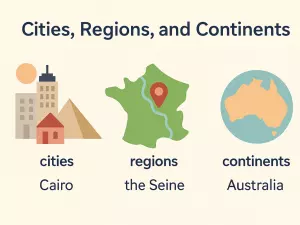
Articles THE with Countries, Cities, and Places

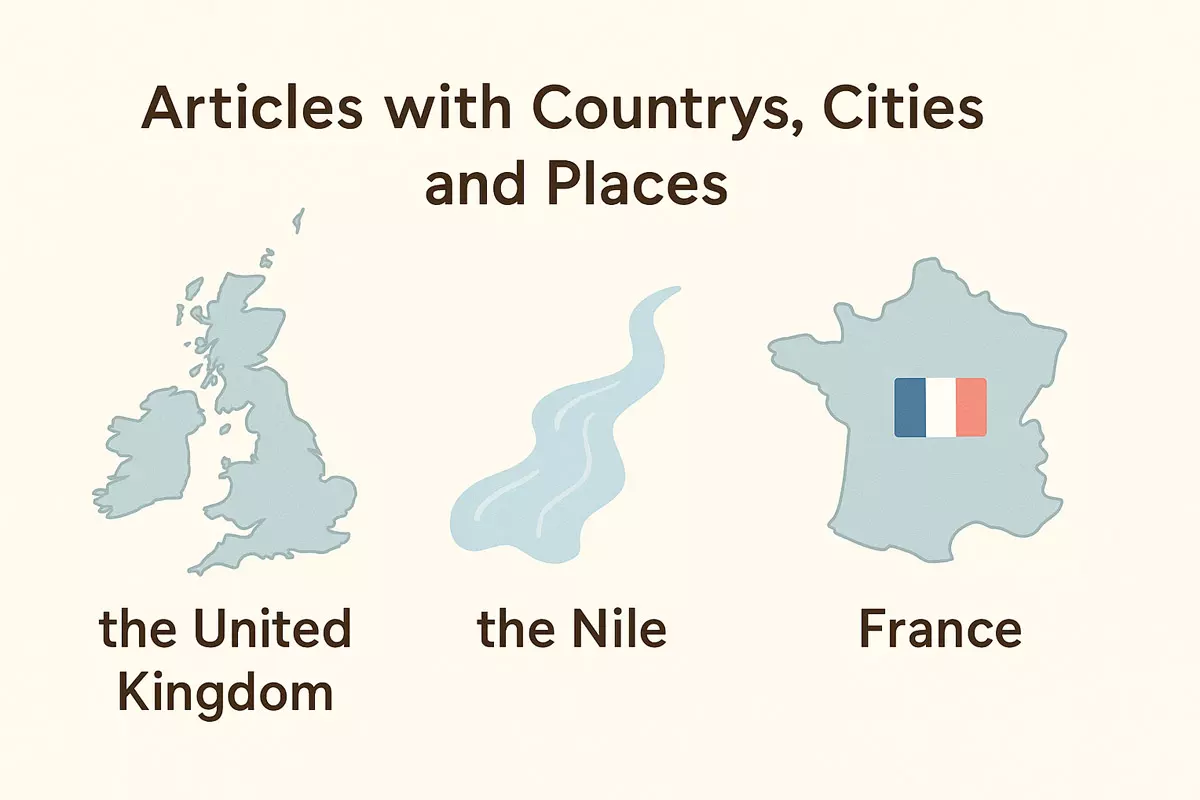 Here we when to use articles with country names, groups, rivers, seas, and mountain ranges, points out exceptions like the UK and the Netherlands, and includes useful tourist phrases plus practice with travel-related sentences.
Knowing when to use words like "the" or "a" before place names can be surprisingly challenging, but mastering the use of articles with names of countries, cities, and landmarks is essential for sounding natural in English. For example, we say "the United States" or "the Netherlands," but simply "France" or "London" without an article. Similarly, landmarks may require "the," as in "the Eiffel Tower," while others, like "Central Park," do not. Paying attention to these patterns will help improve your fluency and accuracy.
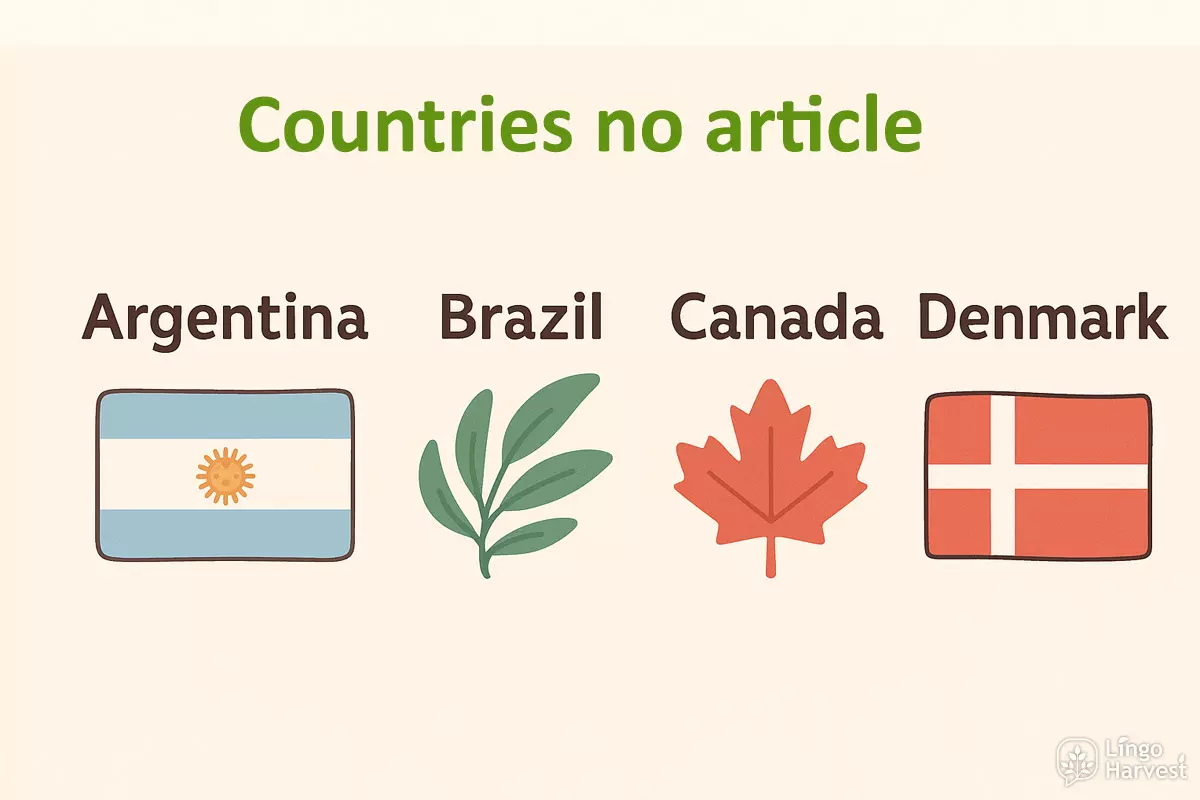
Countries with No Article (most names)
Most country names in English appear without any article. This is the standard pattern, and it's one of the simplest rules when talking about nations. If you say "France is beautiful in spring" or "I visited Japan last year," you naturally avoid using "the" before the country name. This is the case for almost all single-word country names, and even many with two or more words, unless their names include words like "republic," "kingdom," or refer to a union or group.
Common Examples
- Argentina
- Brazil
- Canada
- Denmark
- Egypt
- Finland
- Greece
- Hungary
- India
- Japan
- Mexico
- Norway
- Peru
- Russia
- Sweden
- Turkey
- Vietnam
You’ll notice that these country names do not take "the" or "a" before them. Saying "the Canada" or "a Finland" would sound incorrect to native speakers. This rule applies regardless of whether you’re talking about travel, geography, or history.
Why No Article?
The absence of an article is largely due to the fact that these names are treated as proper nouns, much like personal names. In English grammar, proper nouns usually stand alone without an article unless they are descriptive or pluralized (as in "the Netherlands"). This helps keep sentences concise and avoids unnecessary repetition.
Exceptions to Be Aware Of
While most countries follow this rule, there are exceptions, especially with names that include words such as "republic," "kingdom," or are plural (like "the Philippines"). For the majority, however, the default is to use the name without any preceding article.
Understanding this simple pattern will make your English sound more natural and fluent when referring to nations around the world.
Countries/Groups with the (the UK, the Netherlands)
Some country and group names in English require the definite article “the,” especially when the name refers to a political union, geographical feature, or plural territory. This isn’t a random choice; the article often signals a collection or a descriptive phrase, setting these names apart from most countries, which stand alone without “the.”
When to Use "the" with Country Names
The use of “the” is most common with:
- Countries whose names are plural or describe a group of lands or islands
- Names with words like “kingdom,” “republic,” or “states”
- Some regions and historical territories
Examples of Countries and Groups Requiring "the"
Here are some of the most common cases:
- the United Kingdom
- the Netherlands
- the United States (of America)
- the Philippines
- the Czech Republic
- the United Arab Emirates
- the Maldives
- the Bahamas
- the Dominican Republic
- the Gambia
- the Seychelles
- the Marshall Islands
- the Solomon Islands
- the Comoros
- the Vatican (or the Vatican City)
- the Central African Republic
- the Democratic Republic of the Congo
- the Republic of the Congo
- the Sudan (less common now, mostly historical)
Patterns to Notice
- Plural names: “the Netherlands,” “the Philippines,” “the Bahamas”
- Political entities: “the United States,” “the United Kingdom,” “the Czech Republic”
- Island groups: “the Maldives,” “the Seychelles,” “the Solomon Islands”
Why Not "the" for Most Countries?
Most single-named countries (like France, China, or Brazil) do not use an article. The definite article signals that the country is a collection, a formal union, or a descriptive phrase, not a single geographic unit.
Common Mistakes
Learners sometimes overuse “the” with countries that never take it. For example:
- ❌ the Canada → Canada
- ❌ the Germany → Germany
- ❌ the Russia → Russia
Summary Table: When to Use "the"
| Type of Name | Examples |
|---|---|
| Plural/Collective Territories | the Netherlands, the Philippines, the Maldives, the Bahamas, the Seychelles |
| Political Unions or Republics | the United Kingdom, the United States, the Czech Republic, the United Arab Emirates, the Dominican Republic |
| Groups of Islands | the Solomon Islands, the Marshall Islands, the Comoros |
| Special Cases | the Gambia, the Sudan (historical), the Vatican |
Understanding these patterns helps avoid common article mistakes and makes your English sound more natural. Use “the” when the name points to a group, union, or descriptive political title, but not with most country names.
Rivers, Seas, Mountain Ranges
Geographical features such as major waterways, bodies of water, and elevated landforms often follow their own rules when it comes to using articles in English. These natural landmarks are referenced in a variety of ways, and knowing the standard article usage helps avoid common mistakes.
Definite Article Usage
Most well-known rivers, seas, and chains of mountains require the definite article “the” before their names. This pattern is consistent across English, and is especially important when referring to globally recognized features. For example, we say the Amazon (river), the Mediterranean (sea), and the Alps (mountain range).
- the Nile
- the Yangtze
- the Black Sea
- the Himalayas
- the Danube
- the Mississippi
- the Baltic Sea
- the Andes
- the Rocky Mountains
- the Caspian Sea
- the Thames
- the Red Sea
- the Ural Mountains
- the Volga
- the Apennines
- the Adriatic Sea
- the Carpathians
- the Seine
When Not to Use an Article
Individual mountains and lakes, as well as some islands, typically do not take any article. For example, we say Mount Everest or Lake Victoria, not the Mount Everest or the Lake Victoria. This is a common point of confusion for learners.
- Mount Fuji
- Lake Baikal
- Mount Kilimanjaro
- Lake Superior
- Mount Etna
- Lake Como
Patterns and Exceptions
While most rivers, seas, and mountain ranges follow the rules above, there are rare exceptions and historical names that may differ. Paying attention to context and established usage helps avoid errors. In summary, use “the” for major rivers, seas, and ranges, but omit it for single mountains and lakes.
Buildings vs Public Places
Understanding the distinction between individual structures and shared spaces is essential when discussing cities and locations. In English, articles ("a", "an", "the") are used differently depending on whether you're referring to a specific building or a general public area. This affects both everyday conversation and formal writing about geography, travel, and history.
Defining Buildings and Public Places
A building is typically a constructed structure with walls and a roof, such as a school, museum, or hospital. These are usually specific, named places. In contrast, public places refer to open or communal areas accessible to everyone, like parks, squares, or beaches. The way articles are used can change based on whether the location is unique, named, or generic.
Common Article Usage Patterns
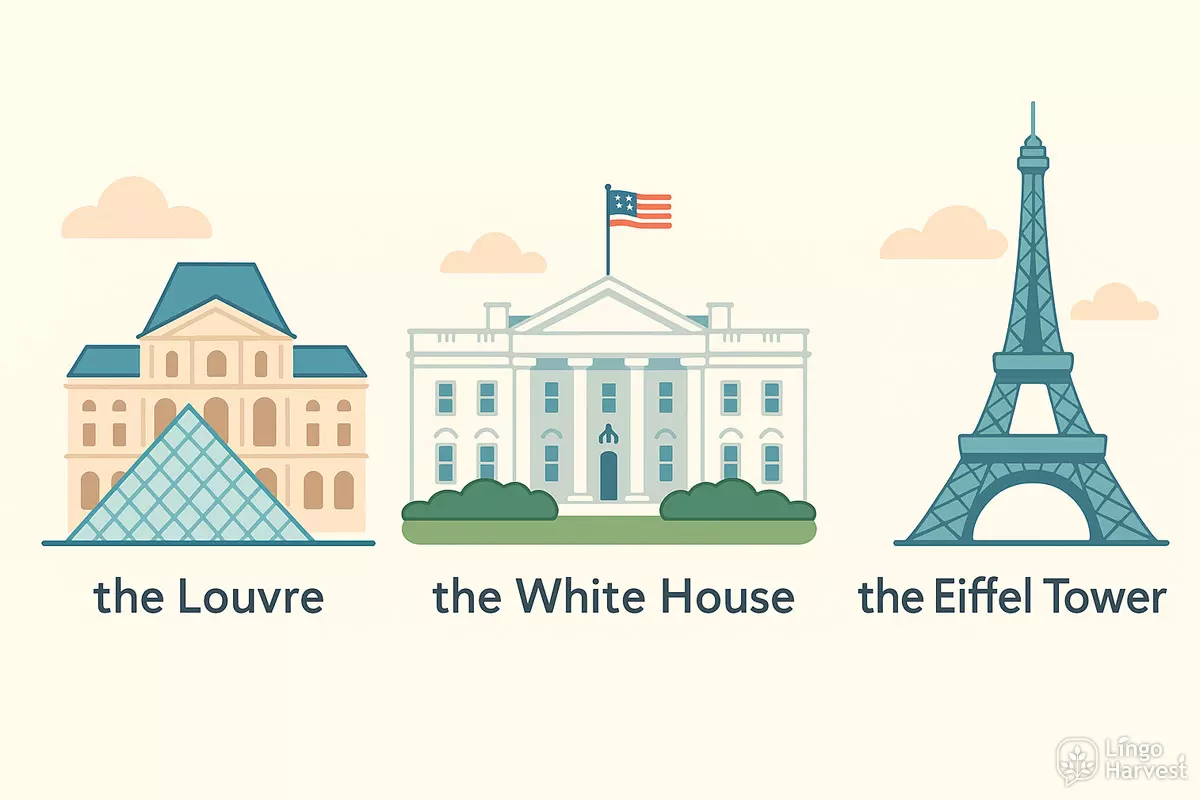
- Named buildings: the Louvre, the White House, the Eiffel Tower
- Generic buildings: a museum, a hospital, a library
- Public places (named): Central Park, Trafalgar Square, Times Square
- Public places (generic): a park, a square, a beach
- Institutions (sometimes no article): go to school, at university, in prison
- Streets and avenues (usually no article): on Oxford Street, in Fifth Avenue
- Buildings with function as a focus: the hospital (when specific), hospital (when general use)
- Public transport places: at the station, in the airport
- Government buildings: the Parliament, the City Hall
- Religious buildings (sometimes no article): in church, at mosque
- Public facilities: the swimming pool, the playground
- Open spaces: the plaza, the promenade
- Geographical features (usually no article): on Mount Everest, in Lake Geneva
Quick Comparison
| Type | Typical Article Usage |
|---|---|
| Named Building | Usually "the" (e.g. the Empire State Building) |
| Generic Building | "a"/"an" for first mention, "the" when specified (e.g. a library, the library) |
| Named Public Place | Often no article (e.g. Hyde Park), but "the" for some (e.g. the National Mall) |
| Generic Public Place | "a"/"an" or "the" as needed (e.g. a park, the park) |
| Institutions (by function) | Sometimes no article (e.g. in hospital [BrE], at school) |
Tips for Learners
- Check if the place is unique and widely recognized; use "the" if so.
- For generic or unknown places, start with "a" or "an".
- Public spaces named after people or locations often omit the article.
- Institutional use (like going to school) may drop the article entirely, especially in British English.
- Some exceptions exist, so exposure to native usage helps.
Grasping these patterns makes it easier to talk about locations accurately, whether you're describing travel experiences, giving directions, or writing about famous landmarks. Pay attention to context and usage, as these often signal the correct article to use with buildings and public spaces.
Common Tourist Phrases
Travelers often find it helpful to master a selection of useful expressions when exploring foreign countries, cities, and other destinations. These phrases can make interactions smoother, whether you’re asking for directions, ordering food, or seeking assistance. While each language has its own nuances, many situations call for similar vocabulary.
Essential Expressions for Getting Around
- Where is…? / How do I get to…?
- What time does it open/close?
- How much does this cost?
- Can you help me?
- I don’t understand.
- Do you speak English?
- I am lost.
- I would like to go to [place].
- Is this seat taken?
- Could you recommend a good restaurant?
- Can I have the bill, please?
- Where is the nearest restroom?
- Is Wi-Fi available here?
- What is the address?
- Is it far from here?
- Can you write that down, please?
- I have a reservation.
- Which way to the city center?
Sample Adaptations for Different Places
Depending on your destination, some phrases may need to be tailored for local customs or languages. Here’s how a few requests might change when asking about countries, cities, or specific sites:
| Situation | Example Phrase |
|---|---|
| Finding a country | “Is this the right bus to Italy?” |
| Asking about a city | “How far is it to Berlin from here?” |
| Visiting a landmark | “Could you show me the way to the Eiffel Tower?” |
| Looking for a place to eat | “Are there any traditional restaurants in this area?” |
| Booking accommodation | “Do you have any rooms available in the city tonight?” |
Tips for Clear Communication
Politeness and patience go a long way. If you’re unsure how to pronounce a city or country name, showing it written down can help. Gestures, maps, and translation apps are also useful tools when language barriers arise. Knowing a handful of adaptable travel expressions ensures a smoother journey wherever you go.
Practice: Complete Travel Sentences
Understanding how to use articles with geographical names is essential for clear communication when talking about travel. Below you’ll find a set of interactive exercises to help reinforce when to use “the,” “a/an,” or no article at all with countries, cities, and landmarks.
Fill in the Blanks: Choose the Correct Article
Read each sentence and decide which article fits best. Write "the," "a," "an," or leave the space blank if no article is needed.
- ______ Netherlands is famous for its tulips.
- We visited ______ Eiffel Tower last summer.
- She lives in ______ Paris.
- ______ United States is a large country.
- They went to ______ Mount Everest during their trip.
- My friends are traveling to ______ Italy next month.
- He has never been to ______ Bahamas.
- ______ Amazon River is the longest in South America.
- We saw ______ beautiful castle in Scotland.
- I would love to visit ______ Lake Baikal one day.
Show answers
- the Netherlands
- the Eiffel Tower
- — (no article)
- the United States
- — (no article)
- — (no article)
- the Bahamas
- the Amazon River
- a
- — (no article)
Common Patterns with Places: Article Usage
Here is a quick reference for when to use or omit articles with different types of place names:
| Type of Place | Article Usage Example |
|---|---|
| Countries (singular, most cases) | Japan, Brazil, Canada (no article) |
| Countries (plural or with "of") | the Netherlands, the United States, the Republic of Korea |
| Mountain ranges, rivers, seas | the Alps, the Nile, the Black Sea |
| Cities, towns, continents | London, Rome, Asia (no article) |
| Buildings, famous landmarks | the Taj Mahal, the Louvre, the Great Wall |
| Lakes, parks, streets | Lake Victoria, Central Park, Oxford Street (no article) |
Sentence Correction: Spot the Mistake
Identify and correct the mistake with articles in each sentence below.
- She traveled to the Spain last year.
- They climbed the Mount Fuji in spring.
- We went sightseeing in the Paris.
- I want to see Niagara Falls the next summer.
Show answers
- She traveled to Spain last year. (remove "the")
- They climbed Mount Fuji in spring. (remove "the")
- We went sightseeing in Paris. (remove "the")
- I want to see Niagara Falls next summer. (remove "the")
Practicing these patterns will help you speak and write about travel destinations more accurately, whether describing a trip to the United Kingdom or an adventure in Peru.