Articles with Geographic Names: Rivers, Mountains, Countries

 Here we when to use the with rivers, seas, oceans, mountain ranges, and deserts, when not to use it with cities and countries, notes exceptions like the USA and the Netherlands, and provides practice in adding or removing the article.
The use of articles with place names in English can be confusing, especially when it comes to rivers, mountain ranges, and countries. For instance, we say the Nile and the Alps, but simply Amazon or Everest without the article. This inconsistency often depends on tradition and how the name is used in context. Typically, rivers and mountain ranges take the definite article, while most cities and countries do not. Learning these patterns helps improve both written and spoken English, making it easier to communicate clearly and accurately.
The with Rivers, Seas, and Oceans
When talking about bodies of water such as rivers, seas, and oceans, English often uses the definite article, but not always. The presence or absence of "the" depends on established naming conventions and sometimes on the structure of the name itself. Understanding these patterns helps avoid common mistakes in both writing and conversation.
When to Use "The"
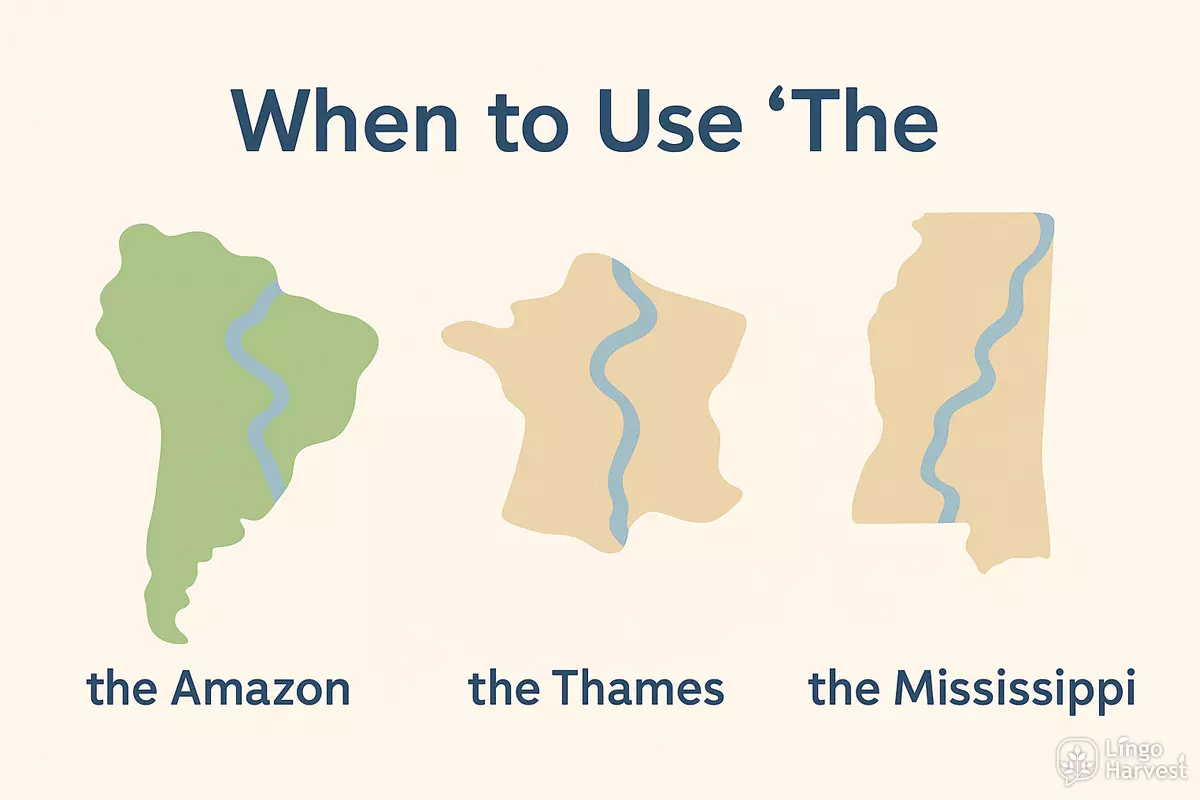
Most major rivers and all oceans and seas take "the" before their names. This is because these names describe unique entities, often with descriptive phrases or traditional forms that demand the article.
- the Amazon
- the Thames
- the Mississippi
- the Nile
- the Danube
- the Pacific Ocean
- the Atlantic
- the Mediterranean Sea
- the Baltic Sea
- the Black Sea
- the Red Sea
- the Caspian Sea
- the Indian Ocean
- the Arctic Ocean
- the Yangtze
- the Seine
- the Volga
- the Mekong
When "The" Is Not Used
Some lakes and a few rivers do not take "the," especially when the name is a proper noun without a descriptive phrase. For example, Lake Superior or Lake Victoria do not use the article, since "Lake" is part of the official name.
- Lake Baikal
- Lake Titicaca
- Lake Michigan
- Lake Geneva
- Lake Tanganyika
- Lake Ontario
Common Patterns and Exceptions
While the rule is clear for most rivers and seas, a few water bodies may confuse learners. The following table highlights some typical patterns and noteworthy exceptions regarding article usage:
| Type | Article Usage Example |
|---|---|
| Ocean | the Atlantic Ocean, the Indian Ocean |
| Sea | the North Sea, the Adriatic Sea |
| River | the Rhine, the Ganges, the Amazon |
| Lake | Lake Superior, Lake Victoria (no "the") |
| Bays & Gulfs | the Bay of Bengal, the Gulf of Mexico |
Summary of Usage
To sum up, almost all rivers, seas, and oceans require "the" before their names, whereas most lakes and single-word proper names do not. Remembering this pattern helps ensure correct and natural article use with geographic names.
The with Mountain Ranges and Deserts
English uses the definite article the with certain types of geographic names—especially when referring to whole ranges of mountains or major deserts. This pattern contrasts with the way we talk about individual peaks or smaller landforms, which usually do not take the article. Understanding when to use the helps you sound more natural and precise in both writing and conversation.
When to Use "the" with Mountain Ranges
For groups or chains of mountains, English almost always includes the before the name. This is because a range is considered a collective entity, not a single object. In contrast, individual mountains (like Mount Everest) typically appear without an article.
- the Alps
- the Andes
- the Himalayas
- the Rockies (Rocky Mountains)
- the Carpathians
- the Urals
- the Pyrenees
- the Appalachians
- the Sierra Nevada
- the Caucasus
Usage with Deserts
Most major deserts are also preceded by the in English. This rule applies whether the word "desert" comes first or last in the name. The article signals that we are talking about a specific, well-known region.
- the Sahara (Desert)
- the Gobi (Desert)
- the Kalahari (Desert)
- the Mojave Desert
- the Sonoran Desert
- the Atacama Desert
- the Namib Desert
- the Arabian Desert
- the Great Victoria Desert
- the Thar Desert
Comparison: Ranges vs. Individual Features
Notice the difference in article usage between entire ranges or deserts and single peaks or locations. Here’s a summary:
| Correct Form | Explanation |
|---|---|
| the Alps | Mountain range (plural/group); takes "the" |
| Mont Blanc | Individual mountain; no article |
| the Sahara | Desert region; takes "the" |
| Mount Everest | Single mountain; no article |
| the Rockies | Mountain range; always with "the" |
| Everest Base Camp | Specific location; no article |
Quick Reference: More Examples
- the Atlas Mountains
- the Blue Ridge Mountains
- the Tien Shan
- the Chihuahuan Desert
- the Simpson Desert
- the Pamirs
- the Zagros Mountains
To sum up: for mountain ranges and deserts, use the. For individual mountains, leave out the article. This distinction helps clarify whether you mean the whole region or just a single landmark.
No Article with Cities and Countries
When mentioning city and country names in English, articles like the or a/an are generally omitted. This is a consistent rule for most modern place names, regardless of whether they are well-known capitals or smaller towns. Unlike rivers or mountain ranges, which sometimes require an article, singular city and country names almost never take one.
Typical Usage Without Articles
Place names such as France, Japan, London, and New York appear in sentences without any article in front. For example, we say “I visited Italy last year,” not “I visited the Italy.” This pattern holds true for both written and spoken English.
Common Examples
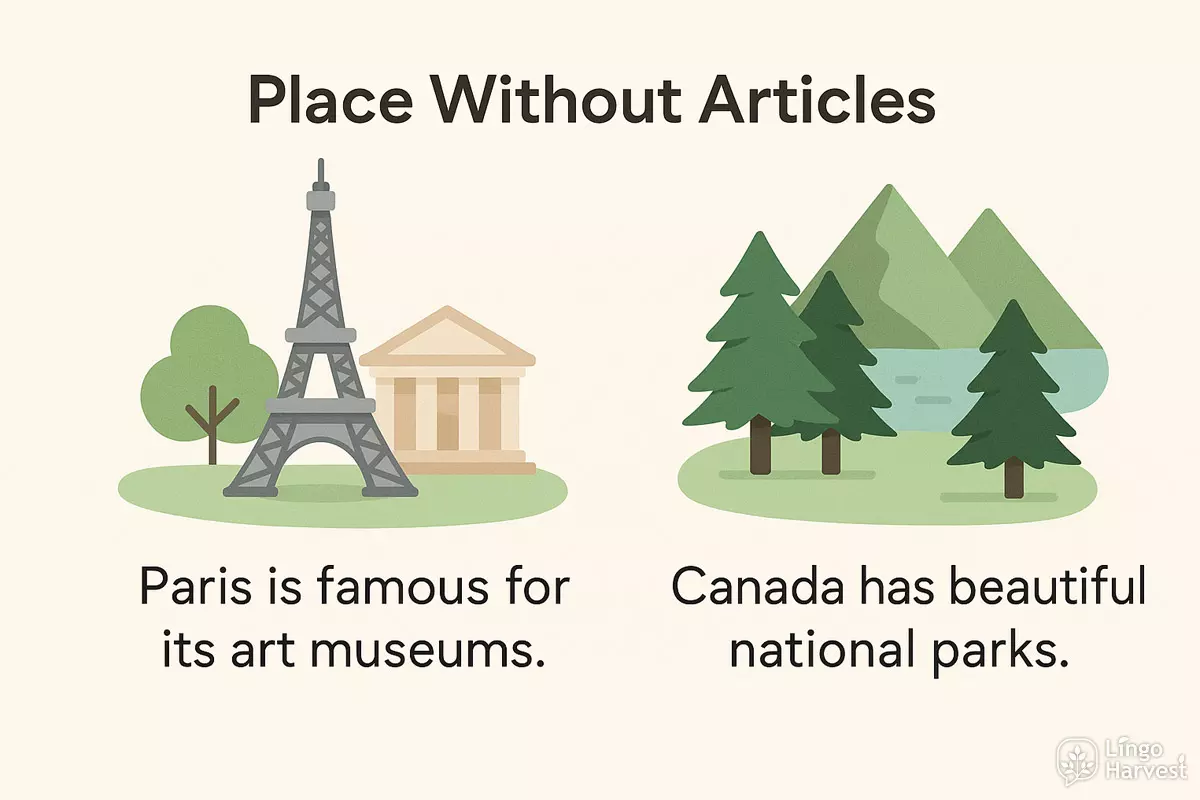
- Paris is famous for its art museums.
- Canada has beautiful national parks.
- Tokyo is a bustling metropolis.
- Brazil hosted the Olympics in 2016.
- Rome is known for its ancient ruins.
- Australia is home to unique wildlife.
- Mumbai is the financial center of India.
- Egypt attracts millions of tourists.
- Beijing will host the Winter Olympics.
- Sweden is famous for its design and innovation.
- Berlin has a vibrant cultural scene.
- Morocco is located in North Africa.
- Madrid is the capital of Spain.
- Thailand offers stunning beaches.
- Vienna is renowned for classical music.
Exceptions and Special Cases
There are a few exceptions where articles are used, usually because the country name describes a group of states, islands, or territories, or contains a common noun. Examples include the Netherlands, the United States, the Philippines, and the United Kingdom. However, for the vast majority of cities and countries, no article is needed.
Quick Reference: When Not to Use an Article
- Most single-word country names: China, Brazil, India, Germany
- All city names: Moscow, Sydney, Nairobi, Toronto
- Countries ending with -land: Finland, Switzerland, Iceland
- Island countries (unless plural or descriptive): Madagascar, Cyprus, Malta
Remember, this convention helps distinguish city and country names from geographic features like rivers and mountain ranges, which often follow different rules regarding articles.
Exceptions (The Netherlands, The USA)
Some country names break the usual rule of omitting articles before geographic names. While most country names appear without "the," a few require a definite article due to historical or linguistic reasons. These exceptions often stem from the original meaning or grammatical structure of the name in English.
Why Certain Country Names Use "The"
The use of "the" before names like "Netherlands" and "USA" is rooted in grammar and tradition. For instance, "the Netherlands" refers to "the low lands," and "the United States of America" emphasizes the plural nature of the states united into one country. This convention extends to similar cases, especially when the name is descriptive or plural.
- the Netherlands
- the United States (of America)
- the United Kingdom
- the Philippines
- the Bahamas
- the Maldives
- the Czech Republic
- the United Arab Emirates
- the Gambia
- the Seychelles
- the Congo (Democratic Republic/Republic of the)
- the Comoros
- the Sudan (sometimes, but less common today)
- the Vatican (the Vatican City State)
- the Solomon Islands
- the Marshall Islands
- the Central African Republic
- the Dominican Republic
- the Lebanon (historical/archaic, less in modern usage)
When to Use the Article
Generally, use "the" with:
- Country names in plural form (e.g., the Netherlands, the Philippines)
- Countries whose names include a common noun plus an adjective (e.g., the United States, the United Kingdom)
- Names that refer to a group of islands or a political union
Common Mistakes
It’s easy to confuse which names need an article. For example, we say "the Netherlands" but simply "Germany," not "the Germany." Remember, most single-word country names do not take an article.
Quick Reference Table
| Country Name | Correct Form with Article |
|---|---|
| Netherlands | the Netherlands |
| United States | the United States |
| Philippines | the Philippines |
| Bahamas | the Bahamas |
| United Kingdom | the United Kingdom |
| Maldives | the Maldives |
| United Arab Emirates | the United Arab Emirates |
| Dominican Republic | the Dominican Republic |
Understanding which place names require an article helps avoid common errors in writing and speech. These patterns remain consistent across academic and conversational English, so recognizing them improves both clarity and correctness.
Practice: Add or Remove the Article
Try these exercises to master when to use "the" with names of rivers, mountains, countries, and other geographic features. Read each sentence and decide whether you need to add or remove "the" for correct usage. Pay attention to the type of place: some require the definite article, while others do not.
Instructions
For each phrase or sentence, add "the" if it’s necessary, or remove it if it’s not. Think about rules for rivers, mountain ranges, countries, and regions.
- ___ Amazon is the second longest river in the world.
- Have you ever climbed ___ Alps?
- They traveled across ___ France by train.
- ___ United States is a large country.
- She visited ___ Mount Everest last year.
- He sailed down ___ Nile.
- ___ Lake Baikal is the deepest lake on Earth.
- We spent our vacation in ___ Netherlands.
- She trekked through ___ Andes.
- They crossed ___ Sahara on camels.
- ___ Canada is famous for its natural beauty.
- Have you seen ___ Rocky Mountains?
- He lives near ___ Black Sea.
- ___ Japan consists of many islands.
- They explored ___ Gobi Desert together.
Quick Reference: Article Use with Geographic Names
- Use "the" with: rivers, seas, oceans, mountain ranges, groups of islands, deserts, plural country names, regions.
- Do not use "the" with: most single mountains, lakes, most single countries, continents, cities.
| Type of Name | Article Usage Example |
|---|---|
| River | the Thames, the Yangtze |
| Mountain Range | the Himalayas, the Andes |
| Single Mountain | Mount Fuji, Mount Kilimanjaro |
| Country (single) | Brazil, India, Japan |
| Country (plural or descriptive) | the Philippines, the United Kingdom |
| Desert | the Sahara, the Gobi |
| Sea/Ocean | the Mediterranean Sea, the Pacific Ocean |
| Lake | Lake Superior, Lake Victoria |
| Region | the Middle East, the Balkans |
Show answers
- The Amazon is the second longest river in the world.
- Have you ever climbed the Alps?
- They traveled across France by train. (No article)
- The United States is a large country.
- She visited Mount Everest last year. (No article)
- He sailed down the Nile.
- Lake Baikal is the deepest lake on Earth. (No article before "Lake")
- We spent our vacation in the Netherlands.
- She trekked through the Andes.
- They crossed the Sahara on camels.
- Canada is famous for its natural beauty. (No article)
- Have you seen the Rocky Mountains?
- He lives near the Black Sea.
- Japan consists of many islands. (No article)
- They explored the Gobi Desert together.