Articles with the World, the Internet, the Police and Similar Nouns

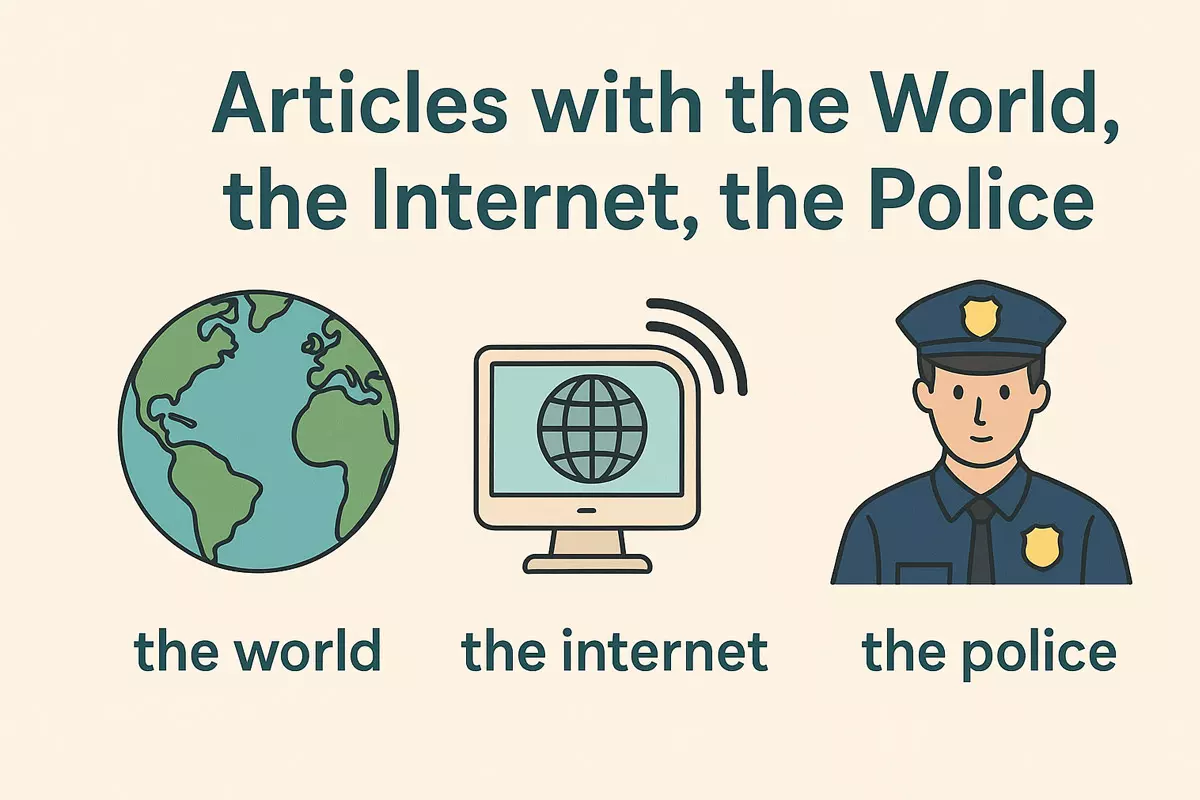 Here we when to use 'the' with nouns like world, environment, police, media, internet, and web. It discusses cases without an article, highlights frequent learner mistakes, and offers practice to correct article usage in context.
- Nouns that normally take “the”: the world, the environment
- Institutions and groups: the police, the media, the press
- Technology and systems: the internet, the web, the phone
- When these nouns appear without an article
- Typical learner mistakes in these patterns
- Practice: fix article use in short paragraphs
Have you ever noticed that we say the world or the police, but simply nature or music without a definite article? These differences aren’t random; rather, they reflect specific patterns in English usage. Certain collective nouns and unique entities often take the definite article, while general concepts or uncountable nouns usually do not. Becoming familiar with these patterns not only clarifies why we use the in some cases and not others, but also helps you communicate more naturally and accurately in English.
Nouns that normally take “the”: the world, the environment
Some English nouns almost always appear with the definite article “the.” This is especially common with words that refer to unique things, collective concepts, or institutions. For example, when we talk about “the world” or “the environment,” we mean something specific and universally understood, not just any world or any environment.
Why do these nouns need “the”?
The definite article is used with these nouns because they describe things that are either unique or understood by everyone in context. When you say “the world,” it’s clear you mean our planet as a whole, not a random or imaginary world. Similarly, “the environment” refers to the natural world around us, not just any surroundings.
Common nouns that usually require “the”
Below are some examples of nouns that typically appear with “the.” These words refer to institutions, concepts, and physical entities widely recognized in English usage:
- the world
- the environment
- the Internet
- the police
- the sky
- the sea
- the economy
- the government
- the media
- the public
- the sun
- the moon
- the weather
- the future
- the past
- the law
- the press
- the countryside
- the city
- the universe
Usage in context
These expressions almost never appear without “the.” For instance, we say “the police arrived quickly,” not “police arrived quickly.” Similarly, “the Internet is down” is correct, while “Internet is down” sounds incomplete. This pattern helps listeners or readers know exactly which entity or concept you are referring to.
Examples: Correct and incorrect usage
| Correct | Incorrect |
|---|---|
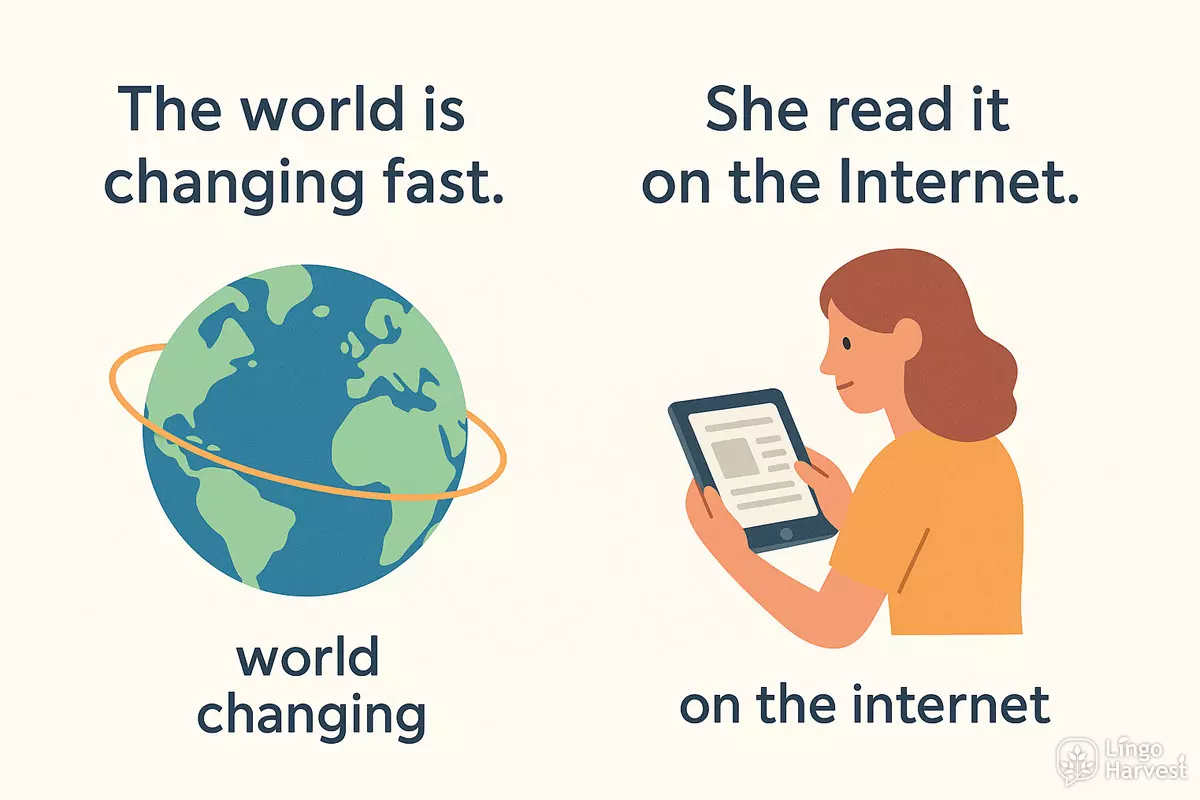
| The world is changing fast. | World is changing fast. |
| We must protect the environment. | We must protect environment. |
| The police are investigating. | Police are investigating. (only correct in headlines or as a plural noun) |
| She read it on the Internet. | She read it on Internet. |
Remember, using “the” with these nouns is not just a grammar rule—it’s about helping your listener or reader understand exactly what you mean. With practice, recognizing these patterns will become second nature.
Institutions and groups: the police, the media, the press
Understanding how nouns like “the police” or “the media” are used in English helps clarify both grammar and meaning. These words often refer collectively to groups or institutions, rather than to specific individuals. Typically, such terms take a plural verb, even though they look singular, because they represent a body of people acting together.
Usage and characteristics
When talking about organizations or collective groups, English frequently uses “the” followed by a plural or mass noun. For example, “the police” refers to all police officers as a unit, while “the media” encompasses various channels of mass communication. These words are rarely used without “the” and almost never in the singular: you would not say “a police” or “a media” to mean an individual member.
- The police are investigating the case. (not “a police”)
- The media have reported on the story. (not “a media”)
- The press was present at the event. (collectively refers to journalists and news organizations)
- The clergy often plays a role in community events.
- The public expects transparency from officials.
- The military operates under strict regulations.
- The youth of today faces new challenges.
- The elderly often require special care.
- The government has introduced new policies.
- The authorities are monitoring the situation.
- The staff have received training.
- The jury was selected yesterday.
- The audience applauded at the end.
- The workforce is adapting to new technologies.
Patterns and grammatical points
Terms like “the police” and “the media” do not have a commonly used singular form. To refer to one person from these groups, use alternative expressions:
- “A police officer” instead of “a police”
- “A journalist” or “a reporter” instead of “a press”
- “A member of the clergy” instead of “a clergy”
Also, these group nouns typically take plural verbs, even though the word itself may look singular. For example, “The police are” and “The media have” are the correct forms.
Comparison of institutional group nouns
| Group noun | Typical usage/Verb agreement | Individual member | Notes |
|---|---|---|---|
| The police | Plural: are | Police officer | Never “a police” for one person |
| The media | Plural: have | Journalist, reporter | Mass noun, not countable in this sense |
| The press | Plural or singular: have/has | Journalist, reporter | Refers to news organizations collectively |
| The clergy | Plural: are | Priest, minister | Refers to all religious officials |
| The authorities | Plural: are | Official, administrator | Used for people in power |
Summary
Institutional group nouns like “the police” and “the media” function as collective references to organizations or professions, not individuals. Understanding their grammatical behavior—especially verb agreement and lack of a singular form—helps avoid common mistakes. This pattern extends to many other English nouns that refer to institutions, professions, or large social groups.
Technology and systems: the internet, the web, the phone
Understanding how we refer to major technologies—like the internet, the web, and the phone—reveals interesting patterns in language. These terms, often paired with “the,” reflect their unique status as universal systems or services. Unlike many common nouns, these names act almost like proper nouns, representing something singular and global in scope.
Why do we use “the” with these technologies?
We say “the internet” and “the phone” because they refer to a specific, widely recognized network or system rather than one of many possible examples. “The web,” short for “the World Wide Web,” is treated similarly. In contrast, we don’t always use “the” with other technologies (“email,” “radio,” or “television” can appear without it), highlighting the special role of these systems.
- The internet – the global network connecting computers.
- The web – the system of interlinked hypertext documents.
- The phone – referring to the telephone network or the act of calling.
- The radio – the system of broadcasting audio signals.
- The television – the medium of televised content.
- The cloud – shared remote servers for data and applications.
- The network – the infrastructure for communication or data exchange.
- The grid – often used for the electrical power network.
- The press – the institution of news media.
- The mail – the postal delivery system.
- The subway – an underground train system.
- The highway – a major road system.
- The police – the law enforcement institution.
- The army – the national military force.
Comparing usage patterns
Let’s look at how these terms differ from others in the technology domain. Some take “the” almost universally, while others do not. This distinction often depends on whether the noun refers to a singular, established system or a generic item or activity.
| Term | Typical Usage with “the” |
|---|---|
| the internet | Always used with “the” when referring to the global network |
| the web | Almost always includes “the” (as in “browse the web”) |
| the phone | Used with “the” when meaning the telephone system in general |
| Rarely used with “the” (“send an email” vs. “use the email system”) | |
| radio | Can appear with or without “the” (“on the radio” vs. “listen to radio”) |
Common phrases and collocations
When talking about these systems, certain expressions are especially frequent. Here are some typical phrases:
- Connect to the internet
- Browse the web
- Call on the phone
- Listen to the radio
- Watch the television
- Store files in the cloud
- Send a letter through the mail
- Travel on the subway
- Report it to the police
- Serve in the army
- Drive on the highway
- Read in the press
When these nouns appear without an article
Some nouns such as world, Internet, and police are usually paired with the definite article (the), but there are instances where they appear without any article. These cases often depend on idiomatic usage, specific grammatical constructions, or changes in meaning. Understanding these contexts helps avoid common errors in English grammar.
Common situations where no article is used
- With certain prepositions: Phrases like at school or in prison drop the article when talking about the general institution or concept, not a specific building.
- When used adjectivally: Nouns such as police function as adjectives in phrases like police officer or police station, so no article is needed before police.
- In compound nouns: Expressions like world peace, Internet access, and police force typically do not take an article before the first noun.
- As uncountable or abstract nouns: Sometimes, Internet or world is used in an abstract sense without an article: Internet changes everything or World opinion is divided.
- In headlines and titles: Articles are often omitted in journalistic or academic headings for brevity: Police Investigate Incident.
- With certain set phrases: Some idiomatic expressions drop the article, such as go online (referring to the Internet) or world-class.
- When used in a general sense: For example, Police protect citizens or Internet connects people—here, the nouns refer to the concept as a whole, not a specific instance.
- With modifiers or possessives: When the noun is modified by a possessive or another determiner, the article is not used: his world, my Internet connection, our police department.
- In technical or scientific language: Technical writing may omit articles for conciseness: Internet protocol, world history timeline.
- In plural references: For example, police forces or worlds (in science fiction or astronomy).
Examples illustrating article omission
- She dreams of world peace.
- Internet access is essential for remote work.
- Police responded quickly to the call.
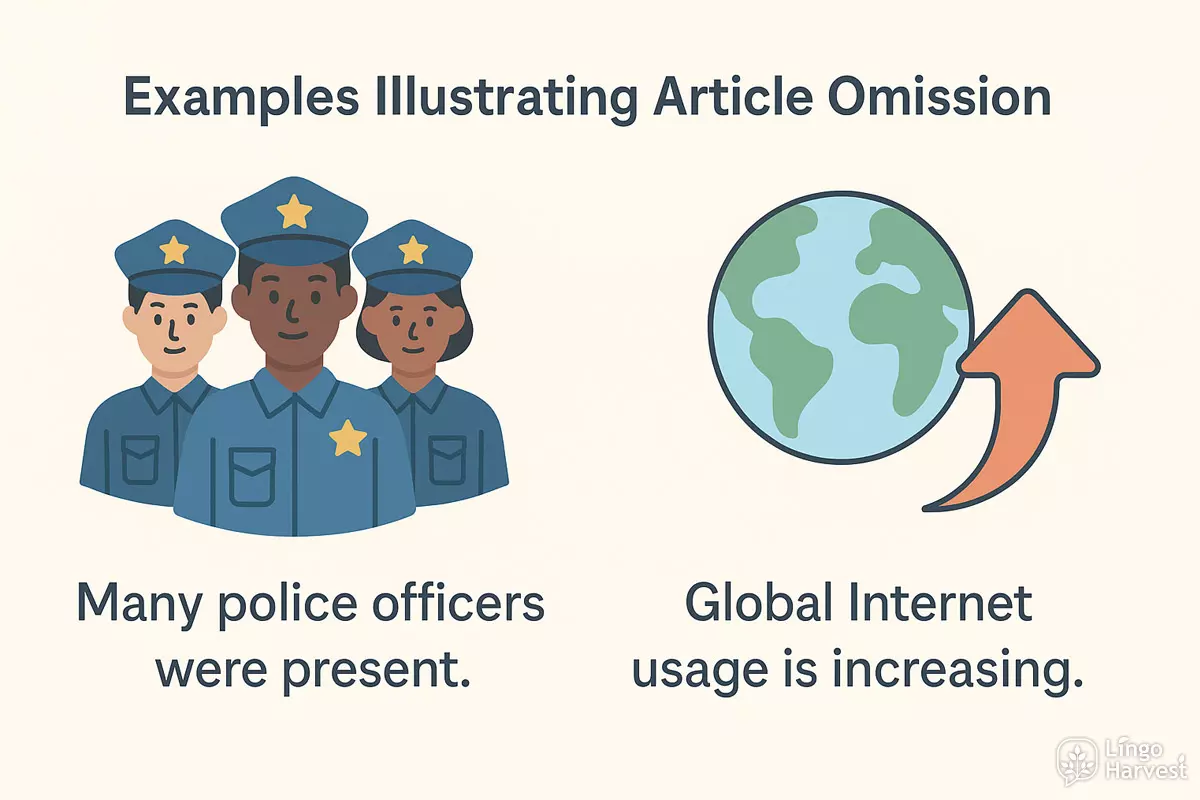
- Many police officers were present.
- Global Internet usage is increasing.
- He is studying world history.
- They work in law enforcement, not police.
- New Internet technologies emerge every year.
- World leaders met to discuss climate change.
- Police have made several arrests.
Summary of usage patterns
Choosing whether to use an article with nouns like world, Internet, and police depends on meaning, structure, and context. In set phrases, compound terms, and abstract or plural references, these words frequently appear without any article. Awareness of these patterns improves both written and spoken English accuracy.
Typical learner mistakes in these patterns
Learners often stumble when choosing whether to use "the" with collective nouns or unique institutions like "the world," "the Internet," or "the police." One of the main difficulties is knowing when the definite article is needed and when it should be omitted. Misunderstandings can lead to sentences that sound unnatural or even confusing to native speakers.
Common pitfalls with articles and specific nouns
- Leaving out "the" where it is required: "Internet is useful." → "The Internet is useful."
- Adding "the" where it is not needed: "The nature is beautiful." → "Nature is beautiful."
- Confusing "the police" (institution) with "police" (adjective or plural noun): "Police is coming." → "The police are coming."
- Using "the" with proper names or brands: "The Google is popular." → "Google is popular."
- Omitting "the" before universally unique items: "World is changing." → "The world is changing."
- Applying "the" to abstract nouns: "The love is important." → "Love is important."
- Misusing "the" with plural nouns when speaking in general: "The cats are friendly." (when talking about cats in general) → "Cats are friendly."
- Forgetting "the" with certain organizations: "He works for United Nations." → "He works for the United Nations."
- Unnecessary article before languages: "The English is difficult." → "English is difficult."
- Overusing "the" with meals and days: "The breakfast is ready." → "Breakfast is ready."
Comparing correct and incorrect usage
| Incorrect | Correct |
|---|---|
| Police is important in society. | The police are important in society. |
| He found information on Internet. | He found information on the Internet. |
| He wants to travel around world. | He wants to travel around the world. |
| The nature is unpredictable. | Nature is unpredictable. |
| The Google is a big company. | Google is a big company. |
| She was interviewed by police. | She was interviewed by the police. |
| The breakfast is ready. | Breakfast is ready. |
| The English is spoken here. | English is spoken here. |
Why these errors happen
Learners often transfer rules from their native languages, where articles may not exist or are used differently. The confusion increases with terms that seem generic but actually refer to unique entities in English. To avoid these mistakes, it helps to memorize common nouns that always or never take "the" and to practice with real-world examples.
Practice: fix article use in short paragraphs
Understanding when to use "the" with nouns like "world," "Internet," and "police" is essential for clear English writing. Below, you’ll find short paragraphs where articles are missing, unnecessary, or misused. Read each one and decide how to correct the article usage.
Exercise: Edit the Paragraphs
Read these short texts. Some have missing or extra articles before nouns such as "world," "Internet," or "police." Rewrite each sentence, fixing the article mistakes. Pay close attention to when "the" is needed or should be omitted.
- World is changing rapidly because of Internet and social media.
- Police responded quickly to call last night.
- Information on Internet is not always reliable.
- Many people dream of traveling around world.
- After accident, police arrived within minutes.
- She is researching history of Internet for her project.
- Global warming affects world in many ways.
- He was arrested by police after incident at station.
- How has Internet changed communication across world?
- Police have important role in society.
Show answers
- The world is changing rapidly because of the Internet and social media.
- The police responded quickly to the call last night.
- Information on the Internet is not always reliable.
- Many people dream of traveling around the world.
- After the accident, the police arrived within minutes.
- She is researching the history of the Internet for her project.
- Global warming affects the world in many ways.
- He was arrested by the police after the incident at the station.
- How has the Internet changed communication across the world?
- The police have an important role in society.
Common Patterns: "the" with Certain Nouns
Here are typical cases where you need to use "the" with particular nouns. Review these patterns to help you spot and correct mistakes:
- the world: Used when referring to the planet or humanity as a whole.
- the Internet: Standard when talking about the global network.
- the police: Usually takes "the" when referring to law enforcement in general.
- the history of [noun]: When speaking about a specific subject’s history.
- the call / the accident / the incident: Use "the" when a specific event is meant.
Spot the Error: Quick Check
Decide whether "the" should be added, removed, or kept in these sentences:
- She read news on Internet.
- The police is investigating the case.
- Children all over world enjoy stories.
- He joined police after college.
- Internet changes quickly every year.
- The news are surprising today.
- Police was called to the scene.
- They want to improve access to Internet.
- People around world use smartphones.
- Police officer helped us find the place.
- She studies history of world cultures.
- More police is needed in this area.
Show answers
- She read the news on the Internet.
- The police are investigating the case.
- Children all over the world enjoy stories.
- He joined the police after college.
- The Internet changes quickly every year. (Specific system)
- The news is surprising today. ("News" is uncountable)
- Police were called to the scene. ("Police" = plural)
- They want to improve access to the Internet.
- People around the world use smartphones.
- A police officer helped us find the place. ("A" for one officer)
- She studies the history of world cultures.
- More police are needed in this area. ("Police" = plural)
Practicing article use with these common nouns helps you write more naturally and avoid typical mistakes in English.