Articles with School, Work, and Home: Go to school vs go to the school

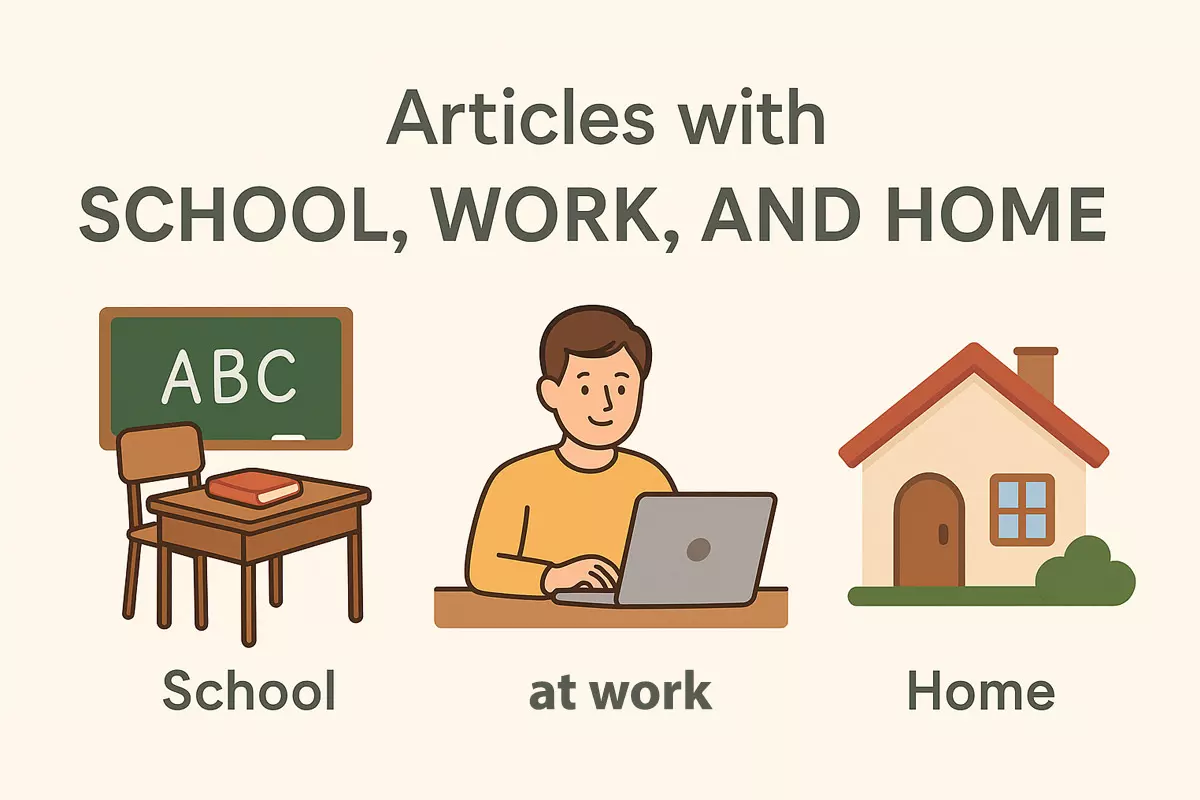 Here we rules for using or omitting articles with nouns like school, work, home, bed, prison, and hospital. It also explains meaning changes, common mistakes, and includes practice choosing between zero article and the.
Have you ever noticed that we often say we are going to work, school, or home without using the word "the," but in other situations, we include it? The choice to use or omit the article in these common expressions is not random; it reflects subtle distinctions in meaning and context. When we say we are going to school or work, we usually refer to the general activity or purpose, such as studying or working, rather than a specific building. However, if we add "the," it often points to a particular place, event, or situation.
Institution nouns without articles: go to school, be at work
In English, certain nouns representing institutions—such as “school,” “work,” “university,” “prison,” and “church”—are often used without an article when referring to their primary function or activity. This means we say “go to school” (to learn), “be at work” (to do your job), or “in prison” (serving a sentence), rather than using “the” or “a.” Using no article signals that the person is involved in the typical purpose of that place.
Common patterns with institution nouns
When you talk about routine activities or roles, omit the article. Here are some examples:
- go to school (as a student)
- be at work (as an employee)
- go to bed (to sleep)
- be in hospital (as a patient, UK English)
- go to prison (to serve a sentence)
- be at university (as a student)
- go to church (to worship)
- be in class (participating in a lesson)
- go to college (for education)
- be at sea (as a sailor)
- go home (return to your house)
- be on holiday (taking a vacation)
- go to town (visit the town center)
- be in court (as a participant, not a visitor)
- go into hospital (UK, as a patient)
- be at table (eating a meal, formal)
When do you need an article?
Articles (“the,” “a”) are used when you refer to the physical building, a specific institution, or when the person is not engaged in the usual role. For example, “I went to the school to pick up my child” (not as a student), or “She visited the hospital” (as a visitor).
Summary: Article use with institution nouns
The choice to omit the article depends on whether you mean the activity/role or the location. Here’s a structured overview:
| No Article (activity/role) | With Article (specific place/other purpose) |
|---|---|
| go to school (as a student) | go to the school (to a building, not as a student) |
| be at work (doing your job) | be at the work (rare, specific workplace) |
| in hospital (UK, as a patient) | in the hospital (as a visitor or in US English) |
| go to church (to worship) | go to the church (visit the building, not for worship) |
| go to prison (as a prisoner) | go to the prison (visit, not as an inmate) |
Remember, omitting the article is a signal that you are talking about the standard purpose or function of the institution. When your meaning shifts to a physical place or a specific instance, include an article. This pattern is a common feature in both spoken and written English.
When adding “the” changes the meaning
Using “the” before words like “school,” “work,” or “home” can shift the meaning of your sentence in important ways. Without the article, these places are usually thought of in their general or institutional sense: you go to school to study, to work to do your job, or to home to be where you live. Adding “the” often makes it clear you are talking about the specific building, location, or a particular instance—not the concept or usual activity.
General vs. Specific Meaning
When you say “go to school,” you mean attending classes as a student. But “go to the school” implies visiting the building for a reason other than regular study—like picking someone up or attending an event. The same logic applies to “work” and “home.”
- Go to school: To attend classes as a student.
- Go to the school: To visit the school building for a special reason.
- Go to work: To perform your job or duties at your workplace.
- Go to the work: Rare, but might mean a specific project site or piece of work.
- Go home: To return to your place of residence.
- Go to the home: To visit a particular home, often used for institutions (e.g., “the nursing home”).
Expanded Examples
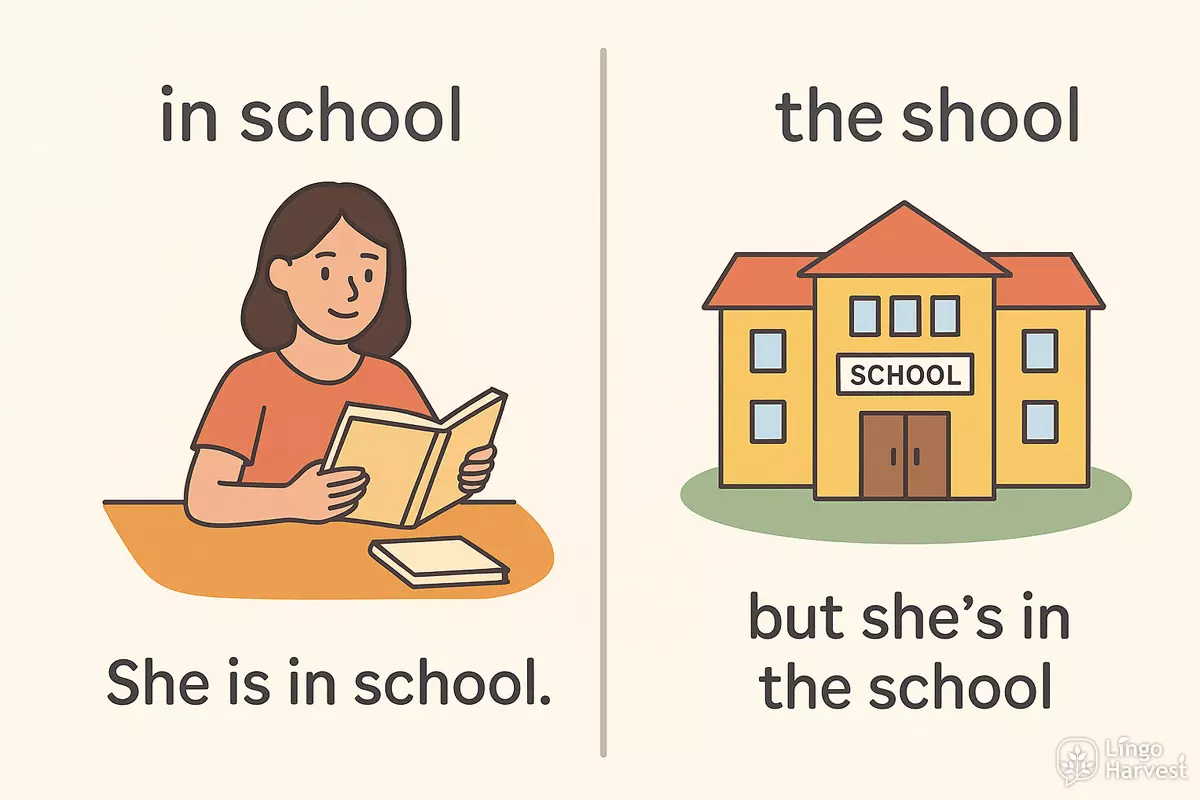
Here are more situations showing how adding “the” changes the focus:
- She is in school (she’s a student), but she’s in the school (inside the building).
- He’s at work (doing his job), but he’s at the work (at a particular work site).
- I went home (to my house), but I went to the home (to a specific institution or someone else’s house).
- Children start school at age 6, but parents visit the school for a meeting.
- She left work early (her job), but she left the work unfinished (a specific task).
- He called home (his family), but he called the home (an institution).
- We walked to school every day, but today we walked to the school to see a play.
- He’s from home (from his house), but he’s from the home (from a care facility).
- She is working from home, not from the home.
- They drove to work, but later they drove to the work site.
Summary Table: No Article vs. "The"
| Without "the" | With "the" |
|---|---|
| Go to school (attend as a student) |
Go to the school (visit the building for another reason) |
| Go to work (do your job) |
Go to the work (visit a specific work location or project) |
| Go home (return to your place of residence) |
Go to the home (visit a particular home or institution) |
| At school / At work / At home | At the school / At the work / At the home |
Understanding this subtle shift helps you communicate your meaning more clearly and naturally in English.
Patterns with home, bed, prison, hospital
When using words like "home," "bed," "prison," or "hospital," English often drops the article to focus on the purpose or typical activity associated with these places. This means that the phrase refers not to a specific location or object, but to the idea of being there for its usual function. Compare this to phrases where the article is included, which often changes the meaning to a specific place or object.
Common Usage Without Articles
You’ll hear native speakers say things like "go to bed," "be in hospital," or "come home" without "the" or "a." This is because these expressions are about the general activity—sleeping, receiving treatment, or returning to one’s residence. The same rule applies to "prison" when referring to being incarcerated.
- go to bed (to sleep)
- in bed (sleeping/resting)
- go home (return to your place of residence)
- be at home (in your place of residence)
- in hospital (receiving medical treatment, UK English)
- go to hospital (to receive care, UK English)
- in prison (serving a sentence)
- go to prison (become incarcerated)
- leave home (move out or go away from home)
- get out of bed (wake up)
- sent to prison (punished by incarceration)
- back from hospital (return after treatment)
- stay in bed (remain resting)
- return home (come back to your house)
- released from prison (freed after sentence)
When the Article Changes the Meaning
Adding "the" or "a" before these words usually points to a specific place, object, or building, not the general activity or function. Here’s how the meaning shifts:
- go to the bed (approach a particular bed, not necessarily to sleep)
- at the hospital (at a specific hospital building, possibly visiting)
- visit the prison (go to a particular prison, perhaps to see someone)
- clean the home (refers to a specific house or apartment)
Summary Table: Article Use with Common Nouns
| Phrase without article | Meaning or Function |
|---|---|
| go to bed | To sleep; the activity, not a specific bed |
| in hospital (UK) | Receiving medical care, not just visiting |
| go home | Return to your place of residence |
| in prison | Serving a sentence as a prisoner |
| go to the hospital | Go to a specific hospital building (often US English) |
| in the bed | Located on or in a particular bed (not necessarily sleeping) |
| at the home | At a specific home/building, not necessarily your own |
| at the prison | At a particular prison (possibly visiting) |
Takeaway
Dropping the article with these words is a special pattern in English, signaling the place’s typical use—sleeping, living, healing, or serving time. Using "the" or "a" usually points to a specific location or object instead. This distinction helps clarify whether you mean the general function or a particular place.
Abstract vs physical location use
Understanding when to use articles with places like “school,” “work,” and “home” depends on whether you’re talking about an activity or the literal building. If you say “go to school,” you’re highlighting the general activity of attending classes, not the physical structure. In contrast, “go to the school” refers to visiting the actual premises, perhaps for a meeting or event, rather than the purpose of studying. This distinction applies to other common nouns as well. For instance, “at work” means engaged in your job, while “at the work” (rarely used) would point to a specific site or project. Similarly, “at home” describes being in your domestic environment, not just the house itself.
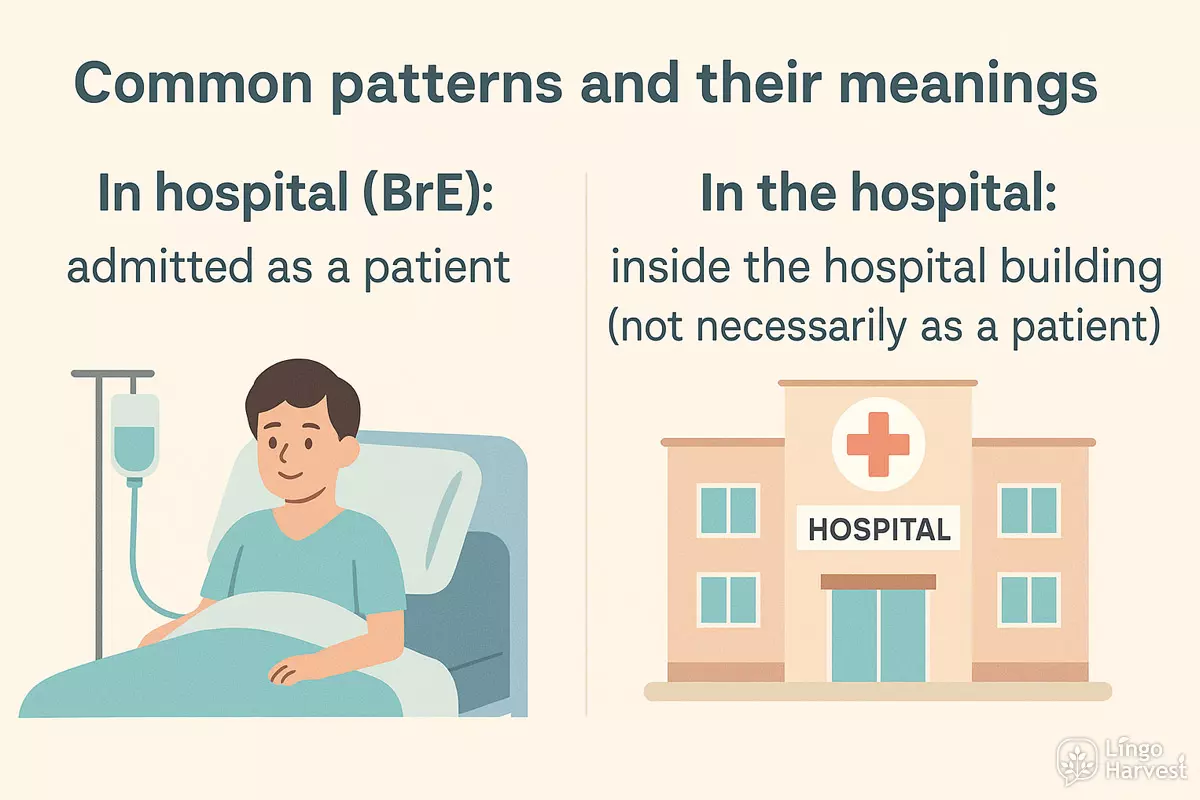
Common patterns and their meanings
- Go to school: attend classes (not the building itself)
- Go to the school: visit the school building (for a meeting, event, etc.)
- At work: engaged in employment duties
- At the work: at a specific work site (uncommon)
- Go home: return to your place of residence
- Go to the home: visit a specific house or care facility
- Go to church: attend religious service
- Go to the church: visit the church building (for a wedding, sightseeing, etc.)
- In hospital (BrE): admitted as a patient
- In the hospital: inside the hospital building (not necessarily as a patient)
- Go to bed: go to sleep
- Go to the bed: approach the bed (perhaps to make it or find something)
- In prison: serving a sentence
- In the prison: inside the prison building (visitor, worker, etc.)
- At university: enrolled as a student (BrE)
- At the university: at the physical campus (any reason)
- To class: attend a lesson
- To the class: go to a specific classroom or group
Summary of abstract vs. concrete reference
The main difference boils down to whether you are referencing an institution or activity in a general sense (no article), or a specific place or building (with “the”). This subtlety is especially important for learners, as the article changes both meaning and nuance. Using the article incorrectly can lead to confusion about whether you mean the activity or simply the location.
Frequent mistakes and how to correct them
Many English learners confuse when to use articles with words like “school,” “work,” and “home.” The confusion often comes from not knowing if these nouns are being used in a general (institutional) sense or to refer to a specific building or place. Let’s look at the most common pitfalls and practical ways to fix them.
Common errors with articles
Learners often add “the” where it’s not needed, or forget it when it’s required. Here are typical mistakes and their corrections:
- ❌ She goes to the school every day. → ✅ She goes to school every day. (general activity)
- ❌ I am at work now. (correct if you mean “working,” but see below)
- ❌ He went to the home after work. → ✅ He went home after work.
- ❌ They are in school. (correct if they are students; see below for nuance)
- ❌ She is at the work. → ✅ She is at work.
- ❌ We visited school yesterday. → ✅ We visited the school yesterday. (specific building)
- ❌ He is going to home. → ✅ He is going home.
- ❌ I like to stay at the home. → ✅ I like to stay at home.
- ❌ She is in the school now. (correct if you mean “inside the building,” not as a student)
- ❌ I go to the work by bus. → ✅ I go to work by bus.
How to fix these mistakes
Remember, use the noun without an article when talking about the general activity or institution. Add “the” only when you refer to the specific place or building. Here’s a quick reference guide:
| Phrase | When to use |
|---|---|
| go to school | When someone is a student, or referring to the activity of studying |
| go to the school | When visiting a particular school building or location |
| at work | When someone is working or present at their job in general |
| at the work | Rare, only when “work” is a specific site or project (uncommon) |
| go home | Means going to your place of residence (no article needed) |
| go to the home | When referring to a particular home, often an institution (e.g., nursing home) |
Tips to remember
- Use no article for daily activities or roles (go to school, be at work, go home).
- Use “the” when specifying a particular place or building (visit the school, at the home).
- Listen for context—are you talking about the activity, or the building?
- If you mean an institution, leave out “the.” If you mean a specific location, include “the.”
By keeping these distinctions in mind, you’ll avoid the most frequent errors and communicate more clearly in English.
Practice: choose zero article or “the” in context
Understanding when to use “the” or no article before words like “school,” “work,” and “home” is crucial for sounding natural in English. Let’s try some exercises to practice in real situations. Pay attention to whether the noun refers to the general activity or a specific place/building.
Fill in the blanks: zero article or “the”?
Choose the correct option (no article or “the”) for each blank in the sentences below.
- I go to ___ school every morning at 8 am.
- She left ___ office early because she felt sick.
- After dinner, he went home to relax.
- We visited ___ school to see the new library.
- My brother works at ___ hospital in our town.
- Children usually like ___ school holidays.
- Dad is at ___ work right now; he’ll be back at 6.
- I met her outside ___ school after classes ended.
- They invited us to ___ home for lunch on Sunday.
- Every morning, I go to ___ work by bus.
Show answers
- zero article (“I go to school every morning at 8 am.”)
- the (“She left the office early because she felt sick.”)
- zero article (“After dinner, he went home to relax.”)
- the (“We visited the school to see the new library.”)
- the (“My brother works at the hospital in our town.”)
- zero article (“Children usually like school holidays.”)
- zero article (“Dad is at work right now; he’ll be back at 6.”)
- the (“I met her outside the school after classes ended.”)
- zero article (“They invited us to home for lunch on Sunday.” — incorrect; should be “They invited us home for lunch on Sunday.”)
- zero article (“Every morning, I go to work by bus.”)
Common patterns: when do we use “the”?
- When referring to a specific building or location: “the school,” “the office,” “the hospital.”
- When talking about the general activity or purpose, use no article: “go to school,” “at work,” “at home.”
- “Home” usually takes no article when referring to your own place of living, but can take “the” when talking about someone else’s home: “We went to the Browns’ home.”
Quick reference: typical contexts
| Activity/Context | Correct Form |
|---|---|
| Attending as a student (general activity) | go to school (no article) |
| Visiting a building (not as a student) | go to the school |
| Going to your house to rest | go home (no article) |
| Arriving at your workplace | go to work (no article) |
| Visiting a workplace as a guest | go to the work (rare, only in special contexts) |
| Going to a specific hospital (not as a patient) | go to the hospital |
| Being admitted as a patient (UK English) | go to hospital (no article) |
More practice: correct or incorrect?
Mark each sentence as correct (✅) or incorrect (❌). If incorrect, think about how to fix it.
- She goes to the school every weekday to teach.
- I went to home after the party.
- We met at work yesterday.
- He’s in the hospital after his accident.
- They are going to the work tomorrow.
- She is at the school right now to pick up her son.
- I like to stay at the home on weekends.
- He went to the university to meet a professor.
- She is going to work early today.
- We visited school yesterday.
Show answers
- Correct (refers to the building; she’s a teacher)
- Incorrect → I went home after the party.
- Correct
- Correct
- Incorrect → They are going to work tomorrow.
- Correct (specific school building)
- Incorrect → I like to stay at home on weekends.
- Correct (specific university building)
- Correct
- Incorrect → We visited the school yesterday. (specific building)
Practicing these distinctions will help you use “school,” “work,” and “home” naturally in conversation and writing. If unsure, think about whether you mean the general activity or a particular place.