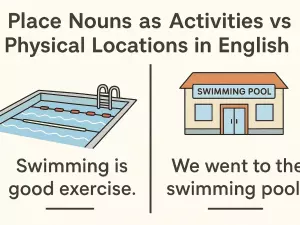
Institutional Nouns with Zero Article Like School and Prison

 This article explains what institutional nouns are in English, how their meaning changes with or without the, and the difference between activity and building meanings. It also covers typical learner mistakes and provides practice with article usage.
- What institutional nouns are in English grammar
- Difference between activity meaning and building meaning
- Zero article with school, prison, hospital, and church
- Using the when referring to specific locations
- Meaning changes caused by article choice
- Common learner mistakes with institutional nouns
- Practice: choose correct article forms in context
Have you ever wondered why we say at university or in hospital without using a word like the beforehand? This pattern in English occurs because, when referring to certain institutions, the article is dropped to indicate a general activity or function rather than a specific place. For example, saying someone is in hospital emphasizes that they are there for treatment, not just visiting. Similarly, at university highlights the activity of studying rather than the physical location. These subtle differences reflect how English communicates context and purpose through article usage.
What institutional nouns are in English grammar
Certain nouns in English represent places or institutions associated with a specific function or activity. These are known as institutional nouns. What sets them apart is that they often refer not just to the physical building, but to the activity or purpose tied to that place. For instance, "school" can mean the building, but more often it means the process of education or attendance rather than the bricks and mortar.
Defining characteristics
Institutional nouns typically describe locations where a group of people regularly gathers for a particular reason—education, punishment, worship, or treatment, for example. When talking about the intended institutional function, English frequently omits the definite or indefinite article ("the" or "a/an") before these words. This is called the zero article usage, and it signals that the noun is being used in a general or abstract sense.
Common institutional nouns
Here are some of the most frequent examples of these nouns in English, especially when used without an article:
- school → The children go to school every morning.
- university → She is studying economics at university.
- college → He hopes to go to college next year.
- hospital → She stayed in hospital for two days.
- prison → He was sent to prison for the crime.
- jail → The suspect spent the night in jail.
- court → The case will be decided in court.
- church → They go to church on Sundays.
- bed → I went to bed early last night.
- work → She is already at work.
- sea → The sailors were lost at sea.
- town → He went to town to buy groceries.
- home → We stayed at home all day.
- camp → The children are away at camp.
- parliament → The bill was debated in parliament.
- market → She buys fresh fruit at market.
- class → The students are in class right now.
- university → Many graduates look for jobs after university.
- college → She met her best friend in college.
- university → He returned to university after a break.
When are articles omitted?

The zero article is used when referring to the general function or purpose of the institution, not the physical place. For example:
- She’s in prison (serving time, not just visiting the building).
- He goes to school every day (as a student, not visiting the building for another reason).
- She’s in hospital (as a patient, in British English).
- They go to church on Sundays (to worship, not to look at the architecture).
Why does this matter?
Learning how institutional nouns work helps you sound more natural and precise in English. It helps distinguish between talking about the function of a place versus the physical location. For example, “He is at school” (he’s a student) versus “He is at the school” (he could be a visitor, parent, or worker).
Difference between activity meaning and building meaning
Institutional nouns such as school, prison, church, and hospital can refer either to a type of activity (what people do there) or to the physical place (the building itself). This distinction is crucial for understanding why these nouns often appear without an article in English: the absence of an article typically signals the activity or institutional use, while including an article usually points to the building as a physical location.
Activity meaning: Focus on purpose
When you use these nouns without an article, you usually refer to their primary function or the activity associated with them. For example, saying "go to school" means to attend classes as a student, not merely to visit the school building. This usage emphasizes the role or institution, not the structure.
- She is in hospital (as a patient, receiving treatment).
- He went to church (to attend a service).
- The children are at school (learning, not just present in the building).
- He was sent to prison (as punishment, not just visiting).
Building meaning: Focus on the place itself
When you use an article (a, the) with these nouns, you refer to the physical structure, regardless of its function at the moment. This could mean visiting, working, or simply being present in the building, not necessarily participating in its main institutional activity.
- She visited the hospital (to see someone, not as a patient).
- They painted the church (the building, not attending a service).
- We met at the school (the location, not for studying).
- He works at a prison (as a guard, not as an inmate).
Quick comparison
| Without Article (Activity) | With Article (Building) |
|---|---|
| go to school (as a student) | go to the school (visit the building) |
| in hospital (as a patient) | in the hospital (inside the building for any reason) |
| at church (attending service) | at the church (at the building, e.g., for a concert) |
| sent to prison (as a punishment) | at the prison (location, e.g., as a visitor or staff) |
| in bed (sleeping/resting) | on the bed (physically on top, not sleeping) |
| at university (studying) | at the university (at the campus for any reason) |
Common institutional nouns with activity meaning
- office → She stayed late at the office to finish the report.
- factory → He works at factory during the night shift.
- courtroom → The lawyer spent the whole day in courtroom.
- chapel → They gathered in chapel for the ceremony.
- campus → Students live on campus during the semester.
- barracks → The soldiers returned to barracks after training.
- clinic → She went to clinic for a routine checkup.
- laboratory → Researchers stayed in laboratory all night.
- field → The team trained in field before the match.
- headquarters → The decision was made at headquarters.
- site → Engineers are working on site this week.
- port → The crew remained in port due to bad weather.
Understanding this difference helps you use articles correctly and sound more natural in English. It also explains why native speakers say, "He is in hospital" (in the UK) or "She goes to school," omitting the article when focusing on the activity or institutional role.
Zero article with school, prison, hospital, and church
When talking about certain institutions—like school, prison, hospital, and church—English often drops the article "the" when referring to their general function or purpose. This usage can be confusing for learners because the presence or absence of the article changes the meaning of a sentence.
General vs. Specific Reference
No article is used when we mean the activity or purpose associated with the institution, not the building itself. For example, "She goes to school" means she attends as a student, not that she is visiting the building for another reason. The definite article "the" is required when referring to a specific building or a particular visit for a non-standard reason.
- He is in prison → He is serving a sentence as a prisoner.
- She is in hospital (UK) / She is in the hospital (US) → She is there as a patient.
- They go to church → They attend religious services.
- Children are at school → They are there to study.
- He went to prison → He was incarcerated.
- She is at hospital (UK) → She is admitted as a patient.
- They are at church → They are attending a service.
- He is at school → He is present as a pupil or teacher.
- He went to the prison → He visited as a guest, worker, etc.
- She visited the hospital → She went there as a visitor, not a patient.
- They cleaned the church → They are talking about the building.
- She painted the school → She worked on the building, not attending as a student.
Summary Table: Article Use with Institutional Nouns
| Phrase | Meaning | Article Used? |
|---|---|---|
| go to school | Attend as a student | No |
| go to the school | Visit the building for another reason | Yes |
| be in prison | Serve a sentence | No |
| be in the prison | Be at the location as a visitor/staff | Yes |
| be in hospital (UK) | Admitted as a patient | No |
| be in the hospital (US/UK) | At the building for any reason | Yes |
| go to church | Attend a religious service | No |
| go to the church | Visit the building (not for worship) | Yes |
Key Patterns to Remember
- Zero article = typical function (student, patient, prisoner, worshipper).
- Definite article = specific building or non-typical purpose.
- British English often omits "the" with "hospital"; American English usually includes it.
- Other institutions (university, college, bed, class, court) can follow similar patterns.
Understanding this distinction helps clarify meaning and avoids common mistakes in English usage.
Using the when referring to specific locations
When we talk about institutional nouns like "school," "prison," or "hospital," the use of the definite article the depends on whether we mean the institution in general (its function) or a particular place or building. Adding the signals that you are thinking about a specific location or a particular building, not the usual activity associated with it.
General function vs. specific place

If you say, "She is in school," you mean she attends as a student. But "She is in the school" means she is inside the school building, perhaps after hours or not as a student. The same applies to other institutional nouns.
- "He went to prison." → He was sent there as a prisoner.
- "He went to the prison." → He visited the building, perhaps to see someone.
- "My grandmother is in hospital." → She is there as a patient.
- "My grandmother is in the hospital." → She is physically inside the hospital, regardless of her role.
- "The children are at school." → They are there to study.
- "The parents are at the school." → They are at the building, maybe for a meeting.
- "He is in church." → He is attending a service or religious activity.
- "He is in the church." → He is inside the church building, possibly as a tourist.
- "She goes to university." → She is a student there.
- "She went to the university." → She visited the university building for another reason.
- "They are in court." → They are part of legal proceedings.
- "They are in the court." → They are inside the courtroom building.
- "He stays in bed." → He is lying down, resting.
- "He put his shoes under the bed." → Refers to a particular piece of furniture.
Structured examples: article use and meaning
| Without the | With the |
|---|---|
| She is in prison. (She is a prisoner.) |
She is in the prison. (She is inside the building, not necessarily as a prisoner.) |
| He is at school. (He is a student or teacher.) |
He is at the school. (He is at the location, not necessarily as a student or teacher.) |
| She is in hospital. (She is a patient.) |
She is in the hospital. (She is inside the building for any reason.) |
| They are in church. (They are attending a service.) |
They are in the church. (They are physically inside the church building.) |
Takeaway
Choosing whether to use the with institutional nouns changes the focus from the activity or role (zero article) to the physical location or building (with the). This distinction helps speakers be precise when describing situations involving schools, hospitals, prisons, and similar places.
Meaning changes caused by article choice
Choosing whether or not to use an article with institutional nouns like school, prison, hospital, and church can significantly affect the message. Using the zero article (no article) often signals that the noun is being referred to for its intended institutional purpose, while adding the or a typically shifts the focus to the building itself or to a specific instance.
Zero article: institutional function
When there is no article, the noun refers to the general activity or purpose associated with the institution, not the physical place. For example, at school means someone is there to study or teach, while in prison means someone is serving a sentence.
- go to school → attend classes as a student
- be in prison → serving a sentence as a prisoner
- at hospital (BrE) → admitted as a patient or staff
- in church → participating in a religious service
- go to bed → go to sleep, not just enter the bed
- at university → enrolled or working in higher education
- in class → attending a lesson
- in court → involved in legal proceedings
- at sea → working or traveling as a sailor
- in hospital (BrE) → being treated as a patient
Definite and indefinite articles: physical place or specific case
Adding the or a before these nouns changes their meaning. Now, the phrase refers to the actual building or a specific institution, or sometimes to a particular occasion.
| Zero Article (Institutional Use) | With Article (Physical/Specific Use) |
|---|---|
| He is in prison (serving time as an inmate) | He visited the prison (the building, maybe as a tourist or guard) |
| She goes to school (as a student) | She painted the school (the building) |
| They are in hospital (receiving treatment) | They walked past the hospital (the building) |
| He is in church (attending a service) | He cleaned the church (the structure) |
| She is at university (studying/working) | She visited a university (one among many) |
| The sailor is at sea (sailing) | They saw the sea (the body of water) |
Key points to remember
- Zero article often focuses on the activity or role within the institution.
- Adding an article shifts the reference to the building or a specific, identified place.
- This distinction can change the meaning of a sentence entirely.
- Some nouns (like hospital) follow this pattern mainly in British English.
- Context and intent determine which form to use.
Common learner mistakes with institutional nouns
Learners often struggle with when to use the zero article before institutional nouns like school, prison, hospital, and church. The confusion usually arises from translating directly from their native languages or misunderstanding the function of these words in English sentences. Here are some of the most frequent pitfalls and misconceptions.
Using an article when none is needed
One of the most widespread errors is adding the or a when the noun refers to the institution’s general purpose. For example, learners may say “He is in the school” instead of the correct “He is in school” when referring to someone as a student. This mistake often occurs with these common institutions:
- work → She is at work until six.
- home → He stayed home because he was sick.
- camp → The children are at camp all week.
- market → She goes to market every morning.
- parliament → The law was discussed in parliament.
- courtroom → The witness was already in courtroom.
- office → He is rarely in office on Fridays.
- campus → Most students live on campus.
- training → The athletes are in training this month.
- rehab → He spent six weeks in rehab.
Confusing specific places with general functions
Another frequent issue is not recognizing the difference between being at a place for its main purpose versus simply being at the location. For instance, “She is in hospital” (as a patient) versus “She is in the hospital” (visiting or as a staff member). This distinction can be subtle but is important for natural English.
| Incorrect usage | Correct usage | Meaning |
|---|---|---|
| He is in the school. | He is in school. | He is a student attending classes. |
| She is in the hospital. | She is in hospital. | She is a patient receiving treatment. |
| They are at the prison. | They are in prison. | They are prisoners serving a sentence. |
| My son goes to the church every Sunday. | My son goes to church every Sunday. | He attends religious services. |
| She is in the bed. | She is in bed. | She is sleeping or resting. |
| He is at the university. | He is at university. | He is a student. |
Unnecessary articles with routine activities
A common slip is inserting an article before institutional nouns when talking about habitual actions or roles. For example, “after the school” instead of “after school” or “go to the bed” instead of “go to bed”. These should be article-free when describing the typical activities associated with the institution.
- after school ✅
- go to bed ✅
- at university ✅
- in prison ✅
- at sea ✅
Mixing up British and American usage
Note that some differences exist between British and American English. For example, “in hospital” (without an article) is common in British English, while American English prefers “in the hospital.”
In summary, remembering when to use the zero article with institutional nouns helps learners sound more natural and avoid common errors. The pattern is to omit the article when the noun refers to its typical function for the person involved.
Practice: choose correct article forms in context
Understanding when to use or omit articles with institutional nouns like school, prison, hospital, and similar words is essential for natural English. Context determines if these nouns take a zero article (no article) or require the or a/an. Below, you'll find a mixture of gap-fill exercises and a comparison list to test your grasp of these patterns in realistic sentences.
Fill in the Blanks
Choose the correct option for each gap: no article, the, or a/an.
- After the accident, she was taken to ___ hospital for treatment.
- My nephew goes to ___ school near his house.
- The mayor visited ___ prison to speak with the inmates.
- Tom was sent to ___ prison for theft.
- We stopped by ___ school to pick up some paperwork.
- She hopes to go to ___ university in London next year.
- His father is at ___ hospital as a patient.
- The teachers met in ___ school office after classes ended.
- My friend works at ___ university as a professor.
- They visited ___ church every Sunday.
- Many people go to ___ church to pray, but not everyone is religious.
- He goes to ___ bed at 10 pm every night.
- We arrived at ___ airport two hours early.
- She has been in ___ prison for ten years.
- He was sent to ___ hospital after fainting at work.
Show answers
- the
- - (no article)
- the
- - (no article)
- the
- - (no article)
- the
- the
- a
- - (no article)
- the
- - (no article)
- the
- - (no article)
- the
Usage Patterns: Article or Zero Article?
Here is a summary of when to use or omit articles with institutional nouns in different contexts:
- Zero article: when referring to the general purpose or function of the institution. Example: "She is at school." (as a student)
- The: when referring to a specific institution or building, or when the context is particular. Example: "He went to the school to meet the headmaster."
- A/an: when introducing a non-specific or new institution/building. Example: "We visited a school during our trip."
Mini-Quiz: Correct or Incorrect?
Decide if the article usage is correct (✅) or incorrect (❌):
- She is in the bed.
- He was sent to prison for five years.
- We go to the church every Sunday.
- I met him at school.
- The children are in class right now.
- She stayed in the hospital after the accident.
- He is still at work.
- They returned home late.
- The sailors were lost at sea.
- He went to court to testify.
Show answers
- Incorrect (should be: She is in bed.)
- Correct
- Correct (when referring to the building; if for worship, omit "the")
- Correct
- Correct
- Incorrect (should be: She stayed in hospital.)
- Correct
- Correct
- Correct
- Correct
Practicing with real-life situations helps you internalize these patterns. Notice how meaning and context influence article choice with institutional nouns.