Place Nouns as Activities vs Physical Locations in English

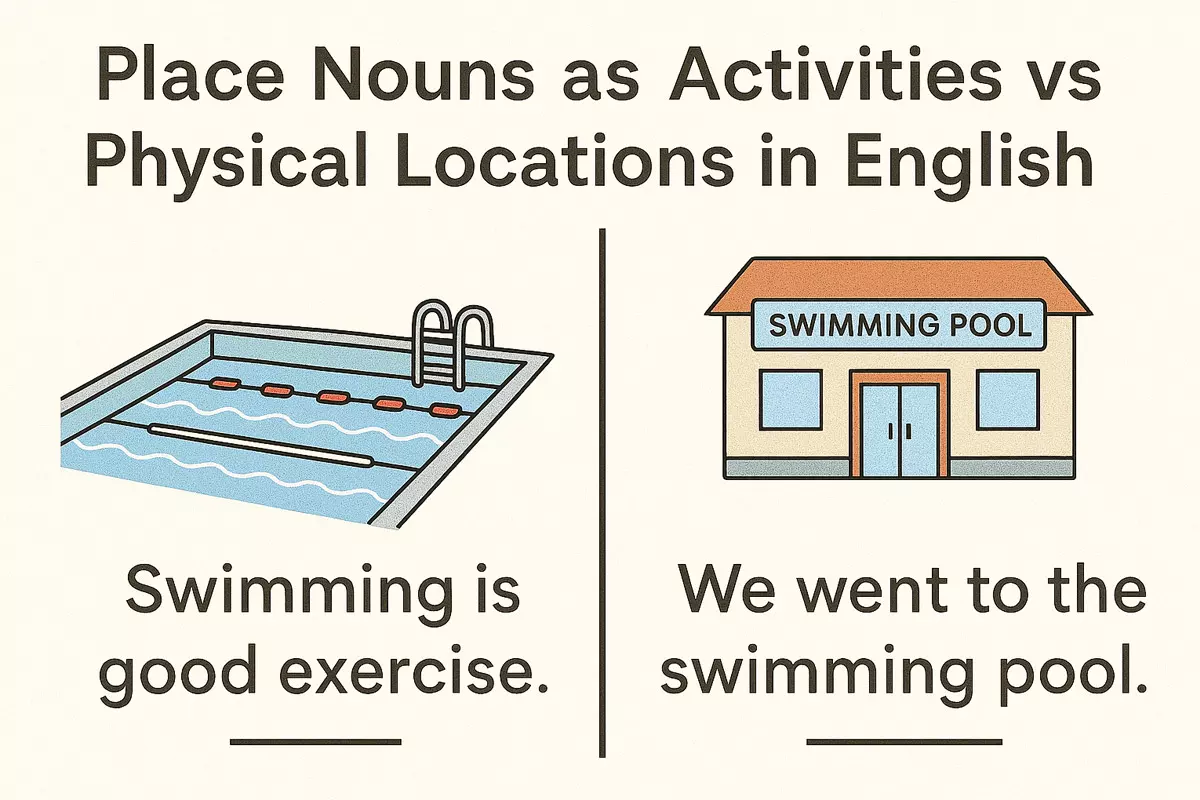 Here we how English place nouns such as school or office indicate either activities or locations, explains article use and meaning shifts, addresses common learner confusion, and provides practice distinguishing activity and location meanings in sentences.
- How place nouns can express activity or location
- Difference between going to work and going to the office
- Place nouns with zero article vs definite article
- Meaning shifts caused by article choice
- Common activity-based place nouns in English
- Typical learner confusion with place reference
- Practice: choose activity or location meanings in sentences
Have you ever wondered why we say someone is at school but in a restaurant? In English, the choice of prepositions with place names often depends on whether we are talking about the function or the physical location. When we say someone is at school, we usually mean they are engaged in the activity of learning, not just present in the building. On the other hand, in a restaurant refers more to the physical space where dining happens. These subtle differences add nuance to everyday conversation and can sometimes be confusing for learners.
How place nouns can express activity or location
In English, many nouns that refer to places can be used to describe either a physical spot or the activity commonly associated with it. This dual function often depends on context, verb choice, or even prepositions. For example, "school" can mean the building itself or the act of attending lessons. This flexibility allows speakers to communicate more efficiently, often leaving the meaning to be inferred from surrounding words.
Physical Space vs. Ongoing Action
When a place noun indicates a physical location, it usually refers to a concrete setting. However, in informal and idiomatic English, the same noun can represent an activity or event that typically happens there. For instance, "gym" might mean the actual fitness center, or simply the act of exercising ("I'm going to gym" = "I'm going to work out").
- School: The building, or the process of attending classes ("School starts at 8 a.m.").
- Church: The physical church, or the act of attending a religious service ("I'm at church" = attending the service).
- Prison: The facility, or being incarcerated ("He went to prison" = he was imprisoned).
- Hospital: The institution, or receiving medical care ("She's in hospital" in British English).
- Work: The workplace, or the act of working ("He's at work" = he's working).
- Bed: The furniture, or the act of sleeping ("He went to bed" = he went to sleep).
- University: The campus, or studying there ("She is at university" = she is a student).
- Camp: Campsite, or the activity of camping ("The kids are at camp" = participating in camp activities).
- Home: The house, or being at one's residence ("I'm home" = I am present at my house).
- Table: The piece of furniture, or the activity of eating ("Come to the table" = time to eat).
- Market: The location, or the act of shopping ("She went to market" = she went shopping).
- Court: The sports area, or playing a sport ("He is on court" = playing tennis, basketball, etc.).
- Stage: The theatre platform, or performing ("She's on stage" = performing).
- Field: The open area, or playing a sport ("On the field" = playing).
- Farm: The land, or working as a farmer ("He is on the farm" = working there).
- Bar: The establishment, or socializing/drinking ("They are at the bar" = drinking/socializing).
- Bank: The building, or doing financial transactions ("She is at the bank" = handling banking).
- Office: The workspace, or working ("He is in the office" = working).
- Store: The retail space, or shopping ("She is at the store" = buying something).
- Park: The green space, or relaxing/playing ("The kids are at the park" = playing outside).
Comparing Activity and Location Usage
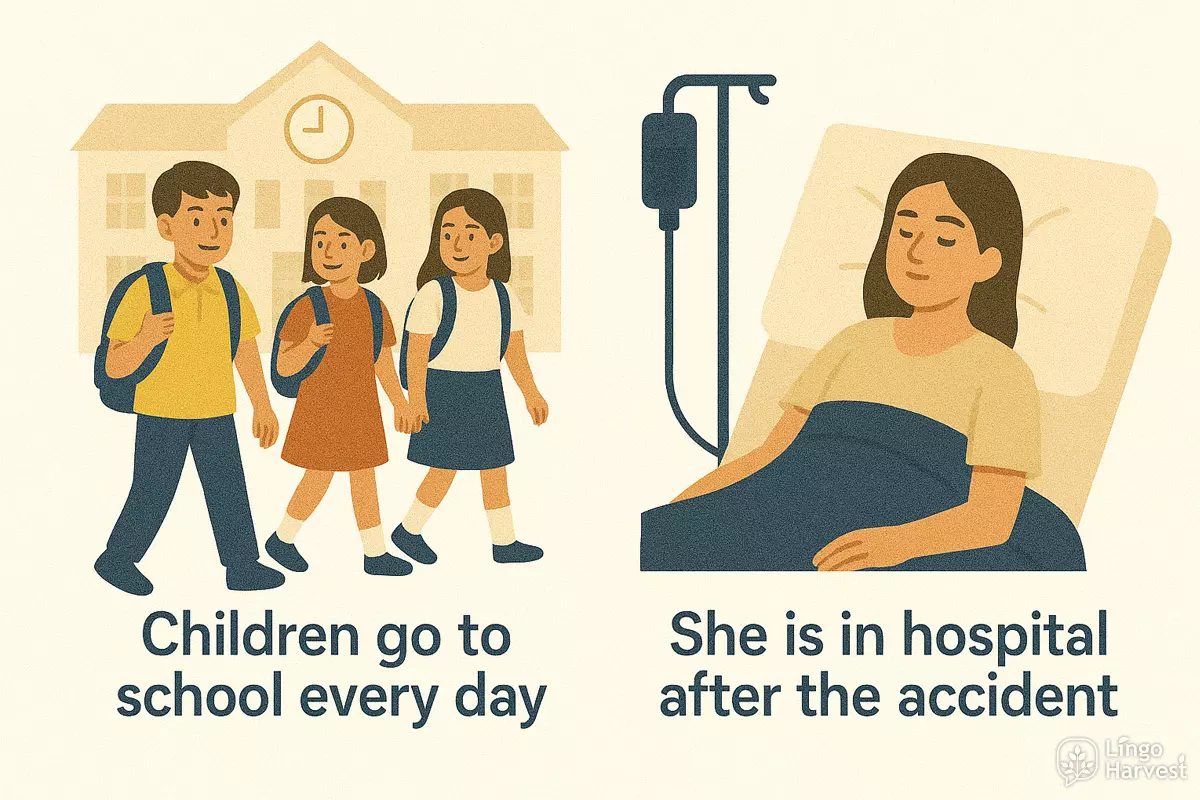
Some place nouns can shift meaning depending on the presence or absence of articles and prepositions. The table below illustrates how context changes interpretation for several common examples:
| Place Noun | Physical Location Example | Activity/Function Example |
|---|---|---|
| School | The school is across the street. | Children go to school every day. |
| Hospital | A new hospital opened downtown. | She is in hospital after the accident. (BrE) |
| Prison | The prison has high walls. | He went to prison for theft. |
| Bed | The bed is comfortable. | I’m going to bed now. |
| Church | The church was built in 1880. | They are at church every Sunday. |
| Work | His work is near the station. | She is at work until five. |
| Home | The home was renovated. | I’ll be home by six. |
| Table | The table is made of oak. | Come to table, dinner is ready. |
Quick Practice: Identify the Meaning
For each sentence below, decide if the place noun refers to a physical location or an activity/role:
- She is in hospital after surgery.
- The market is very busy on Saturdays.
- They went to bed early last night.
- The school was built last year.
- I’ll see you at work tomorrow.
- He is still in prison for the crime.
- The children are at school now.
- She stayed in bed all day with a fever.
- The meeting will be held at the office.
- He returned home late in the evening.
Show answers
- Activity (receiving medical care)
- Physical location (the marketplace itself)
- Activity (sleeping/going to sleep)
- Physical location (the building)
- Activity (doing one’s job)
- Activity/state (being imprisoned)
- Activity (studying/attending classes)
- Activity/state (resting due to illness)
- Physical location (specific workplace building)
- Physical location (one’s home)
Difference between going to work and going to the office
In English, certain place nouns can refer to both physical locations and the activities associated with them. This is especially clear when comparing expressions like "going to work" and "going to the office." While both phrases might seem interchangeable, they actually highlight subtle distinctions in meaning and usage.
Activity vs. Physical Location
"Going to work" usually emphasizes the activity of working, regardless of where it takes place. It can mean starting your job for the day, whether from home, a café, or a traditional workplace. In contrast, "going to the office" focuses on the physical destination—a specific building or location where office work is done. This phrase doesn't necessarily imply you will be working; you could be attending a meeting, picking up files, or even visiting for a social reason.
- Going to work: Refers to beginning one’s job or daily duties, wherever that may be.
- Going to the office: Specifies traveling to an office building or workplace, regardless of the activity.
Examples of Usage
- "I’m going to work early today." (May mean starting work from home or anywhere else.)
- "She’s not going to the office this week." (She isn't physically visiting her office building.)
- "After the pandemic, many people stopped going to the office but continued going to work."
- "He goes to work at 9 AM every day." (Could be remote or on-site.)
- "I left my keys at the office." (Clearly refers to the building, not the activity.)
- "Are you working from home or going to the office today?"
- "She went to work even though she was feeling sick." (Focus on the action.)
- "Let’s meet at the office at noon." (A specific place.)
- "He likes going to work because he enjoys his job." (Emphasizes the activity.)
- "There’s a package waiting for you at the office."
Summary Table
| Phrase | What it typically means |
|---|---|
| Going to work | Starting job duties or the act of working, location can vary |
| Going to the office | Physically traveling to the office building, regardless of activity |
| At work | Engaged in job activities (could be anywhere) |
| At the office | Located inside the office building |
Understanding these nuances helps learners use English place nouns more naturally, distinguishing when the focus is on the activity and when it’s on the physical space.
Place nouns with zero article vs definite article
Understanding when to use "the" with place names in English depends on whether you’re talking about a location as a general activity or as a specific physical site. This distinction can change the meaning of sentences and is especially important with nouns such as "school," "hospital," "prison," and "church." When we talk about the usual purpose or function of a place, we often use it without any article—this is known as the "zero article." In contrast, the definite article "the" signals that we’re referring to a particular building or site, not just the activity typically associated with that place.
Zero article: Places as activities
Use the noun alone when describing the usual function or activity connected to the place. Here are some common examples:
- go to school (attend classes as a student)
- be in hospital (receive medical treatment)
- go to bed (sleep)
- be at university (study as a student)
- go to church (participate in religious service)
- be in prison (serve a sentence as a prisoner)
- go to college (study as a student)
- be at sea (work as a sailor)
- go to class (attend lessons)
- be in town (be within the town, not a specific location)
Notice that in these cases, the focus is on the activity, not on the specific building.
Definite article: Specific locations
When referring to a particular building or site, or when someone is there for a reason other than its main function, "the" is used:
- go to the school (visit the school as a guest, parent, or for an event)
- be in the hospital (visit someone, work there, or refer to a specific hospital building)
- go to the bed (approach a particular bed, maybe to make it or move something)
- be at the university (visit the campus, not necessarily as a student)
- go to the church (visit the building for a non-religious purpose)
- be in the prison (visit or work at the prison)
- go to the college (refer to a specific college building or institution)
- be at the sea (stand on the shore or refer to a specific sea)
- go to the class (attend a particular class or classroom)
- be in the town (refer to a specific town, perhaps contrasted with another)
Here, "the" shifts the meaning to the physical place rather than the associated action or role.
Summary comparison
| Zero Article (Activity) | Definite Article (Physical Place) |
|---|---|
| She’s at school. (She’s a student attending classes.) |
She’s at the school. (She’s visiting the school building.) |
| He’s in hospital. (He’s a patient receiving treatment.) |
He’s in the hospital. (He’s inside the hospital building, not necessarily as a patient.) |
| They’re in prison. (They’re serving a sentence.) |
They’re in the prison. (They’re in the prison building; could be a visitor or staff.) |
| We go to church on Sundays. (Attend services.) |
We went to the church for the concert. (Visited the building for an event.) |
Key takeaways
- Use zero article for places when the focus is on their general function or activity.
- Use "the" when referring to a specific, physical location or building, or when the reason for being there is not the place’s usual function.
- Context often determines which form is appropriate; always consider the intended meaning.
Meaning shifts caused by article choice
Choosing between definite, indefinite, or zero article with place nouns in English can change whether we interpret the word as an activity or a physical location. This subtle shift is especially important for learners, as it often alters the entire meaning of a sentence.
How articles influence interpretation
When a place noun is used without an article, it usually refers to the activity or function associated with that place. Adding "the" tends to make it specific, pointing to a particular building or site. Using "a/an" often treats the place as one among many, not as an institution or generalized activity.

- I’m in hospital. → I am admitted as a patient, participating in the activity of receiving medical care.
- I’m in the hospital. → I am inside a specific hospital building (could be as a visitor, worker, or patient).
- She goes to school every day. → She attends classes, performing the activity of learning.
- She goes to the school every day. → She visits a particular school building (perhaps for work, meetings, or other reasons).
- He is at church. → He is attending a religious service or event.
- He is at the church. → He is present at a specific church building, perhaps for a wedding, sightseeing, etc.
- They are in prison. → They are incarcerated, serving a sentence.
- They are in the prison. → They are inside a particular prison building (could be as staff, visitors, or prisoners).
- She is at university. → She is studying as a student.
- She is at the university. → She is at a specific university location (could be for a conference, work, or study).
- He went to bed. → He went to sleep.
- He went to the bed. → He approached a particular bed (possibly not to sleep, maybe to look for something).
- She is in class. → She is participating in a lesson or class activity.
- She is in the class. → She is present in a specific classroom or group of students.
- He’s in court. → He is attending a legal proceeding (as a participant).
- He’s in the court. → He is physically inside the court building or area.
- They are at sea. → They are traveling or working on the ocean.
- They are at the sea. → They are at the seaside, near the ocean (possibly on land).
- She is on campus. → She is present within the university grounds, as a member of the community.
- She is on the campus. → She is on a specific campus site (perhaps not as a student).
Summary of patterns
The absence of an article often signals the noun’s institutional or functional meaning, while a definite article points to a concrete, particular place. Indefinite articles are less common with these nouns, but when used, they emphasize one among many similar places.
| Phrase | Activity/Function Meaning | Physical Location Meaning |
|---|---|---|
| in hospital / in the hospital | Receiving medical care as a patient | Inside a specific hospital building |
| at school / at the school | Engaged in learning as a student | Present at a certain school building |
| in prison / in the prison | Serving a sentence as an inmate | Inside a particular prison facility |
| at church / at the church | Participating in worship or religious event | At a specific church building |
| in class / in the class | Taking part in a lesson | Located in a particular classroom |
| at university / at the university | Studying as a university student | On the grounds of a specific university |
| at sea / at the sea | Traveling or working on the ocean | Located by the seaside |
| to bed / to the bed | Going to sleep | Approaching a particular bed |
| in court / in the court | Attending a legal proceeding | In a specific court building |
| on campus / on the campus | Within university as a member | On a particular campus site |
Understanding these article-driven meaning changes is key to accurate and natural English usage, especially when talking about places and the activities associated with them.
Common activity-based place nouns in English
Many English nouns that refer to places actually describe activities or roles associated with those places, rather than just their physical location. These terms are often used to talk about where an action happens, what people do there, or the function of the place, rather than simply its geography. Understanding these “activity-based” nouns can help learners interpret and use English more naturally.
Typical examples of activity-based place nouns
- School – not just a building, but the act of attending classes or the experience of education (“The kids are at school” can mean attending lessons, not merely being in the building).
- Work – often refers to the activity of working, not just the office or workplace itself (“I’m at work” means engaged in job duties).
- Church – implies the religious service or community activity, not just the physical church building (“She is at church” means attending a service).
- Hospital – refers to receiving medical care, not just being inside the building (“He’s in hospital” in British English means admitted as a patient).
- Bed – often used for the activity of sleeping or resting (“She’s in bed” means she’s sleeping or resting, not just physically on a bed).
- Prison – implies serving a sentence, not simply being at the location (“He’s in prison” means incarcerated).
- Class – refers to taking part in a lesson, not just being in a classroom (“She’s in class” means she’s studying right now).
- Practice – for sports, music, or other skills, referring to the training session itself (“He’s at practice” means he’s attending a training session).
- Gym – can refer to exercising, not necessarily the building (“I’m at the gym” means I’m working out).
- Court – when talking about law, it refers to judicial proceedings (“He’s in court” means involved in a legal case).
- Market – can mean shopping, not just being physically at the marketplace (“She’s at the market” can mean she’s buying groceries).
- University – often covers the activity of higher education, not only the campus (“She’s at university” means enrolled as a student).
- Bar – can imply socializing or drinking, not just being present in a bar (“He’s at the bar” often means he’s having drinks).
- Table – sometimes used for the activity of eating or meeting (“They’re at table” in older or formal English means eating a meal).
- Home – includes the idea of being with family or relaxing (“She’s at home” means she’s where she lives, not out elsewhere).
Comparing activity-based and physical location meanings
| Place Noun | Activity-based Meaning | Physical Location Meaning |
|---|---|---|
| School | Attending classes, learning | The school building |
| Work | Doing one’s job | The office/factory/etc. |
| Hospital | Receiving medical care | The hospital building |
| Prison | Serving a sentence | The prison facility |
| Church | Participating in religious service | The church building |
| Gym | Exercising | Gymnasium building |
| Home | Being with family/relaxing | Physical residence |
| Class | Studying/taking a lesson | Classroom space |
Quick practice: Identify the meaning
For each sentence, decide if the underlined place noun is used for an activity or just the physical location.
- Maria is at work until 6 p.m.
- We met outside the school after the game.
- My brother is in hospital recovering from surgery.
- The church on Main Street is very old.
- She goes to the gym three times a week.
- He stayed in bed all morning.
- The children are at school right now.
- We waited at the station for an hour.
- She is still in prison for that crime.
- They had dinner at home yesterday.
Show answers
- Activity
- Physical location
- Activity
- Physical location
- Activity
- Activity
- Activity
- Physical location
- Activity
- Activity
Recognizing when a place noun refers to an activity helps with both understanding and producing natural-sounding English. This awareness is useful for interpreting context, especially in spoken language and informal writing.
Typical learner confusion with place reference
Understanding how English place nouns are used can be tricky, especially when the same word may refer to both a physical location and the activities associated with it. Learners often get puzzled when deciding whether to use a preposition (like "at" or "in") or to drop it, depending on whether the focus is on the location itself or what happens there. This confusion can lead to sentences that sound odd or unnatural to native speakers.
Common mix-ups between activity and location meanings
English frequently allows certain place nouns (such as "school," "church," or "prison") to refer either to the building or to the purpose/activities inside. Mistakes often happen when learners:
- Use a preposition when none is needed: “She is at hospital” instead of “She is in hospital” (when referring to being a patient, not just visiting).
- Forget to use a preposition where it’s required: “He went school” instead of “He went to school” (for the physical act of going to the building).
- Confuse the meaning: “They are in prison” (inmates) vs “They are at the prison” (visitors, staff).
Examples of place nouns with dual meanings
Some nouns commonly used for both places and activities include:
- school → Children start school at the age of six.
- college → She plans to go to college next year.
- university → He is studying economics at university.
- prison → The man was sent to prison for five years.
- hospital → She stayed in hospital after the accident.
- church → They go to church every Sunday.
- court → The case will be decided in court.
- bed → I went to bed early last night.
- work → He is still at work.
- class → The students are in class now.
- home → She arrived home very late.
- sea → The fishermen went to sea at dawn.
- town → We moved to town last year.
- camp → The children stayed at camp all summer.
- market → I bought fruit at the market.
- office → She left her keys in the office.
- schoolyard → The kids were playing in the schoolyard.
- bank → I need to go to the bank today.
- airport → We arrived at the airport two hours early.
Comparing usage: activity vs. location
Many errors stem from not distinguishing between when a noun is used for the general activity (no article, sometimes no preposition) and when it means a specific physical place (usually with an article or preposition). Here’s a structured overview:
| Noun | Activity Meaning (No article, "at/in" sometimes dropped) |
Physical Location (Article/preposition used) |
|---|---|---|
| school | She is at school. (student, learning) | She is at the school. (near or inside the building) |
| hospital | He is in hospital. (admitted as a patient) | He is in the hospital. (anyone inside the building) |
| church | They are at church. (attending service) | They are at the church. (location, not necessarily for worship) |
| prison | She is in prison. (serving a sentence) | She is at the prison. (visitor, staff, or general location) |
| bed | He is in bed. (resting/sleeping) | He is on the bed. (on top of the furniture) |
Why these distinctions matter
Getting these subtle differences right helps learners sound more natural and avoids misunderstandings. For example, “in hospital” (as a patient) and “in the hospital” (inside the building for any reason) can mean very different things in English. Paying attention to whether the reference is about the activity/purpose or the physical space is key to mastering these place nouns.
Practice: choose activity or location meanings in sentences
Understanding whether a noun like "school", "church", or "prison" refers to an activity or a physical place is important for accurate interpretation in English. In this section, you'll analyze sentences to decide if the highlighted word means a specific action or simply the location itself. This helps you become more comfortable with subtle English usage.
Task 1: Decide if the word refers to an activity or a place
Read each sentence and determine if the underlined noun is being used to mean an activity (what people do there) or just the physical location. Make your choices and check your understanding below.
- After his injury, John could not go to school for a month.
- The tourists visited the old church on Main Street.
- Anna goes to gym every morning before work.
- The mayor visited the prison to meet with the warden.
- We met at the bank to discuss the loan application.
- On Sundays, many families go to church together.
- He spent five years in prison for his crimes.
- She left her bag at school.
- They went to the hospital to see the new building.
- After the accident, he was taken to hospital.
Show answers
- 1. Activity
- 2. Location
- 3. Activity
- 4. Location
- 5. Location
- 6. Activity
- 7. Activity
- 8. Location
- 9. Location
- 10. Activity
Comparing Usage: Activity vs. Location
See how meaning changes with these examples:
| Sentence | Meaning |
|---|---|
| She is in hospital. | She is receiving medical care (activity, not just visiting the building). |
| She is at the hospital. | She is at the physical location (could be visiting, working, etc.). |
| He goes to school every day. | He attends lessons (activity). |
| He is at the school for a meeting. | He is at the location (not necessarily for lessons). |
Task 2: Identify the pattern
What do you notice about the use of articles ("the", no article) in these examples? Write your thoughts, then check below.
Show answers
Usually, no article is used when the noun means an activity ("go to school", "in hospital"), while "the" is used for the location ("at the school").
By practicing with real sentences and examples, you will become more confident in understanding and using these place nouns correctly in English.