Articles with Musical Instruments: play the piano, play guitar

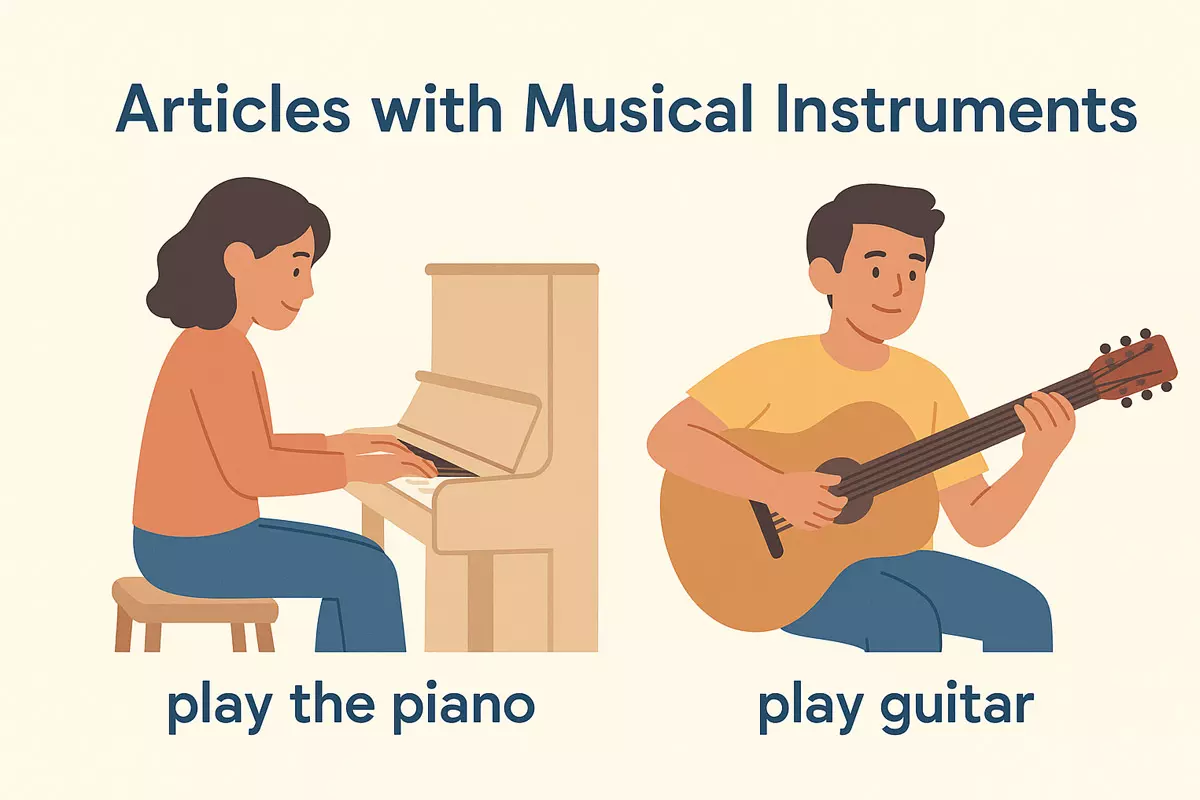 Here we when to use the with musical instruments, such as play the piano, and notes exceptions like play guitar in some dialects. It also discusses owning instruments, countable forms, style differences, and offers practice sentences.
- General rule: play the piano, the violin, the drums
- Zero article in some dialects: play guitar
- Talking about owning and describing instruments
- When instruments behave like normal countable nouns
- Style and register differences in article choice
- Practice: write sentences using instruments with correct articles
Have you ever wondered why we say someone plays the violin but simply play drums or guitar? The use of articles with musical instruments can be confusing, yet these subtle choices reveal interesting patterns in English. For many instruments, like the violin or the piano, we use the definite article "the" when talking about playing them, while with others such as drums or guitar, we often drop the article altogether. These differences are not always based on strict rules but rather on conventions that have developed over time, making English both fascinating and sometimes puzzling to learners.
General rule: play the piano, the violin, the drums
When talking about playing most musical instruments in English, we usually use the definite article “the” before the instrument’s name. This applies to both classical and many modern instruments. For example, native speakers say “play the piano,” “play the violin,” or “play the drums.” This pattern holds whether you’re discussing skill, practice, or performance.
Why do we use “the” with instruments?
English treats most musical instruments as a general category when speaking about the ability or act of playing them. The article “the” signals that we mean the instrument in general, not one specific object. So, if you say “She plays the flute,” it doesn’t matter which flute; it’s about the skill or habit.
Common instruments that follow the rule
- the piano
- the violin
- the drums
- the trumpet
- the saxophone
- the cello
- the guitar (though see below for exceptions)
- the bass
- the clarinet
- the organ
- the accordion
- the oboe
- the harp
- the tuba
- the recorder
Typical sentence structures
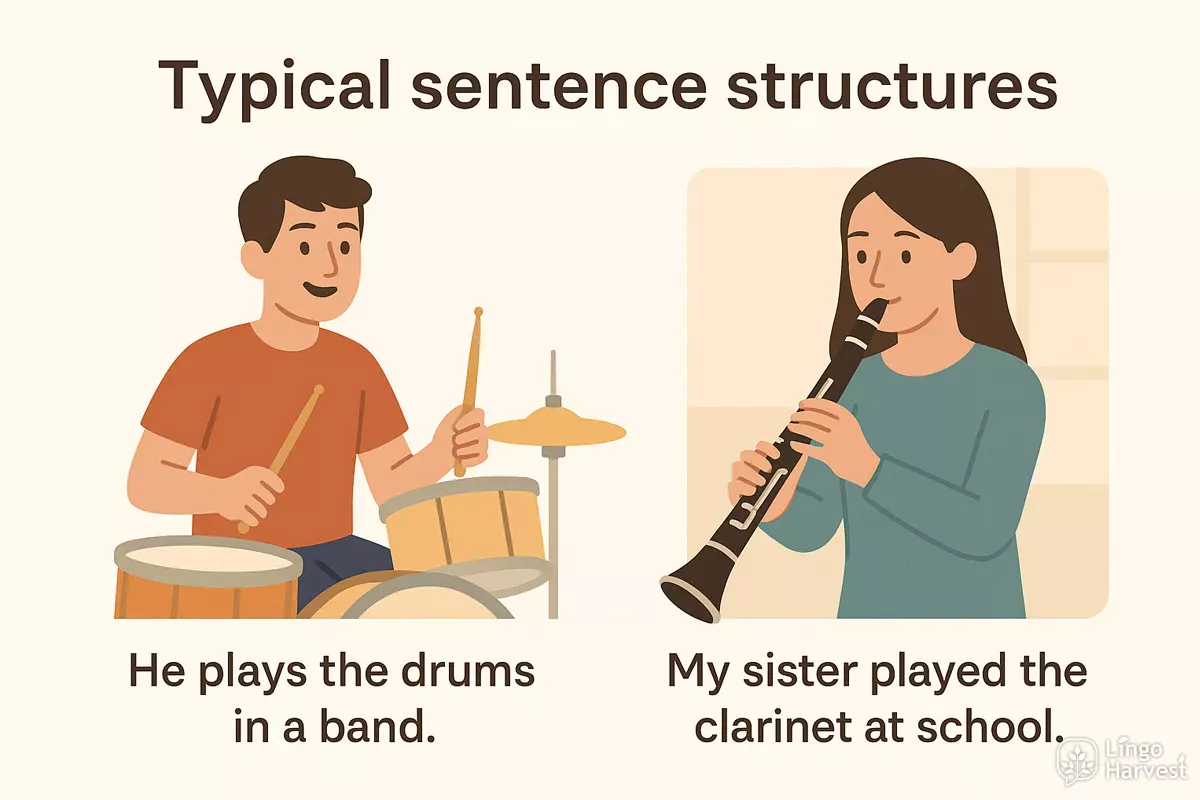
You’ll often find these phrases in statements about ability, hobbies, or professions. Some common patterns include:
- I can play the piano.
- He plays the drums in a band.
- They are learning to play the violin.
- My sister played the clarinet at school.
- Do you play the saxophone?
Notes and exceptions
While “play the” is standard for most instruments, some exceptions exist, especially in informal or American English, where people might say “play guitar” or “play drums” without the article. However, the form with “the” is always correct and more formal, especially in writing or classroom contexts.
Summary of the article rule
- Use “the” with most musical instruments: “play the flute,” “play the violin.”
- No “the” with sports: “play football,” “play chess.”
- Some instruments (especially “guitar” and “drums”) can drop the article in informal speech.
- Never use “a” or “an” before an instrument in this context.
By following this article pattern, your English will sound more natural and accurate when discussing musical talents or interests.
Zero article in some dialects: play guitar
In some varieties of English, especially American English, speakers often omit the definite article when talking about playing musical instruments. For example, instead of saying “play the guitar,” you might hear “play guitar.” This is particularly common in informal speech and writing, and often reflects regional or stylistic preferences.
Where and how is the zero article used?
The omission of the article is most typical with certain instruments and in specific contexts. It tends to appear in phrases describing regular activities, skills, or professions, rather than one-time actions. For example, “She can play piano” suggests general ability, while “She played the piano at the concert” specifies a particular event.
Examples of zero article with instruments
- play guitar
- play drums
- play piano
- play bass
- play trumpet
- play saxophone
- play violin
- play cello
- play flute
- play clarinet
- play harmonica
- play synth
- play organ
- play banjo
- play mandolin
- play accordion
- play ukulele
- play oboe
Comparing usage: article vs. zero article
The choice between using the article or not can depend on dialect, formality, and context. Here’s how the two options compare:
| With "the" | Without article |
|---|---|
| He plays the guitar very well. | He plays guitar in a band. |
| She learned to play the piano as a child. | She can play piano and sing. |
| I heard him on the drums last night. | He’s been playing drums for years. |
| They teach the violin at school. | She wants to learn violin. |
Key points to remember
- Dropping the article is more common in North American English, especially in casual contexts.
- British English generally prefers the article: “play the guitar.”
- Both forms are widely understood, but your choice can signal dialect or register.
- Zero article is rarely used with instruments like “the piano” in very formal writing.
- The meaning often stays the same, but the style shifts subtly.
Talking about owning and describing instruments
When discussing musical instruments in English, the way we talk about possession and description often differs from how we talk about playing them. While “play the piano” uses the definite article, describing what you own or how an instrument looks follows different patterns.
Expressing Ownership
To say you have a musical instrument, use verbs like have, own, or possess. The article you use changes based on whether you mean a specific instrument or instruments in general:
- I have a guitar. (one guitar, not specific)
- She owns a violin. (one, not previously mentioned)
- They have two keyboards. (plural, no article needed)
- Do you have an accordion?
- He owns a clarinet. (one clarinet, general)
- We have a piano at home. (one instrument, first mention)
- She possesses a rare flute. (a specific type)
- They have three electric guitars. (plural)
For more specific references, use a possessive or other determiners:
- My cello is very old.
- His trumpet is silver.
- Their drum set is new.
- Her piano needs tuning.
- Our guitar teacher recommended a new model.
- His saxophone is from the 1960s.
- Their violin case is heavy.
- My keyboard has weighted keys.
Describing Instruments
When describing instruments, adjectives and descriptive phrases come before or after the instrument’s name:
- It’s a beautiful piano.
- She bought an electric guitar.
- This is a handmade violin.
- He plays a vintage saxophone.
- That’s a large drum.
- We have a small flute.
- Her clarinet is black and silver.
- Their harp is very elegant.
- I want a digital keyboard.
- He has a classic acoustic guitar.
Examples of Ownership and Description Patterns
Here are some common ways to combine ownership and description when talking about musical instruments:
- I have an old piano at home.
- She owns a red electric guitar.
- We bought a new drum set last year.
- My friend has a rare synthesizer.
- He keeps his acoustic guitar in the living room.
- Their saxophone is very expensive.
- Do you have a wooden flute?
- Her cello is Italian-made.
- They own several classical instruments.
- This is the violin I told you about.
When instruments behave like normal countable nouns
Musical instrument names aren’t always used in the same way in English. While phrases like play the piano or play the guitar are set expressions, there are many situations where instrument names act like any other countable noun. This usually happens when we’re talking about individual items, types, or quantities, rather than the general idea of playing music.
Talking about specific instruments or types
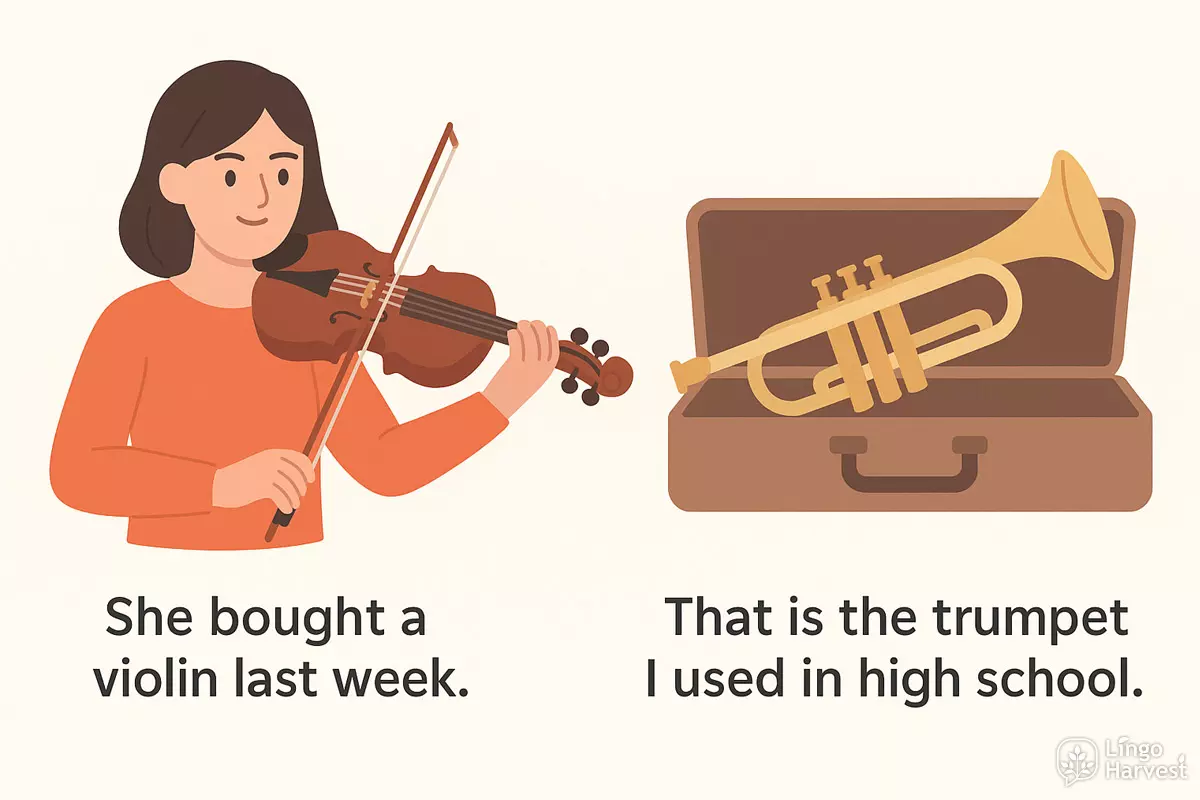
If you mean a particular instrument, a brand, or a physical object, you treat the noun as countable. In these cases, you use a, an, or the just like you do with other objects. For example:
- She bought a violin last week.
- Do you have a drum kit at home?
- He lent me his guitar for the concert.
- That is the trumpet I used in high school.
- There are two pianos in the music room.
- I found an old accordion in the attic.
- They own three saxophones.
- This is my flute.
- We need a new keyboard for the band.
- She collects rare clarinets.
- He lost his harmonica on the bus.
- Can you pass me the ukulele?
Comparing specific and general usage
Notice the difference in meaning between referring to the activity versus the physical object. The table below shows how the article and structure change depending on the context:
| General Activity | Specific Object |
|---|---|
| She can play the piano. | She bought a piano yesterday. |
| He plays guitar in a band. | He owns three guitars. |
| Do you play the drums? | We need a new drum for the set. |
| I enjoy playing violin. | That is my violin on the table. |
Key points to remember
- Use a/an or the when you mean a particular instrument, not the activity.
- Instrument names become plural when you talk about more than one (e.g., two guitars).
- Possessive forms (my clarinet, her keyboard) are common when referring to ownership.
- No article is used when talking about the activity in a general sense (e.g., She plays piano in some varieties of English).
Understanding when to use instruments as countable nouns helps you describe real objects, talk about collections, or compare different models, rather than just the skill or activity of playing.
Style and register differences in article choice
When talking about musical instruments, the choice between using an article or leaving it out often depends on the social context, the level of formality, and even regional preferences. In everyday English, especially in British varieties, people typically say "play the piano" or "play the guitar," using the definite article. However, in more informal or American English, it's common to hear "play piano" or "play guitar" without any article.
Formal vs Informal Usage
In formal or academic writing, the definite article is almost always included ("She studied the violin at university"). In contrast, spoken language, especially among musicians or in casual conversation, frequently omits the article ("He can play drums"). This difference can signal both the register and the speaker's background or community.
Regional Variation
The use of articles with instruments varies by region. British English favors the definite article, while American English is more flexible, especially in informal speech. For example:
- British: "She plays the flute beautifully."
- American (informal): "She plays flute in a jazz band."
Examples Across Registers
Here are some common phrases showing how article usage shifts with style and context:
- play the piano
- play piano
- play the guitar
- play guitar
- play the drums
- play drums
- play the trumpet
- play trumpet
- play the saxophone
- play saxophone
- play the violin
- play violin
- play the cello
- play cello
- play the clarinet
- play clarinet
- play the harmonica
- play harmonica
Contextual Nuances
When discussing a specific instrument owned or referenced earlier, the article may shift to "a" or be omitted for effect. For instance, "He picked up a guitar and started to play," versus the more general "He can play guitar."
Summary of Patterns
- Use the definite article ("the") for general ability or formal contexts.
- Omit the article in informal speech, especially in American English.
- Use "a" or "an" when referring to an unspecified, individual instrument.
Understanding these distinctions helps speakers sound more natural and appropriately match the formality of the situation.
Practice: write sentences using instruments with correct articles
When talking about playing musical instruments in English, article usage is important. Generally, we use the before most instrument names (e.g., "play the piano"), but some instruments, especially in American English, can appear without an article ("play guitar"). Let's practice forming sentences using the right article for each instrument.
Examples of Correct Usage
- She can play the violin very well.
- Do you know how to play the drums?
- I want to learn to play guitar.
- He played the trumpet in the school band.
- My sister plays piano every evening.
- They are learning to play the saxophone.
- Can you play the flute?
- We enjoy playing the harmonica together.
- He dreams of playing bass in a rock band.
- Anna plays the cello beautifully.
- Do you play the accordion?
- She loves to play keyboard at parties.
- He is learning to play the clarinet.
- She played the harp at the concert.
Practice Task: Choose the Correct Article
Fill in the blanks with the or leave it blank if no article is needed.
- He wants to play ___ piano.
- Do you play ___ guitar?
- She learned to play ___ drums as a child.
- We enjoy playing ___ saxophone together.
- My brother can play ___ bass.
- They play ___ violin every weekend.
- Can you play ___ keyboard?
- She loves playing ___ flute.
- He started learning ___ trumpet last year.
- Do they play ___ cello in the orchestra?
- She practices ___ harp every morning.
- We bought ___ ukulele during our trip.
- He wants to try playing ___ harmonica.
- My sister plays ___ accordion very well.
- They both learned to play ___ electric guitar.
Show answers
- the
- guitar (no article or "the")
- the
- the
- bass (no article or "the")
- the
- keyboard (no article or "the")
- the
- the
- the
- the
- a ukulele
- the harmonica / a harmonica (both possible depending on context)
- the accordion
- the electric guitar
Common Patterns: Article Use with Musical Instruments
Here are some typical sentence patterns to help you remember:
- play the + instrument (e.g., play the piano, play the violin)
- play + instrument (no article; often with guitar, bass, piano in American English)
- learn to play the + instrument
- Can you play the + instrument?
- She is playing the + instrument.
Pay attention to regional differences and context. In more formal or British English, "the" is standard with most instruments. In informal or American English, "guitar," "piano," "bass," and "keyboard" may drop the article.