Articles with Instruments: Play the Piano, Play the Guitar

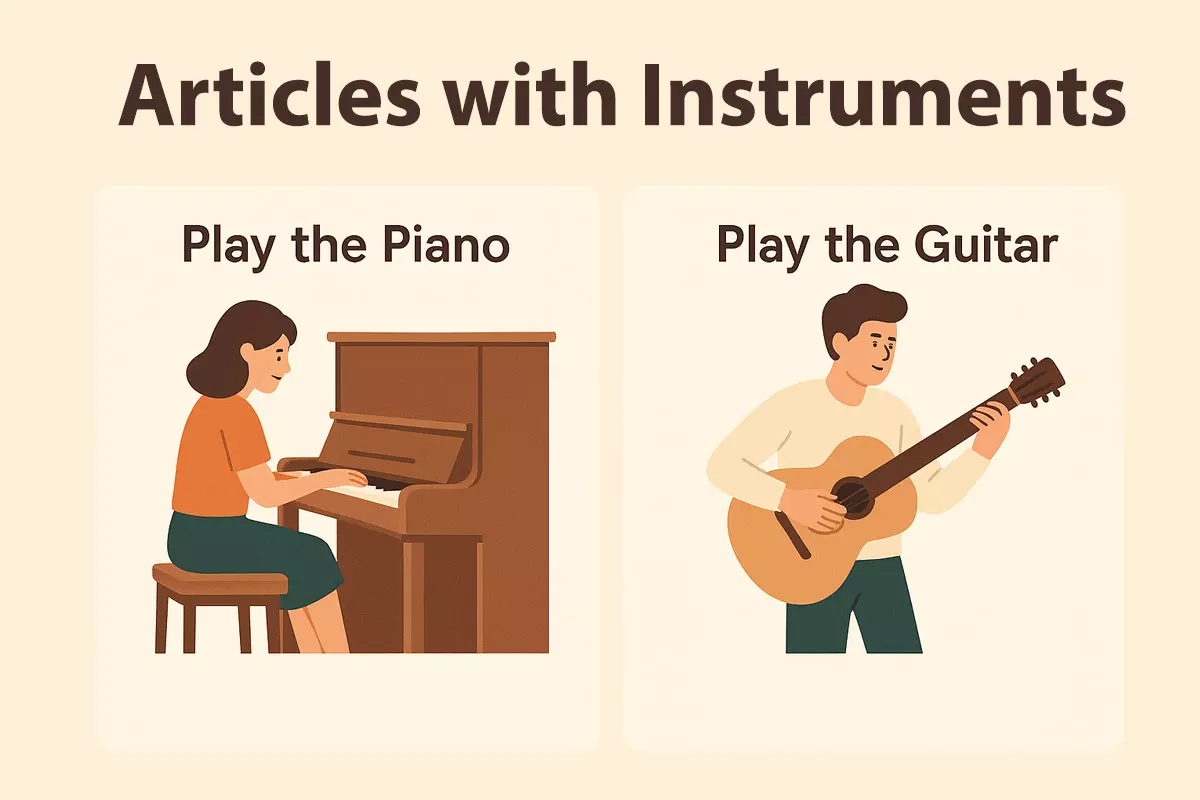 The article explains when to use the with musical instruments, highlights expressions like play the piano, shows when to omit the in general statements, covers formal writing exceptions, and provides practice choosing the correct form.
Talking about musical instruments in English can be confusing, especially when it comes to using articles like "the" or no article at all. For example, we often say "play the piano" but "play guitar," and the rules can seem inconsistent. Generally, British English uses "the" with most instruments, such as "play the violin" or "play the drums," while American English sometimes omits "the" with certain instruments, like "play guitar." Understanding these patterns will help you sound more natural when discussing musical instruments in English.
When to Use the Before Instruments
English learners often wonder why we say "play the piano" but not "play piano." In most cases, the definite article "the" is used before the names of musical instruments when talking about playing them in a general sense. This pattern applies to almost all classical and modern instruments. For example, you would say, "She plays the violin," or "He learned to play the drums." The article signals that you are referring to the instrument as a general concept rather than a specific, individual item.
General Guidelines for Using "the" with Musical Instruments
- Use "the" when referring to the instrument in a general context (e.g., "He plays the guitar").
- Omit "the" when speaking about music genres or lessons in American English (e.g., "She plays guitar" is also correct, especially in the US).
- Usually, "the" is used with instruments in British English, while American English allows both forms.
- Do not use "the" when referring to a plural or indefinite group (e.g., "Guitars are popular").
- When specifying a particular instrument, use "my," "his," "her," etc. (e.g., "She played her violin").
Examples of Correct Article Usage with Instruments

- He can play the piano. ✅
- She is learning the trumpet. ✅
- Do you know how to play the cello? ✅
- They both play the clarinet. ✅
- We listened to him play the flute. ✅
- My sister plays the accordion. ✅
- He wants to master the saxophone. ✅
- She plays the drums in a band. ✅
- He never learned to play the organ. ✅
- She enjoys playing the harp. ✅
- He plays guitar. ❌ (British English; acceptable in American English)
- I can play piano. ❌ (British English; acceptable in American English)
Comparing Article Usage: British vs American English
| British English | American English |
|---|---|
| She plays the piano. | She plays the piano or piano. |
| He’s learning the guitar. | He’s learning the guitar or guitar. |
| I can’t play the drums. | I can’t play the drums or drums. |
| We listened to the violin. | We listened to the violin or violin. |
To sum up, the definite article "the" is standard before instrument names in general statements, especially in British English. However, American English increasingly accepts dropping the article in informal contexts. Always consider regional conventions and context to choose the correct form.
Expressions with Play + the + Instrument
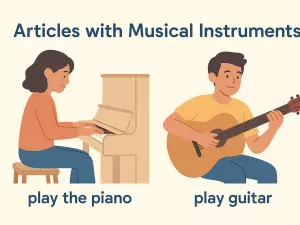
When talking about musical instruments in English, it’s standard to use “play” together with “the” and the name of the instrument. This structure is almost always used, regardless of whether you mean a specific instrument or just the ability or activity in general. For example, you would say “play the piano” or “play the guitar,” not “play piano” or “play guitar” in most contexts.
Common Patterns and Examples
The definite article “the” is part of the usual English pattern for musical instruments. Here are some typical ways these expressions appear:
- She can play the violin.
- Do you know how to play the drums?
- He’s learning to play the flute.
- We enjoy playing the saxophone together.
- My brother wants to play the trumpet.
- They play the cello in the orchestra.
- Can you play the harp?
- She used to play the clarinet at school.
- I love to play the bass guitar.
- He’ll play the accordion at the festival.
- She wishes she could play the oboe.
- They both play the electric guitar.
- He wants to play the banjo for fun.
- Do you play the harmonica?
- She learned to play the mandolin last year.
- He can play the tuba very well.
- We tried to play the recorder in class.
- She hopes to play the viola someday.
- He enjoys playing the double bass.
- They often play the organ at church.
Comparing Instrument and Sport Expressions
It’s important to note that this use of “the” is specific to musical instruments. For sports, English speakers typically use “play” directly with the sport’s name, without any article.
| Musical Instruments | Sports |
|---|---|
| play the piano | play football |
| play the guitar | play tennis |
| play the drums | play basketball |
| play the violin | play hockey |
This contrast helps learners remember that “the” is needed with musical instruments, but not with most sports.
When Not to Use “the”
There are rare cases—often in American English or in informal speech—where you might see “play piano” (without “the”), but the standard, especially in British English and in formal situations, is to include “the.” If you want to sound natural and correct, always use “the” with musical instruments. Remembering this pattern will make your English sound much more fluent and natural when you talk about music and instruments.
No Article in General Statements
When making broad or general statements about musical instruments, English often omits the definite or indefinite article. In these cases, the instrument is treated as a category or concept, rather than a specific, tangible object. This approach is common when discussing abilities, preferences, or universal truths related to playing instruments.
General Patterns Without Articles
Here are some typical situations where instruments appear without any article:
- As part of school subjects or curricula (e.g., "Children study violin at school.")
- When talking about skill or profession (e.g., "She plays guitar professionally.")
- In headlines or short notes (e.g., "Learn piano in 30 days!")
- In lists or overviews (e.g., "He teaches flute, cello, and drums.")
- When referring to music genres (e.g., "Jazz bands often use trumpet.")
- In instructions or manuals (e.g., "Hold saxophone upright.")
- With verbs like "like," "love," "hate" (e.g., "Many people love violin.")
- Describing general abilities (e.g., "I can play guitar and piano.")
- With "by" to describe method (e.g., "He accompanied the song by piano.")
- In research or theory (e.g., "Study focused on clarinet and oboe.")
Examples: Statements Without Articles
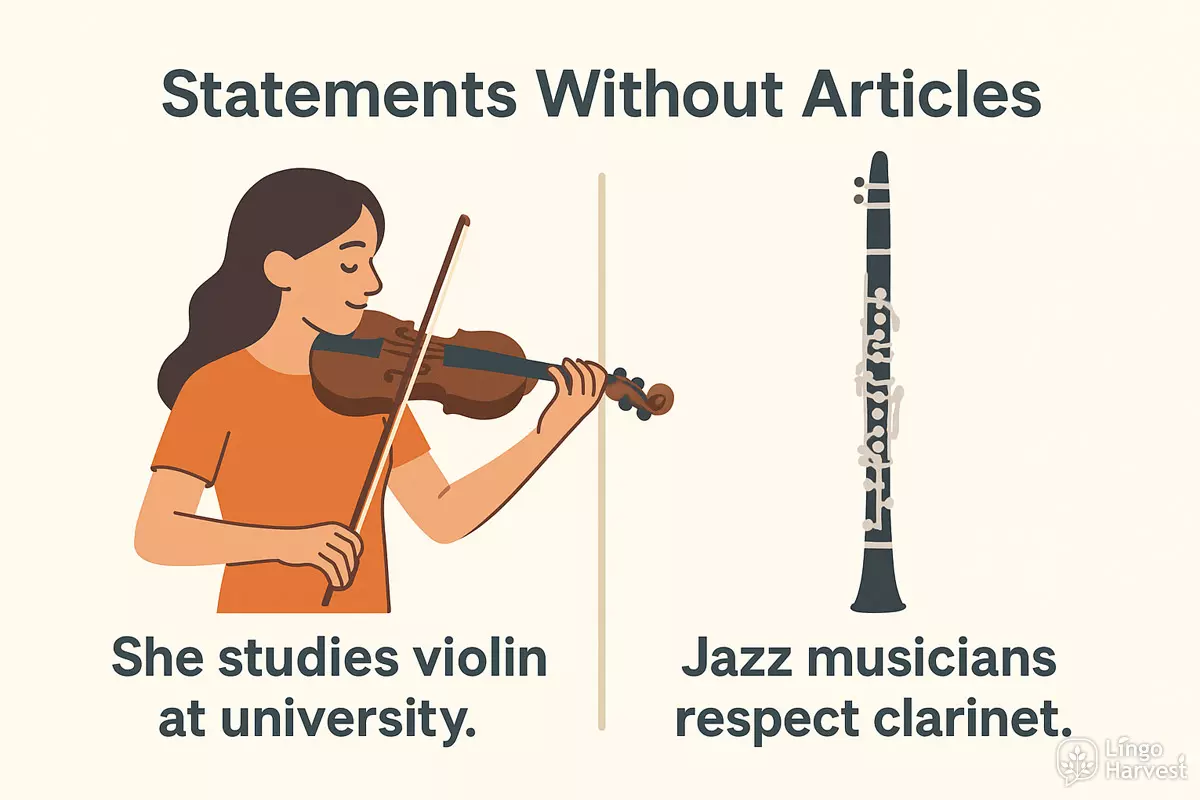
Notice how the following sentences avoid "the" or "a/an" because they refer to instruments in a general sense:
- She studies violin at university.
- Many children learn piano early.
- He can play drums and guitar.
- Bands often feature trumpet and saxophone.
- Jazz musicians respect clarinet.
- We teach flute to beginners.
- They practice cello daily.
- Some students prefer oboe.
- Music therapy uses harp and percussion.
- Orchestra includes violin, viola, cello, and bass.
Comparing Uses: Article vs. No Article
The presence or absence of an article changes the meaning. With an article, you refer to a specific instrument or a traditional way of playing. Without one, you speak in generalities. Here’s how this works:
| With Article | Without Article |
|---|---|
| She plays the piano. (Traditional phrasing, or referring to the instrument in general) |
She studies piano. (Referring to the subject or skill) |
| He bought a guitar. (A specific object) |
He can play guitar. (General ability) |
| They cleaned the drums. (Specific set of drums) |
They practice drums. (General activity) |
| I tuned the violin. (A particular violin) |
I love violin. (Expressing a preference for the instrument in general) |
In summary, omitting articles with instrument names is standard in English whenever you’re talking about general concepts, abilities, or fields of study. This pattern is especially noticeable in educational, professional, and instructional contexts.
Exceptions in Formal Writing
While “play the piano” and “play the guitar” are standard in everyday English, more formal contexts sometimes use different patterns. Academic writing, official documents, or older literature might avoid the definite article, especially when referring to musical ability in general rather than a specific occasion.
Omitting the Article
Writers occasionally drop the article before instrument names, especially in formal or technical prose. This tends to occur in headlines, academic texts, or when stating general skills:
- She can play piano professionally.
- He learned to play violin at a young age.
- Applicants must play trumpet or saxophone.
- Children study flute in primary school.
This structure is less common in spoken English but appears in formal or international contexts, influenced by languages that do not use articles the same way as English.
Comparing Formal and Informal Usage
The difference between conversational and formal patterns can be seen in how articles are used. Here is a comparison between typical spoken English and more formal or academic styles:
| Typical/Informal | Formal/Academic |
|---|---|
| She plays the piano. | She plays piano. |
| He plays the guitar beautifully. | He plays guitar beautifully. |
| Do you play the violin? | Do you play violin? |
| They play the drums in a band. | They play drums in a band. |
| He is learning the flute. | He is learning flute. |
Special Cases and Regional Variations
Certain contexts, such as newspaper headlines, resumes, or international English, favor dropping the article. Additionally, some academic or music examination boards use this structure in syllabi and official descriptions. While less common in British and American everyday speech, it’s worth being aware of these patterns in more structured or global communication.
Summary of When to Omit the Article
- In formal writing and academic contexts
- In headlines or bullet-point lists
- On resumes or CVs describing skills
- In international English influenced by other languages
- In official documents or syllabi
Recognizing these exceptions helps you adapt your language for different audiences and purposes.
Practice: Choose the Correct Form
Understanding when to use articles with musical instruments is essential for clear communication. Below are exercises to help you master the correct usage in different contexts. Read each sentence and select the appropriate article ("the," "a," or no article) for each instrument mentioned.
Fill in the Blank
- She can play ___ piano.
- Do you know how to play ___ guitar?
- He bought ___ violin yesterday.
- My sister wants to learn ___ drums.
- We listened to someone play ___ harp at the concert.
- Would you like to try ___ flute?
- They have ___ trumpet at home.
- Can you play ___ saxophone?
- He dreams of playing ___ cello in an orchestra.
- She enjoys listening to ___ clarinet.
Show answers
- the
- the
- a
- the
- the
- the
- a
- the
- the
- the
Choose the Correct Option
Select the best word to complete each sentence.
- He wants to play the / a piano.
- They bought the / a guitar for their son.
- She practices the / a flute every day.
- I can play the / a drums, but not well.
Show answers
- the
- a
- the
- the
Common Patterns: Article Use with Instruments
Notice the difference in these typical phrases involving instruments and articles:
- play the piano
- play the guitar
- buy a violin
- learn the drums
- own a trumpet
- listen to the harp
Identify the Mistake
Find and correct the error in each sentence:
- I can play piano.
- She is learning to play guitar.
- He wants to buy the violin.
- We listened to a drums.
Show answers
- Should be: I can play the piano.
- Should be: She is learning to play the guitar.
- Should be: He wants to buy a violin.
- Should be: We listened to the drums.
Practicing these examples will help you use the correct article with each musical instrument, whether talking about playing, buying, or listening to music.