Articles with Sports and Hobbies: play football vs go fishing

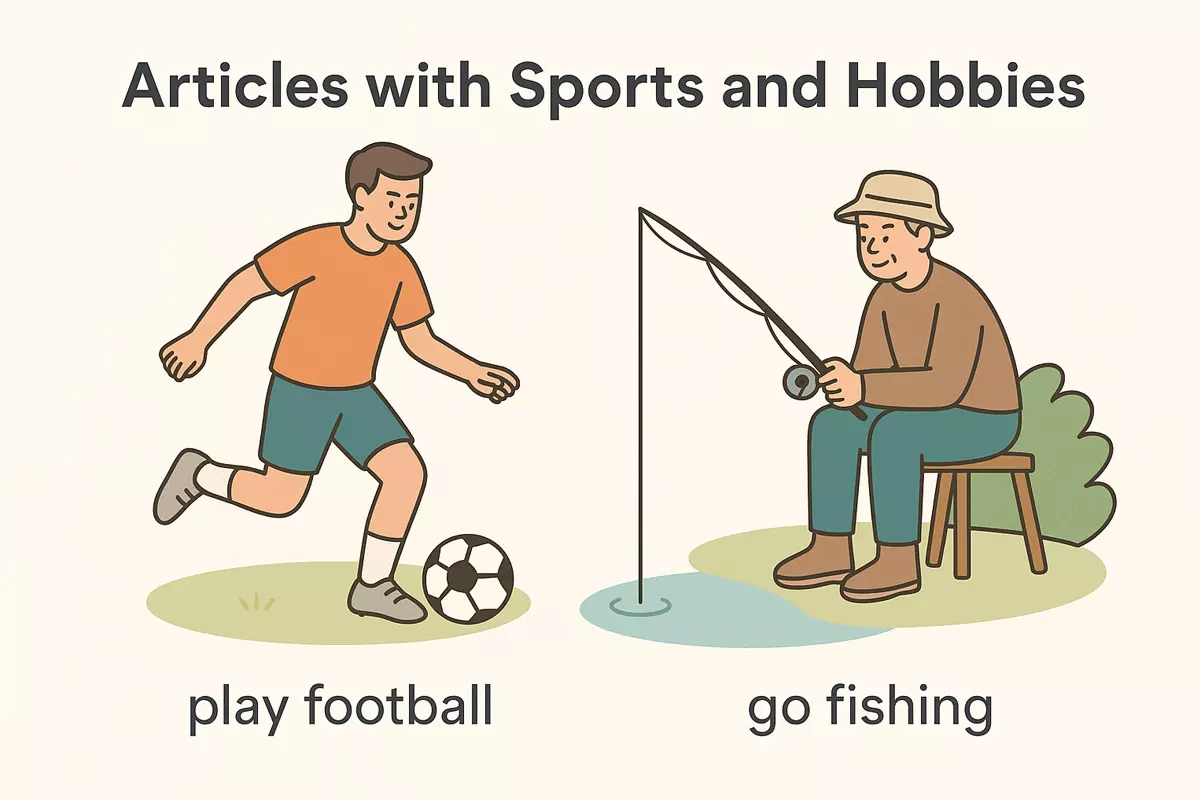 Here we when to use articles with sports and hobbies, how to use go plus -ing forms like go fishing, and when to say a game of tennis. It also explains common mistakes and offers practice correcting sentences about free-time activities.
Have you ever noticed that we use different verbs for various activities, such as saying we play football but go fishing? Choosing the correct verb—like play, go, or do—when talking about sports and hobbies helps your English sound more fluent and natural. For example, we usually play team sports like basketball or tennis, go for activities ending in -ing such as swimming or jogging, and do for more individual or non-team activities like yoga or karate. Mastering these patterns can greatly improve your everyday conversations.
No articles with most sports names
In English, names of most sports are used without the definite or indefinite article. This means you usually say you play, watch, or enjoy a sport without adding "the," "a," or "an" before the sport's name. For example, we say "play tennis," "watch basketball," or "like football," not "play the tennis" or "watch a basketball." This rule applies to the majority of team and individual sports. The absence of articles helps keep the language concise and is a pattern that learners should remember when talking about activities like football, cricket, or volleyball. However, there are occasional exceptions, especially when referring to events or specific instances (e.g., "the football match"), but for the sport itself, articles are not needed.
Common sports without articles
- play football
- play basketball
- play tennis
- play volleyball
- play cricket
- play hockey
- play badminton
- play rugby
- play baseball
- play golf
- play chess
- play table tennis
- play squash
- play handball
- play polo
- play darts
- play snooker
- play softball
- play water polo
- play lacrosse
When to use articles
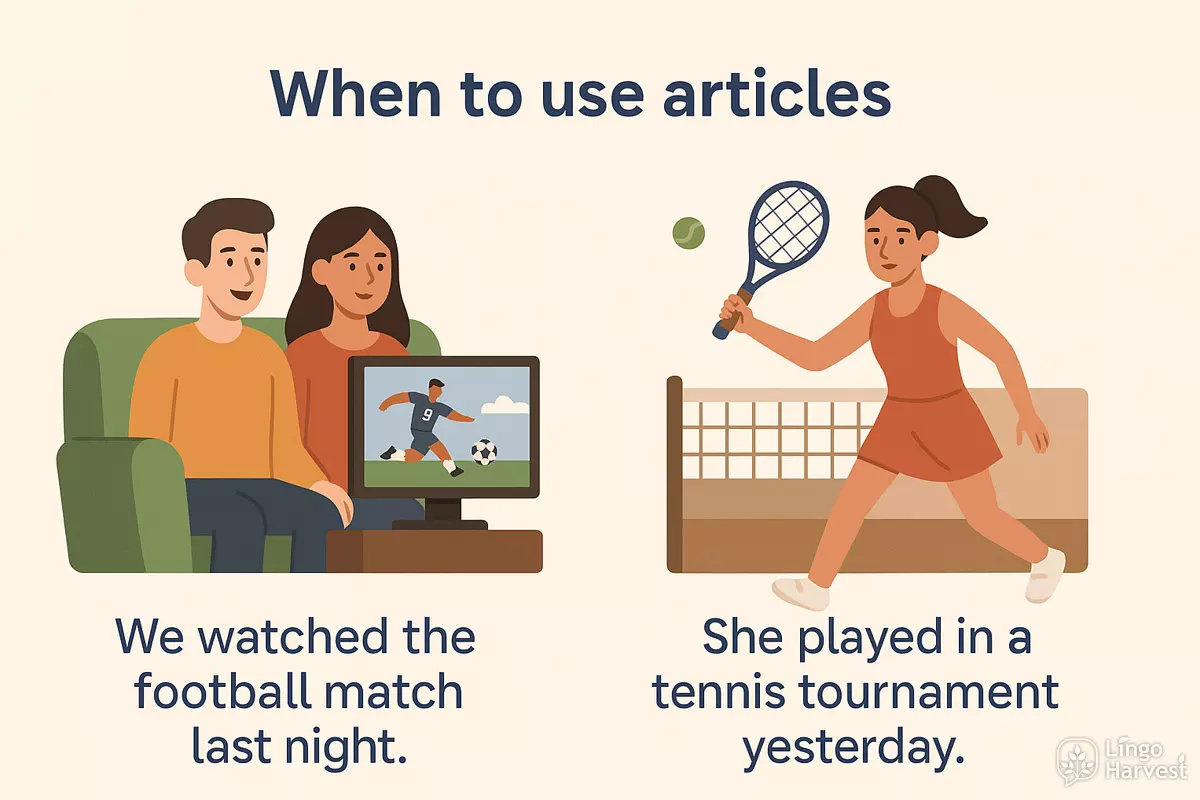
Articles may be used if you are talking about a particular game, match, or event, not the sport in general. For example:
- We watched the football match last night.
- She played in a tennis tournament yesterday.
But if you are talking about the sport as an activity, keep the name article-free.
Difference with hobbies and activities
Unlike most sports names, some hobbies and activities require "go" plus the -ing form (like "go fishing," "go swimming"), or use "do" for certain activities ("do yoga," "do karate"). These can follow different article rules, so be careful with the structure depending on the activity. Understanding this pattern will help you sound more natural when talking about sports in English.
Activities with go + -ing: go swimming, go fishing
When describing hobbies or leisure pursuits that involve movement or travel, English often uses the construction "go" followed by a verb ending in "-ing." This pattern is common for activities that are typically done outdoors or require some sort of journey, such as "go hiking," "go cycling," or "go fishing." The structure helps distinguish these activities from ones usually played as games or sports, like football or chess.
Common Activities Using "go + -ing"
- go swimming
- go running
- go fishing
- go shopping
- go camping
- go skiing
- go jogging
- go dancing
- go sailing
- go climbing
- go skating
- go snowboarding
- go surfing
- go diving
- go bowling
- go birdwatching
- go sightseeing
- go trekking
When to Use "go + -ing"
This structure is preferred for activities that are not organized team sports and usually involve movement or travel. For instance, we say "go swimming" because it refers to the action of swimming as a leisure activity, not as a competitive sport. In contrast, for team sports or games, English typically uses "play" (e.g., "play basketball," "play tennis").
Examples in Context
- We usually go hiking in the mountains on weekends.
- Let's go shopping after work.
- She loves to go dancing with her friends.
- They want to go skiing this winter.
- Do you often go running in the park?
- We decided to go swimming after lunch.
- He likes to go cycling early in the morning.
- They plan to go fishing during the holiday.
- Let's go sightseeing when we visit Rome.
- She wants to go jogging before breakfast.
Comparison: "go + -ing" vs "play"
It's important to know when to use each structure. Here's a guide to help you decide:
| Use "go + -ing" for | Use "play" for |
|---|---|
| Activities: swimming, fishing, jogging, cycling, hiking, camping, shopping, sailing, climbing, skating | Team/competitive sports and games: football, chess, volleyball, tennis, basketball, cards, hockey, golf |
| Usually done alone or in small groups; often not a formal sport | Usually organized games, often with teams or opponents |
| Examples: "go skiing," "go surfing," "go diving" | Examples: "play badminton," "play poker," "play rugby" |
| Focus on the activity/experience itself | Focus on the game, rules, and competition |
Quick Practice: Choose the Right Form
Decide if you should use "go + -ing" or "play" for these activities:
- ______ basketball
- ______ jogging
- ______ chess
- ______ surfing
- ______ tennis
- ______ camping
- ______ yoga
- ______ swimming
- ______ football
- ______ skiing
- ______ gardening
- ______ volleyball
Show answers
- play basketball
- go jogging
- play chess
- go surfing
- play tennis
- go camping
- do yoga
- go swimming
- play football
- go skiing
- do gardening
- play volleyball
When an article is needed: a game of tennis, the match
Sometimes, choosing whether to use an article in sports and hobby contexts depends on whether you mean the activity in general or a specific instance of it. For example, saying “play football” refers to the sport as a whole, while “play a game of tennis” points to a particular match or occasion. This difference can be subtle but is important for clear communication.
General Activities: No Article
When talking about sports or hobbies in a general sense, articles are usually left out:
- She likes to play football.
- They go fishing every weekend.
- He plays chess after work.
- We go swimming in summer.
- She plays volleyball at school.
- They go hiking in the mountains.
- He plays tennis twice a week.
- We go running in the mornings.
- She plays basketball very well.
- They go camping every July.
In these cases, the activity itself is the focus, not a single event or occurrence.
Specific Events: Article Needed
Articles come into play when you mean a particular event, session, or match. This helps distinguish between the general activity and a unique occurrence. Here are some common phrases:
- Let’s have a game of tennis tomorrow.
- Did you watch the match last night?
- I lost a chess game yesterday.
- She won the tournament.
- They organized a fishing trip last month.
- He’s preparing for the final.
- We attended an archery class.
- I joined a yoga session in the park.
- Let’s watch the football game together.
- He missed the training this morning.
- We played a round of golf.
- She’s coaching the junior team.
- He’s signed up for a marathon.
- They entered the competition.
- We had a dance rehearsal yesterday.
- She’s organizing the swimming class tonight.
Comparing General vs. Specific Usage
To clarify how articles change the meaning, here’s a comparison:
| General Activity (No Article) |
Specific Event (With Article) |
|---|---|
| She plays tennis. | She played a game of tennis. |
| He goes swimming. | He joined the swimming lesson. |
| They play football. | They watched the football match. |
| We do yoga. | We attended a yoga class. |
| I enjoy fishing. | I took part in the fishing contest. |
Key Takeaways
- Omit articles for general references to sports and hobbies.
- Use “a,” “an,” or “the” when describing a specific game, event, or session.
- Pay attention to context: if you mean a particular occasion, an article is usually required.
Understanding this distinction makes your English sound more natural and accurate in both spoken and written contexts.
Hobby nouns vs activity verbs
When talking about sports and leisure interests in English, we often choose between using a noun for the hobby itself and a verb phrase for the activity. This choice depends on the type of activity, and it affects the grammar and article use. For example, we say play football but go fishing. Understanding this difference helps you use the right article (or none) and verb form.
Which sports use "play", "go", or "do"?
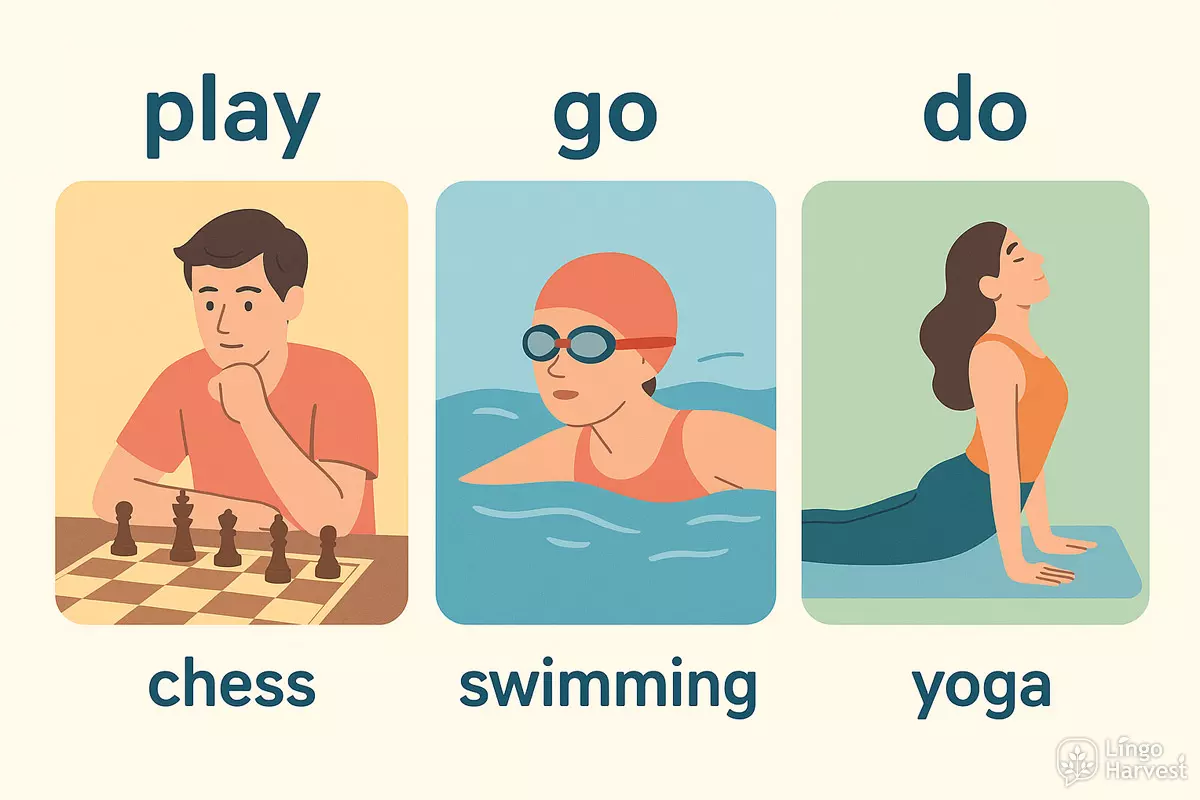
Team sports and ball games typically use play (like play tennis), while activities ending in -ing often use go (such as go swimming). Individual or non-ball activities sometimes use do (for example, do gymnastics).
| Expression type | Examples |
|---|---|
| "play" + noun (usually sports/games) | play football, play chess, play volleyball, play cards, play basketball |
| "go" + -ing form (activities) | go fishing, go swimming, go jogging, go skiing, go cycling |
| "do" + noun (individual activities) | do yoga, do karate, do aerobics, do gymnastics, do judo |
| Hobby noun (the activity itself) | football, fishing, yoga, gymnastics, chess, swimming |
How articles work with these forms
- With play and do, no article is used before the sport: She plays football.
- With go, use the -ing form: We go swimming.
- For the hobby noun, articles are not usually needed unless you specify: Football is popular. (no article) vs I joined a football club. (with article)
Practice: Choose the correct verb phrase
- ___ basketball
- ___ jogging
- ___ judo
- ___ fishing
- ___ chess
- ___ tennis
- ___ yoga
- ___ swimming
- ___ football
- ___ karate
- ___ camping
- ___ gymnastics
Show answers
- play basketball
- go jogging
- do judo
- go fishing
- play chess
- play tennis
- do yoga
- go swimming
- play football
- do karate
- go camping
- do gymnastics
Remember, the structure you choose depends on the activity. Ball sports and games usually go with play, activities ending in -ing often use go, and individual fitness or martial arts often take do. This makes your English both accurate and natural.
Typical article mistakes with sports and hobbies
Many English learners find it tricky to use articles correctly when talking about sports and hobbies. A common issue is knowing when to use "the," "a/an," or no article at all. This can lead to awkward or incorrect phrases like "play the football" or "go the fishing." Understanding the differences in article use with various activities helps you sound more natural.
Mixing up article usage with "play," "go," and "do"
Different verbs for activities require different approaches to articles:
- Play is used with most ball games and requires no article: play tennis, play football, play chess.
- Go is used for activities ending in -ing and also does not need an article: go swimming, go fishing, go cycling.
- Do is used for some activities and hobbies, usually without an article: do yoga, do karate, do athletics.
Frequent mistakes to watch out for
- Adding "the" unnecessarily: ❌ play the football → ✅ play football
- Using "a/an" with uncountable or general activities: ❌ go a swimming → ✅ go swimming
- Using "the" with hobbies in general: ❌ do the yoga → ✅ do yoga
- Forgetting to use "the" when talking about a specific event: ❌ I enjoyed match → ✅ I enjoyed the match
Common patterns and correct forms
| Incorrect Example | Correct Example |
|---|---|
| play the basketball | play basketball |
| go the skiing | go skiing |
| do the karate | do karate |
| play a football | play football |
| go a fishing | go fishing |
| do athletics | do athletics |
| play tennis | play tennis |
| go cycling | go cycling |
Tips to avoid article mistakes
- Remember: most sports and hobbies do not use articles when speaking in general terms.
- Use "the" only for something specific (e.g., "the game we watched last night").
- Watch out for exceptions, like "play the piano" or "play the guitar," where "the" is needed for musical instruments.
- Practice with lists of activities and check which article, if any, is needed.
By focusing on these patterns and practicing with real examples, you can quickly improve your accuracy and confidence when talking about your favorite sports and hobbies in English.
Practice: fix sentences about free-time activities
Many learners mix up when to use play, go, or do with various leisure activities. This exercise helps you spot and correct common mistakes in sentences about sports and hobbies. Pay attention to which verb goes with each activity, as well as the use of articles like a, the, or no article at all.
Find and correct the mistakes
Read each sentence. Rewrite it using the correct verb and article where needed.
- I like to play swimming at the weekend.
- She goes the football every Sunday.
- We do a chess after school.
- My brother goes fishing in summer.
- They plays basketball every Friday.
- He likes to do jogging in the park.
- Anna goes the yoga every morning.
- I want to play the tennis with you.
- Do you like to go cycling?
- We play the skiing in winter.
Show answers
- I like to go swimming at the weekend.
- She plays football every Sunday.
- We play chess after school.
- My brother goes fishing in summer. (Correct)
- They play basketball every Friday.
- He likes to go jogging in the park.
- Anna does yoga every morning.
- I want to play tennis with you.
- Do you like cycling? or Do you like to go cycling?
- We go skiing in winter.
Quick reference: Which verb for which activity?
Here’s a guide to help you choose the right verb for various hobbies and sports:
- play: football, tennis, chess, basketball, volleyball, golf, hockey
- go: swimming, fishing, jogging, running, skiing, cycling, skating, climbing, surfing, hiking
- do: yoga, gymnastics, karate, judo, athletics, aerobics, martial arts, exercises, Pilates
Common errors to avoid
- Don’t use play with activities ending in -ing (e.g., swimming, skiing)
- Don’t add the or a before most sports and hobbies unless you mean a specific instance (e.g., “play tennis,” not “play the tennis”)
- Use go + -ing form for activities done in free time or as a hobby
With these patterns, you can talk about your favorite ways to spend your leisure time much more accurately.