Articles with Abstract Nouns: Love, Freedom, Happiness

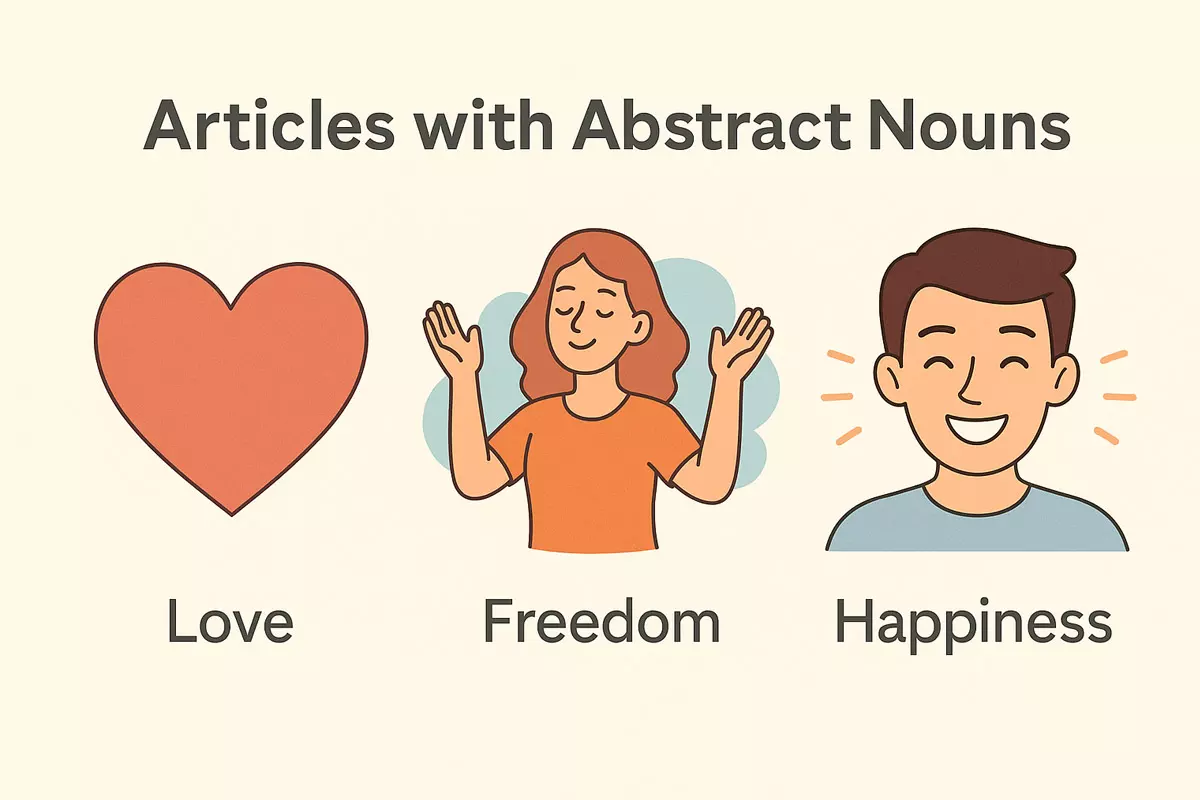 This article explains how to use articles with abstract nouns in English. It covers when to use no article, when to use the for specific cases, how a or an can change meaning, and offers practice exercises to test your understanding.
Examining how we express intangible feelings and ideals shows how language shapes our understanding of concepts such as affection, independence, and joy. By analyzing the grammar and word choices we use to describe these abstract ideas, we can gain insight into not only the meanings themselves but also how we relate to others. This increased awareness helps us communicate more clearly and fosters greater empathy, as we become better equipped to recognize and articulate the emotions and values that influence our thoughts and interactions.
What abstract nouns are in English
Abstract nouns refer to ideas, qualities, or states that cannot be seen or touched. Instead of pointing to physical objects, these words describe concepts such as emotions, conditions, or characteristics. When you talk about love, freedom, or happiness, you are naming something that exists in thought or feeling, not something you can hold in your hand. These nouns answer questions like "What is it?" but their meaning is understood through experience or imagination, rather than direct observation.
Common Features of Abstract Nouns
- They represent intangible things: feelings, ideas, or qualities
- Usually singular and uncountable (e.g., honesty)
- Often formed from adjectives or verbs (e.g., kindness from kind, decision from decide)
- Can be tricky with articles ("a/an/the") since many are uncountable
Examples of Abstract Nouns
Here are some of the most common abstract nouns in English, spanning emotions, states, and qualities:
- Love
- Freedom
- Happiness
- Peace
- Bravery
- Justice
- Friendship
- Wisdom
- Success
- Hope
- Courage
- Honesty
- Patience
- Knowledge
- Truth
- Anger
- Trust
- Fear
- Strength
- Loyalty
How Abstract Nouns Differ from Concrete Nouns
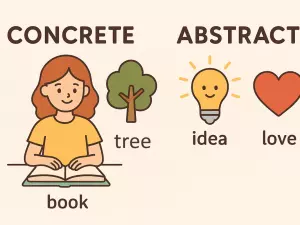
Unlike terms for objects or people, words like beauty or sadness don’t have a physical form. You can’t measure or touch them directly. In contrast, concrete nouns name things you can see or feel, such as table, cat, or music (the sound itself).
| Abstract Noun | Concrete Noun |
|---|---|
| Happiness | Book |
| Freedom | Car |
| Bravery | Dog |
| Peace | Chair |
| Knowledge | Tree |
Grasping the nature of abstract nouns helps with article usage and sentence building. Remember, these words name invisible, often uncountable things—so they’re handled differently from concrete items in grammar and conversation.
Zero article for concepts in general
When talking about abstract nouns as broad, universal ideas, English typically omits articles altogether. This means you don't use "a," "an," or "the" before words like “freedom,” “love,” or “happiness” when you’re referring to the concept itself, not a specific instance. This pattern helps distinguish between talking about an idea in general and a particular example or case.
Common abstract nouns without articles
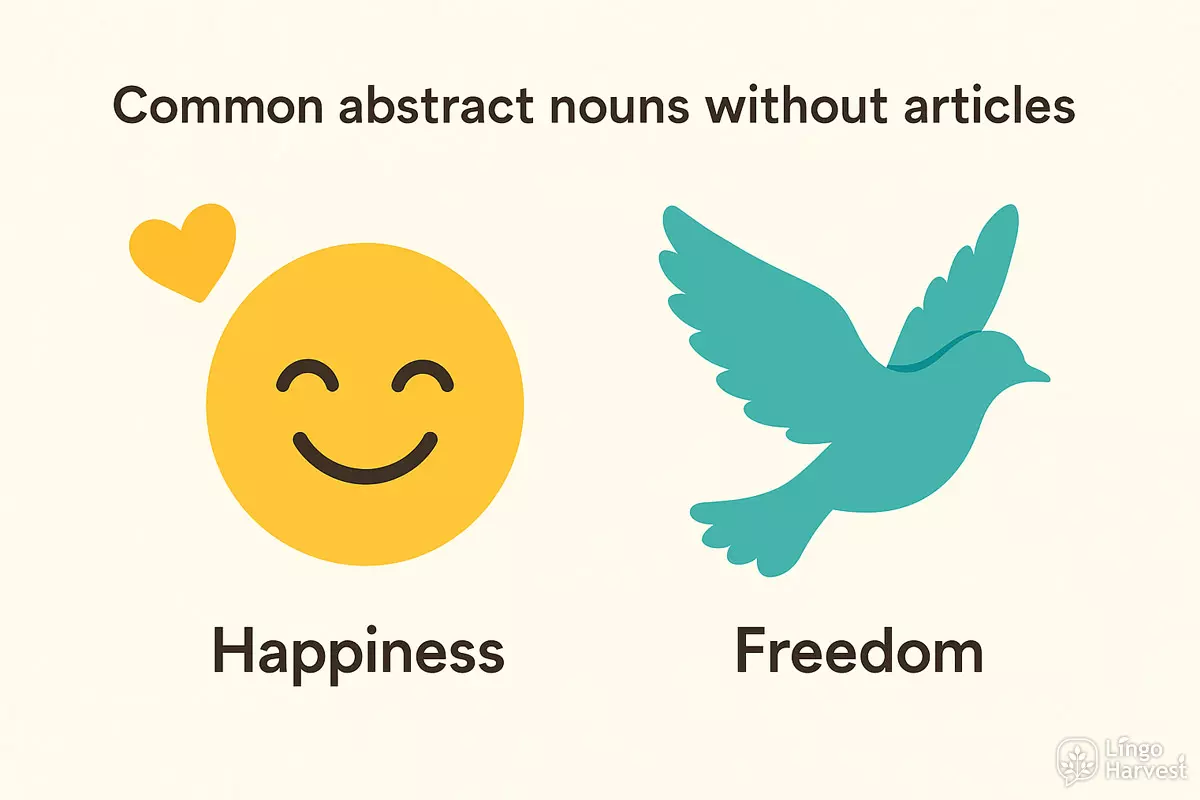
Here are some frequent examples where no article is used because the noun refers to a general concept:
- Love makes life meaningful.
- Happiness is important for mental health.
- Freedom is a basic human right.
- Justice must be served.
- Peace benefits everyone.
- Honesty is valued in relationships.
- Wisdom comes with experience.
- Beauty is subjective.
- Time heals all wounds.
- Knowledge empowers people.
- Trust is essential in teamwork.
- Power can corrupt.
- Courage inspires others.
- Patience pays off.
- Hope keeps us going.
- Success requires effort.
- Friendship enriches life.
- Faith moves mountains.
When to avoid the zero article
It's important to note that if you are talking about a specific example or a defined situation, an article or another determiner may be needed:
- She has a happiness I've never seen before. (a particular kind of happiness)
- He cherished the love they shared. (a specific love)
- They fought for the freedom of their country. (specific freedom)
Summary of patterns
Use the zero article with abstract nouns when:
- Referring to the concept in general, not a particular instance
- Talking about universal truths or ideas
- Describing qualities or emotions in a broad sense
Choosing whether or not to use an article with abstract concepts changes the meaning from general to specific. This distinction is key for clear, natural English.
Using “the” for specific instances of an abstract noun
When referring to abstract concepts like love, happiness, or freedom, English speakers usually omit articles. However, there are situations where “the” is necessary—especially when pointing to a unique, particular moment or example of that idea. This use helps clarify that you’re not talking about the concept in general, but a definite, recognizable case. For example, compare “Love is important” (love in general) with “the love they shared was extraordinary” (a specific love). The definite article singles out a concrete instance, often already known to the listener or reader.
When to Use “The” with Abstract Nouns
You’ll want to use “the” before an abstract noun when:
- Referring to a clearly identified situation or event
- Discussing a particular example introduced earlier
- Describing a well-known or unique occurrence
- Specifying a type or kind within the broader idea
Examples of Specific vs. General Abstract Nouns
Here are some common patterns showing when “the” is needed:
- the freedom we fought for
- the happiness of that summer
- the love between siblings
- the courage she showed
- the honesty in his answer
- the sadness in her eyes
- the hope of a new beginning
- the beauty of the sunset
- the pain of failure
- the trust they built
- the excitement of the event
- the wisdom of experience
- the anger he felt
- the peace after the storm
- the pride in her achievement
- the patience required
- the joy of discovery
- the fear of the unknown
- the kindness shown
- the ambition driving him
Comparing General and Specific Uses
To make the distinction clearer, here’s a comparison of how the same abstract noun changes meaning depending on whether it’s used with or without “the”:
| General (No Article) | Specific (With “the”) |
|---|---|
| Love is powerful. | The love they shared was powerful. |
| Freedom matters to everyone. | The freedom of speech is essential. |
| Happiness is hard to define. | The happiness on his face was obvious. |
| Trust takes time to build. | The trust between them was unbreakable. |
| Peace is the goal. | The peace after the conflict felt unreal. |
Key Takeaways
Choosing “the” helps specify which instance of an abstract idea you mean. It signals to your listener or reader that you’re not speaking in broad or theoretical terms, but about something definite—often with context or details that make it unique.
Using “a” with certain abstract nouns (a hope, a fear)
Not all abstract nouns are used without articles. In English, adding the indefinite article “a” before some abstract terms can change their meaning or make them more specific. For example, “hope” as an idea is uncountable, but “a hope” refers to a particular instance or type of hope. This pattern applies to other emotions, feelings, or states when you want to highlight a single example or a kind among many.
When to Use “a” with Abstract Nouns
The indefinite article “a” often appears with abstract nouns when:
- You are talking about one example among several possible types (“a fear of spiders” vs. “fear in general”).
- You want to indicate a specific occurrence or manifestation (“a happiness that I can’t describe”).
- The abstract noun is modified by a descriptive phrase (“a love that lasts forever”, “a freedom to choose”).
Common Abstract Nouns Used with “a”
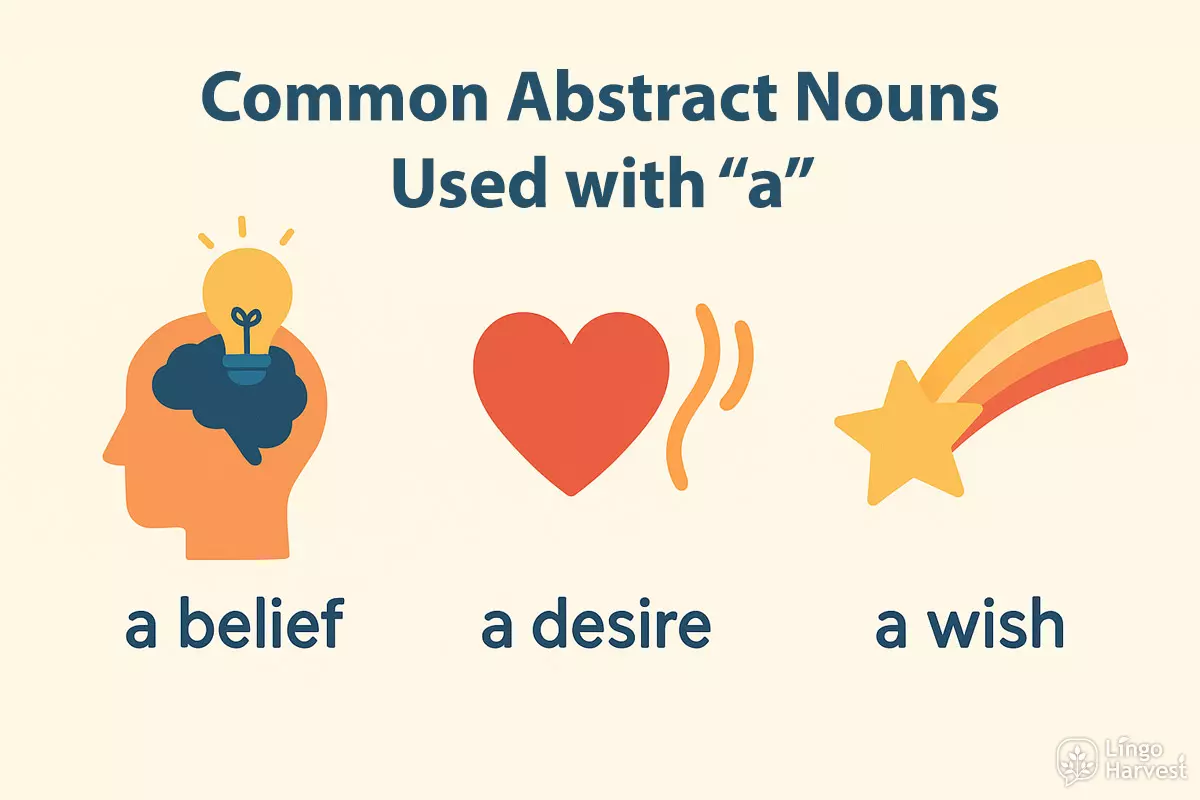
Here are examples where abstract nouns naturally take the indefinite article:
- a hope
- a fear
- a happiness
- a belief
- a desire
- a wish
- a doubt
- a dream
- a feeling
- a joy
- a love
- a right
- a freedom
- a need
- a thought
- a memory
- a possibility
- a reason
- a concern
- a curiosity
Comparing Usage: “Hope” vs. “A Hope”
| Without Article | With “a” |
|---|---|
| Hope is essential for recovery. (hope in general) |
She had a hope that things would improve. (a specific hope) |
| Fear can be paralyzing. (fear as a concept) |
He had a fear of heights. (one type of fear) |
| Freedom is important. (the general idea) |
They fought for a freedom to speak. (a specific aspect of freedom) |
| Love makes life meaningful. (love in general) |
It was a love he’d never known. (a particular love) |
Summary
Adding “a” before certain abstract nouns narrows the meaning to a particular instance, type, or example. This usage is common with feelings, emotions, and qualities when you want to specify or individualize the abstract idea. It’s a subtle but important distinction in English expression.
How articles change the meaning of abstract words
Using articles before abstract nouns like love, freedom, or happiness can subtly shift their meaning in English. When we use no article, the noun usually refers to the concept in general, not any specific instance. Adding the or a/an often narrows the meaning, pointing to a particular example or a special case of the idea.
General vs. Specific: The Role of Articles
Abstract nouns without articles typically mean the idea as a whole. For example, saying "Love is important" refers to the universal feeling. But when we add the or a, we’re talking about a certain type, moment, or instance of that idea. Here are some examples:
- Love conquers all. (all love in general)
- The love between them was obvious. (a specific love)
- A love of music can last a lifetime. (one kind of love, among others)
- Freedom is a basic right. (freedom in general)
- The freedom you feel on vacation is refreshing. (a particular experience)
- Happiness is hard to define. (the general concept)
- A happiness I’ve never known filled the room. (a unique feeling or moment)
- The happiness of the children was clear. (specific happiness, theirs)
- Justice must be served. (the principle)
- A justice that is swift may not be fair. (a type or form)
- The justice in this case was controversial. (specific case)
- Peace is precious. (the idea)
- The peace after the storm was welcome. (specific moment)
- A peace settled over the crowd. (an instance)
Subtle Differences in Meaning
Choosing whether or not to use an article can emphasize uniqueness, generality, or a particular aspect of the abstract noun. For example, the freedom might refer to a certain type of freedom, such as freedom of speech, while just freedom refers to the broad philosophical idea.
Patterns and Tips
Here are some patterns to help you decide when to use articles with abstract words:
- Use no article for the general concept: "Happiness is important."
- Use the for a specific case: "The happiness of that day was special."
- Use a/an for one example or type: "A happiness unlike any other."
- Context often decides: ask, “Am I talking about all, one, or a particular?”
Practice: choose the correct article with abstract nouns
Abstract nouns like love, freedom, and happiness can be tricky when it comes to using articles (“a,” “an,” or “the”). Sometimes, we use them with no article at all. The context and whether you are talking about something in general or specific make all the difference.
Quick rules to remember
- No article is used for abstract ideas in general: Happiness is important.
- The is used when speaking about a particular instance: The happiness I felt was immense.
- A/an is rare but possible when you refer to a type or example: A freedom that people cherish.
Choose the correct article (if any)
Read each sentence and decide which article (a/an, the, or none) fits best. Write your answer on paper or just think about it before checking the answers.
- ____ love can change a person’s life.
- She dreams of ____ freedom to travel.
- ____ happiness you see in his eyes is genuine.
- They fought for ____ equality in their country.
- ____ patience is a virtue.
- He searched for ____ meaning in his work.
- ____ beauty of the painting was unforgettable.
- Sometimes, ____ courage is needed to speak up.
- ____ honesty is always appreciated.
- She found ____ peace in nature.
- ____ knowledge gained from experience is invaluable.
- He admired ____ bravery of the firefighters.
- ____ hope kept them moving forward.
- We must protect ____ freedom of speech.
- ____ truth about the event eventually came out.
Show answers
- Love (no article; general concept)
- the (specific freedom: to travel)
- The (specific happiness in his eyes)
- — (equality as a general abstract concept)
- Patience (no article)
- a (a kind/type of meaning)
- The (specific beauty of the painting)
- — (general concept)
- Honesty (no article)
- — / a (both possible; “peace” general or a specific type of peace)
- The (specific knowledge: gained from experience)
- The (specific bravery of the firefighters)
- — (general abstract concept)
- the (specific freedom: freedom of speech)
- The (specific truth about that event)
Common mistakes with articles and abstract nouns
- Using “the” with abstract nouns when talking about them in general: The love is important. ❌ (Should be just Love is important. ✅)
- Leaving out “the” when talking about a specific instance: Happiness I felt was immense. ❌ (Should be The happiness I felt… ✅)
- Adding “a/an” unnecessarily: A freedom is important for everyone. ❌ (Should be Freedom is important for everyone. ✅)
Practice more: create your own examples
Try writing three sentences about love, freedom, or happiness—one with no article, one with “the,” and one with “a/an” where appropriate. This will help reinforce when each form is used.