Concrete and Abstract Nouns Explained

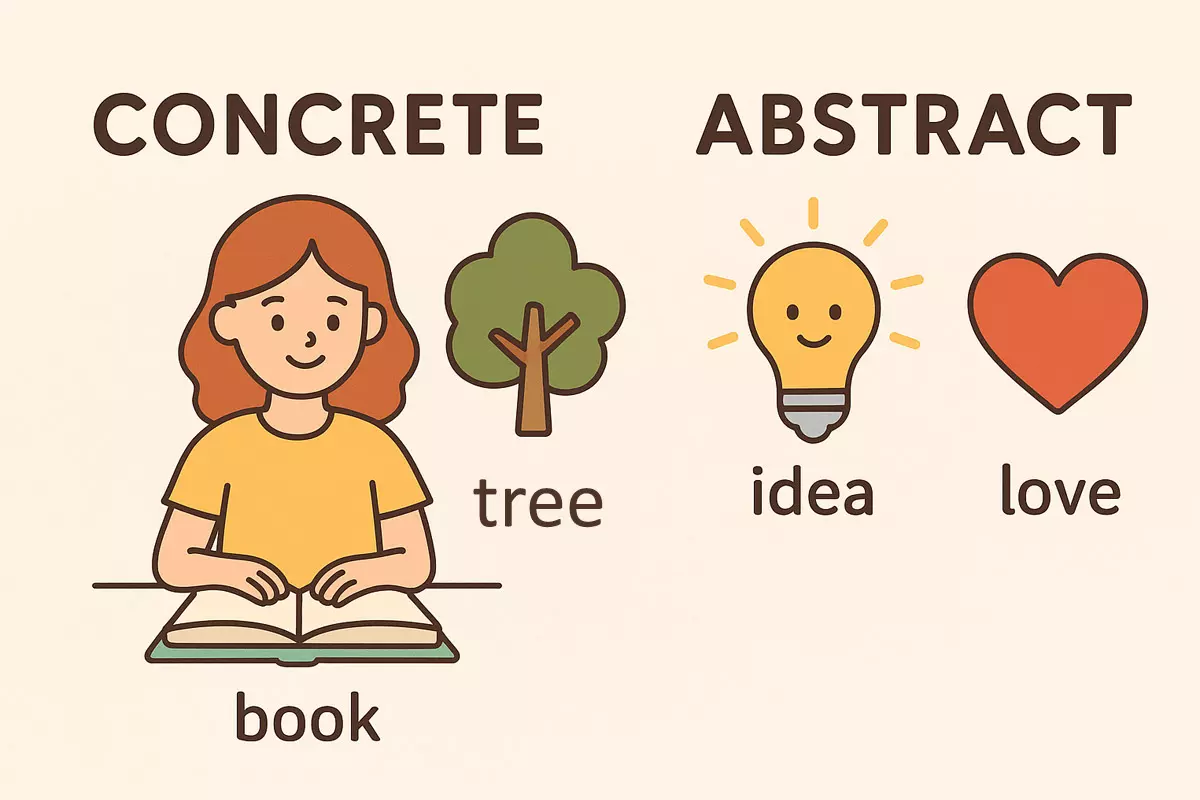 This article explains concrete and abstract nouns, how to tell them apart, and why the difference matters. It covers definitions, practical tests, common learner mistakes, real-life examples, and includes a sorting practice activity.
Have you ever noticed that some words refer to things you can physically touch, like a book or a chair, while others describe ideas or emotions, such as freedom or happiness? In English, these differences help us express both the world we experience with our senses and the thoughts or feelings we hold in our minds. By understanding how certain words name concrete objects and others represent abstract concepts, you can make your communication more accurate and expressive, allowing you to share your ideas more effectively.
What Are Concrete Nouns?
Words that refer to things you can experience with your senses fall into this category. If you can see, touch, hear, smell, or taste something, the word for it is likely a concrete noun. These terms name physical objects and real-world entities, making them easy to recognize in everyday language.
Key Features of Concrete Nouns
- Refer to actual, tangible items or beings
- Can be detected by sight, sound, touch, taste, or smell
- Include both singular and plural forms
- Appear frequently as subjects or objects in sentences
Common Examples
- Dog
- Apple
- Car
- Chair
- River
- Music
- Flower
- Bread
- Teacher
- Mountain
- Book
- Phone
- Rain
- Table
- Cat
- Tree
- Milk
- Window
- Clock
- Shoe
How to Identify Them
Ask yourself if the word names something you could physically interact with or observe. For instance, you can hold a pen, hear music, or see a mountain. These words are not limited to objects; they also include living beings and substances.
Concrete vs. Abstract Nouns
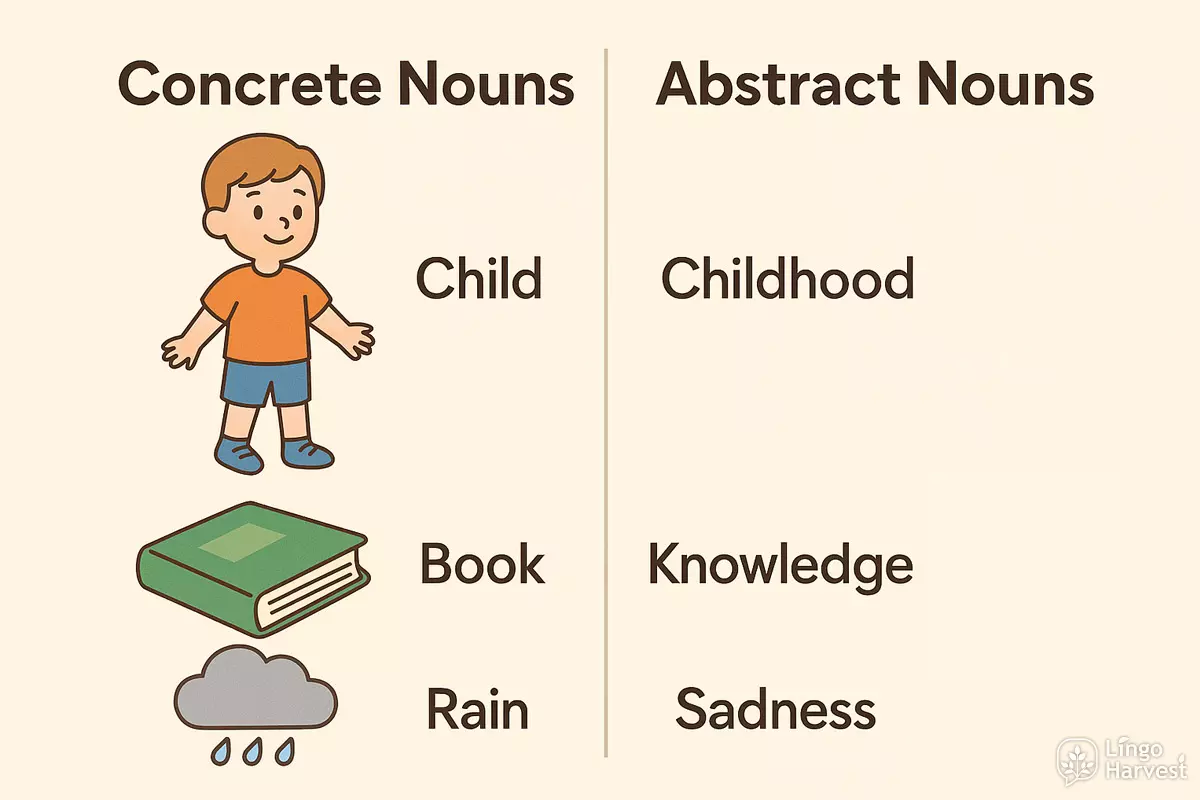
| Concrete Example | Abstract Counterpart |
|---|---|
| Child | Childhood |
| Book | Knowledge |
| Rain | Sadness |
| Music | Joy |
| Mountain | Strength |
In summary, these nouns anchor language to the physical world, helping us describe and discuss everything we can perceive directly.
What Are Abstract Nouns?
Words like happiness, freedom, and anger are used to talk about ideas or feelings rather than objects you can touch or see. These terms describe qualities, emotions, or concepts that exist in our minds, not in the physical world. You cannot hold “bravery” in your hand or see “justice” on a table, but you can experience or recognize them in actions and thoughts.
How Abstract Nouns Differ from Concrete Ones
A major difference between these and concrete terms is that they refer to things that can’t be detected with the five senses. While you can see a “tree” or hear a “bell,” you can only understand “truth” or “loyalty” through thought or experience. This distinction helps clarify meaning in both writing and speech.
Common Types of Abstract Nouns
- Emotions: joy, fear, love, sadness, anger
- States: peace, chaos, poverty, health, childhood
- Qualities: honesty, courage, kindness, patience, beauty
- Ideas: democracy, knowledge, belief, culture, freedom
- Events: progress, failure, victory, growth, loss
Forming Abstract Nouns
Many are created by adding suffixes to adjectives or verbs. For example, “happy” becomes “happiness,” and “decide” turns into “decision.” This pattern helps expand your vocabulary and express complex thoughts.
| Root Word | Abstract Noun Form |
|---|---|
| Brave | Bravery |
| Patient | Patience |
| Decide | Decision |
| Free | Freedom |
| Honest | Honesty |
| Move | Movement |
| Child | Childhood |
| Beautiful | Beauty |
| Grow | Growth |
| Leader | Leadership |
Why They Matter in Communication
Using these nouns allows us to talk about feelings, beliefs, and values, which are essential for expressing opinions and building deeper understanding. They give language the depth needed to discuss more than just tangible things, making conversations richer and more meaningful.
How to Test If a Noun Is Concrete
Determining whether a noun is concrete largely comes down to your senses. A concrete noun refers to something you can perceive physically—if you can see, hear, touch, taste, or smell it, the noun is likely concrete. On the other hand, if the thing named cannot be detected by the senses, it’s probably abstract.
Using the Five Senses Test
Ask yourself if the object, person, or place in question can be experienced directly. For each noun, try these questions:
- Can you see it?
- Can you touch or hold it?
- Can you hear it?
- Can you taste it?
- Can you smell it?
If the answer is “yes” to any of these, you’re dealing with a concrete noun. If all answers are “no,” it’s likely abstract.
Examples: Concrete vs. Abstract Nouns
Here is a comparison of various nouns to show which are considered concrete and which are abstract, based on sensory experience:
| Noun | Type | Can You Sense It? |
|---|---|---|
| Dog | Concrete | ✅ Yes |
| Freedom | Abstract | ❌ No |
| Music | Concrete | ✅ Yes (hear) |
| Happiness | Abstract | ❌ No |
| Apple | Concrete | ✅ Yes (see, touch, taste, smell) |
| Justice | Abstract | ❌ No |
| Perfume | Concrete | ✅ Yes (smell) |
| Love | Abstract | ❌ No |
| Chair | Concrete | ✅ Yes (see, touch) |
| Anger | Abstract | ❌ No |
Quick Tips to Identify Concrete Nouns
- Think of physical objects or substances: water, book, sand, cat, bread.
- Include people and places: doctor, mother, city, park.
- Include things you can experience: thunder, flower, ice, perfume, soup, bell, coin, mountain, pencil.
If you can interact with it in the real world, it’s almost certainly a concrete noun. When in doubt, use the five senses test as your guide.
Practice: Which Are Concrete?
Decide if each noun below is concrete or abstract:
- Table
- Bravery
- Rainbow
- Advice
- Pencil
- Friendship
Show answers
- Table – Concrete
- Bravery – Abstract
- Rainbow – Concrete
- Advice – Abstract
- Pencil – Concrete
- Friendship – Abstract
How to Recognize Abstract Ideas
Distinguishing between abstract concepts and more tangible things can be tricky, especially since not all words fit neatly into one category. Abstract notions refer to qualities, feelings, or concepts that can’t be experienced directly through the five senses. Instead, they exist in our minds, describing states, emotions, or ideas rather than physical objects or people.
Key Traits of Abstract Concepts
- They represent qualities, emotions, or states (e.g., happiness, freedom).
- They are not visible, touchable, or measurable in a physical sense.
- They often describe experiences, ideas, or relationships rather than things you can see or hold.
- They answer questions like “What is it like?” rather than “What is it?”
- They are often used to discuss thoughts, feelings, or values.
Common Examples of Abstract Terms
- Love
- Justice
- Bravery
- Honesty
- Anger
- Time
- Friendship
- Success
- Wisdom
- Peace
- Knowledge
- Truth
- Liberty
- Imagination
- Fear
- Hope
- Trust
- Sadness
Tips for Spotting Abstract Notions
- Ask yourself: Can I see, touch, hear, taste, or smell it? If not, it is likely abstract.
- Try using the word in a sentence about physical experience. If the sentence sounds odd (“I picked up some honesty”), it’s probably not concrete.
- Notice if the word describes mental or emotional states, or ideas about how people behave.
- Abstract terms are often used in discussions about philosophy, psychology, or values.
| Abstract Example | Concrete Example |
|---|---|
| Happiness | Smile |
| Freedom | Passport |
| Anger | Shout |
| Knowledge | Book |
| Friendship | Handshake |
| Fear | Shiver |
| Truth | Fact |
| Justice | Judge |
Recognizing intangible ideas is a matter of asking the right questions and understanding what the word refers to. If it names something you can experience with your senses, it’s probably not abstract. If it’s about feelings, qualities, or concepts, you’re likely dealing with an abstract term.
Examples from Daily Life
Understanding the distinction between tangible and intangible nouns can be easier when you look at situations you encounter every day. In our routines, we often use words that refer to physical objects, as well as others that represent concepts, feelings, or qualities. Here are several scenarios and vocabulary items that highlight these differences.
Common Real-World Instances
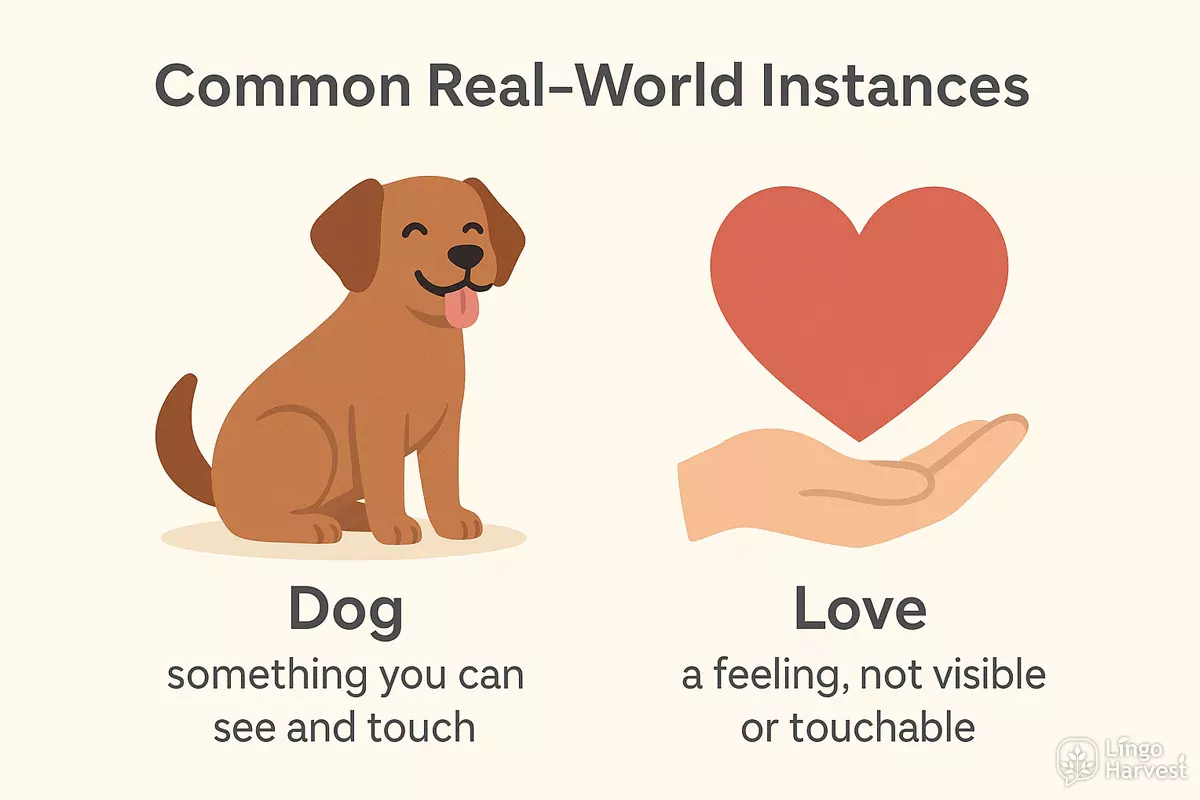
- Dog (something you can see and touch) vs. Love (a feeling, not visible or touchable)
- Book (an object on a shelf) vs. Knowledge (the information you gain from reading)
- Chair (a piece of furniture) vs. Comfort (how you feel when you sit)
- Music (the sounds you hear, but not a physical thing you can hold) vs. Song (the specific composition or recording, which can be stored on a device)
- Teacher (a person) vs. Wisdom (the quality a teacher might have)
- City (a place you can visit) vs. Freedom (a right or idea experienced within a city)
- Phone (an object you use) vs. Communication (the act or concept enabled by the phone)
- Flower (grows in a garden) vs. Beauty (an abstract quality the flower might represent)
- Rain (you can feel and see it) vs. Sadness (an emotion that rain might evoke)
- Car (a vehicle you drive) vs. Speed (the measurable quality of how fast the car moves)
- Food (what you eat) vs. Hunger (the sensation you feel before eating)
- Computer (a device on your desk) vs. Information (the data processed by the computer)
- Painting (an artwork you can hang) vs. Creativity (the ability or concept behind making the painting)
- Mountain (a landform you can climb) vs. Adventure (the experience of climbing)
Comparing Concrete and Abstract Terms
Notice how one type refers to things you can perceive with your senses, while the other represents thoughts, states, or qualities. This can be especially helpful when choosing the right word for a particular context.
| Concrete Example | Abstract Example |
|---|---|
| Child | Innocence |
| House | Safety |
| Gift | Generosity |
| Clock | Time |
| Road | Journey |
| Voice | Opinion |
| Letter | Gratitude |
| Tree | Growth |
By observing these pairs in everyday language, you can better differentiate between words that name physical entities and those that express ideas, emotions, or characteristics. This awareness helps improve both writing and speaking, making communication clearer and more precise.
Why This Difference Matters
Understanding the distinction between tangible and intangible nouns has a real impact on both writing and comprehension. When you recognize which words refer to physical objects and which describe ideas or qualities, you can craft sentences that are clearer and more precise. This awareness also helps you choose the right words to express exactly what you mean, whether you're telling a story, giving instructions, or analyzing a text.
Clarity in Communication
Mixing up physical and conceptual terms can cause confusion. For instance, describing “freedom” as something you can touch or “table” as something you can feel emotionally doesn’t make sense. Knowing which is which prevents awkward phrasing and miscommunication.
Grammar and Sentence Structure
Certain grammatical structures fit better with one type than the other. For example, articles like "a" or "an" typically precede objects you can see or touch, but are rarely used with qualities or concepts. Verbs also change; you can “hold” a book, but you “feel” happiness. Recognizing the difference helps avoid common mistakes.
Examples to Illustrate the Difference
- Concrete: apple, car, mountain, dog, flower, chair, river, phone, bread, house
- Abstract: love, courage, wisdom, fear, beauty, freedom, kindness, friendship, knowledge, trust
Comparison of Features
| Concrete Nouns | Abstract Nouns |
|---|---|
| Can be detected by senses (see, touch, hear, taste, smell) | Cannot be detected by senses; exist as thoughts or feelings |
| Used for physical objects and materials | Used for ideas, emotions, qualities, or states |
| Examples: pencil, music, ice, cloud | Examples: honesty, anger, hope, peace |
| Often countable or measurable | Usually uncountable and not measurable in a physical sense |
Why This Helps in Learning and Teaching
For language learners, distinguishing between these two groups makes it easier to expand vocabulary and understand new words in context. Educators also rely on this distinction to explain grammar rules and sentence patterns. When students know whether a term is physical or conceptual, they’re less likely to mix up verb forms or articles.
Everyday Impact
Whether you’re writing essays, speaking in meetings, or reading literature, knowing the difference leads to more effective communication. It allows you to be specific when needed and to recognize subtleties in meaning, especially in creative or persuasive writing.
Typical Confusions for Learners
For many people studying English, it can be tricky to tell the difference between ideas and things—especially when a word seems to blur the lines. This section highlights some of the most frequent areas where students mix up concrete and abstract words, and offers practical guidance for sorting them out.
Words That Can Be Both Concrete and Abstract
Some English nouns change their meaning depending on context. For example, “light” can refer to the physical rays you see (concrete), or to the idea of understanding (“She saw the light”—abstract). Here are more examples where this duality leads to confusion:
- Hope: a feeling (abstract), but “a hope” can sometimes refer to a specific goal (more concrete)
- Love: the emotion (abstract), but “my love” can refer to a person (concrete)
- Memory: a mental experience (abstract), or a physical object (“a memory card”—concrete)
- Dream: an idea or wish (abstract), or the images you see while sleeping (can feel concrete)
- Change: the process (abstract), or coins/money (concrete)
Common Mix-Ups in Everyday Speech
It’s easy to mistake a noun’s category, especially when the word is familiar or used casually. Here are some typical mix-ups:
- Calling “advice” concrete, since you can read or hear it, but it is actually abstract (the idea or suggestion)
- Thinking of “work” as a thing (concrete), but in most cases, it refers to the activity (abstract)
- Assuming “noise” is concrete because you hear it, but it represents a general phenomenon, not a physical object
- Believing “beauty” is concrete because it’s visible, but it’s an idea or quality (abstract)
Comparison of Concrete and Abstract Examples
| Concrete Noun Example | Abstract Noun Example |
|---|---|
| apple | freedom |
| music (the actual sound you hear) | happiness |
| car | courage |
| letter (a piece of paper) | honesty |
| dog | knowledge |
| rain | trust |
| book (the physical object) | education |
| mountain | friendship |
| shoe | anger |
| computer | success |
Tips to Distinguish Between the Two
- Ask yourself: Can I see, touch, hear, smell, or taste it? If yes, it’s likely concrete.
- If the word is about a feeling, quality, or idea, it’s usually abstract.
- Remember that some nouns can change category depending on the meaning in the sentence.
- Practice by sorting words in readings or conversations into “thing” and “idea” columns.
Clarifying the difference between things you can experience physically and concepts that exist in the mind helps you use English more precisely and confidently.
Practice: Sort Nouns into Two Groups
Understanding the difference between concrete and abstract nouns is easier with hands-on sorting. Below, you'll find a selection of nouns. Your task is to decide which words name things you can experience with your senses (concrete) and which represent ideas, qualities, or concepts (abstract).
Instructions
Read the list of nouns below. For each word, think: Is this something you can see, touch, hear, smell, or taste? Or is it something you can only think about or feel emotionally? Place each noun into the correct category.
- happiness
- mountain
- freedom
- apple
- anger
- river
- music
- courage
- book
- truth
- table
- friendship
- car
- love
- dog
- childhood
- city
- beauty
- bread
- knowledge
Group the Nouns
Now, sort the words above into two groups: those that are physical objects or things you can sense, and those that are intangible concepts or feelings. If helpful, use the table below to organize your answers.
| Concrete Nouns (things you can sense) |
Abstract Nouns (ideas, qualities, feelings) |
|---|---|
| mountain | happiness |
| apple | freedom |
| river | anger |
| music | courage |
| book | truth |
| table | friendship |
| car | love |
| dog | childhood |
| city | beauty |
| bread | knowledge |
Try to complete the sorting on your own before checking the solutions. This will help reinforce your understanding of how to identify different types of nouns.
Show answers
- Concrete nouns: mountain, apple, river, music, book, table, car, dog, city, bread
- Abstract nouns: happiness, freedom, anger, courage, truth, friendship, love, childhood, beauty, knowledge