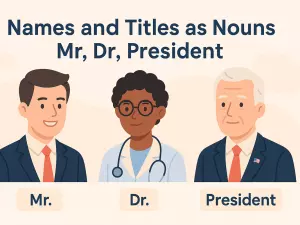
Articles with Proper Nouns: People, Titles, Organizations

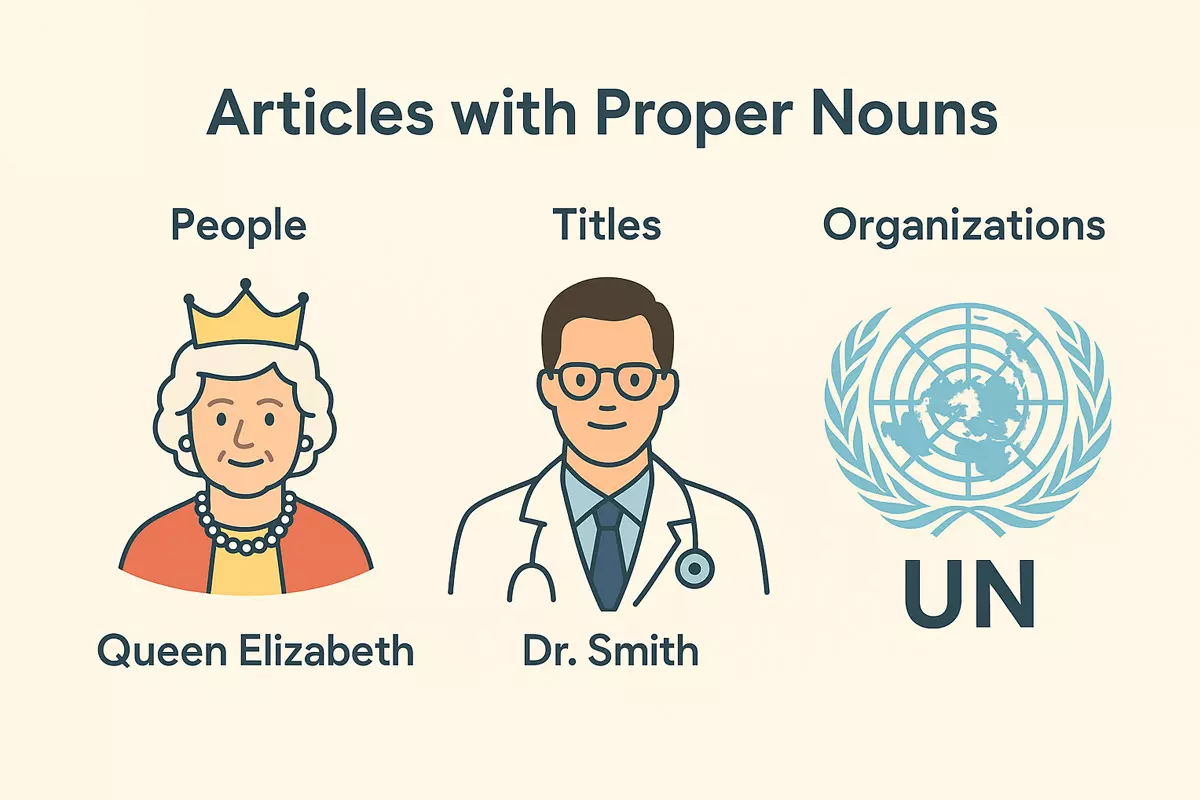 This article explains when to use or omit 'the' with names, titles like the Queen or President Smith, family groups like the Smiths, organizations, companies, and country names. It ends with practice exercises on proper article use.
Knowing when to use a, an, or the with names, job titles, and group names can be challenging, even for skilled writers. Mastering these article rules is important for making your sentences sound natural and clear, especially when referring to specific individuals or organizations. For example, you would say the President of the company when you mean a specific person, but a president when referring to any person holding that position. Similarly, use the with well-known groups, such as the United Nations, but omit articles with most proper names.
Basic rule: no article with most names
When using proper nouns—such as personal names, official titles, and organization names—English typically does not require any article ("a," "an," or "the") before them. This pattern helps distinguish these specific names from general nouns, which often do take an article. Understanding when to omit the article is key to sounding natural and precise.
Personal names
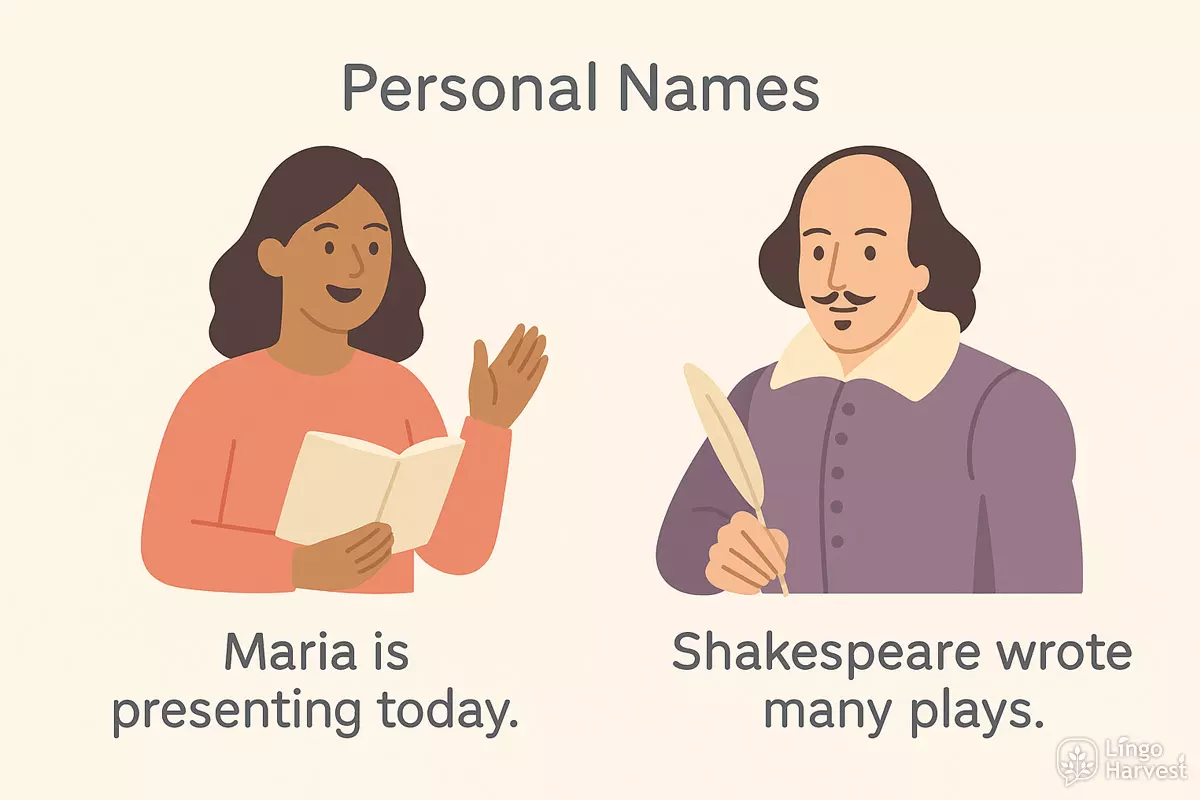
Most individual names stand alone without any article. This applies to first names, last names, and full names alike. The following examples show how names are used in common sentences:
- Maria is presenting today.
- Have you met Dr. Wilson?
- Shakespeare wrote many plays.
- We invited Anna and Mark.
- Mr. Lee will join us soon.
Titles and positions
Official titles or positions, when used directly before a proper noun, also drop the article. However, if the title is used alone or generically, an article may be needed.
- President Lincoln delivered the speech.
- The president delivered the speech.
- Queen Elizabeth visited Canada.
- The queen visited Canada.
Organizations and institutions
Names of companies, institutions, and organizations are usually used without an article, unless the official name contains "the" or requires it for clarity.
- Apple released a new product.
- Harvard is a prestigious university.
- Microsoft announced an update.
- Google is expanding its services.
- UNICEF provides aid worldwide.
Quick reference: When to skip the article
Here are typical cases where articles are omitted:
- First and last names: Emily Clark
- Titled names: Professor Jones
- Countries and cities: France, Tokyo
- Brand names: Nike, Samsung
- Organizations: World Health Organization
- Languages: Spanish, Arabic
- Streets and parks: Central Park, Oxford Street
- Institutions: Stanford University
- Festivals: Diwali, Ramadan
- Mountains and lakes: Mount Everest, Lake Baikal
- Days and months: Monday, June
Exceptions do exist, especially when the name includes a descriptive phrase or when referencing a unique entity (for example, the United Kingdom, the Netherlands, the Amazon). These are covered in later sections.
Titles with and without “the”: the Queen, President Smith
When using titles and ranks with proper names, English sometimes requires the definite article “the,” while other times it omits it. This depends on the formality, whether the title is followed by a name, and whether we’re referring to a unique position or a general one.
When to Use “the” with Titles
We generally include “the” when the title is used alone and refers to a unique role or when it’s clear which individual we mean. For instance:
- The Queen addressed the nation. (There is only one Queen in this context.)
- The President will arrive tomorrow.
- The Pope is visiting.
- The Prime Minister announced new policies.
- The CEO made a statement.
- The Governor attended the event.
When a title is followed by a specific name, we usually drop “the”:
- Queen Elizabeth was beloved by many.
- President Smith gave a speech.
- Pope Francis is popular worldwide.
- Prime Minister Trudeau visited Paris.
- CEO Johnson resigned last week.
- Governor Brown met with officials.
Special Patterns and Exceptions
Some titles can be used both with and without “the,” depending on whether they stand alone or are paired with a name. However, certain roles (like “the Dalai Lama”) almost always use “the,” even with the name, for cultural or traditional reasons. Also, titles used as job descriptions (not specific roles) do not take “the”:
- She became president in 2018. (Any president, not a unique one.)
- He is director of marketing.
Comparison Table: Article Use with Titles
| With “the” | Without “the” |
|---|---|
| The Queen spoke. | Queen Victoria reigned for decades. |
| The President will attend. | President Smith will attend. |
| The Prime Minister arrived. | Prime Minister Lee arrived. |
| The Pope addressed the crowd. | Pope John Paul II visited Poland. |
| The CEO resigned. | CEO Martinez resigned. |
| The Governor declared a holiday. | Governor Adams declared a holiday. |
Summary Guidelines
To sum up, use “the” for unique roles or when the title stands alone. Omit “the” when the title is directly followed by a person’s name. Watch for exceptions, especially with traditional or religious titles, and be attentive to context. This pattern helps maintain clarity and correctness in formal and informal writing.
Family names and groups: the Smiths
When we talk about families or groups with the same last name, such as "the Smiths," English uses a particular pattern with articles and noun forms. Typically, the definite article "the" is placed before the pluralized surname to refer to all family members collectively. For example, "the Smiths" means the Smith family as a whole, not just one person.
How to use articles with family names
- "The Smiths are coming to dinner." (the entire Smith family)
- "I met one of the Smiths yesterday." (refers to a member of the Smith family)
- "Smiths live next door." (uncommon without "the"; sounds incomplete or means people with that surname in general, not a specific family)
- "A Smith called earlier." (refers to an individual whose surname is Smith, not the whole group)
Pluralization and meaning
Pluralizing the surname (adding -s or -es) is standard when speaking about the whole family. This applies to most English surnames, but there are a few exceptions to the rule depending on the ending of the name.
| Singular Family Name | Plural (for families) |
|---|---|
| Smith | the Smiths |
| Jones | the Joneses |
| Evans | the Evanses |
| Brown | the Browns |
| Lopez | the Lopezes |
| Fox | the Foxes |
| Bell | the Bells |
| Harris | the Harrises |
| White | the Whites |
| Clark | the Clarks |
Key points to remember
- Use "the" + pluralized surname for a whole family or group: the Smiths.
- Do not use "the" with a single person's surname unless it’s a nickname or title ("the famous Smith").
- Some surnames need -es or -ses for the plural if they end in -s, -x, -z, -ch, or -sh: Jones → Joneses.
- Omitting "the" sounds odd when referring to a specific family group.
This approach helps distinguish between talking about one person and an entire family or group, and it’s especially relevant when writing or speaking about well-known families, fictional groups, or households.
Organizations and companies: with or without “the”
Choosing whether to use “the” with company or organization names can be confusing, as there is no single rule that applies to all cases. The decision often depends on how the name is constructed and whether it describes a specific group or entity. Understanding these patterns will help you write more naturally and avoid common mistakes.
When to use “the” before organization or company names
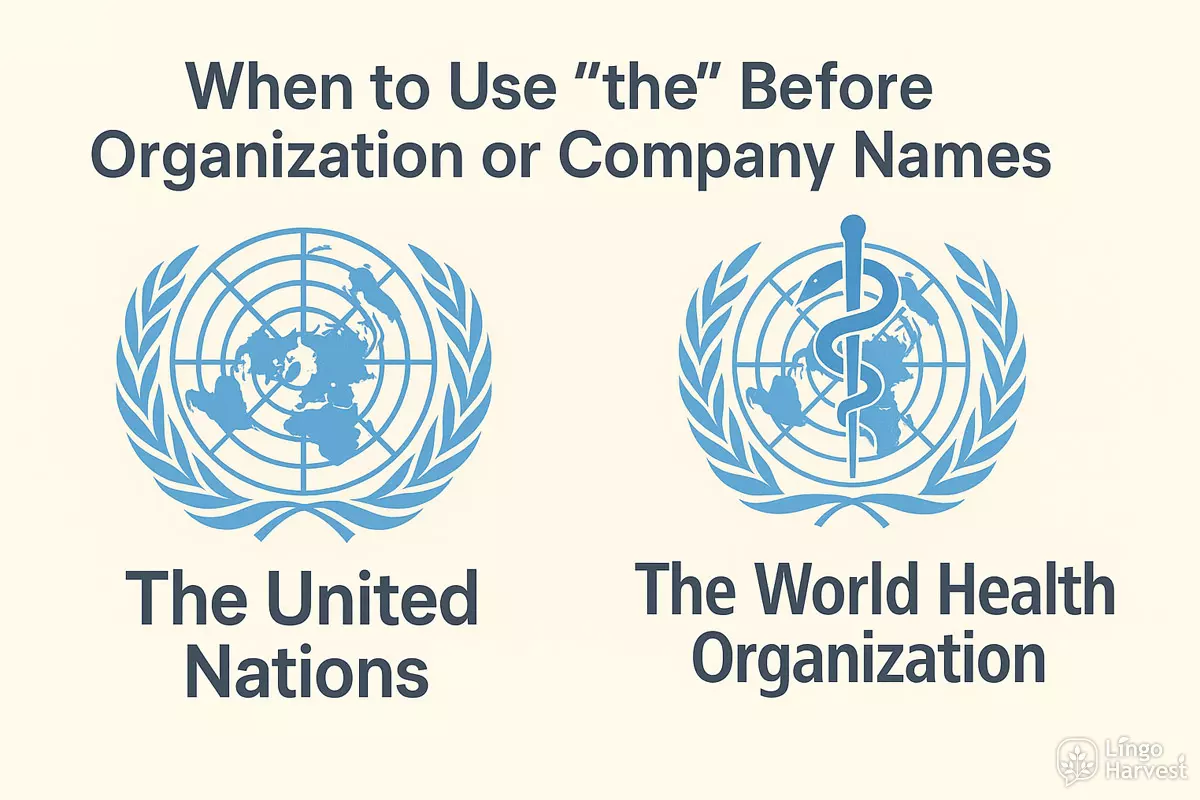
In English, “the” is usually required when the name includes a descriptive phrase, especially if it refers to a group or collective. For example, organizations that use words like “association,” “council,” or “committee” generally take “the.” Here are some common patterns:
- The United Nations
- The World Health Organization
- The European Union
- The Red Cross
- The International Monetary Fund
- The British Museum
- The Walt Disney Company
- The New York Times
- The Bank of England
- The Associated Press
These names usually refer to a unique entity, and “the” helps specify that you are talking about a particular organization.
When to omit “the” before names
In contrast, when a company’s name is treated as a proper noun without a descriptive phrase, “the” is generally left out. This is most common with brand names or businesses named after people, places, or single words:
- Microsoft
- Apple
- Amazon
- Goldman Sachs
- Shell
- IBM
- McDonald’s
- HSBC
- Airbus
- Siemens
Here, adding “the” would sound unnatural and is almost never correct.
Mixed cases and exceptions
Some organizations allow both forms depending on context, or have official names that differ from common usage. For example, “The BBC” is standard, but “BBC” is also widely used in headlines. Similarly, “The University of Oxford” is correct, but people often say just “Oxford University” without “the.”
| With “the” | Without “the” |
|---|---|
| The United States Postal Service | FedEx |
| The Bank of America | JPMorgan Chase |
| The Financial Times | Bloomberg |
| The Rolling Stones (the band) | Spotify |
| The United Parcel Service | DHL |
Quick tips to decide
- If the name sounds like a unique group or institution, “the” is often needed.
- If the name is a brand or single word, skip “the.”
- Check the organization’s own usage for official communications.
- Remember that news headlines may drop “the” for brevity, even when it’s official.
By paying attention to these patterns and checking established usage, you can avoid errors when referencing companies and organizations in your writing.
Country names with and without articles
When it comes to using definite and indefinite articles with country names, English follows some interesting patterns. Most country names stand alone without the need for "the," but a few require it. Understanding when to use or omit an article is important for both clarity and correctness in formal and everyday writing.
Countries that do not take an article
The vast majority of country names are used without any article. This applies to most single-word names and those that are derived from proper nouns or adjectives. Here are some common examples:
- France
- Japan
- Brazil
- India
- Canada
- Australia
- Turkey
- Egypt
- Sweden
- Chile
- Morocco
- Greece
Countries that require "the"
A smaller group of country names is always used with the definite article "the." This typically includes names that are plural, contain common nouns (such as "republic," "kingdom," or "states"), or reference a group of islands or regions.
| Country Name | Article Usage |
|---|---|
| The United States | Always used with "the" (e.g., the United States is large.) |
| The Netherlands | Always used with "the" (e.g., the Netherlands has many canals.) |
| The United Kingdom | Always used with "the" (e.g., the United Kingdom is an island nation.) |
| The Philippines | Always used with "the" (e.g., the Philippines are in Southeast Asia.) |
| The Czech Republic | Always used with "the" (e.g., the Czech Republic is in Europe.) |
| The Maldives | Always used with "the" (e.g., the Maldives is a tropical paradise.) |
| The Bahamas | Always used with "the" (e.g., the Bahamas attract many tourists.) |
Special cases and exceptions
Some country names can be confusing. For example, "Ukraine" does not take an article in modern usage, although "the Ukraine" was once common. Similarly, countries like "Sudan" or "Lebanon" do not require "the," despite older or regional habits. Always check contemporary references if you’re unsure.
- No article: Ukraine, Sudan, Lebanon, Argentina, Peru
- Always with "the": the Gambia, the Comoros
In summary, while most country names are used without an article, some require "the" due to their grammatical structure or historical reasons. Being aware of these patterns will help you avoid common mistakes in both speech and writing.
Practice: correct article use with proper nouns
Choosing the right article with names, titles, and organizations is an essential skill in English. The rules can be subtle, especially when a proper noun is combined with descriptive words or unfamiliar contexts. Below, you'll find exercises and explanations to help you recognize when to use the, a/an, or no article at all with proper nouns.
Quick Review: When Do We Use Articles with Proper Nouns?
- Most personal names (e.g., Maria, Mr. Smith) do not take an article.
- Organizations, countries, and titles may or may not take an article, depending on their structure.
- Use the with unique institutions, geographical features, and some official titles.
- No article is used with most cities, languages, or streets.
- Use the for groups of islands, plural country names, and names with descriptive phrases.
Exercise: Choose the Correct Article
Decide which article (if any) fits in each blank. Type or say your answer before checking below.
- ______ United Nations is headquartered in New York.
- She met ______ President of France at the summit.
- We visited ______ Louvre during our trip.
- I studied at ______ Oxford University.
- He lives on ______ Baker Street.
- ______ Amazon River is the second longest in the world.
- ______ Mount Everest attracts climbers from all over.
- They are flying to ______ Netherlands next month.
- ______ Google was founded in 1998.
- She works for ______ World Health Organization.
Show answers
- The United Nations
- The President of France
- The Louvre
- Ø (no article) Oxford University
- Ø (no article) Baker Street
- The Amazon River
- Ø (no article) Mount Everest
- The Netherlands
- Ø (no article) Google
- The World Health Organization
Common Patterns: Article Use with Names
Here are some typical cases for article usage with proper nouns:
- The + rivers, oceans, seas: the Nile, the Atlantic Ocean
- The + plural country names: the Philippines, the United States
- The + organizations with "of": the Bank of England, the University of Tokyo
- No article with most universities (unless the name contains "of"): Harvard University, Oxford University
- No article with single mountain names: Mount Fuji, Mount Everest
- The + buildings/monuments with unique names: the Eiffel Tower, the Statue of Liberty
- No article with languages and most countries: English, China
- The + newspapers: the Times, the Guardian
- No article with most streets/roads: Fifth Avenue, Baker Street
- The + family names in plural: the Smiths, the Johnsons
Challenge: Identify the Rule
Match each proper noun to the rule that explains its article usage.
| Proper Noun | Rule |
|---|---|
| the United Kingdom | Plural or composite country name |
| Harvard University | University without "of" in the name |
| the Pacific Ocean | Names of oceans/rivers/seas |
| Mount Kilimanjaro | Single mountain name |
| the European Union | Organization with "Union" or descriptive phrase |
| the Guardian | Name of a newspaper |
| English | Name of a language |
| Baker Street | Name of a street |
| the Alps | Names of mountain ranges |
| the Bank of England | Organization with "of" in the name |
Show answers
- the United Kingdom: Plural or composite country name
- Harvard University: University without "of" in the name
- the Pacific Ocean: Names of oceans/rivers/seas
- Mount Kilimanjaro: Single mountain name
- the European Union: Organization with "Union" or descriptive phrase
- the Guardian: Name of a newspaper
- English: Name of a language
- Baker Street: Name of a street
- the Alps: Names of mountain ranges
- the Bank of England: Organization with "of" in the name
By analyzing the rules and practicing with examples, you’ll strengthen your confidence in using articles with names, titles, and organizations. Keep reviewing and testing yourself with real-world examples for the best results!