Names and Titles as Nouns: Mr, Dr, President in English

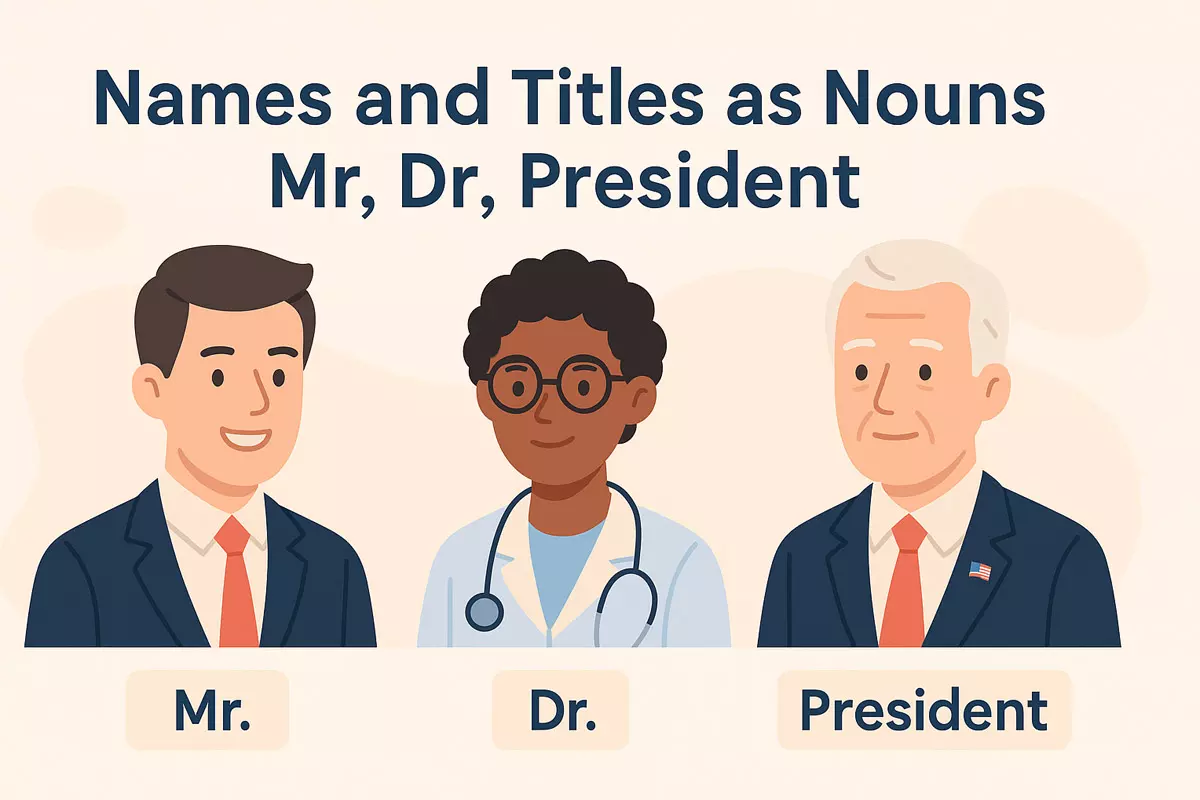 Here we how titles and names work as nouns, rules for capitalizing titles before and after names, using titles without names, plural forms, and when to use titles formally or informally. It also highlights common mistakes and offers practice exercises.
- What titles and names function as nouns
- Capitalization rules for titles before and after names
- Using titles alone without personal names
- Plural forms of titles and professional names
- Formal vs informal use of titles in communication
- Common learner mistakes with title capitalization
- Practice: correct title usage in short texts
Titles such as Mr, Dr, or President serve an important function in English beyond simply showing respect; they help us identify a person's role or status in both spoken and written communication. These words are known as honorifics or titles, and they are used before names to convey specific social or professional positions. By using these titles, speakers and writers provide context about individuals, making conversations clearer and more polite while also reflecting cultural norms regarding hierarchy and recognition.
What titles and names function as nouns
In English, many words that refer to people’s roles, ranks, or identities serve as nouns. These include both formal titles and personal names. When used as nouns, such words can act as the subject or object in a sentence, and sometimes take determiners or modifiers. Recognizing how these words function helps clarify sentence structure and meaning.
Common Titles Used as Nouns

Some titles naturally operate as nouns, especially when they refer to a specific person or group. Here are several examples you’ll see frequently:
- Mr. / Mrs. / Ms. / Miss → Ms. Johnson will join the meeting at noon.
- Doctor (Dr.) → Dr. Smith examined the patient.
- Professor → Professor Adams teaches modern history.
- President → The President addressed the nation.
- Captain → Captain Lewis welcomed the passengers.
- Judge → The Judge announced the final decision.
- Queen / King → The Queen opened the new parliament session.
- Director → The Director approved the project.
- Senator → The Senator proposed a new bill.
- Officer → The Officer asked for identification.
- Major → Major Thompson led the operation.
- Minister → The Minister of Health gave a press conference.
- General → General Carter commanded the troops.
- Governor → The Governor signed the agreement.
- Principal → The Principal spoke to the students.
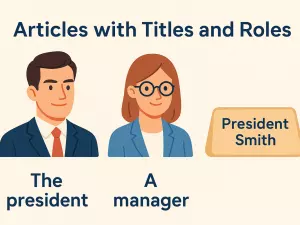
These titles can stand alone (e.g., "The President spoke") or be paired with a name ("President Lincoln"). In both uses, they serve a noun role.
Personal Names as Nouns
Personal names like "Alice," "John," or "Sanchez" are always nouns. They identify specific individuals and are capitalized in English. Sometimes, last names alone are used, especially in formal or academic contexts.
Titles vs. Nouns: When Is a Title Not a Noun?
A title can sometimes act as an adjective when modifying another noun, as in "President Biden's speech," where "President" modifies "Biden." However, in "The president arrived," the word is functioning as a noun.
Examples: Titles and Names in Sentences
- "Doctor Smith will see you now." (Title + name as noun phrase)
- "The captain gave an order." (Title as a common noun)
- "Mr. Jones is late." (Honorific as noun)
- "Elizabeth is the queen." (Name and title both as nouns)
- "Ask Director Lee for approval." (Title + name, noun phrase)
- "The judges discussed the case." (Title in plural, noun)
Structured Comparison: Titles as Standalone Nouns vs. Modifiers
| Standalone Noun | Modifier (Adjective-Like) |
|---|---|
| The president spoke. ✅ "President" is the subject. |
President Lincoln spoke. ✅ "President" modifies "Lincoln." |
| The judge entered. ✅ "Judge" is the subject. |
Judge Carter entered. ✅ "Judge" modifies "Carter." |
| The doctor is here. ✅ "Doctor" is the subject. |
Doctor Evans is here. ✅ "Doctor" modifies "Evans." |
| The captain ordered silence. ✅ "Captain" is the subject. |
Captain Lee ordered silence. ✅ "Captain" modifies "Lee." |
Key Takeaways
Most official titles, honorifics, and personal names can serve as nouns in English. Whether standing alone or combined with a name, their function depends on their place in the sentence. Recognizing this helps with both understanding and producing clear, grammatically correct English.
Capitalization rules for titles before and after names
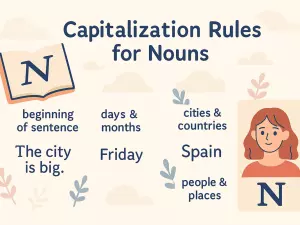
When using titles such as Mr, Mrs, Dr, Professor, or President in English, whether to capitalize them depends on their position relative to the person's name. Generally, these honorifics and professional titles are capitalized when they appear directly before a name, but not always when used alone or after the name.
Titles before names: Always capitalized
If a title comes right before a person's name, it should be capitalized. This applies to both formal and informal titles. For example:
- Mr. Smith will attend the meeting.
- Dr. Williams is our guest speaker.
- President Carter addressed the nation.
- Professor Lee is on sabbatical.
- Queen Elizabeth visited Canada.
Titles after names or standing alone: Lowercase or varied
When these words are used after the name, or on their own (as common nouns), they are usually not capitalized—unless part of a formal address or in certain official documents. Here are typical patterns:
- The president will speak at noon.
- Jane Doe, professor of linguistics, is retiring.
- John Smith, director of operations, approved the plan.
- The queen arrived late.
- We met with the doctor yesterday.
However, in some official or ceremonial contexts, you might see capitalization after the name (e.g., Jane Smith, President), but this is less common in standard writing.
Quick comparison: Title placement and capitalization
| Before the Name | After the Name/Standalone |
|---|---|
| Dr. Johnson | the doctor |
| President Lincoln | Abraham Lincoln, president |
| Mr. Garcia | the mister (rare/archaic) |
| Professor Hall | the professor |
| Queen Victoria | the queen |
Tips and exceptions
- Capitalize titles in direct address: “Good morning, Doctor.”
- Do not capitalize titles used generically: “Several presidents attended.”
- Official documents or lists may capitalize titles after names, but this is a special case.
- Always capitalize titles in headlines or at the start of sentences.
- Compound titles (e.g., Vice President Harris) follow the same rules.
Understanding these distinctions helps ensure clarity and formality in your writing, especially in academic, business, or official contexts.
Using titles alone without personal names
In English, it’s common to see titles like "Doctor," "Professor," or "President" used without attaching a personal name. This practice can signal respect, social hierarchy, or even distance, depending on the context and specific title. Often, such usage appears in formal settings, the media, or when the identity is obvious from context.
When and why titles are used without names
Sometimes, a title is enough to identify or address someone, especially if they’re the only person present with that role, or if their name is unknown or irrelevant. For example, in hospitals, "Doctor" is often called out to get a physician’s attention. In schools, students may say "Principal" when addressing the head of the school.
- When the person’s role is more important than their individual identity
- In formal settings, such as courtrooms ("Your Honor")
- To show respect or maintain social distance
- When the name is unknown ("Excuse me, Officer")
- In reporting or written summaries ("The President stated today…")
- During ceremonies or official announcements
Examples of titles used on their own
Here’s a range of titles commonly used without names in English, especially in direct address or reference:
- Doctor → Doctor Harris will see you now.
- Professor → Professor Miller published a new study.
- Captain → Captain Roberts gave the safety instructions.
- Officer → Officer Lee arrived at the scene.
- President → The President met with foreign leaders.
- Judge → Judge Thompson scheduled the hearing.
- Chairperson → The Chairperson opened the annual meeting.
- Senator → Senator Green spoke about the proposal.
- Ambassador → Ambassador Clark attended the summit.
- Principal → The Principal welcomed new students.
- Director → Director Nguyen approved the budget.
- Coach → Coach Adams encouraged the team.
- Manager → The Manager reviewed the report.
- Minister → The Minister announced new policies.
- Speaker → The Speaker addressed the audience.
- Sir → Sir, your table is ready.
- Madam → Madam, this way please.
- Reverend → Reverend Collins led the ceremony.
- Dean → Dean Foster approved the curriculum changes.
- Colonel → Colonel Hayes commanded the unit.
Patterns and nuances
The acceptability and tone of using a title by itself depend on the relationship between speakers and the context. For example, calling someone "Doctor" in a hospital is normal, but using "Captain" outside a military environment might sound odd unless the role is clear. Some titles, like "Sir" or "Madam," are inherently used alone and can be either formal or polite.
| Context | Example phrase |
|---|---|
| Formal address | "Thank you, Judge." |
| Unknown name | "Excuse me, Officer, can you help?" |
| Role emphasized | "The President will speak at noon." |
| Respectful distance | "Yes, Professor." |
| Everyday politeness | "Good morning, Sir." |
Summary
Relying on titles without personal names provides clarity, maintains formality, or signals respect in English communication. The habit is shaped by the setting, the relationship, and cultural expectations, so it’s important to pay attention to both the title chosen and the situation in which it’s used.
Plural forms of titles and professional names
When referring to more than one person with a title or professional name in English, the way you form the plural depends on both grammar conventions and context. Sometimes, the title itself is pluralized; in other cases, the noun it modifies takes the plural form. Understanding these patterns helps you sound natural and precise in both formal and informal situations.
Standard pluralization patterns
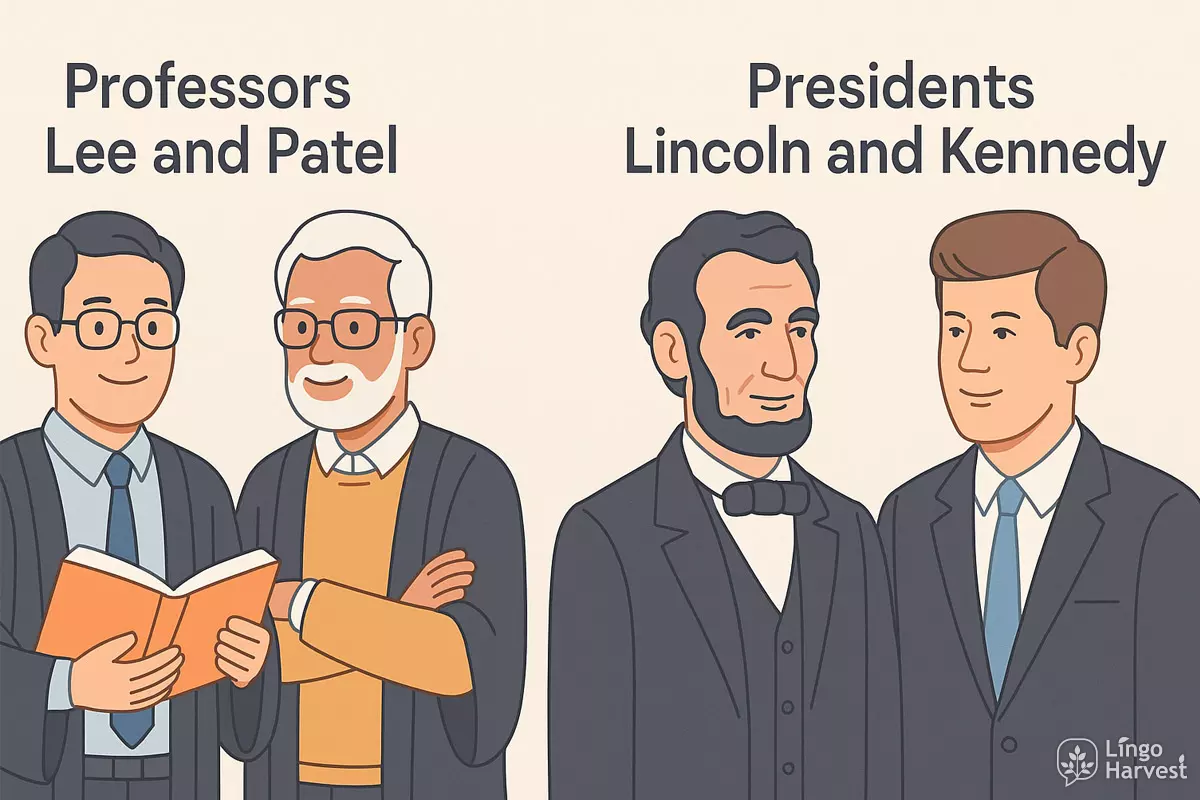
Most professional names and titles add an -s or -es for the plural, just like regular nouns. However, some titles are used differently and may not follow standard rules. Here are some common examples:
- Doctors → Drs. Smith and Jones
- Misters → Messrs. Brown and Green
- Professors → Professors Lee and Patel
- Presidents → Presidents Lincoln and Kennedy
- Misses → Misses Carter and Lane
- Madams (formal) → Mesdames Dubois and Marchand
- Captains → Captains Rogers and Hill
- Generals → Generals Grant and Sherman
- Reverends → Reverends King and Taylor
- Senators → Senators Warren and Cruz
- Attorneys General → Attorneys General Smith and Baker
- Secretaries (of State) → Secretaries Clinton and Kerry
- Ambassadors → Ambassadors Kim and Singh
- Judges → Judges Miller and Torres
- Directors → Directors Brown and White
- Ministers → Ministers Chen and Gupta
- Chairs/Chairpersons → Chairs Johnson and Lee
- Detectives → Detectives Holmes and Watson
- Sergeants → Sergeants Lewis and Clark
- Professors Emeritus → Professors Emeriti
Special cases and irregular forms
Some titles have irregular plurals or use alternative forms, especially in formal writing. For example, "Mr." becomes "Messrs." and "Mrs." becomes "Mmes." in very formal lists. Compound titles like "Attorney General" pluralize the main noun ("Attorneys General") rather than the last word.
| Singular Title | Plural Form | Usage Example |
|---|---|---|
| Mr. | Messrs. | Messrs. Carter and Ford |
| Mrs. | Mmes. | Mmes. Thatcher and Gandhi |
| Miss | Misses | Misses Brown and Black |
| Attorney General | Attorneys General | Attorneys General Harris and Smith |
| Professor Emeritus | Professors Emeriti | Professors Emeriti Clark and Evans |
When not to pluralize the title
In some contexts, especially when using titles as direct address or with a surname, the title remains singular even when referring to more than one person: "Dr. Smith and Dr. Jones," not "Drs. Smith and Jones" (except in formal written lists). This is especially true in speech or informal writing.
Summary
Pluralizing titles and professional names involves both regular patterns and a few exceptions. Mastery of these forms helps you communicate politely and accurately, whether you’re writing formal invitations, academic texts, or official documents.
Formal vs informal use of titles in communication
Understanding when and how to use titles such as "Mr," "Dr," or "President" depends on the relationship between speakers, the context, and cultural expectations. In English, these forms of address signal respect, familiarity, or social hierarchy, and their usage can shift significantly between formal and casual situations.
When to use titles formally
In professional, academic, or official settings, titles are used with last names to show respect and maintain appropriate boundaries. This is common in:
- Business correspondence (e.g., "Dear Mr. Smith")
- Academic communication (e.g., "Dr. Patel will present today")
- Addressing government officials (e.g., "President Carter addressed the nation")
- Introducing speakers or guests (e.g., "Please welcome Professor Lee")
- Medical settings (e.g., "Dr. Johnson will see you now")
- Formal invitations (e.g., "Mr. & Mrs. Green are invited")
- Legal documents (e.g., "Ms. Ramirez, the defendant")
- Letters of recommendation (e.g., "To Whom It May Concern: I recommend Mr. Adams")
- Military or religious contexts (e.g., "Captain Rogers," "Reverend Smith")
- Diplomatic or ceremonial events (e.g., "Ambassador Brown")
Informal and familiar address
In casual conversation, among friends, family, or peers, titles are often dropped in favor of first names or nicknames. Using a title in these situations can sound distant or overly formal. For example:
- Calling a friend by their first name: "Hey, Alex!"
- Addressing family: "Mom, can you help me?"
- Colleagues on equal footing: "Thanks, Sam."
- Using nicknames: "Good game, Buddy!"
- Group chats or informal emails: "Hi everyone,"
Comparing formal and informal patterns
The following table illustrates typical differences in the use of titles across various contexts:
| Context | Example of Title Use |
|---|---|
| Business meeting introduction | “This is Mr. Daniels, our new manager.” |
| Email to a professor | “Dear Dr. Nguyen,” |
| Conversation with a friend | “Sarah, did you see that?” |
| Casual office chat | “Morning, Jamie!” |
| Formal event announcement | “President Wilson will attend.” |
| Family gathering | “Uncle Ben, can you pass the salt?” |
Key points to remember
- Title use reflects the relationship and the level of formality required.
- Switching from title + last name to first name often marks increased closeness.
- In some cultures or workplaces, sticking to titles is the norm until invited otherwise.
- Overusing titles in friendly settings can feel stiff or impersonal.
- Omitting titles in formal situations may be seen as disrespectful.
- The safest approach is to mirror how others address you or to ask for preferences.
Recognizing when to use or drop titles helps maintain respectful and effective communication across different social and professional settings.
Common learner mistakes with title capitalization
Learners of English often stumble over how to capitalize titles like Mr, Dr, and President, especially when these words are used with names or as common nouns. Misunderstandings can lead to awkward or incorrect writing in both formal and informal contexts. Below, we highlight the most frequent issues and clarify the correct conventions.
Mixing Up Capitalization in Titles and Common Nouns
One of the most typical errors is capitalizing a title even when it is not used directly with a name. For example, people may write the President when referring to any president, not a specific one, or Doctor for all doctors. The rule is: capitalize titles when they come before a name or are used as a form of address, but use lowercase when they stand alone.
- Correct: I spoke to President Lincoln yesterday.
- Incorrect: I spoke to the President yesterday. (if you mean any president)
- Correct: I visited Dr Smith’s office.
- Incorrect: I visited the Doctor’s office. (unless “Doctor” is used as a name)
Forgetting to Capitalize Titles Before Names
Another common issue is leaving titles in lowercase when they are part of someone’s name. This happens with both common and academic titles.
- Incorrect: mr Jones will see you now.
- Correct: Mr Jones will see you now.
- Incorrect: dr Lee is in the conference room.
- Correct: Dr Lee is in the conference room.
Capitalization with or without Names: Side-by-Side Examples
| Title Used With Name | Title Used Without Name |
|---|---|
| Dr Patel will attend the meeting. ✅ | The doctor will attend the meeting. ✅ |
| President Carter spoke to the press. ✅ | The president spoke to the press. ✅ |
| Mr Brown is our neighbor. ✅ | The mister is not used as a noun in modern English. ❌ |
| Professor Smith gave a lecture. ✅ | The professor gave a lecture. ✅ |
Other Typical Issues
- Using ALL CAPS for titles (e.g., MR. WILSON) in regular text
- Adding a period after titles where not needed in British English (Dr vs. Dr. in American English)
- Capitalizing every word in a sentence with a title (e.g., He Met With The President Yesterday)
- Using lowercase after a greeting (e.g., dear mr Taylor instead of Dear Mr Taylor)
- Forgetting that some titles (like “sir” or “lady”) are only capitalized before names
Mastering these details helps your writing look polished and professional, especially when referring to people’s names and official roles.
Practice: correct title usage in short texts
Mastering how to use titles like Mr, Dr, and President in English requires attention to both context and formality. Below, you'll find practical exercises and examples to help you recognize and apply these titles accurately in various sentences.
Common Scenarios for Titles
- Addressing someone directly (spoken or written): Good morning, Dr. Smith.
- Referring to someone in the third person: Mr. Johnson will join us soon.
- Using titles with last names only, not first names: President Carter (not President Jimmy)
- Omitting the title when using a full name: Barack Obama, not Mr. Barack Obama
- Formal situations require the full title: Dr. Williams in academic settings
- Never combining titles: Dr. Smith, not Mr. Dr. Smith
- Titles are capitalized when used as part of the name: Professor Lee
- Lowercase when used generically: The president will speak
- Professional titles (Dr., Prof.) are not used with job titles: Dr. Harris, the dean, not Dean Dr. Harris
- Abbreviate only standard titles: Mr., Mrs., Dr.; not for President or Professor
Identify the Correct Title Usage
Choose the correct option for each sentence:
- _____ Smith will see you now. (Mr. / Dr. / President)
- We invited _____ Johnson to the ceremony. (Mr. / Mrs. / President)
- Is _____ Carter available for a meeting? (President / Dr. / Prof.)
- _____ Lee is giving a lecture. (Prof. / Mr. / President)
- We met with _____ Garcia and her team. (Dr. / Mrs. / President)
- _____ Brown signed the document. (Governor / Mr. / Dr.)
- _____ Adams presided over the court. (Judge / Mr. / Prof.)
- _____ Wilson coached the team this season. (Coach / Dr. / Senator)
- _____ Miller addressed the audience. (Speaker / Mr. / Captain)
- _____ Thompson welcomed the new students. (Principal / Dr. / Officer)
Show answers
- Dr. Smith will see you now.
- We invited President Johnson to the ceremony.
- Is President Carter available for a meeting?
- Prof. Lee is giving a lecture.
- We met with Dr. Garcia and her team.
- Governor Brown signed the document.
- Judge Adams presided over the court.
- Coach Wilson coached the team this season.
- Speaker Miller addressed the audience.
- Principal Thompson welcomed the new students.
Spot the Error
Find and correct the title mistakes in these short texts:
- Mr. Dr. Brown will attend the meeting.
- We look forward to hearing from President John.
- Dr. Emily Smith is our new principal.
- professor Miller will speak at the event.
- Mrs. Anna Williams is the CEO.
- Judge Robert will announce the verdict.
- Senator Maria joined the discussion.
- Captain James gave the instructions.
- doctor Lee examined the patient.
- We spoke with Manager Thompson yesterday.
Show answers
- Dr. Brown will attend the meeting. (Never combine Mr. and Dr.)
- We look forward to hearing from President Johnson. (Use last name, not first name)
- Dr. Smith is our new principal. (Use title with last name only)
- Professor Miller will speak at the event. (Capitalize Professor)
- Mrs. Williams is the CEO. (Use title with last name only)
- Judge Roberts will announce the verdict. (Use last name with the title)
- Senator Garcia joined the discussion. (Use last name, not first name)
- Captain James gave the instructions. (Correct: military titles can use first or last name)
- Doctor Lee examined the patient. (Capitalize Doctor when used as a title)
- We spoke with Manager Thompson yesterday. (Title + last name is correct)
Comparison of Title Usage in Context
| Title | Correct Usage Example | Incorrect Usage Example | Notes |
|---|---|---|---|
| Mr. | Mr. Brown will join us. | Mr. John will join us. | Use with last name, not first name. |
| Dr. | Dr. Smith is the speaker. | Dr. Emily Smith is the speaker. | Use with last name only. |
| President | President Carter spoke yesterday. | President Jimmy spoke yesterday. | Use with last name, not first name. |
| Professor | Professor Lee will teach the class. | professor Lee will teach the class. | Title must be capitalized. |
With regular practice and careful observation, you can avoid common mistakes and use English titles naturally and correctly in both speech and writing.