Articles in Noun Phrases with Adjectives and Modifiers

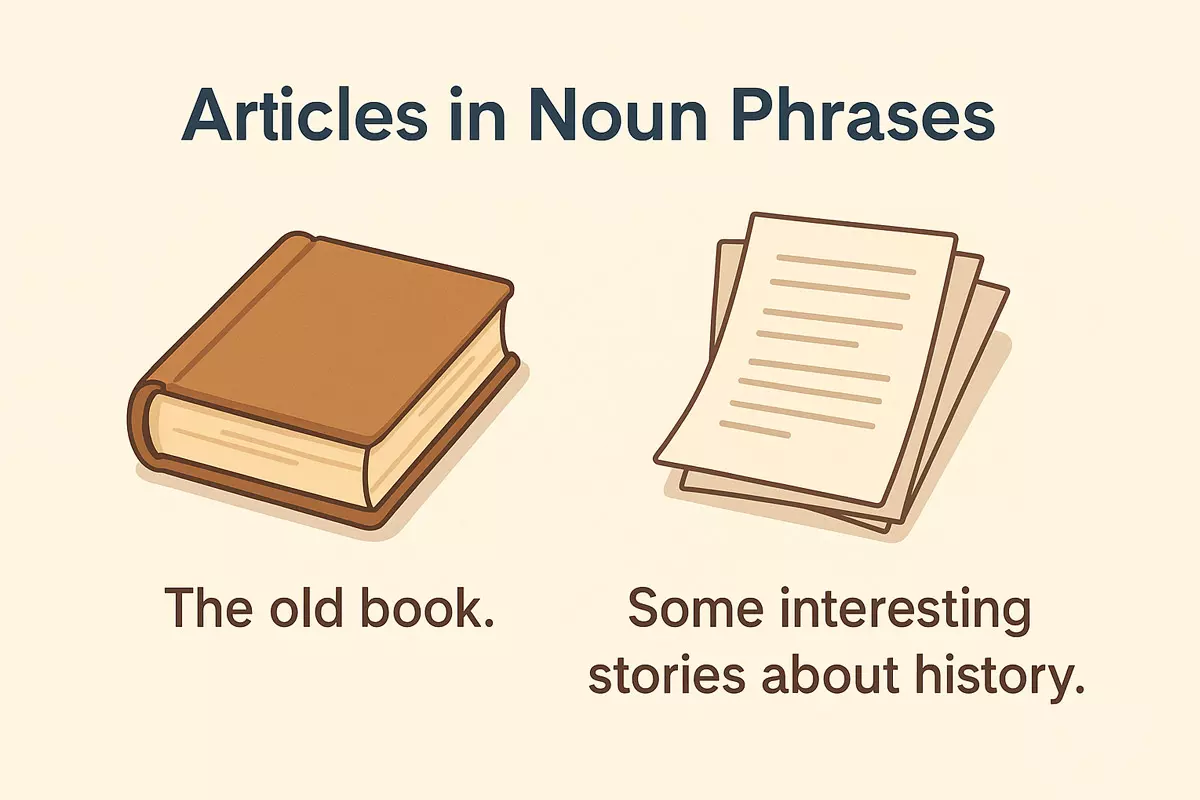 The article reviews noun phrase structure, explains article placement in complex noun phrases, covers articles with multiple adjectives, and discusses noun of noun patterns. It also addresses avoiding double articles and provides practice with complex noun phrases.
Selecting the correct definite or indefinite article becomes more challenging when descriptive words or additional information are included with a noun. It is important to understand how articles work together with adjectives and other modifiers to ensure your sentences sound natural and clear in English. Mastering this interaction helps you communicate more precisely and avoids confusion, especially when you want to emphasize certain qualities or distinguish between general and specific references.
Review of noun phrase structure
Understanding how noun phrases are built is essential before exploring how articles interact with adjectives and modifiers. In English, a noun phrase can be simple or complex, depending on the number and type of elements included.
Basic components of noun phrases
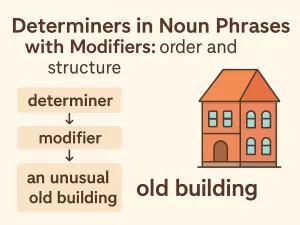
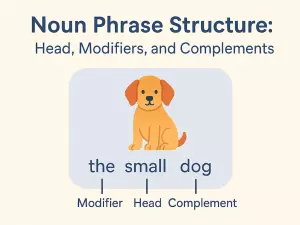
A noun phrase usually centers around a noun (the "head") and may include determiners, adjectives, and various modifiers. The typical order is:
- Determiner (article, possessive, demonstrative, quantifier)
- Adjective(s) (describing the noun)
- Noun (main word of the phrase)
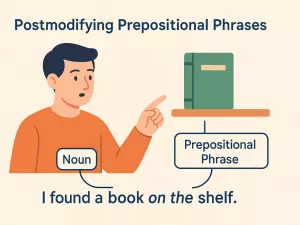
- Postmodifiers (prepositional phrases, relative clauses, etc.)
Here are some common examples, with the structure highlighted:
- The old book
- Some interesting stories about history
- My new car that I bought yesterday
- Those students in the library
Types of modifiers in noun phrases
Modifiers add detail or specificity to the main noun. They can appear before or after the noun, depending on their type:
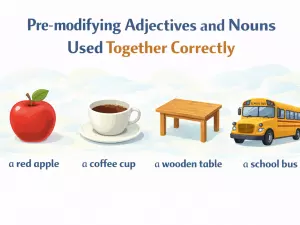
- Pre-modifiers: adjectives, participles, numbers (e.g., "three large dogs")
- Postmodifiers: prepositional phrases, relative clauses (e.g., "the book on the table", "the girl who won the prize")
The placement of the article (a, an, the) is always at the very start of the noun phrase, before any adjectives or modifiers.
Common noun phrase structures
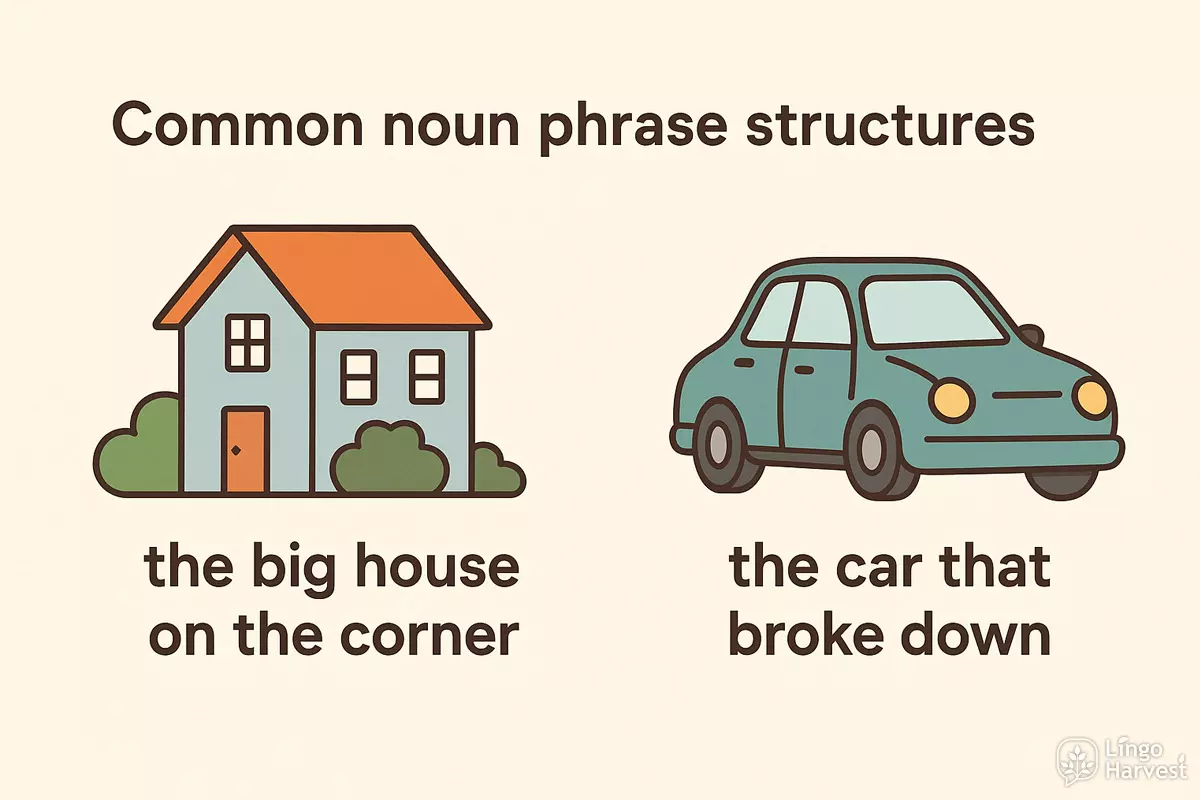
Below is a summary of typical noun phrase patterns, showing where each component fits:
| Pattern | Example |
|---|---|
| Article + Noun | the cat |
| Article + Adjective + Noun | a red apple |
| Article + Adjective + Noun + Prepositional Phrase | the big house on the corner |
| Article + Noun + Relative Clause | the car that broke down |
| Article + Multiple Adjectives + Noun | an old wooden chair |
| Article + Quantifier + Adjective + Noun | the many interesting books |
Practice: Identify the structure
Look at the following noun phrases. Identify the main noun and all modifiers:
- the small brown dog under the table
- a delicious homemade cake
- the students who finished early
- an old friend from college
- the three blue cars in the parking lot
Show answers
- the small brown dog under the table: main noun = dog; pre-modifiers = small, brown; article = the; postmodifier = under the table
- a delicious homemade cake: main noun = cake; pre-modifiers = delicious, homemade; article = a
- the students who finished early: main noun = students; article = the; postmodifier = who finished early
- an old friend from college: main noun = friend; pre-modifier = old; article = an; postmodifier = from college
- the three blue cars in the parking lot: main noun = cars; pre-modifiers = three, blue; article = the; postmodifier = in the parking lot
Position of the article in complex noun phrases
When building more elaborate noun groups, the article (a, an, the) typically comes before any adjectives or modifiers that describe the noun. This placement helps clarify which noun is being referred to, even as additional descriptive words are added. Understanding where to place the article is essential for clear and correct English.
General placement rules
Articles always precede adjectives and any other modifiers directly attached to the noun. For example:
- The tall building
- An interesting book
- A small, red apple
If multiple adjectives or descriptive phrases are present, the article still appears at the very start of the noun phrase.
With multiple modifiers
When a noun phrase includes more than just adjectives—such as participles, numbers, or prepositional phrases—the article remains at the beginning:
- The three large dogs
- An old man with a cane
- The broken window in the hallway
- A rapidly growing company
- An experienced teacher from Canada
Exceptions and special cases
While the article typically comes first, some expressions and fixed phrases may not use an article, especially with uncountable or plural nouns:
- Beautiful flowers in spring (no article with plural, general meaning)
- Fresh air is important (no article with uncountable, general meaning)
Comparing simple and complex noun phrases
Sometimes, seeing side-by-side examples helps clarify article placement as noun phrases become more elaborate:
| Simple Noun Phrase | Complex Noun Phrase |
|---|---|
| The car | The old blue car in the driveway |
| An idea | An exciting new idea for the project |
| A child | A little child wearing a yellow hat |
| The book | The thick book on the top shelf |
| An answer | An honest answer to your question |
Quick reference: Common patterns
Here are some frequent structures showing where the article appears:
- A helpful neighbor
- The last piece of cake
- An unusual solution to the problem
- The first time I met her
- A difficult but rewarding job
- An old friend from college
- The most beautiful painting in the gallery
- A big, friendly dog
- The answer everyone wanted
- An easy exercise for beginners
- The only possible explanation
- A delicious meal with friends
- An important meeting tomorrow
- The perfect gift for her
Correct placement of articles provides clarity, especially as noun phrases become longer or more detailed. Keeping the article at the start—before adjectives and modifiers—ensures your meaning is immediately clear to readers and listeners.
Articles with multiple adjectives
When a noun phrase includes more than one adjective, the use and placement of articles (a, an, the) depend on how the adjectives relate to the noun. Generally, the article appears before all adjectives, not between them. This is true whether the adjectives are describing different qualities or forming a fixed phrase.
Basic placement of articles
The article is placed before the entire string of adjectives that modify the noun. For example:
- a large red apple
- an old wooden chair
- the beautiful, spacious garden
Here, "a," "an," and "the" come before all the adjectives, regardless of how many adjectives are used.
Order of adjectives and article usage
Adjectives follow a general order in English: quantity, opinion, size, age, shape, color, origin, material, and purpose. The article always precedes the entire adjective sequence:
- a few interesting new books
- the three large blue boxes
- an unusual French recipe
When to repeat the article
If each adjective modifies the noun separately (not as a single idea), you may repeat the article for emphasis or clarity. This is less common and often used for stylistic reasons:
- a black and a white cat (two cats: one black, one white)
- the first and the second attempt (two distinct attempts)
But if the adjectives refer to a single noun as one unit, use the article only once:
- a black and white cat (one cat with both colors)
Common patterns with articles and adjectives
Below are examples illustrating article placement with a variety of adjective combinations:
- an expensive Italian car
- a little old house
- the tall young athlete
- a delicious homemade meal
- an ambitious new project
- a small round table
- the last available seat
- a difficult mathematical problem
- the second largest city
- a bright sunny morning
- an elegant black dress
- the only possible answer
- a famous historical figure
- an honest hardworking employee
- the main central square
- a fresh green salad
- an important cultural event
- the oldest surviving document
Summary
In summary, the article is placed before all adjectives in a noun phrase, and is only repeated if the adjectives describe different entities. Pay attention to adjective order and the intended meaning to ensure correct article usage. This helps create clear, natural-sounding English sentences.
Noun + of + noun patterns: the end of the day
Many English noun phrases use a structure where one noun is linked to another by "of." This construction helps specify relationships, ownership, or characteristics. For example, in "the end of the day," the first noun ("end") is clarified by the second noun ("day"). This pattern is common when the first noun needs extra detail or context.
When to Use "of" with Nouns
Writers and speakers often choose this pattern to show:
- Possession or belonging (the cover of the book)
- Parts or components (the handle of the door)
- Measurement or quantity (a piece of cake)
- Origin or source (the sound of music)
- Purpose or function (the key of the room)
- Material (the walls of stone)
- Time or period (the middle of the night)
- Groups or collections (a team of experts)
- Abstract relationships (the cost of living)
- Descriptions (the city of Paris)
Examples of Noun + of + Noun Structures
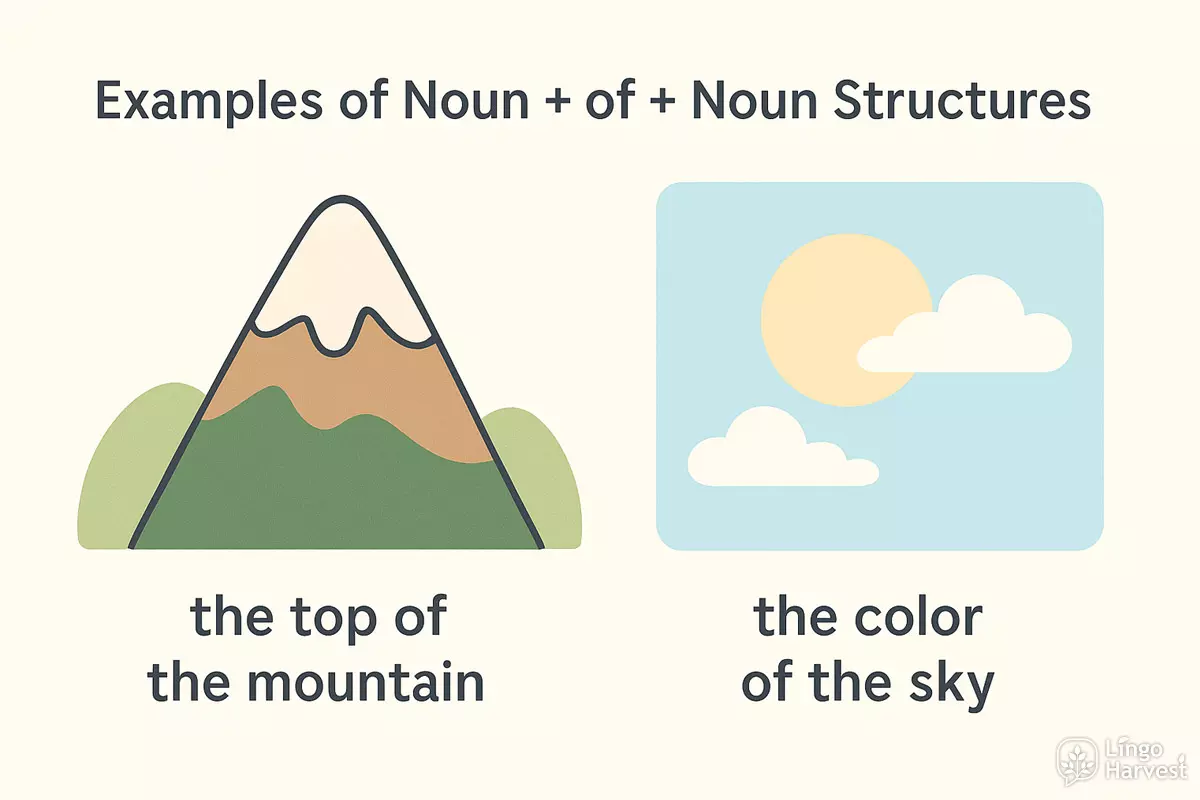
Here are some common phrases using this form:
- the top of the mountain
- the color of the sky
- the leader of the group
- the back of the room
- the heart of the matter
- the owner of the car
- the result of the test
- the roof of the house
- the rules of the game
- the edge of the table
- the smell of coffee
- the title of the book
- the surface of the water
- the meaning of the word
- the history of the city
- the shadow of the tree
Choosing the Right Article
The article before the first noun in these expressions depends on specificity and context. For example:
- the end of the day (a specific time period)
- a piece of cake (any piece, not a specific one)
- the color of the sky (refers to a unique or known sky)
- an example of courage (any example, not a particular one)
Matching the article to the intended meaning is key for clarity.
Comparison: "of" Pattern vs. Possessive 's
Sometimes, you can use either "of" or possessive 's, but they are not always interchangeable. Here’s a comparison:
| Possessive 's | "of" Pattern |
|---|---|
| the cat's tail | the tail of the cat |
| the student's book | the book of the student |
| the city's streets | the streets of the city |
| the company's policy | the policy of the company |
Generally, the possessive 's is more common with people and animals, while "of" is preferred with things, abstract nouns, or longer phrases.
Summary
Using "of" between nouns is a flexible way to connect ideas, show relationships, and clarify meaning, especially with more complex or abstract concepts. Choosing the right article and structure depends on what you want to express, so consider context and specificity when forming these phrases.
Avoiding double articles and redundancy
When constructing noun phrases with adjectives or modifiers, it’s important to use articles efficiently and avoid unnecessary repetition. Double articles—such as using “the” twice in the same noun phrase—are never correct in standard English. This section covers how to spot and prevent redundancy, especially when multiple descriptors are involved.
Common Traps with Articles and Modifiers
Writers often add extra articles by mistake when combining adjectives, compound modifiers, or lists. Only one article should appear at the start of a noun phrase, even if the phrase contains several adjectives or modifiers. Consider these patterns:
- Incorrect: the a beautiful house ❌
- Correct: a beautiful house ✅
- Incorrect: an the old red car ❌
- Correct: the old red car ✅
- Incorrect: a an interesting idea ❌
- Correct: an interesting idea ✅
Redundancy with Series and Lists
When listing multiple nouns, each with its own modifier, do not repeat the article unless each item is truly separate and not part of a single group. Use the article only once if the entire group is described together.
- the red and blue shirts ✅ (one group of shirts, both colors)
- the red shirt and the blue shirt ✅ (distinct shirts, separate articles are correct)
- the red and the blue shirts ❌ (redundant if referring to one group)
Quick Reference: Avoiding Repetition
| Redundant/Incorrect | Concise/Correct |
|---|---|
| the a big dog | a big dog |
| an the important meeting | the important meeting |
| the the best solution | the best solution |
| a an unusual event | an unusual event |
| the and the clever students | the clever students |
| the old and the young musicians (same group) | the old and young musicians |
| a a long journey | a long journey |
| the, the beautiful paintings | the beautiful paintings |
| an an honest answer | an honest answer |
| the my favorite book | my favorite book |
Summary Tips
- Place the article before the first adjective or modifier in a noun phrase.
- Avoid repeating articles in the same phrase unless separating distinct items.
- When using possessives (my, your, his), do not combine with an article (“the my friend” is incorrect).
- Check for extra articles when editing long or complex noun phrases.
By following these guidelines, your noun phrases will remain clear and natural, free from unnecessary repetition.
Practice: build and correct complex noun phrases
Understanding how to form and adjust noun phrases with adjectives and modifiers is crucial for clear, accurate English. Let's focus on building longer, more descriptive noun phrases and identifying article errors that often occur when adjectives or additional information are included.
Task 1: Identify and correct errors with articles
Read each sentence below. Some have mistakes in the use of a/an or the within complex noun phrases. Rewrite the sentence correctly if needed.
Task 1: Correct the article + adjective order
- She adopted adorable small puppy from the shelter.
- He wore the old comfortable sweater his grandmother gave him.
- We visited an unique historic castle during our trip.
- I need the information about a new project.
- They saw a interesting movie last night.
- She bought a red beautiful dress for the party.
- He met an amazing honest person yesterday.
- We walked through a dark long tunnel.
- They found a useful old tool in the garage.
- I saw an unusual big bird near the lake.
Show answers
- She adopted an adorable small puppy from the shelter.
- Correct as written.
- We visited a unique historic castle during our trip.
- Correct as written.
- They saw an interesting movie last night.
- She bought a beautiful red dress for the party.
- He met an amazingly honest person yesterday.
- We walked through a long dark tunnel.
- They found a useful old tool in the garage.
- I saw a big unusual bird near the lake.
Task 2: Expand the noun phrases
Add adjectives and modifiers to make each phrase more descriptive. Keep articles correct.
- cat
- book
- car
- teacher
- idea
- house
- phone
- friend
- painting
- garden
Show answers
- a playful black-and-white cat with bright green eyes
- the old history book on the top shelf
- a fast red sports car from Italy
- the enthusiastic science teacher at my school
- an innovative idea for a mobile app
- a small cozy house with a wooden porch
- a new smartphone with a high-resolution camera
- a loyal childhood friend from my hometown
- a beautiful landscape painting in an ornate frame
- the quiet green garden behind our house
Common patterns: combining articles, adjectives, and modifiers
Notice how articles interact with adjectives and other modifiers. Below is a table showing several ways to structure noun phrases with different elements.
| Article + Adjective(s) + Noun | Full Noun Phrase (with modifiers) |
|---|---|
| a tall building | a tall building in the city center |
| the delicious cake | the delicious chocolate cake that you baked |
| an old friend | an old friend from college |
| the new policy | the new company policy introduced last week |
| a blue suitcase | a blue suitcase with a broken handle |
| an expensive watch | an expensive gold watch from Switzerland |
Challenge: Build your own descriptive noun phrases
Choose any two nouns below. For each, write a complex noun phrase using:
- an article (a/an/the)
- at least one adjective
- one or more modifiers (prepositional phrase, relative clause, etc.)
- painting
- restaurant
- journalist
- computer
- dog
Show answers
- the beautiful painting hanging above the fireplace
- a popular restaurant that serves vegan dishes
- an experienced journalist with a passion for travel
- the new computer on my desk
- a friendly dog with a spotted tail
Practicing these structures will help you use articles and modifiers confidently in your writing and speech.