Complex Determiner Choices in Long Noun Phrases

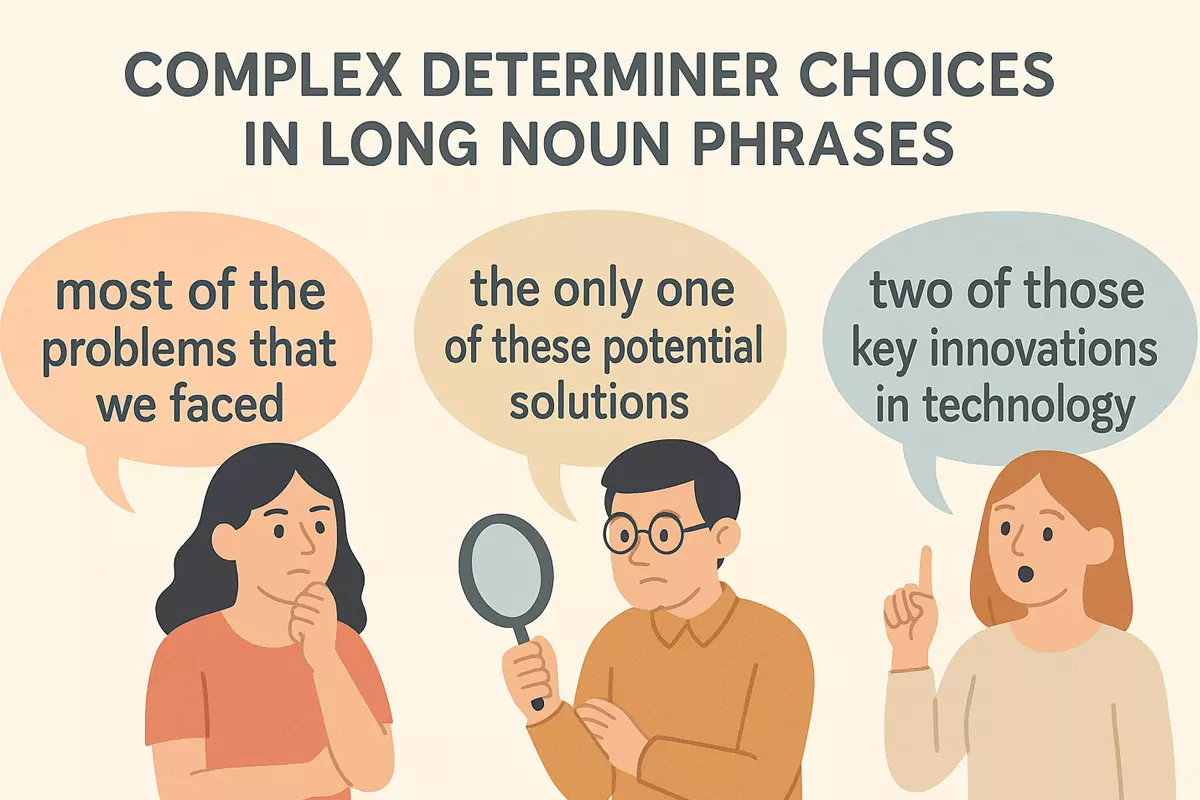 Here we the structure and placement of extended noun phrases, focusing on determiners, modifiers, and their impact on meaning. It also addresses interpreting complex noun groups, common learner issues, and includes practice with reordering long noun phrases.
- Structure of extended noun phrases
- Role of determiners when multiple modifiers appear
- How determiners affect meaning and specificity
- Placement rules in multi-word noun groups
- Interpreting dense academic or technical noun phrases
- Typical learner difficulties with long noun chunks
- Practice: reorder and analyze long noun phrases
Choosing the correct article or quantifier in complex noun phrases can be challenging, particularly when several modifiers or embedded clauses are present. Mastering these subtle distinctions is crucial for producing clear, accurate, and natural-sounding sentences. Careful attention to article and quantifier use not only improves grammatical correctness but also enhances the overall readability and flow of your writing. By practicing and reflecting on these choices, writers can develop greater confidence and skill in constructing effective sentences.
Structure of extended noun phrases
Understanding how long noun groups are built is fundamental for analyzing complex determiner selection. Extended noun phrases (ENPs) often include several layers of modifiers, each contributing to the overall meaning and requiring careful determiner choices. These modifiers can appear before or after the main noun, and their arrangement affects both clarity and grammaticality.
Core components in extended noun groups
At their simplest, these constructions are made up of three main parts:
- Determiners: such as articles, demonstratives, and possessives
- Premodifiers: adjectives, quantifiers, or other descriptive elements
- Head noun: the main subject of the phrase
- Postmodifiers: relative clauses, prepositional phrases, or participial phrases
Common patterns in complex noun phrases
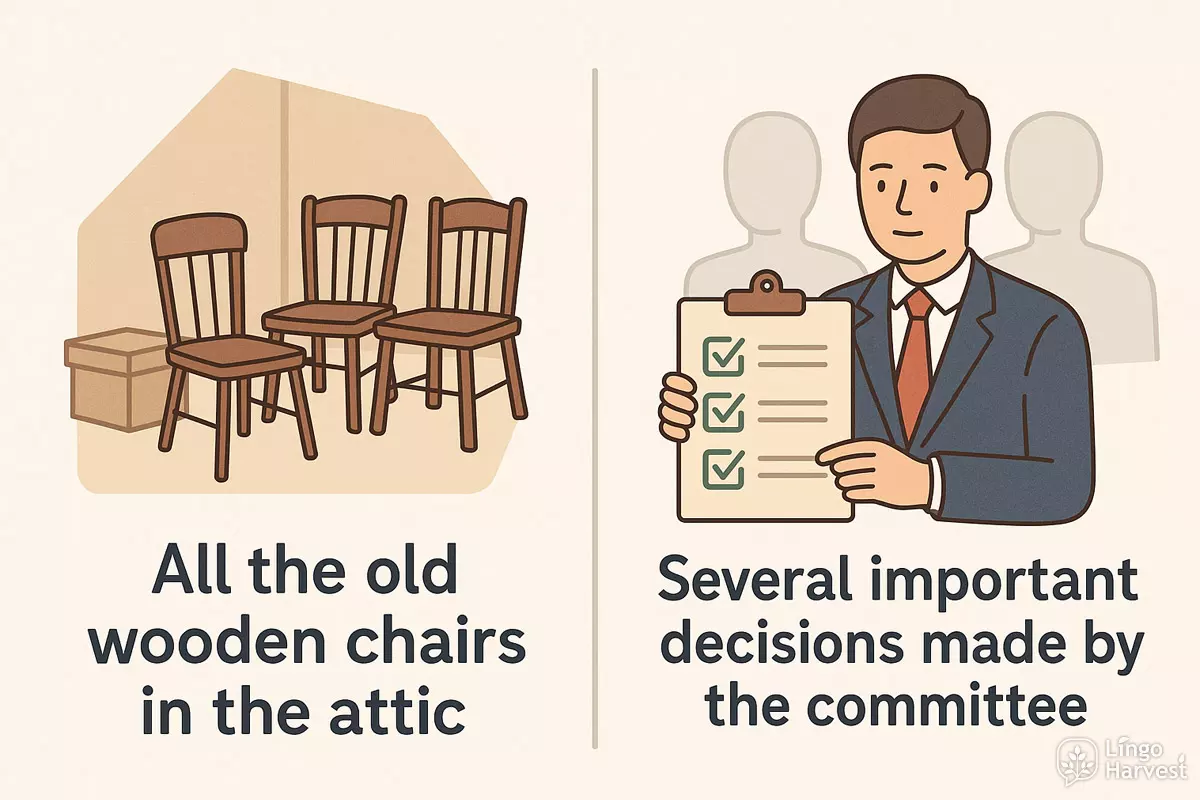
Writers often use a mix of these elements to add detail or specificity. For example:
- All the old wooden chairs in the attic
- Several important decisions made by the committee
- The first three chapters of the book recommended by the professor
- Every single tiny piece of the ancient mosaic
Determinants of determiner choice
Factors influencing which determiner to use include:
- Quantity and specificity (e.g., some vs. every)
- Presence of other modifiers (e.g., the many vs. those few remaining)
- Whether the noun is countable or uncountable
- Contextual emphasis (e.g., this particular vs. any available)
Modifier ordering in extended noun constructions
The arrangement of elements before the head noun follows a fairly strict hierarchy in English. For reference, here’s a summary of typical modifier order:
| Modifier Type | Example |
|---|---|
| Determiner | the, some, my, each |
| Quantity/Number | three, several, many |
| Opinion/Observation | lovely, unusual, difficult |
| Size | small, huge, tiny |
| Age | old, new, ancient |
| Shape | round, square, flat |
| Color | red, blue, golden |
| Origin | French, wooden, silk |
| Material | metal, plastic, woolen |
| Qualifier | kitchen (as in "kitchen table"), wedding (as in "wedding dress") |
Illustrative examples of multi-layered noun groups
Here are several extended noun phrase examples, highlighting how determiners and modifiers interact:
- Those five enormous silver serving platters from Italy
- Each carefully chosen word in the passionate speech
- My two favorite childhood stories about dragons
- The only available seat near the window
- Any remaining unsolved math problems in the assignment
- Several beautiful old stone bridges over the river
- That last unopened letter on the desk
- Some particularly challenging technical questions during the interview
- The first bright yellow daffodils of spring
- Every single rare artifact displayed in the museum
- Our many previous attempts at solving the puzzle
- All those noisy little puppies in the backyard
- Another interesting new proposal for the project
- His three large antique clocks from Paris
- Several recently published research articles on the topic
The interplay of determiners, modifiers, and the head noun creates a rich structure. Mastery of this arrangement is essential for accurate and natural usage in both writing and speech.
Role of determiners when multiple modifiers appear
When a noun phrase contains several modifiers—such as adjectives, quantifiers, or prepositional phrases—the choice and placement of a determiner becomes especially significant. Determiners help clarify which entity is being discussed, even as the phrase grows more complex. Their function is to anchor the entire noun phrase, signaling definiteness, quantity, or possession before any descriptive details appear.
How determiners interact with multiple modifiers
In English, the determiner almost always comes first, preceding all other modifiers. This initial position is crucial because it immediately frames the reference point for the listener or reader. For example, in “those three large antique wooden chairs,” the word “those” sets the scope before any further description is added.
- Definite article: The old blue ceramic vase on the shelf
- Demonstrative: This unusual bright yellow sports car
- Possessive: My two favorite historical fiction novels
- Quantifier: Several interesting new research papers
- Numeral: Five delicious homemade chocolate cakes
- No determiner (plural or uncountable): Freshly baked bread on the table
Common patterns with complex noun phrases
The determiner’s role is to provide clarity as more modifiers are added. Consider the following patterns:
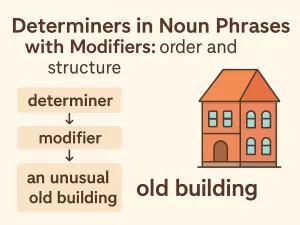
- Determiner + Quantity + Opinion + Size + Age + Shape + Color + Origin + Material + Noun
- Determiner + Adjective(s) + Noun + Prepositional Phrase
- Possessive Determiner + Adjective + Compound Noun
For example:
- Her three small round silver coins from Italy
- Those old wooden chairs in the corner
- My favorite large blue ceramic bowl
- Several fascinating new scientific articles on climate change
Challenges and special cases
Choosing the right determiner becomes tricky with certain modifiers. For instance, possessive determiners and articles cannot usually be combined (*the my car is incorrect), and quantifiers sometimes require different forms or omit articles altogether.
| Phrase Structure | Example |
|---|---|
| Definite article + multiple adjectives + noun | The big old red truck |
| Quantifier + adjective + noun | Several difficult math problems |
| Possessive + adjective + noun + prepositional phrase | My favorite mug from Paris |
| No determiner (mass noun) + modifiers | Fresh cold water in the glass |
| Demonstrative + numeral + adjectives + noun | Those three fascinating recent documentaries |
Key takeaways
Placing the determiner before any modifiers sets the frame for the entire phrase and avoids ambiguity. As noun phrases become longer, being aware of determiner compatibility and restrictions—especially with possessives and quantifiers—prevents ungrammatical constructions. Mastery of this structure allows for clearer, more precise communication, especially in formal or academic writing.
How determiners affect meaning and specificity
Choosing determiners carefully can dramatically change the reference and clarity of long noun phrases. The right word at the start of a noun phrase can signal whether you mean something general, something unique, or something countable. This is especially important in complex structures, where multiple modifiers and embedded phrases can make interpretation tricky for readers.
Shaping Reference: Definite, Indefinite, and Quantitative
Determiners like "the," "a," "some," or "every" each set different expectations for what follows. For example, "the report on climate data" points to a specific, known report, while "a report on climate data" could refer to any such report. Quantifiers such as "many," "few," and "several" further refine meaning by indicating quantity or amount, which is vital in technical or academic writing.
- The – points to a unique or previously mentioned item
- A/An – introduces something new or non-specific
- Some – suggests an unspecified amount or subset
- Any – often used for non-specific or open choices
- Each/Every – emphasizes individuals within a group
- All – refers to the entire group without exception
- Most – indicates the majority, but not all
- Several – refers to more than two, but not many
- Few/Little – stresses scarcity or small number/amount
- Both – signals exactly two items
- Another – introduces an additional, unspecified item
- Much – used for large amounts (uncountable nouns)
- Numerals (e.g., "three," "ten") – state exact quantity
Impact on Ambiguity and Precision
When noun phrases grow longer, the initial determiner helps the reader understand scope. For instance, "every student in the advanced linguistics seminar with published research" marks the whole category, while "some students in the advanced linguistics seminar with published research" restricts the reference to a subset. Without a clear determiner, readers may be unsure whether you mean all, some, or just one entity.
Comparing Determiner Effects in Complex Phrases
Below is a structured comparison showing how various determiners shift meaning when attached to a long noun phrase:
| Determiner | Resulting Meaning in the Example Phrase |
|---|---|
| The | Refers to one specific, identifiable item: the report on recent developments in renewable energy technologies submitted last week ✅ Unique and known to both writer and reader. |
| A | Introduces any single, non-specific item: a report on recent developments in renewable energy technologies submitted last week → One of possibly many, not previously identified. |
| Some | Indicates an unspecified subset: some reports on recent developments in renewable energy technologies submitted last week → More than one, but not all. |
| Every | Encompasses all items in the group: every report on recent developments in renewable energy technologies submitted last week ✅ Total inclusion, no exceptions. |
| Many | Highlights a large, but indefinite, number: many reports on recent developments in renewable energy technologies submitted last week → Emphasizes quantity rather than specificity. |
| Few | Stresses scarcity: few reports on recent developments in renewable energy technologies submitted last week ❌ Only a small number are implied. |
| All | Means the complete set: all reports on recent developments in renewable energy technologies submitted last week ✅ No exclusions. |
| Any | Opens the reference to any possible item(s): any report on recent developments in renewable energy technologies submitted last week → No restrictions on choice. |
Summary
The determiner at the start of a noun phrase serves as a guidepost, shaping not only the boundaries of reference but also the precision with which information is conveyed. In lengthy or intricate noun phrases, this choice can mean the difference between clarity and confusion for your audience.
Placement rules in multi-word noun groups
Understanding where to position determiners, adjectives, and modifiers in extended noun phrases helps readers and listeners process complex information efficiently. In English, these sequences often include articles, quantifiers, possessives, and descriptive words, each with its own preferred order. The arrangement is not random—certain patterns and rules help maintain clarity and grammatical correctness.
Typical order of elements
A long noun phrase can have several components. The general sequence is:
- Determiner (e.g., the, some, my)
- Pre-modifying adjectives (old, red, expensive)
- Quantifiers (many, few, several)
- Other modifiers (e.g., participles: broken, running)
- Main noun (books, table)
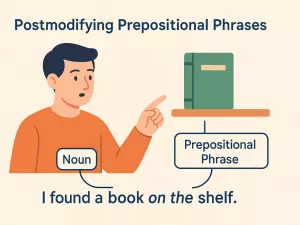
- Post-modifiers (often prepositional phrases: on the desk, with the blue cover)
Common placement patterns
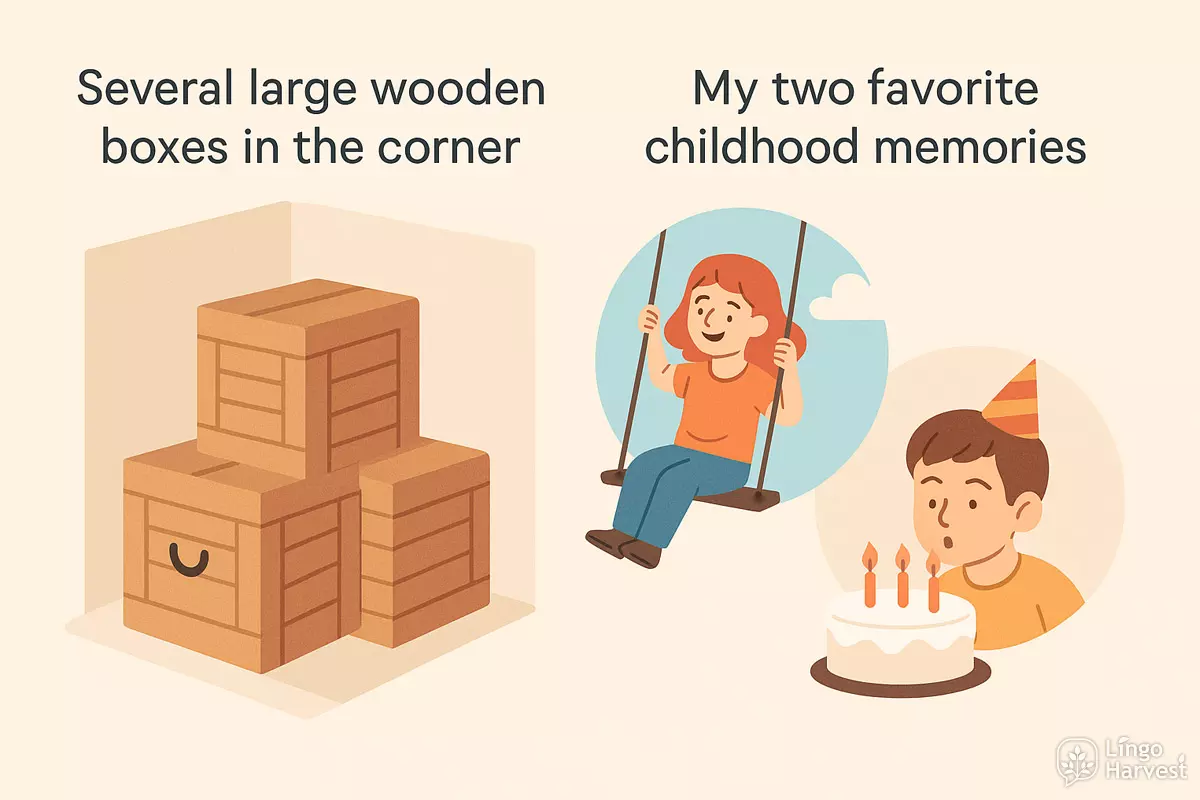
The following examples show how different elements fit together in extended noun groups:
- All the old French novels on the shelf
- Several large wooden boxes in the corner
- My two favorite childhood memories
- Those beautiful antique silver candlesticks
- Any interesting articles about medieval history
- Each new policy under review
- The first three delicious chocolate cakes
- Some important recent scientific discoveries
- His last three financial reports
- Every single tiny screw in the machine
- Several little-known medieval poets
- The best available option for students
- Our many shared childhood experiences
- These remarkable historical photographs
- Few relevant current statistics
- The only remaining original document
- Each carefully chosen ingredient
- Some vital community health resources
- His numerous failed business ventures
- The final urgent government announcement
Exceptions and restrictions
Not all elements can be combined freely. For instance, double determiners like the my or these a are ungrammatical (❌). Additionally, quantifiers such as all and each usually precede other determiners, and opinion adjectives (e.g., interesting) typically come before factual or physical descriptions (e.g., red, wooden).
| Element | Typical Position & Example |
|---|---|
| Determiner | First: the three old books |
| Quantifier | Before adjectives: all the red chairs |
| Adjective(s) | Before noun: three large wooden tables |
| Post-modifier | After noun: the report on climate change |
Summary tips
- Start with determiners or quantifiers.
- Order adjectives by opinion, then size, age, shape, color, origin, material.
- End with the main noun, then any post-modifiers.
- Avoid stacking multiple determiners together.
- Use only what’s necessary for clarity—overly long noun groups can confuse.
Getting comfortable with these patterns will help you build clear, precise phrases in both writing and conversation.
Interpreting dense academic or technical noun phrases
Understanding long, information-packed noun groups in scholarly or technical writing can be challenging. These structures often combine multiple adjectives, modifiers, and determiners with specialized vocabulary, which can obscure the relationships between the elements. Careful analysis is essential for accurate comprehension and clear communication.
Key features of complex noun strings
Extended noun phrases in academic contexts often involve:
- Multiple premodifiers (e.g., "advanced neural network training algorithms")
- Embedded possessives or genitives ("the system’s performance evaluation metrics")
- Stacked determiners and quantifiers ("each of the several proposed alternative models")
- Technical terms as modifiers ("carbon nanotube sensor array design")
- Abbreviations or acronyms within the phrase ("MRI signal intensity mapping protocols")
Strategies for parsing and understanding
To unpack these dense constructions, consider:
- Identifying the head noun (the main subject of the phrase)
- Grouping modifiers logically (what describes what?)
- Recognizing fixed technical expressions or collocations
- Breaking down the phrase from right to left (starting with the head noun)
- Looking for clues in determiners and quantifiers about scope or reference
Common patterns in technical contexts
Many fields rely on recurring patterns when building elaborate noun groups. Here are some typical structures:
- Measurement + Material + Device: "high-frequency silicon photonic modulator"
- Quantity + Quality + Process: "multiple randomized controlled trial analyses"
- Attribute + Function + Entity: "low-latency data transmission protocol"
- Modifier + Acronym + Application: "enhanced MRI tissue segmentation method"
Examples of intricate noun phrases
Below is a list of sample phrases that illustrate the complexity and variety found in technical writing:
- Long-term atmospheric greenhouse gas emission profiles
- High-resolution satellite-based precipitation measurement techniques
- Double-blind placebo-controlled clinical trial outcomes
- Quantum-dot-sensitized solar cell efficiency parameters
- Automated machine learning hyperparameter optimization frameworks
- Post-surgical infection risk reduction strategies
- Deep convolutional neural network feature extraction layers
- Multi-center prospective cohort study design
- Real-time polymerase chain reaction assay protocols
- Genome-wide association study statistical significance thresholds
- Time-dependent Schrödinger equation solution methods
- Distributed ledger blockchain transaction validation procedures
- Energy-efficient wireless sensor network routing algorithms
- Patient-reported health-related quality of life measures
- Non-invasive brain-computer interface calibration routines
- Electrochemical impedance spectroscopy data interpretation models
- High-performance computing cluster resource allocation policies
- Next-generation sequencing read alignment tools
- Three-dimensional finite element mesh refinement techniques
- Self-assembled monolayer surface modification procedures
Challenges and pitfalls
Readers often struggle with:
- Misidentifying the main noun, leading to misinterpretation
- Overlooking the scope provided by determiners ("the", "each", "several")
- Confusing nested structures or attributive phrases
- Assuming all modifiers are equally important
Quick comparison: Determiner placement in technical noun phrases
| Phrase | Determiner Placement | Effect on Meaning |
|---|---|---|
| the new data analysis method | Determiner at the start ("the") | Refers to a specific, previously mentioned method |
| each of the several alternative hypotheses | Stacked determiners ("each of the several") | Highlights individual consideration within a set |
| some recent clinical trial results | Indefinite quantifier ("some") | Indicates non-specific subset |
| these advanced polymer composite materials | Demonstrative determiner ("these") | Signals a particular group in context |
By systematically analyzing the parts and recognizing common patterns, readers can more confidently interpret complex noun constructions in academic and technical writing.
Typical learner difficulties with long noun chunks
Parsing extended noun groups in English often presents a significant hurdle for language learners. With multiple modifiers, determiners, and embedded phrases, it becomes challenging to identify the correct word order and relationships between elements. Confusion frequently arises when students must decide which determiners to use, especially when several modifiers are stacked before the noun.
Common areas of confusion
Learners tend to struggle with several recurring issues:
- Choosing between "a," "the," "some," or "any" in multi-word noun phrases
- Placing adjectives and quantifiers correctly in relation to the head noun
- Handling possessives alongside other determiners (e.g., "my two friends' new house")
- Understanding which nouns require determiners and which do not
- Interpreting the meaning when prepositional phrases are embedded (e.g., "the result of the recent policy change")
- Distinguishing restrictive and non-restrictive elements within the phrase
- Managing agreement between determiners and plural/singular nouns
- Deciding on article use before abstract or uncountable nouns in complex strings
- Recognizing when to use "of" constructions versus simple adjective order (e.g., "a piece of cake" vs. "chocolate cake")
- Handling embedded relative clauses (e.g., "the book that my friend gave me last year")
Frequent learner mistakes
When faced with lengthy noun groups, typical errors include:
- Omitting a necessary article or determiner
- Inserting redundant or incorrect determiners ("the my friend's suggestion")
- Misordering adjectives, quantifiers, and possessives
- Overusing "of" structures where simpler forms are preferred
- Failing to link modifiers correctly, leading to ambiguity
Comparison of correct and incorrect determiner placement
| Incorrect Example | Corrected Version |
|---|---|
| the my friend's old house | my friend's old house |
| a the big red car | the big red car / a big red car |
| some informations about the process | some information about the process |
| the two first chapters | the first two chapters |
| an advice for you | some advice for you |
| my all books | all my books |
Underlying causes
Many of these mistakes come from transferring patterns from learners’ native languages, where noun phrase structure may differ considerably. Additionally, the sheer number of possible combinations in English can overwhelm learners, especially when rules seem inconsistent or exceptions abound.
Strategies for improvement
To overcome these challenges, students benefit from:
- Analyzing example sentences with varied determiner and modifier patterns
- Practicing with real-life texts, breaking down longer noun groups
- Memorizing common collocations and fixed expressions
- Using visual diagrams to map out phrase structure
With repeated exposure and targeted practice, learners can gradually build confidence in handling extended noun groups with the correct determiner choices.
Practice: reorder and analyze long noun phrases
Understanding how to structure extended noun groups is essential for clarity and precision. In English, these constructions often involve multiple determiners, adjectives, and modifiers, making word order critical. Let's explore how to analyze and reorganize such phrases for naturalness and correctness.
Task 1: Identify the Correct Order
Below are several jumbled noun phrases. Rearrange the elements in each to form a natural, grammatical phrase.
- interesting / several / new / research / articles
- wooden / two / old / large / tables
- complex / every / grammatical / rule / single
- recent / a / government / controversial / decision
- students / hardworking / many / international / graduate
- small / three / round / glass / bowls
- beautiful / her / long / black / hair
- modern / several / efficient / energy / systems
- first / the / important / major / breakthrough
- tiny / those / delicate / white / flowers
Show answers
- several interesting new research articles
- two large old wooden tables
- every single complex grammatical rule
- a recent controversial government decision
- many hardworking international graduate students
- three small round glass bowls
- her beautiful long black hair
- several modern efficient energy systems
- the first important major breakthrough
- those tiny delicate white flowers
Task 2: Analyze Determiner Choice
Consider these long noun phrases. For each, identify the determiners (words like the, some, every, those), and explain their function.
- those three incredibly detailed scientific research proposals
- every single important historical event
- some of the most difficult exam questions
- her two favorite childhood storybooks
Show answers
- those (demonstrative: specifies which proposals), three (quantity)
- every (universal determiner: refers to all events), single (emphasis)
- some (indefinite determiner), the (definite article), most (superlative)
- her (possessive), two (number)
Common Patterns in Extended Noun Groups
Observe the typical order for elements in complex noun chains. Here are frequent components:
- Determiner (the, a, those, my)
- Quantity (two, several, many)
- Opinion adjective (interesting, beautiful)
- Size/age/shape (large, old, round)
- Color/origin/material (red, Italian, wooden)
- Purpose/qualifier (sleeping [as in sleeping bag], research [as in research proposal])
- Head noun (the main subject, e.g., students, tables)
Comparing Reordered Noun Phrases
| Original Elements (Jumbled) | Natural Order |
|---|---|
| three / beautiful / old / Italian / paintings | three beautiful old Italian paintings |
| my / first / two / difficult / math / exams | my first two difficult math exams |
| those / large / round / blue / vases | those large round blue vases |
| a / fascinating / new / technological / innovation | a fascinating new technological innovation |
| some / small / delicious / French / pastries | some small delicious French pastries |
Challenge: Build Your Own
Create a long noun phrase using at least four modifiers. For example, start with a determiner, add a quantity, adjectives, and a noun. Write your phrase, then analyze the order of elements you used.
Show answers
Example: "these five incredibly complex old linguistic theories"
- Determiner: these
- Quantity: five
- Adverbs/Intensifiers: incredibly
- Opinion/Description: complex
- Age: old
- Qualifier: linguistic
- Noun: theories
By practicing with varied, intricate noun chains, you'll develop a stronger intuition for natural word order and determiner use in extended noun groups.