Articles in There Is / There Are with Quantifiers (some, many, a few)

 Here we how to use there is and there are with nouns, when to use quantifiers like some, any, many, and a few instead of articles, how to combine them, and highlights typical mistakes. It also offers practice with sentence completion.
Learning to use quantifiers such as some, many, and a few with expressions like there is and there are can greatly improve your English fluency and accuracy. By combining these words correctly, you can describe amounts, objects, and situations more clearly in both spoken and written communication. This skill is essential for everyday conversations, as it allows you to express yourself more naturally and be easily understood by others. Practicing these structures will help you become more confident and precise when talking about quantities and making descriptions.
Structure of there is/there are with nouns
When talking about the existence or presence of something, English uses “there is” for singular nouns and “there are” for plural nouns. This construction is especially useful when you want to introduce something new or describe a situation. The choice between “is” and “are” depends on whether the noun following the verb is singular or plural. Quantifiers like “some,” “many,” or “a few” are often added to give more detail about the amount or number.
Basic Sentence Patterns
- There is + a singular noun (e.g., There is a book on the table.)
- There is + an uncountable noun (e.g., There is some water in the glass.)
- There are + plural nouns (e.g., There are many people in the room.)
- There are + a few / some + plural nouns (e.g., There are a few cookies left.)
Using Quantifiers with “There is/There are”
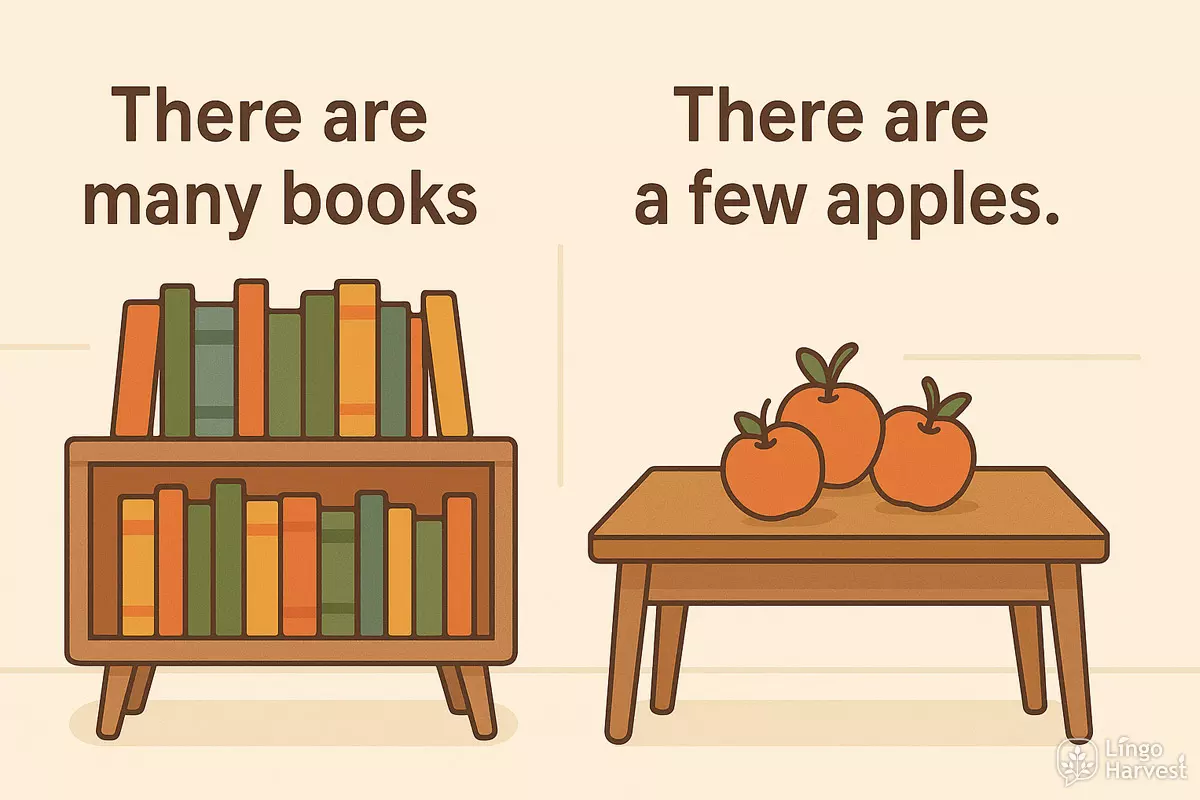
Quantifiers change the meaning by specifying quantity. With uncountable nouns, use “some” or “much.” With plural countable nouns, use “some,” “many,” or “a few.” The choice of quantifier helps express whether there is a large or small amount of something.
| Sentence Structure | Example |
|---|---|
| There is + a/an + singular noun | There is a cat in the garden. |
| There is + some + uncountable noun | There is some milk in the fridge. |
| There are + many + plural noun | There are many books on the shelf. |
| There are + a few + plural noun | There are a few apples on the table. |
| There are + some + plural noun | There are some chairs in the room. |
Common Examples with Quantifiers
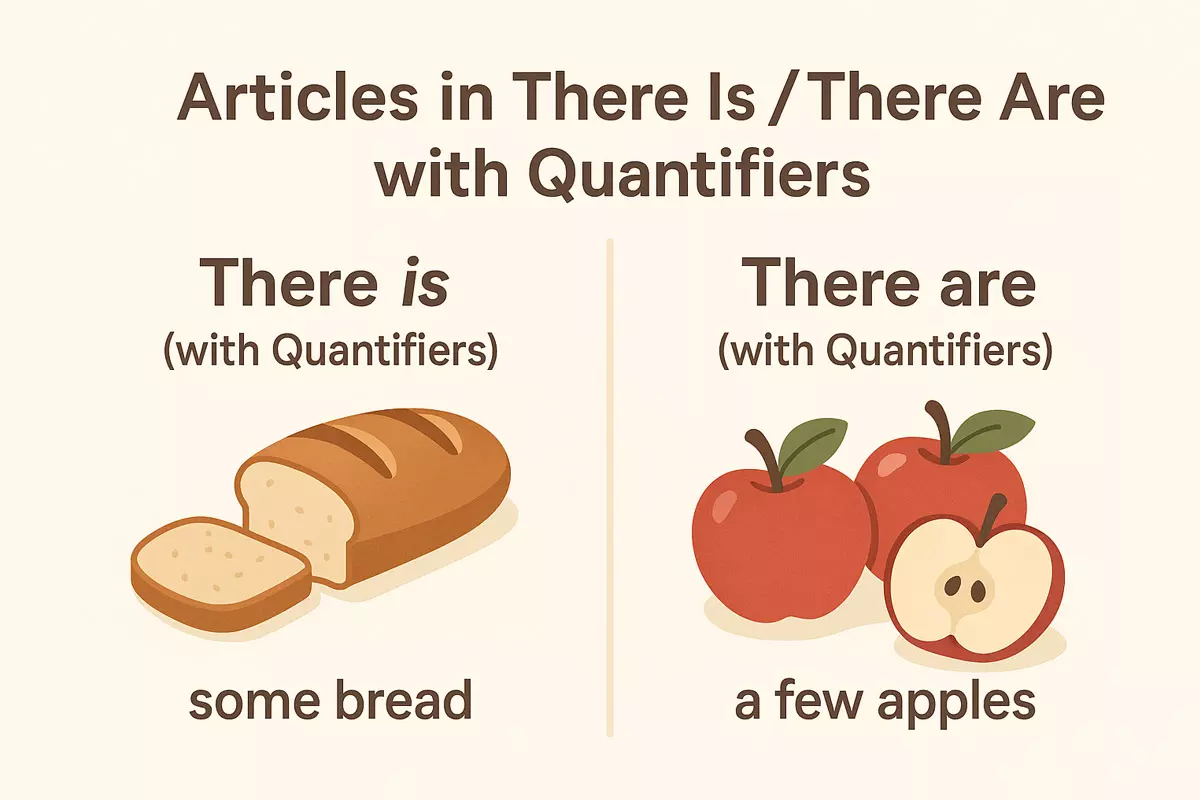
- There is some bread left.
- There are many students in class.
- There is a little sugar in the bowl.
- There are a few mistakes in your essay.
- There is not much time.
- There are some interesting photos here.
- There is a problem with the printer.
- There are several reasons to try.
- There are no tickets available.
- There is an apple on the plate.
- There are lots of options.
- There is only one answer.
When quantifiers replace articles
In English, words like some, many, and a few often take the place of articles such as a, an, or the in sentences with there is or there are. These quantifiers help indicate the amount or number of things being discussed, making the meaning more precise. Instead of just saying that something exists, these words tell us how much or how many.
Why use quantifiers instead of articles?
Articles simply show that something exists or is mentioned for the first time. Quantifiers, however, add detail about quantity. For example, "There is a book on the table" just means one book, but "There are some books on the table" expresses that there is more than one, but an unspecified number.
Common quantifiers in 'there is/are' sentences
- some
- many
- a few
- a lot of
- several
- much
- any (in negatives/questions)
- no
- plenty of
- few
- little
- lots of
- each
- enough
- too much
- too many
- not much
- not many
- a little
- a couple of
- dozens of
- hundreds of
- thousands of
- no more
- no longer any
- the amount of
- the number of
- quite a few
- quite a bit of
- a great deal of
- a large amount of
- a large number of
- almost no
- almost any
Examples: Articles vs. Quantifiers
| With Article | With Quantifier |
|---|---|
| There is a cat in the garden. | There are some cats in the garden. |
| There is an apple on the table. | There are a few apples on the table. |
| There is a problem. | There are many problems. |
| There is a student in the classroom. | There are several students in the classroom. |
| There is an answer. | There is no answer. |
Tips for choosing quantifiers
Use some for positive statements when the exact number isn’t important. Choose many or much for large amounts (many for countable, much for uncountable nouns). A few and a little indicate small quantities. In negative sentences or questions, any is common.
Remember, using a quantifier instead of an article usually changes the focus from a single item to a group or an amount. This helps communicate more specific information about what is present or absent.
Using some, any, many, a few with nouns
When describing quantity in English, words like "some," "any," "many," and "a few" help us express amounts in a clear way. These quantifiers are especially common with "there is" and "there are" structures, and each has a specific use depending on context, sentence type, and whether the noun is countable or uncountable.
How to Use "Some" and "Any"
"Some" is typically used in positive statements to talk about an unspecified amount. It works with both countable plural nouns and uncountable nouns. For example:
- There are some books on the table.
- There is some water in the glass.
"Any" is mostly used in negative sentences and questions. It can also be used with both countable and uncountable nouns:
- There aren't any apples left.
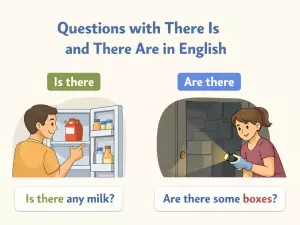
- Is there any milk in the fridge?
Using "Many" and "A Few"
"Many" is used for large quantities of countable nouns, often in questions and negatives:
- Are there many students in the classroom?
- There aren't many cars on the road today.
"A few" means a small number, but enough to be significant. It is only used with plural countable nouns:
- There are a few cookies left.
- We have a few ideas for the project.
Summary Table: Quantifiers with Nouns
| Quantifier | Used with | Typical Example |
|---|---|---|
| some | Plural countable & uncountable nouns (affirmative) | There are some chairs.✅ There is some juice.✅ |
| any | Plural countable & uncountable nouns (negatives/questions) | Are there any messages?→ There isn't any rice.❌ |
| many | Plural countable nouns (questions/negatives, sometimes affirmatives) | There aren't many buses.❌ Are there many parks here?→ |
| a few | Plural countable nouns (affirmative) | There are a few pens on the desk.✅ |
More Examples of Quantifiers in Context
An expanded set of examples can help clarify how these words are used:
- There are some oranges in the bowl.
- There is some bread on the plate.
- There aren't any mistakes in your work.
- Are there any questions?
- There aren't many options available.
- Do you have many friends here?
- There are a few tickets left.
- There are a few clouds in the sky.
- There isn't any sugar in the cupboard.
- There are many reasons to visit.
Choosing the right quantifier depends on the noun and the meaning you want to express. Practice with different nouns and sentence types to become more confident using these words naturally.
Combining quantifiers and articles
When using "there is/are" sentences, English often combines quantifiers (like "some," "many," "a few") with articles ("a," "an," "the") to give more precise information about quantity and specificity. The choice depends on whether the noun is countable or uncountable, singular or plural, and if the context is definite or indefinite.
How quantifiers and articles interact
Quantifiers usually come before the noun phrase and, if used together with articles, follow a particular order. For example, "some" and "many" generally replace the article, while "a few" and "a little" can work with or without articles, depending on the noun.
- There are some books on the table. (some + plural noun, no article)
- There is a book on the table. (a + singular countable noun)
- There are a few apples in the basket. (a few + plural noun, no article)
- There is some milk in the fridge. (some + uncountable noun)
- There are many cars in the parking lot. (many + plural noun, no article)
- There is little time left. (little + uncountable noun, no article)
- There is a little hope for success. (a little + uncountable noun, no article)
- There are a lot of people here. (a lot of + plural noun)
- There is an apple on the plate. (an + singular noun)
- There are the students you wanted to meet. (the for specific group)
- There are few options available. (few + plural noun, means not many)
- There is much information online. (much + uncountable noun)
- There are several chairs in the room. (several + plural noun)
- There is no water left. (no + uncountable noun)
- There are no pens on the desk. (no + plural noun)
Patterns to remember

The article is usually omitted when a quantifier like "some," "many," "few," or "no" is present, because these already specify the noun. Only use "a" or "an" with singular, countable nouns and without another quantifier.
| Quantifier + Noun | Example Sentence |
|---|---|
| some + plural/uncountable | There are some cookies. / There is some sugar. |
| many + plural | There are many students in the hall. |
| a few + plural | There are a few questions left. |
| a/an + singular countable | There is a bottle on the shelf. |
| the + specific noun | There are the books I mentioned. |
| no + plural/uncountable | There is no bread. / There are no chairs. |
Summary tips
- Use "a/an" only for one item (singular, countable).
- Quantifiers like "some," "many," or "a few" do not combine with "a/an" or "the" unless the noun is specific ("the few people who came").
- With uncountable nouns, use quantifiers ("some," "much," "a little") instead of articles.
- For negatives, "no" replaces both the quantifier and the article.
Understanding the patterns makes it easier to form correct sentences with "there is" and "there are" in English, especially when expressing quantities or referring to non-specific items.
Typical mistakes in real communication
Many learners struggle with “there is / there are” when using quantifiers like "some," "many," or "a few" in everyday English. These errors can make statements confusing or unnatural, especially when talking about quantity or the existence of things.
Common problems with quantifiers and verb agreement
A frequent issue is mixing up singular and plural forms. For example, people often say “There is many apples” instead of the correct “There are many apples.” This happens because the focus shifts to the quantifier, and the verb agreement gets overlooked.
- Forgetting to use “are” with plural nouns and quantifiers like "many" or "a few".
- Using “is” with countable plural nouns: There is a few books on the table. ❌
- Placing “some” with uncountable nouns incorrectly: There are some milk in the fridge. ❌
- Confusing “some” and “many”: There is many water here. ❌
- Omitting the article: There are few students in class. (meaning: almost none, which may not be what you intend)
- Misplacing quantifiers: There are apples many on the tree.
- Using “some” in negative sentences: There aren’t some chairs here. ❌
- Using “a few” with uncountable nouns: There are a few sugar left. ❌
- Repeating quantifiers unnecessarily: There are some many people here.
- Incorrect word order: There some are apples.
Confusion between countable and uncountable nouns
Learners often forget that “many” is for countable nouns, while “much” is for uncountable nouns. The same goes for “a few” (countable) vs. “a little” (uncountable).
| Incorrect Usage | Correct Form |
|---|---|
| There is many books on the shelf. | There are many books on the shelf. |
| There are a few sugar in the bowl. | There is a little sugar in the bowl. |
| There are some milk in the glass. | There is some milk in the glass. |
| There is a few pens in my bag. | There are a few pens in my bag. |
| There are much apples here. | There are many apples here. |
Other real-life mix-ups
When speaking quickly, it’s easy to confuse “there’s” for both singular and plural, especially in informal conversation: “There’s some books on the table.” While native speakers sometimes do this, it’s best to keep forms correct in formal situations.
- Using contractions incorrectly: There’s many reasons.
- Mixing up positive and negative sentences: There isn’t any apples. (should be “aren’t”)
- Not matching quantifier to noun type: There are a few information. (information is uncountable)
By paying attention to these patterns and practicing with real examples, you’ll avoid the most common slips and sound more natural when talking about quantities and existence in English.
Practice: complete there is/there are sentences with correct forms
Mastering "there is" and "there are" with quantifiers like some, many, and a few is essential for describing quantity and existence in English. Below you'll find a series of practice activities to reinforce your ability to use these structures naturally, especially when combined with articles and quantifiers.
Fill in the blanks
Complete the following sentences by choosing the correct form: there is or there are. Pay attention to whether the noun is countable/uncountable and the quantifier used.
- ______ some apples on the table.
- ______ a few problems with the computer.
- ______ many books on the shelf.
- ______ some water in the glass.
- ______ a cat under the sofa.
- ______ many students in the classroom today.
- ______ a few cookies left in the jar.
- ______ a pencil in my bag.
- ______ some milk in the fridge.
- ______ many cars in the parking lot.
- ______ a lot of noise outside tonight.
- ______ several emails waiting for you.
- ______ no chairs available in the hall.
- ______ too many tasks to finish today.
- ______ little sugar left in the bowl.
Show answers
- There are some apples on the table.
- There are a few problems with the computer.
- There are many books on the shelf.
- There is some water in the glass.
- There is a cat under the sofa.
- There are many students in the classroom today.
- There are a few cookies left in the jar.
- There is a pencil in my bag.
- There is some milk in the fridge.
- There are many cars in the parking lot.
- There is a lot of noise outside tonight.
- There are several emails waiting for you.
- There are no chairs available in the hall.
- There are too many tasks to finish today.
- There is little sugar left in the bowl.
Choose the correct quantifier
Select the most appropriate quantifier (some, many, or a few) for each sentence.
- There are ______ chairs in the room. (more than 10)
- There is ______ juice left in the bottle. (not much)
- There are ______ apples in the basket. (a small number)
- There is ______ bread on the table. (an unspecified amount)
- There are ______ tourists in the museum. (a large number)
- There is ______ water in the glass. (almost none)
- There are ______ books on the shelf. (a huge number)
- There is ______ noise coming from outside. (too much)
- There are ______ options to choose from. (several)
- There is ______ sugar in the jar. (none)
- There are ______ reasons to believe him. (quite a few)
- There is ______ traffic today. (a large amount)
- There are ______ people at the event. (not many)
- There is ______ furniture in the room. (a little)
- There are ______ problems with the plan. (too many)
Show answers
- many
- a little / some
- a few
- some
- many / a lot of
- almost no
- hundreds of / lots of / a lot of
- too much
- several
- no
- quite a few
- a lot of / much
- not many
- a little
- too many
Quick Reference: Common Patterns
Here is a helpful overview of typical sentence structures using "there is/there are" with quantifiers and articles:
| Structure | Example |
|---|---|
| There is + a/an + singular noun | There is a dog in the yard. |
| There are + (no article) + plural noun | There are books on the table. |
| There is + some + uncountable noun | There is some juice in the glass. |
| There are + many/a few + plural noun | There are many students in the hall. There are a few pencils on the desk. |
Make your own sentences
Try writing at least five original sentences using "there is" or "there are" with different quantifiers and articles. For example:
- There are a few sandwiches on the plate.
- There is some information in the report.
- There are many flowers in the garden.
- There is an apple on the chair.
- There are some questions at the end of the test.
Practicing these forms will help you gain confidence in everyday English descriptions.