Verbs of Possession and Existence Explained

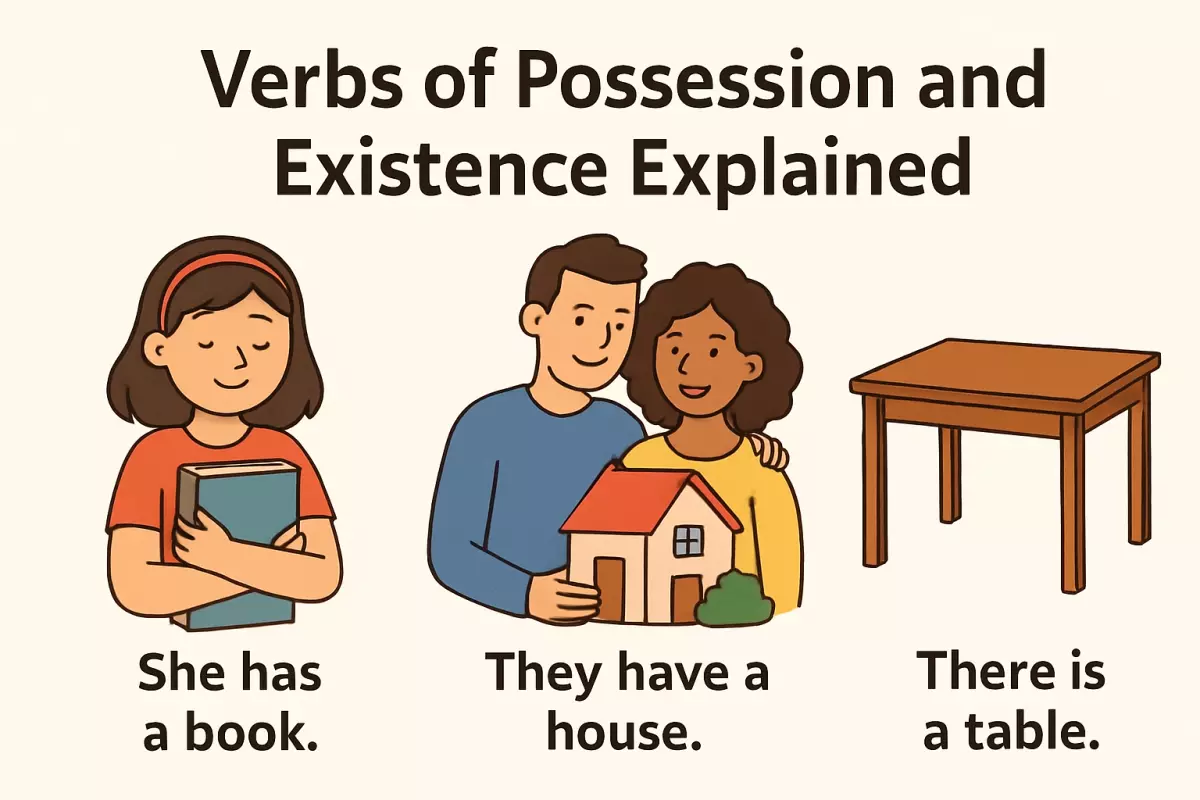 This article explains what possession and existence verbs express, including patterns for have, own, belong, exist, and there is/there are.
Verbs that express ownership and existence can shift the meaning of a simple sentence in everyday conversation. In this lesson, you will learn when to use have, own, be, and there is or there are, so you can describe what you possess and what exists in a place with accuracy. With clear examples and practice, your English will sound more natural and confident in real situations.
What possession and existence verbs express
These verbs let you describe two closely related ideas: (1) who controls, owns, contains, or is connected to something, and (2) whether something is present, available, or located in a place or situation. They often appear in simple present and past forms because they state facts, states, and conditions rather than actions.
Possession: relationships between an owner and a thing
Possession verbs express a stable link such as ownership, family ties, attributes, or parts of a whole. In English, the most common pattern is Subject + have + object, but other verbs add specific meanings like legal ownership, physical holding, or responsibility.
- Ownership: “She owns a small apartment.” / “They have a cabin.”
- Control or management: “He runs the store.” / “The company operates two labs.”
- Physical holding: “I’m holding your keys.” / “She carried the box.”
- Keeping/retaining: “We kept the receipt.” / “He retains full rights.”
- Possession by arrangement: “She rents a room.” / “They lease the equipment.”
- Responsibility: “I handle the bookings.” / “She manages the budget.”
- Relationships: “They have two children.” / “He has a close friend in Berlin.”
- Attributes: “The plan has risks.” / “The device lacks a charger.”
- Parts and contents: “The house has a basement.” / “The bottle contains water.”
- Temporary possession: “Can I borrow your pen?” / “She lent me her notes.”
- Receiving possession: “He got a new phone.” / “They received a package.”
- Giving up possession: “She sold her car.” / “They donated old books.”
Existence: stating that something is present or happens
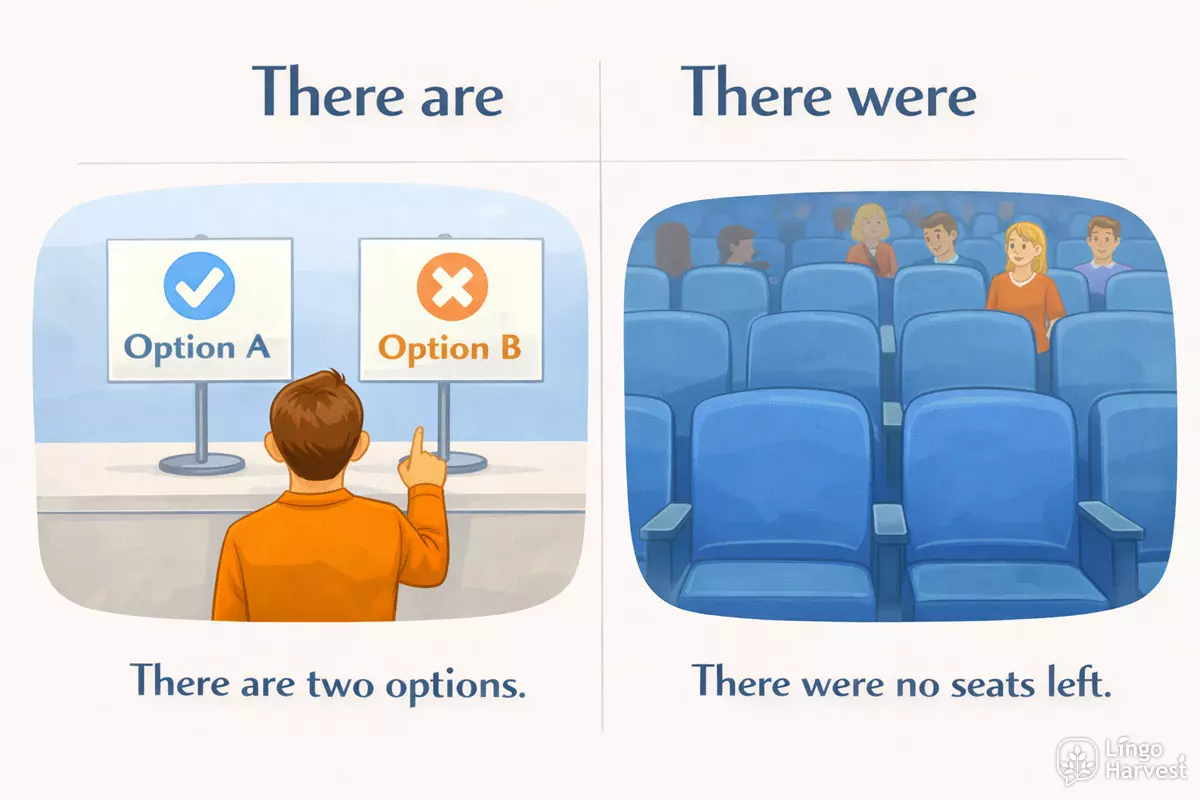
Existence verbs introduce or confirm the presence of something. The most common pattern is There + be + noun, which is used to present new information or describe what is available in a place, time, or situation.
- Basic presence: “There is a mistake in the report.” / “There are two options.”
- Past existence: “There was a power cut.” / “There were no seats left.”
- Existence with location: “There’s a café near the station.”
- Existence with time: “There will be a meeting tomorrow.”
- Availability: “Is there any milk?” / “There aren’t any tickets.”
- Occurrence (events): “There was an accident.” / “There will be delays.”
- Quantity focus: “There are three messages for you.”
- Indefinite nouns are typical: “There’s a problem.” (more natural than introducing a known item)
- With modals: “There might be a better way.” / “There must be a reason.”
- With “exist” for formal tone: “A solution exists.” / “No clear evidence exists.”
- With “remain” for what continues: “Two issues remain.”
- With “appear/arise” for new situations: “A problem arose.” / “New concerns appeared.”
Common usage patterns and frequent pitfalls
- “There is/are” agrees with the noun that follows: ✅ “There are many reasons.” ❌ “There is many reasons.”
- Use “have” for ownership; use “there is/are” for presence in a place: ✅ “I have a car.” / “There is a car outside.”
- Don’t use “there have” to mean “there is/are”: ✅ “There are problems.” ❌ “There have problems.”
- Possession can be abstract: “The argument has flaws.” / “The policy lacks clarity.”
- Existence structures often introduce new topics: “There’s something we need to discuss.” → then the details follow.
Have, own, belong, exist patterns
These verbs often describe possession or presence, but they behave differently in grammar. The main differences are (1) whether the verb takes a direct object, (2) whether it commonly uses progressive forms, and (3) whether it needs a preposition or a “there” structure.
Core sentence frames (what each verb typically “wants”)
- have + direct object → She has a car.
- own + direct object → They own the building.
- belong + to + noun/pronoun → This book belongs to me.
- exist (usually no direct object) → Unicorns do not exist.
- there + be as a common alternative to exist → There is a problem.
Common patterns and usage choices
- Have for possession: use it for relationships, attributes, and everyday ownership. I have a sister. He has blue eyes. We have a house.
- Have for experiences: it often means “experience” or “take.” Have a good time. Have lunch. Have a headache.
- Own is more formal and specific: it emphasizes legal or permanent possession. She owns the rights. He owns three apartments.
- Belong focuses on the rightful owner: it answers “Whose is it?” more than “Who has it right now?” The keys belong to Maya.
- Belong is rarely used in the passive: prefer active forms. ✅ The laptop belongs to the school. ❌ The laptop is belonged to the school.
- Exist states that something is real or present: it is common with abstract nouns and in formal contexts. Evidence exists. A solution exists.
- “There is/are” is usually more natural than “exist” in everyday speech. ✅ There are three options. (more conversational) → Three options exist. (more formal)
- Negatives are frequent with exist: It doesn’t exist. Such a rule doesn’t exist.
- Questions: Do you have…? / Who owns…? / Who does this belong to? / Does life exist on other planets?
- Time and temporary possession: have can be temporary; own usually is not. I have your umbrella (for now). vs. I own your umbrella (unlikely unless you bought it).
Progressive forms (when “-ing” sounds natural)
- Have is usually not progressive for possession: ❌ I’m having a car. → ✅ I have a car.
- Have can be progressive for activities/experiences: ✅ We’re having dinner. ✅ She’s having a great time.
- Own is rarely progressive because ownership is a stable state: ❌ He’s owning the company. → ✅ He owns the company.
- Belong is rarely progressive: ❌ This is belonging to me. → ✅ This belongs to me.
- Exist is almost never progressive: ❌ Dinosaurs are existing. → ✅ Dinosaurs existed.
High-value example set (concise, varied patterns)
- I have a meeting at 3. (event scheduled)
- She has two brothers. (relationship)
- We have no choice. (fixed expression)
- Do you have any ID? (availability/possession)
- He owns a small business. (legal possession)
- Who owns this domain name? (ownership question)
- This seat belongs to the manager. (assigned/rightful possession)
- Who does this jacket belong to? (natural question form)
- Such mistakes still exist. (continued reality)
- There isn’t enough evidence. (preferred everyday structure)
- There exists a risk of delay. (formal “there exists” variant)
- No such law exists in this country. (formal negative)
There is and there are structures
Use this pattern to introduce something for the first time, point out what exists in a place, or describe what is present in a situation. It works like a “presenting” structure: the real subject usually comes after the verb, and the sentence often begins with there as a dummy subject.
Core patterns and word order
- Affirmative: There + be + noun phrase (+ place/time) → There is a café near the station.
- Negative: There + be + not + noun phrase → There isn’t any milk.
- Yes/No question: Be + there + noun phrase? → Is there a problem?
- Wh-question: Wh-word + be + there + noun phrase? → How many people are there?
- With location first (common in speech): Place + there + be + noun phrase → In the box, there are old photos.
- With modifiers after the noun: There + be + noun + relative clause → There’s a book that explains it.
Choosing is vs are (agreement)
- Use there is with singular count nouns: There is a message for you.
- Use there are with plural count nouns: There are two messages for you.
- With uncountable nouns, use there is: There is some information in the email.
- With lists, agreement often follows the first noun in informal speech: There’s a pen and two pencils on the desk. (more formal: There are a pen and two pencils…)
- In careful writing, match the verb to the main noun phrase as a whole: There are a pen and two pencils on the desk.
Common contractions and natural spoken forms
- There’s = there is: There’s a reason.
- There are is usually not contracted in standard writing; in speech you may hear there’re, but it’s often avoided in formal text.
- There isn’t / There aren’t: There aren’t any seats left.
Quantifiers and determiners that fit well
- There is a/an + singular: There is an error in line 3.
- There are some + plural: There are some cookies in the jar.
- There isn’t any + uncountable/plural: There isn’t any parking here.
- There are a lot of / lots of: There are lots of options.
- There are many + plural (more formal): There are many reasons to wait.
- There is much + uncountable (more formal): There isn’t much time.
- There are several + plural: There are several ways to do it.
- There is no + noun (strong negative): There is no solution without data.
Expanded example set (correct vs. common mistakes)
- ✅ There is a meeting at 3. ❌ Is a meeting at 3.
- ✅ There are three keys on the hook. ❌ There is three keys…
- ✅ Is there any sugar? ❌ Is there some sugar? (possible, but usually any for neutral questions)
- ✅ There isn’t any evidence. ❌ There aren’t any evidence.
- ✅ How many students are there in your class? ❌ How many students there are… (wrong word order for a direct question)
- ✅ There was a delay yesterday. ❌ There were a delay yesterday.
- ✅ There were no seats, so we stood. ❌ There was no seats…
- ✅ There has been a change in the plan. ❌ There have been a change…
- ✅ There will be a test next week. ❌ There will are a test…
- ✅ There used to be a cinema here. ❌ There used to are…
- ✅ There might be a mistake. ❌ There might is…
- ✅ There must be a way. ❌ There must is…
- ✅ There is someone at the door. ❌ There are someone…
- ✅ There are people waiting outside. ❌ There is people…
Other tenses and modal forms
- Past: There was / There were → There were a few issues last night.
- Present perfect: There has been / There have been → There have been updates since Monday.
- Future: There will be → There will be enough chairs.
- Modal: There may/might/could/must be → There might be traffic.
- Past habit: There used to be → There used to be a park here.
When not to use this structure
- To show ownership, prefer have: ✅ I have a car. ❌ There is a car to me.
- To describe a known subject, use a normal subject-first sentence: ✅ The car is in the garage. (not presenting new information)
- To avoid repetition, switch to pronouns after introducing something: There’s a new app. It’s free.
State vs action meanings
Possession and existence verbs often have two readings: a stable condition (something is true over time) and an event-like reading (something happens, changes, or is achieved). Choosing the right form affects tense, adverbs, and which complements sound natural.
How to recognize a state reading
State uses describe a continuing situation rather than a change. They typically avoid “in X minutes” timing and sound best with duration phrases (for X years) or general time references (usually, often).
- Have (possession/relationship): “She has a car.” “He has two sisters.”
- Own (legal possession): “They own the apartment.”
- Belong to (membership/possession): “This key belongs to my neighbor.”
- Contain (contents): “The box contains old photos.”
- Include (components): “The price includes tax.”
- Exist (presence in reality): “Unwritten rules exist in every workplace.”
- There is/are (presence in a place/situation): “There are chairs in the hall.”
- Remain (continued existence/state): “Only a few tickets remain.”
- Lack (absence): “The report lacks detail.”
- Need (requirement as a condition): “This plant needs sunlight.”
- Weigh/measure/cost (fixed properties): “It weighs 2 kilos.” “It costs $20.”
- Fit (suitability as a condition): “The lid fits the jar.”
How to recognize an action or change reading
Action uses focus on gaining, losing, creating, or bringing something into a situation. They work well with time-to-completion phrases (in an hour), step-by-step narration, and adverbs like suddenly or finally.
- Get (obtain/receive): “She got a new job.” “I got an email.”
- Acquire (obtain, often formal): “The museum acquired a painting.”
- Buy (purchase): “They bought a house.”
- Win (gain by success): “He won a scholarship.”
- Find (come to have by discovery): “I found my keys.”
- Lose (stop having): “She lost her wallet.”
- Give (transfer away): “He gave me his notes.”
- Receive (transfer in): “We received the package.”
- Bring (cause to be present): “Bring your ID.”
- Provide (supply): “The hotel provides towels.”
- Create (cause to exist): “They created a new role.”
- Appear/disappear (come into/out of existence or view): “A problem appeared.” “The stain disappeared.”
Common usage patterns and contrasts
- State verbs rarely take the progressive when they mean possession or existence: ❌ “I am having a car.” ✅ “I have a car.”
- Progressive can be possible when “have” means an activity/experience: ✅ “We’re having lunch.” ✅ “She’s having a difficult week.”
- Time expressions help choose the reading: ✅ “They have a house for ten years.” (continuing) ✅ “They got a house in two months.” (achievement)
- Existence vs introduction: ✅ “There is a café on this street.” (presence) ✅ “A new café opened on this street.” (came into existence)
- Possession vs transfer: ✅ “This book belongs to Ana.” (state) ✅ “Ana gave me the book.” (event)
- Quantities often sound more natural with existence structures: ✅ “There are three options.” rather than forcing a possession verb when no owner matters.
- Focus choice changes meaning: “The plan includes a backup.” (what it contains) vs “They added a backup.” (the act of adding).
Negatives and questions
When you talk about possession or existence, the tricky part is often how to deny it or ask about it. The patterns depend on which verb you are using: a possession verb (like have) typically behaves like other main verbs, while an existence verb (like be or there is/are) follows its own question and negation routines.
Core patterns to remember
- Possession with “have”: use do/does/did for questions and negatives in most modern English.
- Existence with “be”: invert the verb and subject for questions; add not for negatives.
- Existence with “there is/are”: invert is/are with there for questions; add not after is/are for negatives.
- Short answers: match the auxiliary or verb used in the question (for example, Do you…? Yes, I do. / Is there…? No, there isn’t.).
Possession: “have” in questions and negatives
- Question: Do you have a car? / Does she have a key? / Did they have enough time?
- Negative: I don’t have cash. / He doesn’t have a passport. / We didn’t have a choice.
- Short answers: Yes, I do. / No, she doesn’t. / Yes, they did.
- Common learner issue: ❌ Have you a car? (possible but formal/older style) → ✅ Do you have a car?
- With have got (informal): Have you got a pen? / I haven’t got any time. (note: this pattern does not use do).
- Tag questions: You have a ticket, don’t you? / She doesn’t have a map, does she?
Existence: “be” and “there is/are”
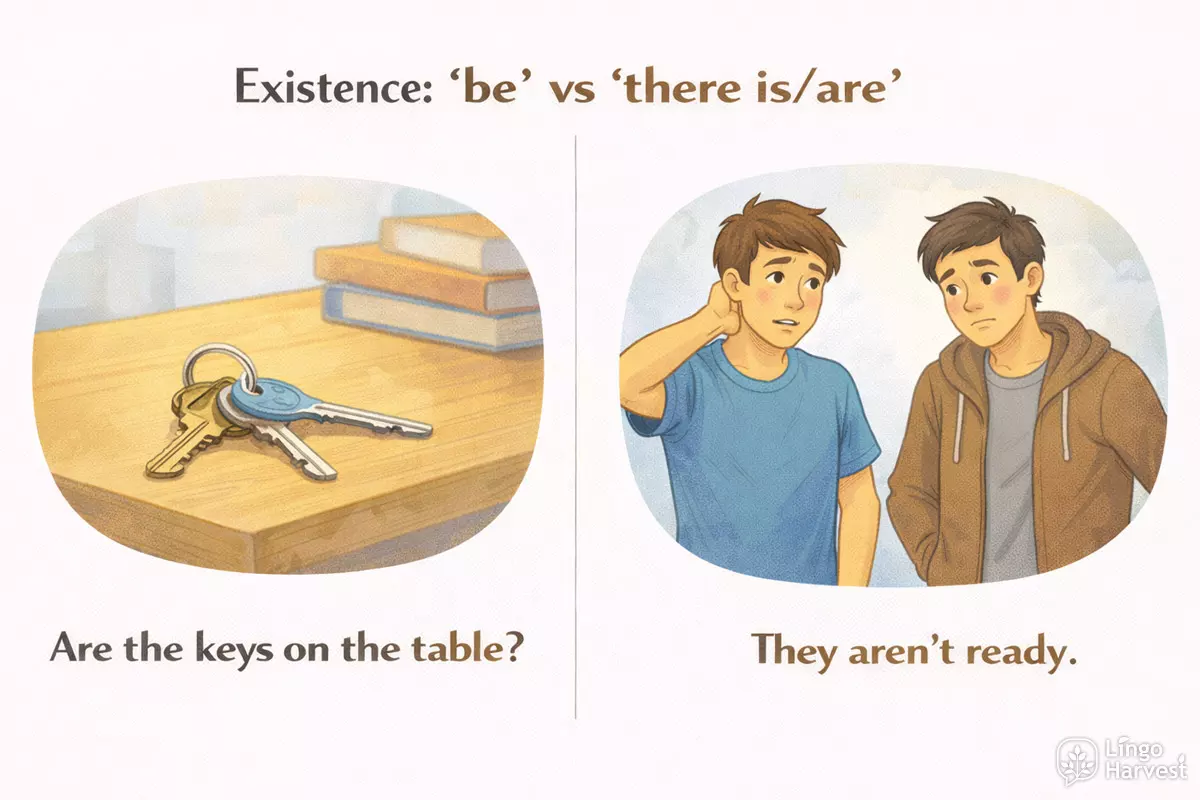
- Question with be: Is the meeting today? / Are the keys on the table? / Was there a delay?
- Negative with be: The room isn’t quiet. / They aren’t ready. / I wasn’t there.
- Question with there is/are: Is there a problem? / Are there any seats left? / Was there a reason?
- Negative with there is/are: There isn’t a bus after midnight. / There aren’t any clean cups.
- Short answers: Is there a printer? → Yes, there is. / No, there isn’t.
- Polite checking: Is there any chance you can help? (existence of a possibility, not a physical object).
Choosing between “any” and “a/an” in negatives and questions
- Questions often use a/an for one item: Is there a bathroom?
- Negatives and open-ended questions often use any: There aren’t any tickets. / Do you have any questions?
- Emphasis on “not even one”: There isn’t a single seat. / I don’t have a clue.
- Offering/requesting can keep some in questions: Do you have some time now? / Is there some way to fix it?
Common meaning shifts to watch
- Do you have…? usually asks about possession or access: Do you have a charger?
- Is there…? asks whether something exists or is available in a place/situation: Is there a charger here?
- With people: Do you have a doctor? (your doctor) vs. Is there a doctor? (any doctor present).
- With events: Do we have a meeting? (scheduled) vs. Is there a meeting? (does it exist/has it been arranged).
Common learner confusion
Learners often mix up possession (who owns something) with existence (whether something is present). The most reliable fix is to choose the verb based on the sentence focus: the owner (possession) or the thing/place (existence).
- Using “have” when the sentence really means “there is/are”
If the subject is a place or situation (not an owner), English usually prefers an existence pattern.
❌ “The city has many museums in the center.” (possible, but often sounds like ownership/management)
✅ “There are many museums in the center (of the city).” - Using “there is/are” when you mean ownership
Existence structures don’t identify an owner as the grammatical subject.
❌ “There is a car.” (doesn’t say who owns it)
✅ “I have a car.” / “My family has a car.” - Confusing “have” (possession) with “have got” (possession, often informal)
Both commonly express ownership, but usage differs by register and region. “Have got” is frequent in conversation; “have” is neutral and common in writing.
✅ “I have a key.” / “I’ve got a key.” - Forming questions and negatives incorrectly with “have”
In many varieties, questions/negatives with lexical “have” use do-support.
✅ “Do you have a pen?” / “I don’t have time.”
In some contexts (especially with “have got”), learners will also see:
✅ “Have you got a pen?” / “I haven’t got time.” - Mixing “there is/are” with a definite subject too early
“There is/are” typically introduces new information; it sounds odd with something already specific/known.
❌ “There is the book on the desk.” (often unnatural unless contrasting)
✅ “The book is on the desk.” - Agreement errors: “there’s” with plurals
In speech, “there’s” is often used informally with plural nouns, but standard agreement is still useful for writing.
✅ “There are two reasons.” (formal/standard)
(Informal speech: “There’s two reasons.”) - Choosing “be” vs “exist” vs “there is/are”
“Exist” is more formal and often used for general truths; “be” locates or describes; “there is/are” introduces presence.
✅ “Unicorns don’t exist.” (general fact)
✅ “The keys are on the table.” (location)
✅ “There are keys on the table.” (introducing what’s present) - Overusing “have” for relationships and characteristics
English uses “have” for many non-ownership meanings (illness, features, experiences). Learners sometimes avoid it or replace it with “be,” creating unnatural sentences.
✅ “I have a headache.” (not “I am a headache”)
✅ “This phone has a good camera.” (feature) - Misplacing the owner in “of” phrases
When you want to highlight the thing rather than the owner, “of” can work, but it often sounds formal or heavy compared with possessives.
✅ “My friend’s car” (common)
✅ “The car of my friend” (possible, but less natural in everyday English) - Confusing “there” (dummy subject) with the adverb “there” (place)
In “There is a problem,” “there” doesn’t mean a location. Learners sometimes add extra location words unnecessarily.
✅ “There is a problem.” (existence)
✅ “The problem is there, on the screen.” (location) - Forgetting that existence patterns often take prepositional phrases
“There is/are” commonly pairs with location/time phrases to specify where/when something is present.
✅ “There’s a meeting at 3.”
✅ “There are several cafés near the station.” - Using “have” to describe availability in a way that sounds like ownership
Shops, hotels, and services can “have” things available, but “there is/are” or “we offer” may fit better depending on meaning.
✅ “We have free Wi‑Fi.” (service available)
✅ “There is free Wi‑Fi in the lobby.” (presence in a place)
Quick pattern check
- Owner-focused → subject is a person/organization → use a possession verb: “She has…”, “They own…”, “He keeps…”
- Thing/place-focused → introduce what is present → use an existence structure: “There is…”, “There are…”
- Known item + location → use “be”: “The wallet is in my bag.”
Formal vs informal usage
Register affects which possession and existence verbs sound natural. In careful writing and official speech, speakers often choose more explicit, less contracted forms and avoid idioms that feel conversational. In everyday talk, shorter structures, contractions, and idiomatic patterns are common, especially when the meaning is obvious from context.
Common register patterns to watch
- Contractions: Informal contexts favor contractions (e.g., there’s, I’ve got), while formal contexts often keep full forms (there is, I have).
- “Have” vs “have got”: have got is typically more conversational; have is more neutral and often preferred in formal writing.
- Existential “there + be”: Neutral overall, but contractions (there’s) and omission of expected agreement are more tolerated in speech than in edited prose.
- Choice of existence verb: Formal styles may use more specific verbs (exist, remain, occur) instead of the broad there is/are.
- Idioms of possession: Casual speech uses idioms like have on (wear), have over (host), or have someone over; formal contexts often replace them with more literal verbs (wear, host).
- Precision and scope: Formal contexts often clarify quantity, scope, or conditions (There are three outstanding issues) rather than leaving them implied (There are some issues).
- Avoiding vague “got”: In formal writing, got can feel imprecise; alternatives like received, obtained, became, or arrived are common.
- Negation choices: Informal speech often uses short negatives (don’t have, there isn’t), while formal writing may use more explicit phrasing (does not have, there is no).
- Information structure: There + be is frequent in speech to introduce new information; formal writing may prefer a direct subject when clarity matters (Several factors influence the outcome).
- Politeness and softening: Requests in formal settings may avoid direct possession claims and use indirect wording (Do you have a moment? → Could you spare a moment?).
- Agreement in speech: In conversation, there’s is often used before plural nouns (There’s two options), but edited writing usually expects plural agreement (✅ There are two options).
- Existence vs location: Formal writing may separate “existence” from “location” more carefully (There is a file on the server vs The file is on the server), choosing the structure that best matches the focus.
Quick contrasts (more formal → more informal)
- There is no evidence of X. → There isn’t any evidence of X.
- The organization has sufficient funds. → The organization’s got enough money.
- We have received your request. → We got your request.
- Several issues remain. → There are still a few issues.
- A solution exists. → There’s a solution.
- Do you possess the necessary documentation? → Do you have the paperwork?
- The device contains a battery. → The device has a battery in it.
- We will host a meeting on Monday. → We’re having a meeting on Monday.
- There are two alternatives available. → There’s two choices. ❌ (common in speech, usually avoided in formal writing)
- The report indicates that errors are present. → Looks like there are some errors.
- No further opportunities remain. → There aren’t any more chances.
- We do not have sufficient time. → We don’t have time.
Homework: possession verb practice tasks
These activities target the most common patterns for expressing ownership, relationships, and “there is/are” meanings. Focus on choosing the structure that matches the meaning: owner-focused (possession) versus existence/location-focused (there is/are).
Task 1: Choose the best verb or structure
Complete each sentence with the best option (or rewrite as instructed). Use correct tense and agreement.
- My sister _______ a new laptop. (have / own / there is)
- In our town _______ two libraries. (have / there are)
- This apartment _______ a balcony, but it doesn’t _______ a dishwasher. (has / there is / have)
- Who _______ this bicycle? (owns / has / there is)
- On the table _______ a set of keys. (is / has / owns)
- Our company _______ offices in three countries. (has / there are)
- That museum _______ several paintings by local artists. (has / owns / there are)
- There _______ a problem with the printer. (is / has)
- I don’t _______ any cash on me. (have / own)
- This car _______ to my neighbor. (has / belongs / owns)
- My phone battery _______ 5% left. (has / there is)
- In the file _______ a missing page. (there is / has)
Show answers
- has
- there are
- has; have
- owns
- is
- has
- has
- is
- have
- belongs
- has
- there is
Task 2: Rewrite to switch the focus (possession → existence, or existence → possession)
Rewrite each sentence so the meaning stays the same, but the grammar changes as indicated.
- (Possession → Existence) She has three cousins in Canada.
- (Existence → Possession) There is a big garden behind our house.
- (Possession → Existence) The hotel has a gym on the top floor.
- (Existence → Possession) There are no clean cups in the kitchen.
- (Possession → Existence) This book has a map inside.
- (Existence → Possession) There is a scratch on my screen.
- (Possession → Existence) The plan has two main risks.
- (Existence → Possession) There are five students in my group.
Show answers
- There are three cousins in Canada (that she has).
- Our house has a big garden behind it.
- There is a gym on the top floor of the hotel.
- The kitchen doesn’t have any clean cups.
- There is a map inside this book.
- My screen has a scratch on it.
- There are two main risks in the plan.
- My group has five students.
Task 3: Correct the errors (meaning and grammar)
Each sentence has at least one issue. Rewrite it correctly.
- There have a mistake in this report.
- My friend is owning a restaurant.
- This room has three windows in it are.
- In my bag has a charger.
- The laptop belongs my sister.
- There is many reasons to wait.
- I am having a car.
- This key is belonged to the landlord.
- Our school owns a lot of students.
- On the wall there are a photo.
Show answers
- ✅ There is a mistake in this report.
- ✅ My friend owns a restaurant. / My friend has a restaurant.
- ✅ This room has three windows. / There are three windows in this room.
- ✅ There is a charger in my bag. / I have a charger in my bag.
- ✅ The laptop belongs to my sister.
- ✅ There are many reasons to wait.
- ✅ I have a car.
- ✅ This key belongs to the landlord.
- ✅ Our school has a lot of students.
- ✅ On the wall there is a photo. / There is a photo on the wall.
Task 4: Short production (controlled writing)
Write 8–10 sentences about a place you know (home, classroom, office, neighborhood). Use the patterns below at least once each.
- One sentence with There is + singular noun.
- One sentence with There are + plural noun.
- One sentence with have/has for features (not ownership of people).
- One sentence with own for legal possession (company/person).
- One sentence with belong to (include to).
- One sentence with a negative form (don’t have, doesn’t have, there isn’t, or there aren’t).
- One sentence with a question (Do you have…? or Is there…?).
- One sentence with a quantifier (some/any/a lot of/many/much).