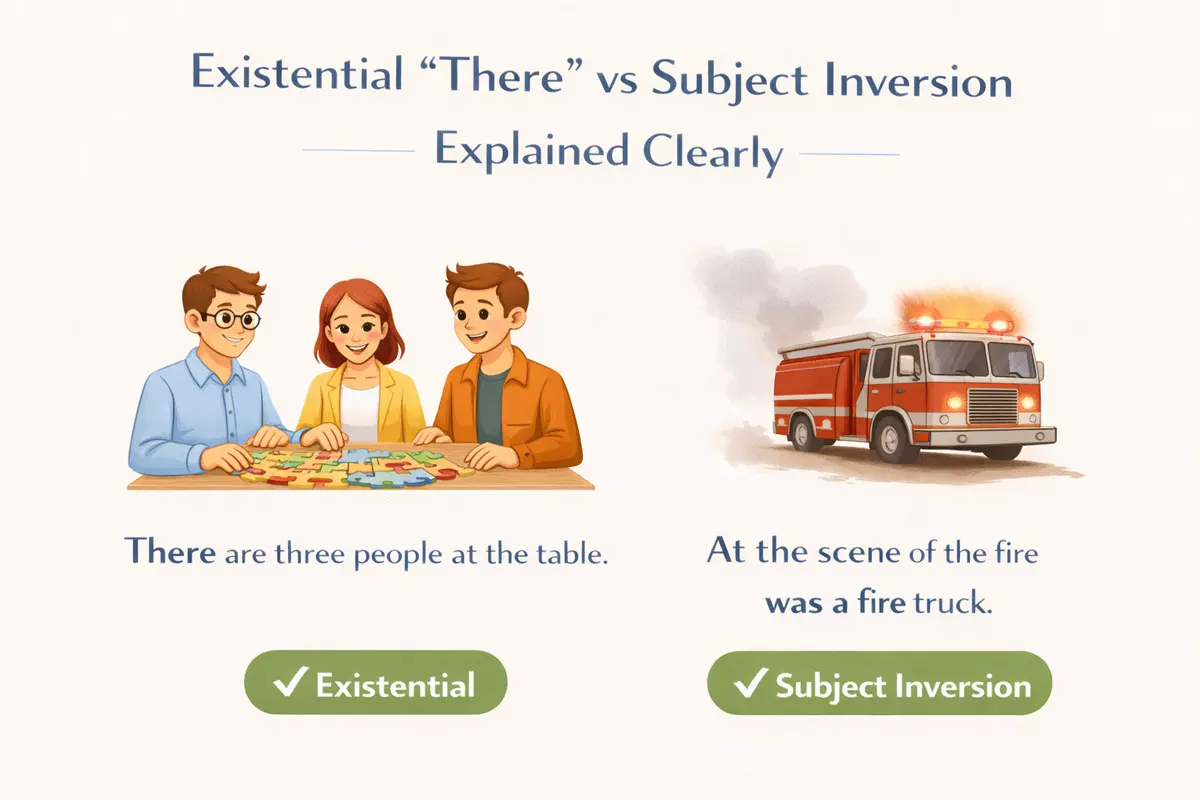
Existential “There” vs Subject Inversion Explained Clearly

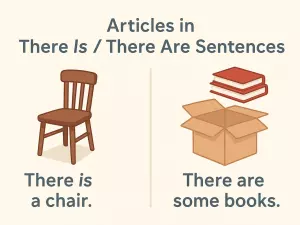
 Here we the meaning of existential there, basic there is/there are patterns, and how existential there differs from inversion.
Have you ever wondered why we sometimes say there is a book on the table instead of a book is on the table, or why questions like is there a problem change the order of words? These variations are not random; they help English speakers highlight certain information or introduce new topics naturally. By understanding these different sentence patterns, we gain insight into how English communicates emphasis and meaning in subtle but important ways, making our conversations clearer and more effective.
What existential there expresses
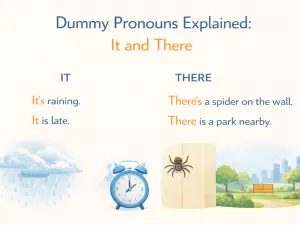
The word there in existential sentences serves as a grammatical placeholder, helping to introduce the existence or presence of something rather than specifying a location. Unlike its use as an adverb (as in “over there”), existential there does not point to a place but signals that something exists or occurs. This construction is common in English for presenting new information or mentioning something for the first time.
Existence, presence, and introduction of new topics
When English speakers want to state that something or someone exists, especially when it’s not the topic yet, they often use existential there. This structure allows for a neutral, introductory tone. It’s especially useful for:
- Announcing the presence of something (“There is a letter on the table.”)
- Introducing events (“There will be a meeting tomorrow.”)
- Describing changes in state (“There has been a mistake.”)
- Pointing out quantities or amounts (“There are three apples left.”)
- Referring to people or things for the first time (“There was a man at the door.”)
- Expressing possibility or opportunity (“There could be another way.”)
- Stating necessity (“There needs to be a solution.”)
- Reporting existence in the past or future (“There used to be a cinema here.”)
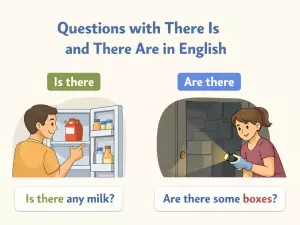
- Posing questions about existence (“Is there any coffee?”)
- Making general statements (“There seems to be a problem.”)
- Signaling absence (“There isn’t any sugar.”)
- Describing situations (“There comes a time when…”)
- Expressing surprise or emphasis (“There goes my chance!”)
- Pointing out conditions (“There would be trouble if…”)
- Highlighting availability (“There remains only one option.”)
- Emphasizing results (“There followed a long silence.”)
How existential sentences differ from other structures

Unlike standard subject–verb sentences, existential there allows the true subject to appear after the verb. This is especially useful when the identity or number of the subject is not known or is being introduced for the first time. The construction helps make statements more natural and less abrupt.
| Existential “There” Example | What it Expresses |
|---|---|
| There is a cat in the garden. | Existence/presence of a cat |
| There were several problems. | Introduction of problems as new information |
| There has been an accident. | Reporting an event or occurrence |
| There will be a quiz tomorrow. | Announcement of a future event |
| There isn’t any milk left. | Stating absence or lack |
| There must be a reason. | Expressing necessity or logical assumption |
In summary, existential there is a versatile way to introduce, announce, or question the existence or presence of people, things, or events in English. It’s a key structure for shifting focus onto what is new, unknown, or important in a conversation or text.
Basic there is / there are patterns
When we talk about things existing or being present somewhere in English, we often use “there is” or “there are.” These structures are called existential sentences. They let us introduce new information, especially when the subject is indefinite or unimportant. Understanding how to form and use these sentences is essential for clear and natural English.
How the structure works
The pattern is simple: start with “there,” then add the correct form of “be,” and finally include the noun or noun phrase. The verb “be” changes depending on whether the noun is singular or plural, and can also shift for tense.
- There is a book on the table.
- There are five people in the room.
- There was a problem last night.
- There were many options available.
- There will be a meeting tomorrow.
- There has been an accident.
- There have been several updates.
- There might be a mistake.
- There could be some confusion.
- There isn’t any milk left.
- There aren’t any tickets.
- There wasn’t enough time.
- There weren’t any complaints.
- Is there a bathroom here?
- Are there any questions?
- Was there a call for me?
- Were there problems yesterday?
- There should be a solution.
- There must be an explanation.
- There can’t be a mistake.
Choosing between “there is” and “there are”
The form you use depends on whether the noun following “be” is singular or plural.
| Singular | Plural |
|---|---|
| There is a cat in the garden. | There are cats in the garden. |
| There was a storm last night. | There were storms last night. |
| Is there a problem? | Are there any problems? |
| There has been a change. | There have been changes. |
Key points to remember
- Use “there is” for singular nouns and “there are” for plural nouns.
- Switch to the correct tense when talking about the past or future (was/were, will be, etc.).
- Negative forms: “There isn’t” (singular), “There aren’t” (plural).
- Questions: invert “there” and “be” (“Is there…?” “Are there…?”).
- These sentences focus on existence or presence, not identity or characteristics.
Mastering these patterns will help you introduce new topics, describe situations, and ask about the presence of things or people in English with confidence.
Difference between existential there and inversion
Understanding how “existential there” and subject-verb inversion work in English will help clarify why sentences like “There is a book on the table” feel different from “On the table sits a book.” Both forms rearrange word order, but their purposes and grammatical structures aren’t the same.
Existential “There”
The existential “there” introduces the existence of something, often when the subject is new or unknown. It’s followed by a form of “be” and then the real subject:
- There are cookies in the jar.
- There was a sudden noise.
- There have been many changes.
Notice that “there” isn’t the true subject—it’s a placeholder, helping the sentence flow naturally when introducing information.
Subject Inversion
With inversion, the usual subject-verb order is switched, often for stylistic reasons or to emphasize location, direction, or time. The real subject comes after the verb:
- On the wall hung a picture.
- Down the hill rolled the ball.
- Here comes the bus.
This construction is common in literary or descriptive writing, and “there” is not used as a dummy subject.
| Feature | Existential “There” | Subject Inversion |
|---|---|---|
| Purpose | Introduce new or unknown subjects | Emphasize location, direction, or style |
| Word Order | There + verb + subject | Prepositional phrase/adverb + verb + subject |
| “There” Used? | ✅ Yes (as a dummy subject) | ❌ No |
| Examples | There is a cat outside. | Outside sat a cat. |
Quick Reference: Key Contrasts
- Existential “there” always uses the verb “be”; inversion can use various verbs.
- Inversion often starts with a location, time, or adverbial phrase; existential “there” never does.
- “There” in existential sentences has no real meaning—it’s just grammatical; inversion never uses “there” in this way.
- Inversion is less common in everyday speech but frequent in writing for emphasis or variety.
In summary, existential “there” serves to introduce and highlight the existence of something, while inversion is a stylistic shift that places the subject after the verb, commonly for emphasis or to foreground setting. Recognizing these patterns helps you both understand and craft more natural English sentences.
Information focus and sentence flow
Understanding how information is highlighted and how ideas progress in a sentence is key to distinguishing between existential "there" and subject inversion constructions. Both structures help writers and speakers control which information stands out and how smoothly sentences connect to one another, but they do so in different ways.
How existential "there" shifts attention
When you use existential "there," the subject is delayed, and the new or important information is often placed at the end of the sentence. This pattern makes it easy to introduce new topics or highlight something unexpected. For example, in the sentence "There is a cat on the roof," the existence of "a cat" is new information, and the listener's attention is naturally drawn to it.
- There is a book on the table.
- There are many reasons to celebrate.
- There was a loud noise outside.
- There seems to be a mistake.
- There have been several delays.
- There could be another explanation.
- There used to be a bakery here.
- There will be questions at the end.
- There might be a solution.
- There remains one problem.
Subject inversion and its impact on flow
Subject inversion, on the other hand, often appears for stylistic reasons or to emphasize adverbs, location, or time. It places the verb before the subject, which can create a dramatic or formal effect, or simply help connect ideas more smoothly. For instance, "On the roof sat a cat" puts emphasis on the location, guiding the reader’s focus differently than existential "there."
- Down the street ran the children.
- Into the room walked the teacher.
- Rarely have I seen such skill.
- Only after sunset did the lights appear.
- Here comes the train.
- Out of nowhere appeared a rainbow.
- Not until midnight did the party end.
- Beside the river stood an old tree.
- Never before had they met.
- At the door waited a surprise.
Comparing focus and progression
The way these structures are used affects not just what is emphasized, but also how sentences connect and flow in a paragraph. Existential "there" is particularly common when introducing new entities or events, while inversion is more likely to be found in narrative or descriptive writing, adding variety and rhythm.
| Structure | Primary Information Focus | Typical Use | Example |
|---|---|---|---|
| Existential "there" | New element or event | Introducing topics or items | There are cookies in the jar. |
| Subject inversion | Location, time, or manner | Adding emphasis or variety | In the jar are cookies. |
Choosing between these two patterns depends on what you want to highlight and how you want your sentences to flow. Both tools can help avoid repetitive sentence structure, keep your writing dynamic, and make sure the most important information stands out.
Formal vs informal preferences
When choosing between existential “there” constructions and subject-verb inversion, the level of formality in your writing or speech often guides which structure feels most natural. Academic writing and official documents tend to favor certain sentence patterns, while everyday conversation and creative works lean toward others. Understanding these tendencies helps you sound more natural and appropriate in different contexts.
Where existential “there” feels natural

Existential “there” is widely used in spoken English and informal writing. It introduces new information smoothly, especially when the subject is indefinite or unknown. In casual speech, it’s common to say things like:
- There’s a problem with the printer.
- There were lots of people at the party.
- There might be a mistake in your report.
- There have been several changes lately.
- There seems to be some confusion.
- There goes the last bus.
- There used to be a park here.
- There comes a time when you must decide.
- There’s nothing we can do about it.
- There must have been a misunderstanding.
- There appeared a strange light in the sky.
- There remains a question to answer.
Notice how these sentences feel neutral or conversational, focusing on the existence or appearance of something rather than its identity.
Subject inversion in more formal or literary contexts
Subject-verb inversion, where the verb comes before the subject, often appears in formal, literary, or poetic language. This structure can add emphasis, create variety, or highlight the subject. In everyday speech, it’s less common except in questions or after certain adverbs. Some typical examples include:
- On the table sat a large bouquet of flowers.
- Rarely have I seen such dedication.
- Down the street ran the children.
- Never before had she heard such news.
- Into the room burst the police.
- Only then did he understand.
- So beautiful was the sunset that we stopped to watch.
- Hardly had the clock struck twelve when the bell rang.
- Beside the lake stood an old oak tree.
- Little did they know what awaited them.
Comparison of patterns and preferences
| Context | Preferred Structure |
|---|---|
| Casual conversation | Existential “there” (e.g. There’s a cat outside.) |
| Formal writing | Subject-verb inversion for emphasis or variety |
| Storytelling/literature | Inversion for dramatic effect (e.g. Into the darkness crept the thief.) |
| Describing new or indefinite subjects | Existential “there” (e.g. There were signs of rain.) |
| After negative/limiting adverbs | Inversion (e.g. Never have I felt so proud.) |
| Presenting facts neutrally | Existential “there” |
| Questions | Inversion (e.g. Is there a problem?) |
In summary, existential “there” is your go-to for everyday, neutral, or introductory statements, while subject-verb inversion adds formality, emphasis, or stylistic flair. Being aware of these tendencies lets you tailor your language to fit the situation, whether you’re drafting an email, writing a novel, or giving a presentation.
Common learner confusion
Many English learners find it tricky to tell the difference between existential “there” sentences (like “There is a book on the table”) and subject-verb inversion structures (such as “On the table sits a book”). This confusion is understandable, since both structures often describe the same situation but use a different word order and focus. Below, we’ll explore frequent areas where students get mixed up and highlight the key contrasts with examples.
Mixing up the purpose of each structure
One frequent misunderstanding is thinking that both forms are always interchangeable. In reality, existential “there” introduces something new or emphasizes existence (“There are three cats outside”), while subject inversion is more literary or formal, often focusing on location or movement (“Outside stand three cats”). Learners sometimes swap them without considering the subtle change in meaning or register.
Word order and agreement challenges
It’s easy to stumble over verb agreement and word order, especially when the subject comes after the verb. For example, “There are many problems” vs. “On the list are many problems.” The inverted structure can sound unusual, making it harder to spot errors.
Confusing “there” with adverbs
Another pitfall is mistaking existential “there” for the adverb “there” (as in “The book is there”). The existential form doesn’t refer to a place but acts as a grammatical placeholder. This difference isn’t always clear to learners, especially in speech.
Comparing existential “there” and inversion
| Existential “There” | Subject Inversion |
|---|---|
| There is a dog in the yard. | In the yard is a dog. |
| There were no seats left. | Left were no seats. |
| There seems to be a mistake. | A mistake seems to be present. |
| There came a loud noise. | A loud noise came. |
| There goes the bus! | Here comes the bus! |
Common mistakes and confusions
- Using “there” with verbs that don’t allow existential constructions (e.g., There arrived a letter ❌ instead of A letter arrived ✅).
- Forgetting subject-verb agreement after “there” (e.g., There is many people ❌).
- Misplacing adverbs: There quickly is a problem ❌ vs. There is quickly a problem ✅ (but both are awkward; usually, adverbs do not split “there is”).
- Overusing inversion in everyday conversation, making speech sound unnatural.
- Confusing “there is” (existence) with “it is” (identification or description).
Summary of key signals
- Existential “there” is used to introduce or emphasize the existence of something.
- Subject inversion usually follows a prepositional phrase and tends to be more formal or literary.
- Verb agreement always matches the real subject, not “there.”
- Adverbs rarely interrupt existential “there” structures.
- Inversion often places the verb before the subject for stylistic effect.
By focusing on these distinctions and practicing with real examples, learners can avoid the most common pitfalls and gain confidence in using both existential “there” and subject inversion appropriately.
Examples from written English
Writers and editors often encounter both existential “there” structures and subject-verb inversion in formal texts, fiction, journalism, and academic prose. These constructions can subtly change the focus or rhythm of a sentence, and their use is often deliberate. Below are illustrative sentences and patterns drawn from authentic written sources, showing the range and nuance of each structure.
Existential “There” Constructions
This structure introduces the existence or presence of something. It is especially common in descriptions, reports, and narrative openings:
- There is a book on the table.
- There were several people waiting outside.
- There has been a misunderstanding.
- There appears to be a mistake in the data.
- There will be consequences for these actions.
- There seems to be a pattern emerging.
- There comes a time when decisions must be made.
- There remains much to be discovered.
- There have been numerous studies on this topic.
- There exists a possibility of error.
Subject Inversion Patterns
Subject-verb inversion often appears in literary writing, questions, and for stylistic emphasis. Unlike existential “there,” inversion usually places an adverbial or complement first, followed by the verb and subject. Here are some real examples:
- On the hill stood an old mansion.
- Rarely have I seen such dedication.
- Only then did he realize the truth.
- Never before had they attempted this feat.
- Down the street ran the children.
- Hardly had she spoken when the phone rang.
- In the garden bloomed the first roses of spring.
- Across the valley echoed the sound of bells.
- Little did he know what awaited him.
- So powerful was her speech that the audience fell silent.
Side-by-Side Comparison
To clarify the distinctions and typical phrasing, here’s a structured comparison of existential “there” and subject inversion as seen in written English:
| Existential “There” | Subject Inversion |
|---|---|
| There is a problem with the software. | Beside the river stood an ancient tree. |
| There have been many changes recently. | Never before have we witnessed such unity. |
| There comes a point when silence is best. | Down the hall rushed the nurses. |
| There remains hope for a resolution. | Rarely do opportunities like this arise. |
Writers select between these structures to control flow, highlight new information, or create stylistic effects. Recognizing their usage in published sources can help readers and learners appreciate how subtle shifts in structure can affect meaning and emphasis.
Practice: choose the correct structure
Understanding when to use existential "there" versus subject-verb inversion is essential for clear and accurate English sentences. This section offers a series of exercises and examples to help you determine which structure fits best in different contexts.
Review the following sentences and decide whether the existential "there" construction or subject-verb inversion is appropriate. Consider word order, meaning, and common usage patterns. Some items also ask you to correct mistakes or explain your choice.
Choose the correct sentence structure
-
Which is correct?
- There is a book on the table.
- Is a book on the table.
-
Pick the natural option:
- On the hill stood an old castle.
- There on the hill stood an old castle.
-
Complete the sentence: _______ many reasons to visit this city.
- There are
- Are there
-
Correct the word order:
- In the corner sits a cat.
- A cat in the corner sits.
-
Choose the most appropriate structure for a news headline:
- There was discovered a new planet.
- Discovered was a new planet.
- A new planet was discovered.
-
Which sentence sounds natural in everyday speech?
- There is someone waiting outside.
- Is someone waiting outside.
-
Choose the correct structure:
- There were several mistakes in the report.
- Were several mistakes in the report.
-
Pick the better option for descriptive writing:
- At the end of the street stood a small café.
- There at the end of the street stood a small café.
-
Complete the sentence correctly: _______ no evidence to support the claim.
- There is
- There are
-
Which version is more natural?
- On the table lay several documents.
- Several documents on the table lay.
Show answers
- The correct sentence is: There is a book on the table.
- Both can be correct, but On the hill stood an old castle. is the standard inversion form.
- There are many reasons to visit this city.
- In the corner sits a cat. (subject–verb inversion for emphasis)
- A new planet was discovered. (passive voice is preferred for news headlines)
- There is someone waiting outside.
- There were several mistakes in the report.
- At the end of the street stood a small café.
- There is no evidence to support the claim.
- On the table lay several documents.
Identify the structure
Look at each sentence and decide: is it an example of existential there or subject-verb inversion?
- There are three people waiting outside.
- Down the street came a parade.
- There have been many changes lately.
- Into the room walked the professor.
- There will be a meeting tomorrow.
- Across the field ran a herd of horses.
- There is no clear answer to this question.
- On the table lay several documents.
- There seems to be a misunderstanding.
- From the shadows emerged a strange figure.
Common patterns to remember
- Existential there introduces new information or states that something exists: There is a problem.
- Subject-verb inversion often follows adverbs or prepositional phrases, especially in formal or literary contexts: On the wall hung a painting.
- Do not combine there with inversion structures: Never before had I seen such a thing.
- With existential there, the real subject appears after the verb: There are several options.
- In inversion, the subject follows the verb to create emphasis or stylistic effect: Under the bridge lived a troll.
- Existential there is common in neutral and informational writing.
- Inversion is more frequent in narratives, descriptions, and headlines.
- Existential there cannot normally be stressed.
- In inversion, the verb agrees with the subject that follows it.
- Inversion is optional and stylistic, while existential there serves a grammatical function.
Show answers
- There are three people waiting outside. — Existential “there”
- Down the street came a parade. — Subject-verb inversion
- There have been many changes lately. — Existential “there”
- Into the room walked the professor. — Subject-verb inversion
- There will be a meeting tomorrow. — Existential “there”
- Across the field ran a herd of horses. — Subject-verb inversion
- There is no clear answer to this question. — Existential “there”
- On the table lay several documents. — Subject-verb inversion
- There seems to be a misunderstanding. — Existential “there”
- From the shadows emerged a strange figure. — Subject-verb inversion
Summary Table: Structure Comparison
| Structure Type | Example Sentence |
|---|---|
| Existential "there" | There is a dog in the garden. |
| Subject-verb inversion | In the garden sat a dog. |
| Existential "there" | There were several problems. |
| Subject-verb inversion | On the table lay several books. |