Questions with There Is and There Are in English

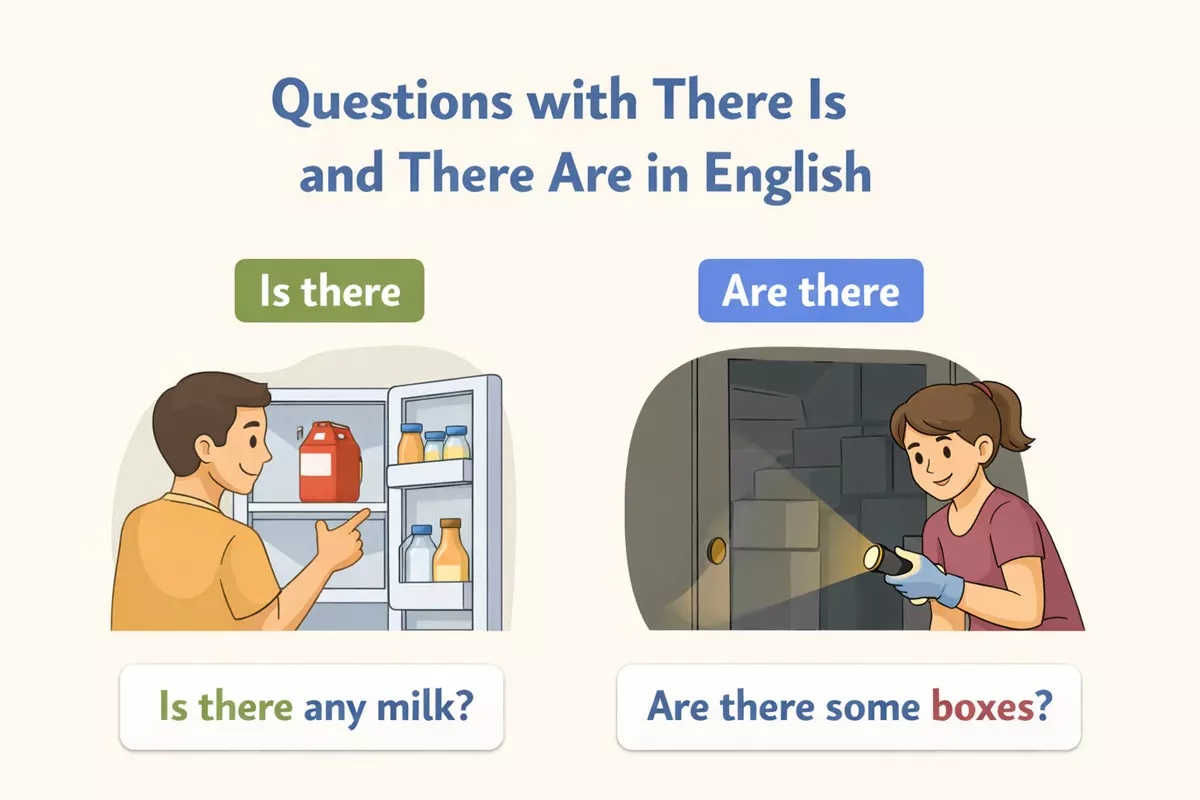 Here we how to use there is and there are in English, including yes/no and WH-questions, singular and plural forms, correct word order, short answers, common mistakes, and provides practice exercises to check your understanding.
Learning how to ask about the presence or availability of objects and people in English is essential for effective communication. By understanding how to form questions such as "Is there any milk in the fridge?" or "Are there any students in the classroom?" you can easily find out whether something or someone is present. Mastering these question structures not only helps you gather information but also boosts your confidence in daily conversations, making your interactions smoother and more efficient.
There Is / There Are Overview
Understanding how to talk about the existence or presence of things in English often means using the structures there is and there are. These phrases help you point out objects, people, or ideas, especially when introducing something for the first time. The choice between them depends on whether the subject is singular or plural.
When to Use Each Form
Use there is for singular nouns or uncountable nouns, and there are for plural nouns. This distinction is crucial for making grammatically correct sentences and questions.
- There is a book on the table. (singular)
- There is some water in the glass. (uncountable)
- There are three chairs in the room. (plural)
Common Patterns and Examples
Both forms appear in affirmative, negative, and question sentences. Here are some common ways you might use them:
- Is there a problem? (question, singular)
- Are there any cookies left? (question, plural)
- There isn’t a bus stop nearby. (negative, singular)
- There aren’t enough tickets. (negative, plural)
- There is a cat outside. (affirmative, singular)
- There are two emails for you. (affirmative, plural)
- Is there milk in the fridge?
- Are there students in the classroom?
- There isn’t any information available.
- There aren’t many options.
Quick Reference Table

| Form | Example |
|---|---|
| Affirmative (Singular) | There is a dog in the yard. |
| Affirmative (Plural) | There are books on the shelf. |
| Negative (Singular) | There isn’t a taxi outside. |
| Negative (Plural) | There aren’t any apples left. |
| Question (Singular) | Is there a message for me? |
| Question (Plural) | Are there any questions? |
Key Points to Remember
- Use there is for one thing or uncountable nouns.
- Use there are for more than one thing (plural).
- Questions invert the order: “Is there…?” and “Are there…?”
- Negatives add “not”: “There isn’t…” and “There aren’t…”
- These forms are essential for describing existence, availability, and location.
Mastering these structures will help you express what is present or absent in any situation, especially when asking or answering questions in everyday English.
Yes/No Questions with There Is/Are
Forming yes/no questions using “there is” and “there are” is a practical way to ask about the existence or presence of something. These question forms are common in everyday English for checking if something exists, if something is available, or if something is present in a particular place or situation. The pattern is simple: invert the subject and the verb.
How to Form Yes/No Questions
To make a yes/no question, start with “Is there” for singular or non-count nouns, and “Are there” for plural nouns. This structure allows you to confirm or deny the presence of people, objects, or conditions.
- Is there a pen on the table?
- Is there any milk left in the fridge?
- Is there a restroom nearby?
- Are there any apples in the basket?
- Are there students in the classroom?
- Are there enough chairs for everyone?
- Is there a problem?
- Are there any messages for me?
- Is there a bus stop around here?
- Are there tickets available for the concert?
- Is there water on Mars?
- Are there signs of life in the ocean?
- Is there an ATM near here?
- Are there any good restaurants in this area?
- Is there a mistake in this sentence?
- Are there many cars on the street?
- Is there a book on the shelf?
- Are there children playing outside?
Short Answers
Responding to these questions is straightforward. Use “Yes, there is/are” or “No, there isn’t/aren’t” depending on the question.
| Question | Short Answer |
|---|---|
| Is there a dog in the house? | Yes, there is. / No, there isn’t. |
| Are there any cookies left? | Yes, there are. / No, there aren’t. |
| Is there a phone charger here? | Yes, there is. / No, there isn’t. |
| Are there enough seats? | Yes, there are. / No, there aren’t. |
Tips for Usage
- Use “Is there” for singular or uncountable nouns.
- Use “Are there” for plural nouns.
- To make questions negative, add “not” (e.g., “Isn’t there a problem?”).
- Short answers repeat the structure: “Yes, there is/are” or “No, there isn’t/aren’t.”
These question forms are essential for clear, polite communication in English, helping you check information, make requests, or clarify situations with ease.
WH-Questions with There Is/Are
When asking for specific information about the existence or location of things, we use WH-questions together with "there is" or "there are." These questions start with a WH-word—such as what, where, who, which, how many, or why—to inquire about people, places, objects, or reasons. This structure is common in everyday English, especially when you want to know details about availability, presence, or position.
How to Form WH-Questions
To create these questions, place the WH-word at the beginning, followed by "is there" or "are there," and then the subject or additional information. The choice between "is" and "are" depends on whether the subject is singular or plural. For example, "Where is there a restaurant?" (singular) or "How many chairs are there in the room?" (plural).
Common WH-Words Used
- What – asking about things: "What is there to do here?"
- Where – asking about places: "Where is there a bank nearby?"
- Who – asking about people: "Who is there in the office right now?"
- Which – asking for choices: "Which books are there on the shelf?"
- How many – asking about quantity: "How many students are there in the class?"
- How much – asking about uncountable quantity: "How much sugar is there left?"
- Why – asking about reasons: "Why is there a delay?"
- When – asking about time: "When is there a meeting?"
Examples of WH-Questions
Here are some typical patterns and examples you might hear:
- What is there to watch on TV tonight?
- Where are there good places to eat?
- Who is there to help us?
- Which buses are there to the airport?
- How many days are there left before the exam?
- How much water is there in the bottle?
- Why is there so much noise outside?
- When is there less traffic?
- What animals are there in the zoo?
- Where is there a pharmacy open late?
- How many options are there on the menu?
- Who is there at the reception desk?
Word Order in WH-Questions
Notice that the order is: WH-word + is/are + there + subject/complement. This differs from regular questions, where "Is there...?" or "Are there...?" comes at the start.
| WH-Word | Example Question |
|---|---|
| What | What is there to eat? |
| Where | Where is there a post office? |
| How many | How many people are there in line? |
| Why | Why is there a problem? |
| Which | Which rooms are there for guests? |
Using these question forms helps you get specific information about existence, presence, or location. Practice by making your own questions based on places and situations in your daily life.
Singular vs Plural Forms
Understanding when to use there is and there are depends on the number of items you’re talking about. Use there is for one thing, and there are for more than one. This basic distinction is key to asking clear questions in English, whether you’re referring to a single item or a group.
How It Works in Questions
To form questions, simply invert the word order. For singular, use Is there...? For plural, use Are there...? This rule applies to both countable and uncountable nouns, but be careful: uncountable nouns (like water or furniture) use the singular form.
| Form | Example Question |
|---|---|
| Is there one…? | Is there a book on the table? |
| Is there uncountable…? | Is there any milk left? |
| Are there multiple…? | Are there any apples in the fridge? |
| Are there people/objects…? | Are there students in the classroom? |
Typical Patterns and Examples
- Is there a pen on the desk?
- Is there an umbrella in your bag?
- Is there any water in the bottle?
- Is there a problem?
- Are there any chairs in the hall?
- Are there books on the shelf?
- Are there any cookies left?
- Are there enough plates for everyone?
- Are there cars outside?
- Are there any messages for me?
- Is there a phone nearby?
- Are there many tourists in the city?
- Are there new emails?
- Is there a restroom here?
- Are there tickets available?
- Are there mistakes in my homework?
- Is there a way to fix this?
- Are there reasons to worry?
Common Mistakes to Avoid
- Using is with plural nouns: ❌ Is there apples? → Are there apples?
- Using are with singular or uncountable nouns: ❌ Are there a chair? → Is there a chair?
- Confusing countable and uncountable nouns: Is there any bread? (correct, since bread is uncountable)
Remember: the choice between is and are signals whether you’re asking about one thing, many things, or something uncountable. Getting this right helps your questions sound natural and clear.
Word Order in There Questions
When forming questions with "there is" or "there are," English follows a specific pattern. The typical sequence starts with a question word (if needed), then the verb ("is" or "are"), then "there," and finally the subject or additional information. This structure is different from regular subject-verb-object sentences, so it’s important to pay attention to the placement of each element.
Basic Pattern for Yes/No Questions
To ask a yes/no question, simply invert the verb and "there." The verb comes first, followed by "there," then any noun or phrase. Here are some common examples:
- Is there a problem? → Yes, there is.
- Are there any questions? → No, there aren’t.
- Is there a restaurant nearby? → Yes, there is.
- Are there many people here? → Yes, there are.
- Is there time to finish? → Yes, there is.
- Are there enough chairs? → No, there aren’t.
- Is there a bus at 8? → Yes, there is.
- Are there any tickets left? → No, there aren’t.
- Is there a hotel on this street? → Yes, there is.
- Are there new updates? → Yes, there are.
Pattern for Wh- Questions

For questions with "what," "where," "how many," or other wh-words, place the question word at the beginning, then the verb ("is" or "are"), followed by "there," and then the rest of the sentence. This helps focus the question on the information you want.
- Why is there a delay? → Because there is heavy traffic.
- How many people are there? → There are about twenty.
- What is there to do? → There is a lot to do.
- Where is there a bank? → There is a bank on Main Street.
- How much sugar is there? → There is only a little sugar.
- Which options are there? → There are three options.
- When is there a meeting? → There is a meeting at 3 pm.
- Who is there with you? → There is my friend with me.
Summary Table: Question Formation
| Type | Word Order Example |
|---|---|
| Yes/No Question | Is/Are + there + subject? Are there any cookies? |
| Wh- Question | Wh-word + is/are + there + subject? Where is there a restroom? |
| How Many/How Much | How many/much + noun + is/are + there? How many students are there? |
| Which/What | Which/What + is/are + there? What is there to eat? |
Key Points to Remember
- The verb always comes before "there" in questions.
- Use "is" for singular and "are" for plural nouns.
- Wh-words go at the start if you need more than a yes/no answer.
- Contractions like "Isn't there?" are common in spoken English.
- Negative questions (e.g., "Isn't there a solution?") use the same inversion.
By following these patterns, you can confidently form and understand questions using "there is" and "there are" in English conversations and writing.
Short Answers and Common Replies
When responding to questions that use “there is” or “there are,” English speakers often use brief answers. These replies avoid repeating the whole question and instead focus on confirming or denying the information. Mastering these patterns helps your conversations sound natural and fluent.
Typical Patterns for Short Answers
The most common way to answer these questions is by using “Yes, there is/are” or “No, there isn’t/aren’t.” The choice depends on whether the noun is singular or plural, and whether the sentence is positive or negative. Here’s how the forms break down:
| Question | Short Answer |
|---|---|
| Is there a bank nearby? | Yes, there is. / No, there isn’t. |
| Are there any apples in the fridge? | Yes, there are. / No, there aren’t. |
| Is there a problem? | Yes, there is. / No, there isn’t. |
| Are there students in the classroom? | Yes, there are. / No, there aren’t. |
Other Useful Replies
Sometimes, a simple “yes” or “no” is not enough. You might need to give more information or react politely. Here are some common ways to reply:
- Yes, there is one. (when you want to specify there is exactly one item)
- No, there isn’t any. (to emphasize none at all)
- I think there is. (if you are not completely sure)
- There are a few. (when there are some, but not many)
- There aren’t many. (to express a small quantity)
- There’s one over there. (to point out the location)
- No, there are none left. (to confirm zero in a polite way)
- Yes, there are several. (when there are more than a few)
- No idea, sorry. (when you do not know the answer)
- Let me check, but I think there isn’t. (if you need to confirm)
- Yes, there’s plenty. (when there is a large amount)
- No, there’s nothing here. (for emphasis, especially with uncountable nouns)
Tips for Sounding Natural
In everyday English, contractions are much more common than the full forms: “there isn’t” instead of “there is not,” and “there aren’t” instead of “there are not.” Using these short answers and replies helps keep conversations quick and friendly. If you want to be even more polite, you can add “I’m afraid” to a negative answer: “I’m afraid there isn’t.” This softens the response and is often used in customer service or formal situations.
Typical Learner Mistakes
Many English learners run into trouble when forming questions with "there is" and "there are," especially when deciding which form to use, how to invert the word order, and how to handle negatives or uncountable nouns. Missteps with these structures can make questions sound unnatural or even confusing to native speakers.
Common Problems with Structure and Agreement
Choosing between "is" and "are" often causes confusion. Learners sometimes forget to match the verb with the noun’s number, or they might use incorrect word order in questions. Below are frequent errors:
- Using "Is there" for plural nouns: Is there many books on the table? ❌
- Using "Are there" for singular or uncountable nouns: Are there any milk in the fridge? ❌
- Not inverting subject and verb in questions: There is a problem? ❌
- Omitting "any" in negative or plural questions: Are there apples? (when asking if any exist, "Are there any apples?" is more natural.)
- Using double negatives: Isn’t there no solution? ❌
- Adding unnecessary words: Is there exist a bus stop nearby? ❌
- Forgetting to use "there" at all: Is a restaurant near here? instead of Is there a restaurant near here?
Confusing Countable and Uncountable Nouns
One tricky area is knowing when to use "there is" versus "there are" with nouns that can be both countable and uncountable, or with mass nouns. Learners might mix up these forms, especially in questions.
| ❌ Incorrect Question | ✅ Correct Question |
|---|---|
| Is there any chairs in the room? | Are there any chairs in the room? |
| Are there some water left? | Is there any water left? |
| Is there apples on the tree? | Are there apples on the tree? |
| Are there a problem? | Is there a problem? |
| Is there any information? | Is there any information? |
Mixing Up Short Answers
Responding to "there is/are" questions with the wrong form is another stumbling block. For example, answering "Yes, there are" to "Is there a pen on the desk?" is incorrect. Learners should match the form of the question in their short answers.
- Question: Is there a park nearby? → Correct: Yes, there is. / Incorrect: Yes, there are.
- Question: Are there any cookies left? → Correct: No, there aren’t. / Incorrect: No, there isn’t.
Summary of Frequent Errors
- Wrong verb form with singular/plural nouns
- Incorrect word order in questions
- Misuse of "any" in questions
- Confusion with countable/uncountable nouns
- Incorrect short answers
- Omission of "there" in questions
- Double negatives or unnecessary words
Understanding these patterns can help learners avoid common mistakes and improve their confidence when asking questions with "there is" and "there are" in English.
Practice Exercises and Self-Check
Test your understanding of how to form and use “there is” and “there are” in English with these activities. These tasks will help you recognize the correct structure for singular and plural situations, as well as for positive, negative, and question forms. Try to complete each exercise before checking the answers provided.
Fill in the Blanks
Complete each sentence using either there is or there are.
- ______ a book on the table.
- ______ five students in the classroom.
- ______ an apple in my bag.
- ______ many cars in the parking lot.
- ______ a cat under the sofa.
- ______ two sandwiches in the fridge.
- ______ a computer in the office.
- ______ three windows in the room.
- ______ a message on my phone.
- ______ some water in the bottle.
Show answers
- There is a book on the table.
- There are five students in the classroom.
- There is an apple in my bag.
- There are many cars in the parking lot.
- There is a cat under the sofa.
- There are two sandwiches in the fridge.
- There is a computer in the office.
- There are three windows in the room.
- There is a message on my phone.
- There is some water in the bottle.
Making Questions
Rewrite the following statements as questions using the correct form of “there is” or “there are.”
- There is a letter for you.
- There are any messages for me.
- There is a mistake in your homework.
- There are many books on the shelf.
- There is a café near my house.
- There are two keys on the desk.
- There is enough time to finish.
- There are a lot of people outside.
- There is a bus stop on this street.
- There are some clean cups in the cupboard.
Show answers
- Is there a letter for you?
- Are there any messages for me?
- Is there a mistake in your homework?
- Are there many books on the shelf?
- Is there a café near your house?
- Are there two keys on the desk?
- Is there enough time to finish?
- Are there a lot of people outside?
- Is there a bus stop on this street?
- Are there any clean cups in the cupboard?
Negative Forms Practice
Change the sentences below to the negative form.
- There is a dog in the garden.
- There are cookies on the plate.
- There is milk in the fridge.
- There are students in the hall.
- There is a pencil in my bag.
- There are chairs in the kitchen.
- There is a bank on this street.
- There are any apples in the bowl.
- There is some coffee left.
- There are lights in the room.
Show answers
- There isn’t a dog in the garden.
- There aren’t cookies on the plate.
- There isn’t milk in the fridge.
- There aren’t students in the hall.
- There isn’t a pencil in my bag.
- There aren’t chairs in the kitchen.
- There isn’t a bank on this street.
- There aren’t any apples in the bowl.
- There isn’t any coffee left.
- There aren’t lights in the room.
Quick Reference Table: Forms of "There Is" and "There Are"
Here’s a summary that compares the common forms for positive, negative, and question usage:
| Form | Singular | Plural |
|---|---|---|
| Positive | There is (There’s) | There are |
| Negative | There isn’t / There is not | There aren’t / There are not |
| Question | Is there…? | Are there…? |
Short Writing Task
Write 3 sentences about your room: one using the positive form, one using the negative form, and one as a question. Try to use both singular and plural nouns.
Show answers
- There is a desk near the window.
- There aren’t any posters on the wall.
- Are there two chairs in your room?
Practice will help you become more confident using “there is” and “there are” in different situations. Review your answers and repeat the exercises to reinforce your understanding.