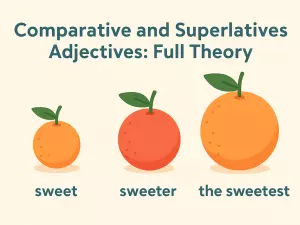
Articles in Comparisons and Superlatives: the best, a better idea

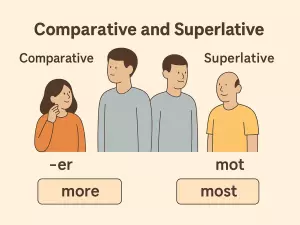
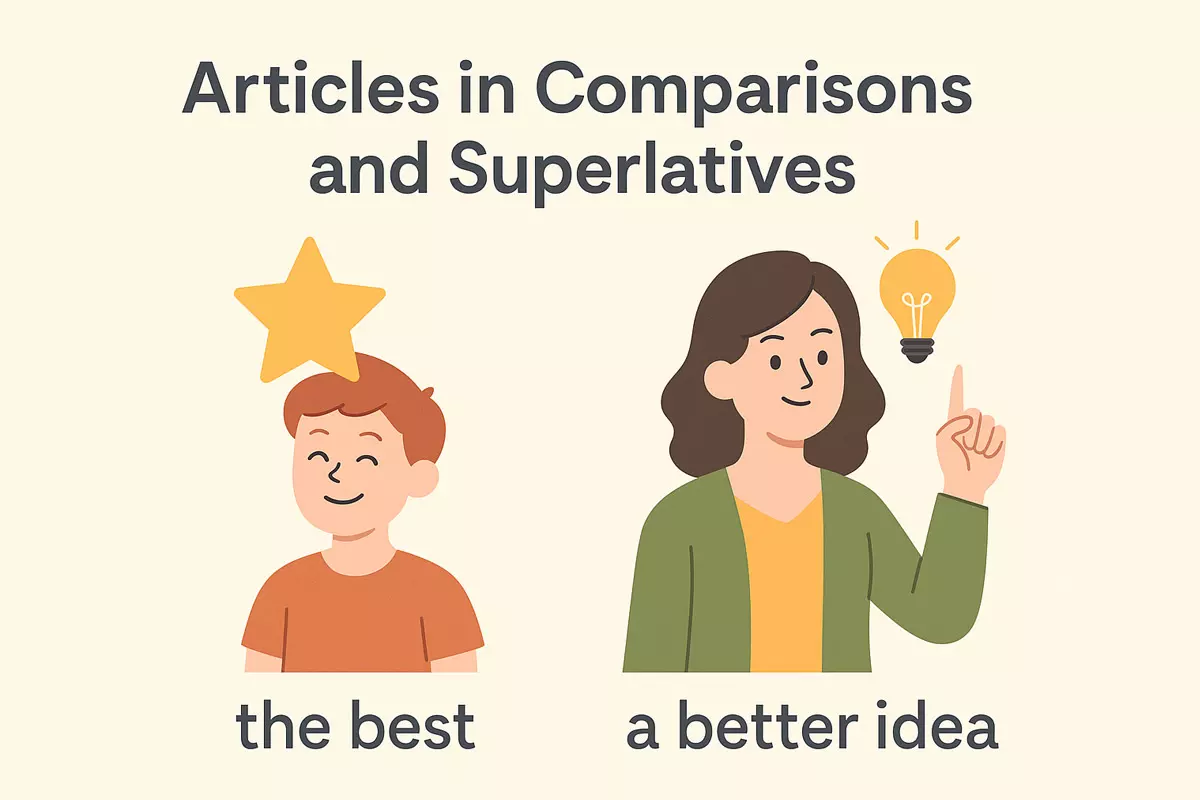 This article explains how to use the and a with superlatives and comparatives, highlights fixed expressions without articles, covers patterns like the sooner the better, and helps you avoid mistakes with missing or extra the in comparison sentences.
- Using “the” with superlatives: the best, the most interesting
- Articles with comparatives: a better idea, the bigger house
- Zero article in fixed comparative expressions
- Special patterns: the sooner the better
- Mistakes with missing or extra “the”
- Practice: choose the correct form in comparison sentences
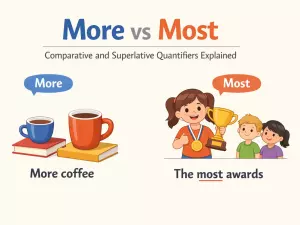
Have you ever wondered why we use phrases like the most delicious or a smarter option? Understanding how to choose the correct article when making comparisons or describing extremes can be challenging, but it is an important skill. Mastering the use of articles such as a, an, and the in these contexts will help you communicate your ideas more clearly and naturally, allowing your English to sound both accurate and confident in everyday conversations or writing.
Using “the” with superlatives: the best, the most interesting
Superlative adjectives and adverbs are used to show that something is at the highest or lowest degree within a group. In English, we almost always use the definite article “the” before superlatives. This signals that we are talking about one specific thing or person that stands out from all the rest. For example, we say the tallest building, the most delicious cake, or the fastest runner.
Why do we use “the”?
The definite article points to something unique or specific. Since a superlative describes the only one at the top or bottom of a scale, “the” is required. Without it, the sentence sounds incomplete or incorrect.
Common patterns with superlatives
- the + adjective-est (for short adjectives): the coldest day, the smallest room
- the most/least + adjective (for longer adjectives): the most expensive car, the least important detail
- the + superlative adverb: He ran the fastest, She worked the most carefully
Examples of superlative phrases
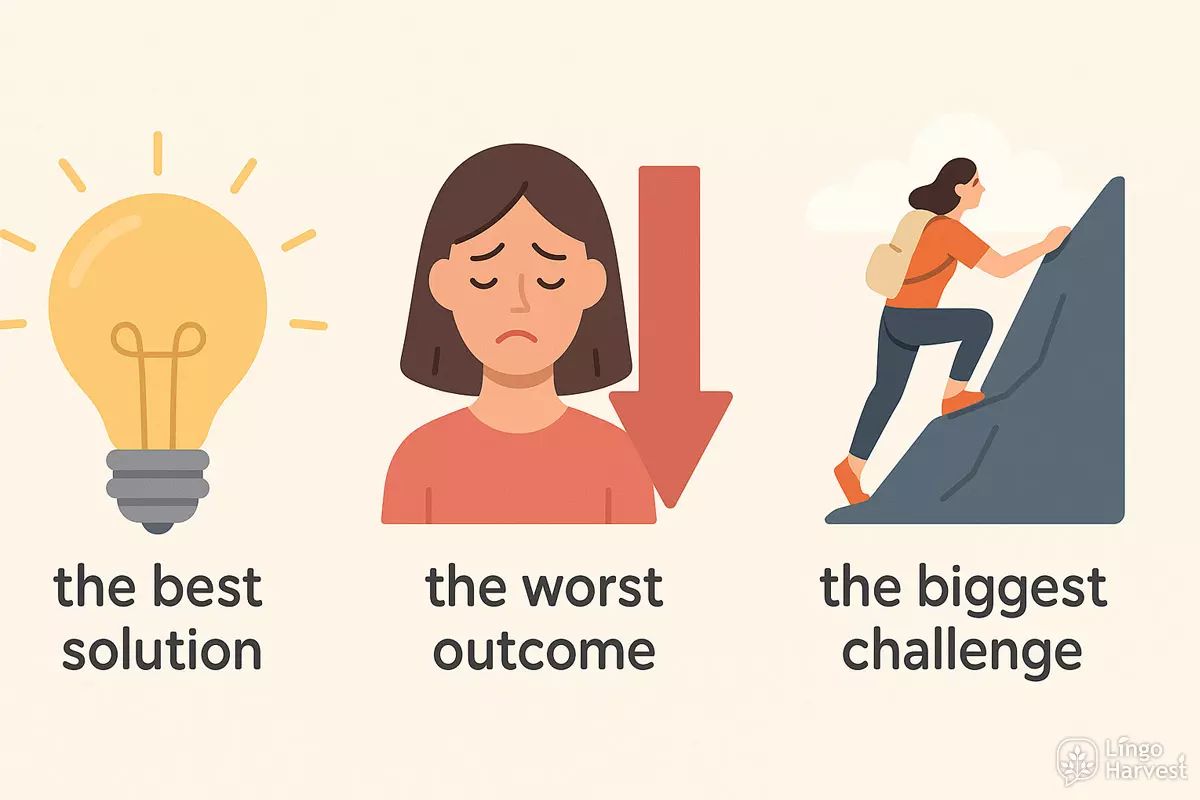
- the best solution
- the worst outcome
- the biggest challenge
- the earliest train
- the most popular answer
- the least likely event
- the highest mountain
- the oldest building
- the most creative idea
- the brightest student
- the simplest explanation
- the most exciting match
- the friendliest neighbor
- the most difficult task
- the quietest place
- the least expensive option
- the most dangerous road
- the deepest lake
- the most comfortable chair
- the most interesting book
Exceptions and special cases
There are rare cases where “the” may be omitted, usually in newspaper headlines or poetic language, but in normal conversation and writing, always use “the” before a superlative. For example: She is the smartest in the class ✅; She is smartest in the class ❌.
Comparative, superlative, and “the” at a glance
| Form | Example (Correct) | Example (Incorrect) |
|---|---|---|
| Comparative (no “the”) | This idea is better. | ~This idea is the better. |
| Superlative (with “the”) | This is the best idea. | ~This is best idea. |
| Superlative (most/least) | She is the most talented singer. | ~She is most talented singer. |
| Superlative adverb | He works the hardest. | ~He works hardest. |
To sum up, the definite article is an essential part of forming superlatives in English. Whether you are describing the best, the tallest, or the most interesting, remember to include “the” before the superlative form.
Articles with comparatives: a better idea, the bigger house
When using comparative adjectives in English, the choice between a and the can change the meaning of a sentence. “A” with a comparative generally introduces one option among many, while “the” pinpoints a specific item, often in direct comparison with others. For example, a better idea suggests any idea that’s an improvement, whereas the better idea singles out the superior option between two or more.
Choosing between “a” and “the” with comparatives
Use “a” before a comparative adjective when referring to any instance of improvement or difference, not a particular one. “The” is used when the context narrows the choice, often in situations of direct comparison, or when only two items are being discussed.
- a faster route → one of several possible quicker ways
- the faster route → the quicker of two specific routes
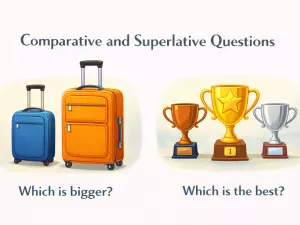
- a smaller suitcase → any suitcase that’s smaller than another
- the smaller suitcase → the more compact of two being considered
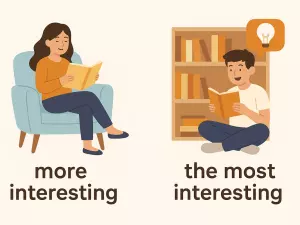
- a more interesting book → any book that’s more engaging
- the more interesting book → the specific book that stands out among others
- a longer explanation
- the longer explanation
- a newer model
- the newer model
- a bigger house
- the bigger house
- a higher price
- the higher price
- a darker color
- the darker color
- a simpler solution
- the simpler solution
Summary of usage patterns
Generally, use a with comparatives for non-specific references and the for specific or directly compared items. This distinction helps clarify meaning and avoid ambiguity in communication.
| With “a” | With “the” |
|---|---|
| a better idea | the better idea |
| a bigger house | the bigger house |
| a faster solution | the faster solution |
| a more comfortable chair | the more comfortable chair |
| a cheaper ticket | the cheaper ticket |
| a safer option | the safer option |
| a longer holiday | the longer holiday |
| a newer model | the newer model |
Mastering the use of articles with comparatives will make your comparisons clearer and more precise. Pay attention to context: is your statement about any improved option, or are you selecting the top choice among a group?
Zero article in fixed comparative expressions
Many English comparative phrases appear without an article, especially in set expressions and idioms. These patterns are so fixed in usage that adding "the" or "a" would sound unnatural. Such constructions are common in both spoken and written English, often used to compare qualities, quantities, or changes over time.
Common patterns without articles
The absence of an article is typical in expressions with comparatives like "the more, the merrier," but also in everyday combinations. These phrases usually connect two actions, qualities, or states, emphasizing a relationship or progression rather than a specific item.
- Better late than never
- The sooner, the better
- More haste, less speed
- Easier said than done
- Older and wiser
- Less is more
- Longer than expected
- Stronger together
- Harder to please
- Higher and higher
- Further and further
- No sooner said than done
- Cheaper by the dozen
- Faster than light
- Worse for wear
- Smaller than average
- Bigger picture
- Quicker than most
- Lower and lower
- Fewer and fewer
Why no article?
In these formulas, the focus is on the comparative quality, not a particular object or group. The structure is idiomatic, so inserting an article would break the fixed pattern. For example, "The more you practice, the better you get" does not refer to a specific "more" or "better"—the meaning is general and abstract.
Comparative expressions in structure
When both halves of a comparison appear together, especially with "the" plus a comparative ("the more... the more..."), this is a unique structure. Here, "the" does not function as an article but as a conjunction meaning “by how much.” In other cases, no article is used at all.
| Expression | Meaning |
|---|---|
| Better late than never | It’s preferable to do something late than not at all |
| The sooner, the better | Acting quickly is preferable |
| Less is more | Simplicity is better than excess |
| More haste, less speed | Rushing leads to mistakes and delays |
| Easier said than done | Something is simpler to talk about than to actually do |
| Older and wiser | With age comes wisdom |
| Stronger together | Unity brings strength |
| Harder to please | More difficult to satisfy |
These expressions are memorized as whole units, making them reliable for everyday communication and writing. If you use them as they are, you will sound more natural and fluent in English.
Special patterns: the sooner the better
Some English expressions use articles in fixed comparative structures, often to show a direct relationship between two things. A classic example is “the sooner, the better,” but there are many similar patterns. These structures typically emphasize that as one quality increases or decreases, another does too. They’re useful for making clear, concise comparisons in everyday speech and writing.
Common comparative patterns with articles
You’ll often see “the” used before comparative adjectives or adverbs to create these set phrases. Here are several widely used examples:
- The more, the merrier (More people means more fun.)
- The less said, the better (Saying less is preferable.)
- The earlier, the better (Earlier is preferable.)
- The bigger, the better (Bigger is preferable.)
- The harder you work, the more you achieve
- The longer I wait, the more nervous I get
- The colder it gets, the more I want to stay inside
- The faster you run, the sooner you finish
- The more you practice, the easier it becomes
- The less you spend, the more you save
- The higher you climb, the farther you can see
- The more the merrier (The more people, the better.)
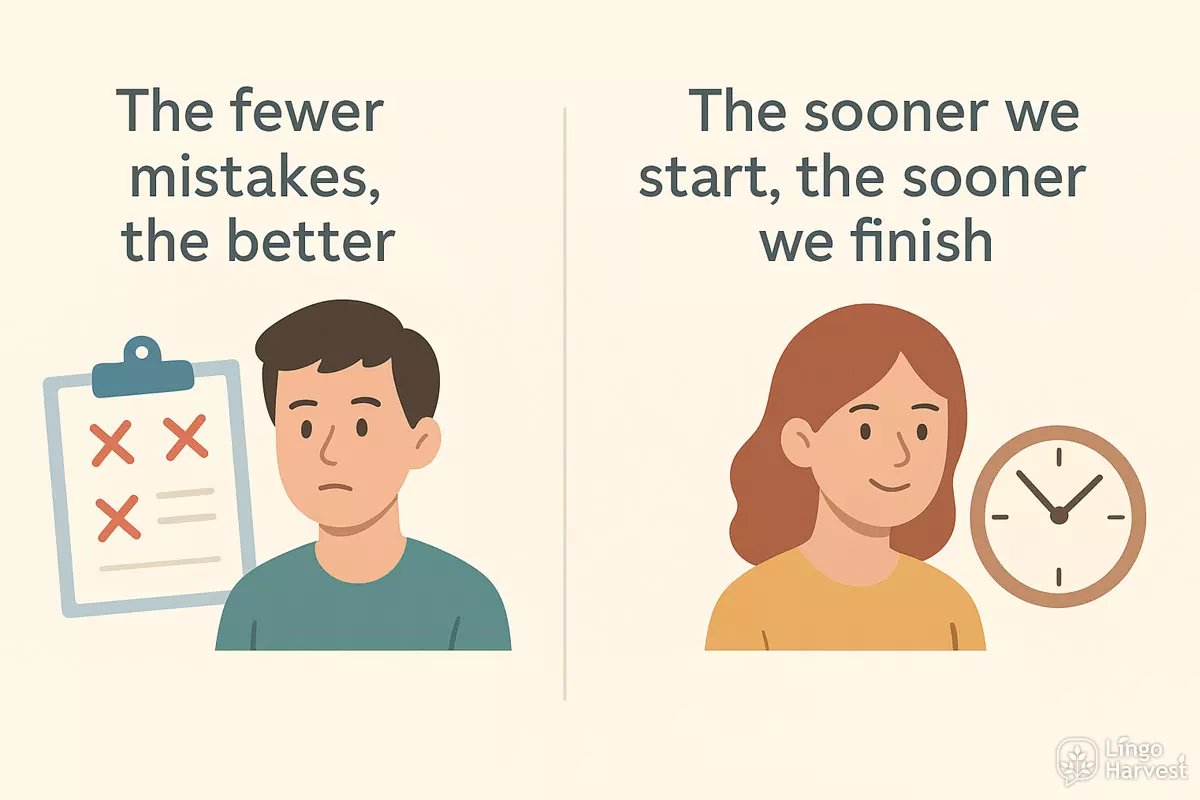
- The fewer mistakes, the better
- The sooner we start, the sooner we finish
- The later, the worse (If you wait longer, it’s worse.)
- The more, the better
How these patterns work
These structures use “the” before the comparative form to link two related qualities or actions. The format is usually:
| Part 1 | Part 2 |
|---|---|
| the + comparative | the + comparative |
| the earlier | the better |
| the more you read | the more you know |
| the less you worry | the happier you are |
This pattern highlights a cause-and-effect or proportional relationship. It’s especially common in advice, instructions, or when expressing preferences.
Key points to remember
- Always use “the” before the comparative adjective or adverb.
- Both clauses have the same structure for clarity.
- These patterns are fixed; changing the article or form breaks the meaning.
- They often work as set phrases, so memorizing common examples is helpful.
Using these expressions naturally can make your English sound more fluent and precise, especially when making direct comparisons or giving advice.
Mistakes with missing or extra “the”
When making comparisons or using superlatives, it’s easy to get confused about whether to include “the.” Learners often forget to use it where it’s needed, or add it where it doesn’t belong. This can lead to awkward or even incorrect sentences, especially when talking about things like “the best solution” or “a better way.” Understanding these patterns helps your English sound more natural.
When “the” is necessary
Superlatives almost always need “the” before them, because you’re describing something unique in a group. For example:
- Incorrect: She is best student in the class.
- Correct: She is the best student in the class.
- Incorrect: Mount Everest is highest mountain.
- Correct: Mount Everest is the highest mountain.
In these cases, omitting the article changes the meaning or makes the sentence ungrammatical.
When “the” is not needed
With comparative forms (“better,” “more interesting”) and when talking about things in general, “the” is often unnecessary. Examples:
- Incorrect: She has the better idea.
- Correct: She has a better idea.
- Incorrect: This car is the faster than that one.
- Correct: This car is faster than that one.
Adding “the” here implies you’re talking about a specific, previously mentioned thing, which is not the case.
Common trouble spots
Some expressions and patterns especially trip up learners. Here are common mistakes and their corrections:
- I have the better answer. ❌ → I have a better answer. ✅
- This is best choice. ❌ → This is the best choice. ✅
- He ran the fastest in the group. ✅
- She is the most talented musician here. ✅
- This solution is the more efficient. ❌ → This solution is more efficient. ✅
- Of all, she is most experienced. ❌ → Of all, she is the most experienced. ✅
- Can you suggest the better option? ❌ → Can you suggest a better option? ✅
- Which is the more expensive? ❌ → Which is more expensive?
- He is the tallest in his family. ✅
- This is the most interesting book I’ve read. ✅
- She found a best way. ❌ → She found the best way. ✅
Summary Table: Article Use in Comparisons and Superlatives
| Form | Correct Article Usage |
|---|---|
| Superlative (e.g., best, most interesting) | Always use “the” He is the fastest. |
| Comparative (e.g., better, more expensive) | Do not use “the” unless specifying a particular one This is a better idea. |
| General plural/singular noun | No article, or use “a/an” for singular Cats are faster than dogs. This is a better plan. |
| Specific noun (previously mentioned) | Use “the” The plan you suggested is the best. |
Paying attention to these patterns helps you avoid common errors and makes your comparisons and superlatives clear and correct.
Practice: choose the correct form in comparison sentences
Understanding how to use "a," "the," or omit articles in comparative and superlative sentences is essential for clear English. The following exercises and explanations will help you build confidence in making these choices.
Identify the Correct Article in Comparative and Superlative Forms
Below are sentences with missing articles. Choose the correct word ("a," "the," or leave blank) for each blank to complete the comparison or superlative correctly.
- He has ______ better solution than you do.
- Sarah is ______ most talented artist in our class.
- This is ______ more interesting book than the last one.
- Mount Everest is ______ highest mountain in the world.
- I think he made ______ wiser decision this time.
- She found ______ best place to eat in town.
- That was ______ worst movie I've ever seen.
- Do you know ______ faster way to get there?
- Tom has ______ bigger car than his brother.
- Who is ______ oldest person in your family?
Show answers
- He has a better solution than you do.
- Sarah is the most talented artist in our class.
- This is a more interesting book than the last one.
- Mount Everest is the highest mountain in the world.
- I think he made a wiser decision this time.
- She found the best place to eat in town.
- That was the worst movie I've ever seen.
- Do you know a faster way to get there?
- Tom has a bigger car than his brother.
- Who is the oldest person in your family?
Common Patterns: When to Use "the" or "a" in Comparisons
It's helpful to see typical sentence patterns for articles with comparative and superlative forms. The table below summarizes common usage:
| Pattern | Example |
|---|---|
| a/an + comparative + noun | a better idea |
| the + superlative + noun | the best solution |
| the + superlative + in/of + group | the tallest student in the class |
| Comparative without article (when used as adjective only) | This car is faster than mine. |
| a/an + comparative + one | a more comfortable one |
Quick Practice: Choose the Correct Form
Select the correct option in each sentence:
- I need (a / the / —) bigger suitcase for my trip.
- She is (a / the / —) smartest student in the group.
- Is there (a / the / —) cheaper alternative?
- That was (a / the / —) funniest joke I've heard today.
- He bought (a / the / —) most expensive phone in the shop.
- Can you recommend (a / the / —) good restaurant nearby?
- This is (a / the / —) best solution to our problem.
- She chose (a / the / —) longer route to avoid traffic.
- It was (a / the / —) most exciting match of the season.
- We’re looking for (a / the / —) quieter place to study.
Show answers
- I need a bigger suitcase for my trip.
- She is the smartest student in the group.
- Is there a cheaper alternative?
- That was the funniest joke I've heard today.
- He bought the most expensive phone in the shop.
- Can you recommend a good restaurant nearby?
- This is the best solution to our problem.
- She chose a longer route to avoid traffic.
- It was the most exciting match of the season.
- We’re looking for a quieter place to study.
Practicing these structures helps build a natural sense for article use in comparison and superlative sentences. Review the patterns above and try to create your own examples for further mastery.