Practice: Correct the Article in Each Sentence (B1–B2)

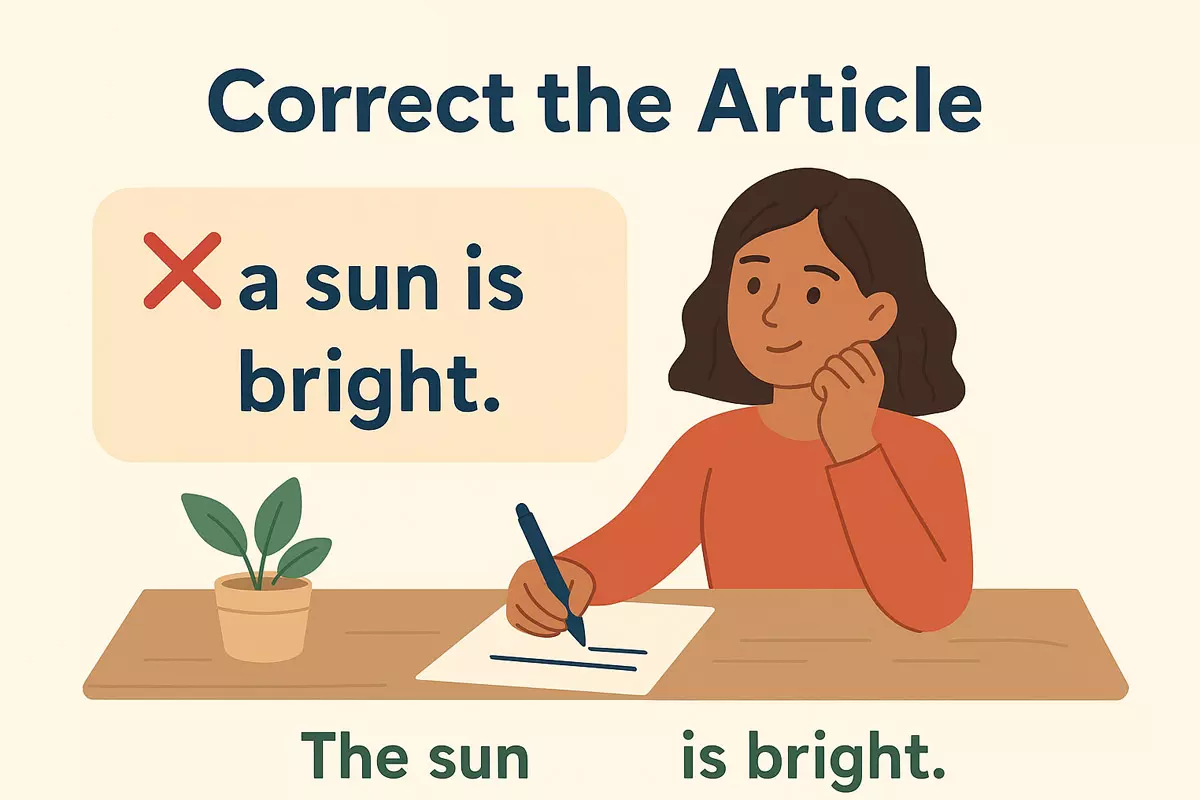 Here we key rules for writing articles, common B1–B2 errors with examples, and error-spotting practice. It also gives step-by-step correction strategies, model answers with explanations, and extra exercises for self-study.
Many English learners struggle to use "a," "an," and "the" correctly, which can lead to confusion and unclear writing. Mastering these articles is important because they help specify meaning and make sentences sound natural. By practicing how to choose the right article for different situations, you can improve both your writing and speaking skills. This exercise is designed to help you identify and correct common mistakes, so you can communicate your ideas more clearly and confidently in English.
Quick review of key article rules
Understanding when to use a, an, and the is essential for clear English sentences. Articles help specify whether you are talking about something specific or something more general. There are some basic principles that make article use easier to manage, especially at the B1–B2 level.
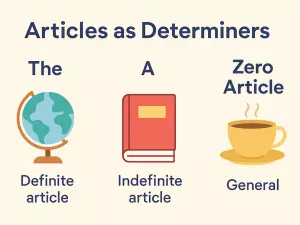
Definite and indefinite articles
- a — used before singular, countable nouns when mentioning something for the first time, or when it is not specific (e.g., "I saw a cat.").
- an — the same as a, but used before words starting with a vowel sound (e.g., "She ate an apple.").
- the — used when the listener/reader knows which thing is meant, or when it is unique (e.g., "the sun," "the book you lent me").
Zero article (no article)
Sometimes, no article is used. This usually happens with:
- Plural nouns (in general): "Dogs are friendly."
- Uncountable nouns (in general): "Milk is white."
- Names of most countries, languages, meals, and some places: "She speaks Spanish." / "Breakfast is ready."
Common rules and patterns
| When to use | Example |
|---|---|
| First mention of a singular countable noun | a car, an idea |
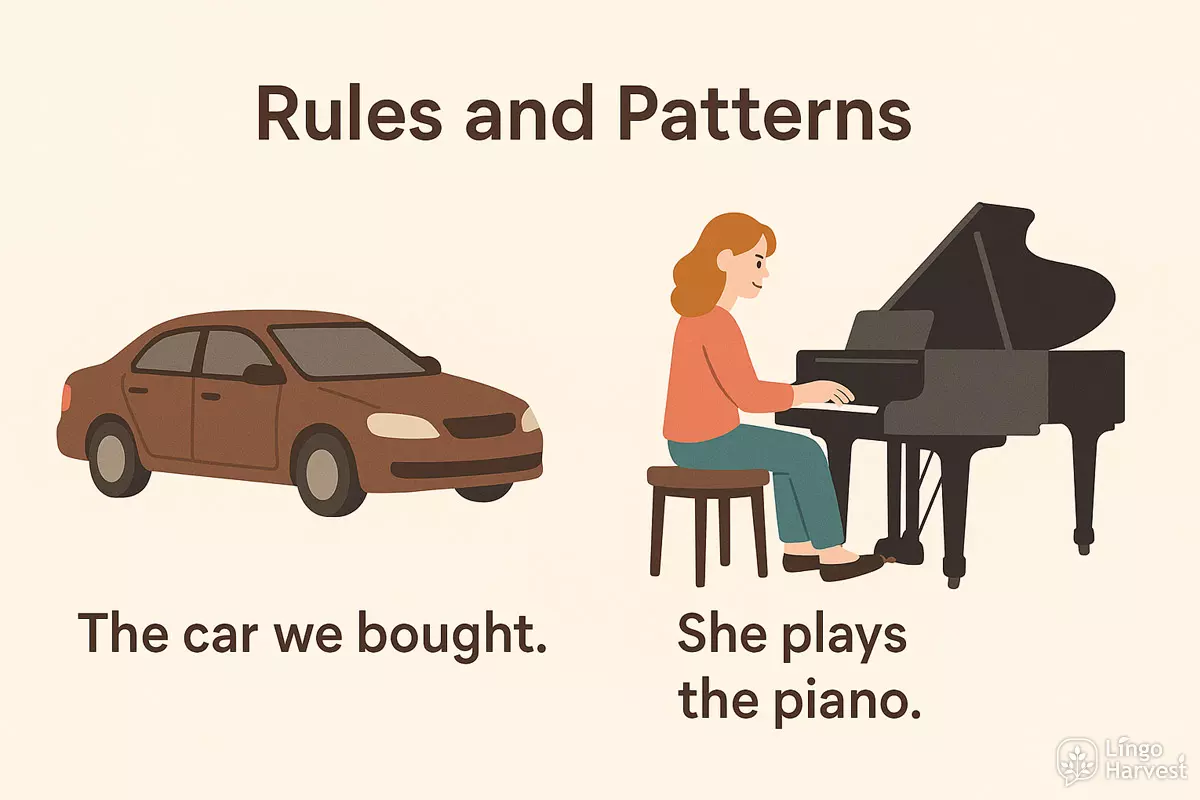
| Specific, previously mentioned noun | the car we bought |
| Unique objects | the moon, the president |
| Superlatives and ordinal numbers | the best day, the first time |
| General statements about plural/uncountable nouns | Cats are cute. Water is important. |
| Names with “of” phrases | the end of the street |
| Some geographical names | the United Kingdom, the Nile |
| Jobs and professions (singular) | a teacher, an engineer |
| Meals, languages, sports (in general) | Lunch is ready. I play football. |
| Musical instruments (specific) | She plays the piano. |
Frequent mistakes to avoid
- Don’t use the with names of people (usually): the Mary ❌.
- Don’t use a/an before plural nouns: a dogs ❌.
- Don’t use the with most countries: the France ❌.
- Don’t forget to use an before vowel sounds, not just vowel letters (e.g., an hour).
Quick practice
Which article (a/an/the/–) fits in each sentence?
- She is ___ engineer.
- I saw ___ interesting movie yesterday.
- ___ sun rises in the east.
- We had ___ lunch at noon.
- He visited ___ United States last year.
Show answers
- an
- an
- The
- – (no article)
- the
Typical B1–B2 article errors in context
Learners at the intermediate level often struggle with the correct use of "a," "an," and "the" in English sentences. These mistakes can make communication less clear or even change the intended meaning. Below, we’ll look at the most frequent issues that come up, with plenty of examples to show how articles are misused in real-life sentences.
Common Patterns of Article Errors
- Leaving out articles when they’re needed: “I have cat” instead of “I have a cat.”
- Adding articles where none are required: “She goes to the school every day” (when talking about school in general).
- Confusing "a/an" with "the": “He is the doctor” (when introducing a profession) instead of “He is a doctor.”
- Using "the" with general nouns: “The love is important” instead of “Love is important.”
- Incorrect use with plural or uncountable nouns: “She gave me an information.”
- Omitting "the" with superlatives: “She is best student in class.”
- Placing articles with proper names: “The John is coming.”
- Wrong article before vowel/consonant sounds: “An university” vs. “A university.”
- Misusing articles with geographical names: “The France is beautiful.”
- Forgetting to use “the” with unique objects: “Sun rises in east.”
- Adding "the" before meals: “I had the breakfast.”
- Using "a/an" with abstract nouns: “It’s a happiness.”
- Confusing zero article with definite article: “Mount Everest is the highest mountain” vs. “The Mount Everest is…”
- Omitting articles in set expressions: “Go to the bed” vs. “Go to bed.”
Examples: Error and Correction
Below are some sample errors that B1–B2 students often make, along with the corrected versions and a brief explanation.
| Incorrect Sentence | Corrected Sentence & Comment |
|---|---|
| I have dog. | I have a dog. → "Dog" is singular and countable, so "a" is needed. |
| She is best player. | She is the best player. → Superlatives need "the". |
| He goes to the work every morning. | He goes to work every morning. → "Work" as a routine place doesn’t take an article. |
| We visited the Paris last year. | We visited Paris last year. → Most city names do not take "the". |
| She has an information for you. | She has information for you. → "Information" is uncountable, so no article. |
| The Mount Everest is very high. | Mount Everest is very high. → No article for most mountain names. |
| I want to be an engineer. | I want to be an engineer. ✅ (Correct: "an" before vowel sound) |
| We had the dinner at 7 PM. | We had dinner at 7 PM. → Meals do not usually take articles. |
| She is a happiest person I know. | She is the happiest person I know. → Superlative needs "the", not "a". |
| He is the teacher. | He is a teacher. → Use "a" when stating someone’s profession (unless specifying which teacher). |
Key Takeaways
Article mistakes at B1–B2 often stem from translating directly from a learner’s native language or misunderstanding English rules. Focusing on typical patterns—such as when to use or omit "the," and choosing between "a/an" and zero article—can help learners avoid the most frequent pitfalls and improve both accuracy and fluency in writing and speaking.
Error-spotting sentences with mixed problems
When practicing article correction, it’s common to find sentences containing a mixture of issues—not just with articles (a, an, the), but sometimes also with word order, verb forms, or unnecessary words. Identifying and correcting these errors is excellent training for improving your overall accuracy and fluency.
How to approach mixed-problem sentences
Start by reading the sentence carefully and identifying which word or phrase feels incorrect or awkward. Consider if an article is missing or used incorrectly. Next, check for other mistakes, such as subject-verb agreement or misplaced modifiers. Sometimes, more than one correction is needed.
Common error types often combined with article mistakes
- Omitting necessary articles before countable singular nouns (e.g., “She bought book” instead of “She bought a book”).
- Using an article with uncountable nouns where it’s not needed (e.g., “He gave me a advice” instead of “He gave me advice”).
- Incorrect word order (e.g., “In the park beautiful is the tree” instead of “The tree in the park is beautiful”).
- Wrong verb forms (e.g., “She go to the store” instead of “She goes to the store”).
- Extra or missing prepositions (e.g., “He arrived to the school” instead of “He arrived at the school”).
- Redundant words (e.g., “He is the a teacher” instead of “He is a teacher”).
- Using “the” with general plural nouns (e.g., “The cats are friendly” meaning cats in general; it should be “Cats are friendly”).
- Confusing “a” and “an” (e.g., “an university” instead of “a university”).
- Forgetting to use “the” for something specific already mentioned (e.g., “I saw a movie. Movie was good.” instead of “The movie was good.”).
- Incorrect placement of adverbs (e.g., “She quickly runs always” instead of “She always runs quickly”).
- Double negatives (e.g., “He didn’t see nothing” instead of “He didn’t see anything”).
- Mixing up countable and uncountable noun usage (e.g., “Many informations” instead of “Much information”).
- Using articles with names (e.g., “The Anna is my friend” instead of “Anna is my friend”).
- Confusing definite and indefinite articles (e.g., “She is the doctor” when introducing someone for the first time; should be “a doctor”).
- Omitting articles with superlatives (e.g., “He is best player” instead of “He is the best player”).
Sample sentences with mixed mistakes
Try to spot and correct the errors in each of these examples:
- She is teacher in a school.
- I have a information for you.
- The cats is sleeping under table.
- He bought new car last week.
- We visited an university yesterday.
- She is best student in our class.
- I saw a movie. Movie was interesting.
- He is the a engineer.
- There are much cars in the street.
- My friend lives in the London.
- She always eat breakfast in morning.
- He didn’t have no time.
- This is a informations I wanted.
- The dogs are friendly animals.
- Anna is the my sister.
Tips for correcting sentences with multiple errors
- Check each noun for article use: is it countable, specific, or general?
- Look for subject-verb agreement issues, especially after correcting articles.
- Read your correction aloud—does it sound natural?
- Don’t focus only on articles; scan for other common mistakes as well.
- Remember: more than one correction may be needed in a single sentence.
Practice identifying and fixing these combinations regularly to build confidence and accuracy in both written and spoken English.
Step-by-step correction strategies
When working with sentence-level corrections, it helps to follow a logical sequence to identify and fix mistakes. Start by reading the entire sentence for overall meaning, then focus on details such as grammar, vocabulary, and punctuation. This methodical approach helps you notice errors that might be hidden when looking at individual words in isolation.
1. Read for general understanding
Before making changes, read each sentence to understand its main idea. This helps you spot errors that disrupt meaning or clarity. Sometimes, mistakes are more obvious when you focus on the message instead of the form.
2. Identify common error types
Look for frequent problem areas. These often include:
- Verb tense mistakes
- Subject-verb agreement
- Incorrect word order
- Preposition errors
- Missing articles (a, an, the)
- Spelling mistakes
- Wrong word choice
- Punctuation issues
- Extra or missing words
- Incorrect plural forms
- Pronoun errors
- Incorrect use of comparatives/superlatives
- Confusing similar words (their/there/they're, its/it's)
- Incorrect conjunctions
- Run-on sentences
- Sentence fragments
- Capitalization errors
- Redundant words
3. Analyze the structure
Check if the sentence follows standard English word order (subject + verb + object). Rearranging words can often resolve awkward phrasing or clarify meaning.
4. Compare with correct forms
When unsure, compare the sentence to a known correct structure. This can reveal subtle mistakes. For example:
| Incorrect Sentence | Corrected Sentence |
|---|---|
| I have went to the store yesterday. | I went to the store yesterday. |
| She don't like apples. | She doesn't like apples. |
| He can sings well. | He can sing well. |
| There is many cars outside. | There are many cars outside. |
5. Double-check your corrections
After making edits, read the sentence again to ensure it sounds natural and makes sense. Ask yourself: Does the sentence communicate the intended idea clearly? Is the grammar correct? If possible, compare your version with a reliable source or grammar reference.
6. Practice with feedback
Improvement comes from practice and reflection. If you have access to a teacher or language partner, ask for feedback on your corrections. Over time, you’ll develop a stronger instinct for spotting and fixing errors.
By applying these practical steps, you can systematically review and improve sentences, making your writing more accurate and effective.
Model answers with explanations
Understanding how to use articles correctly can be challenging at the B1–B2 level. Below, you’ll find sample corrections for common mistakes involving "a," "an," and "the," along with explanations to clarify each choice. Reviewing these examples will help you recognize patterns and avoid similar errors in your own writing.
Sample sentences and corrections
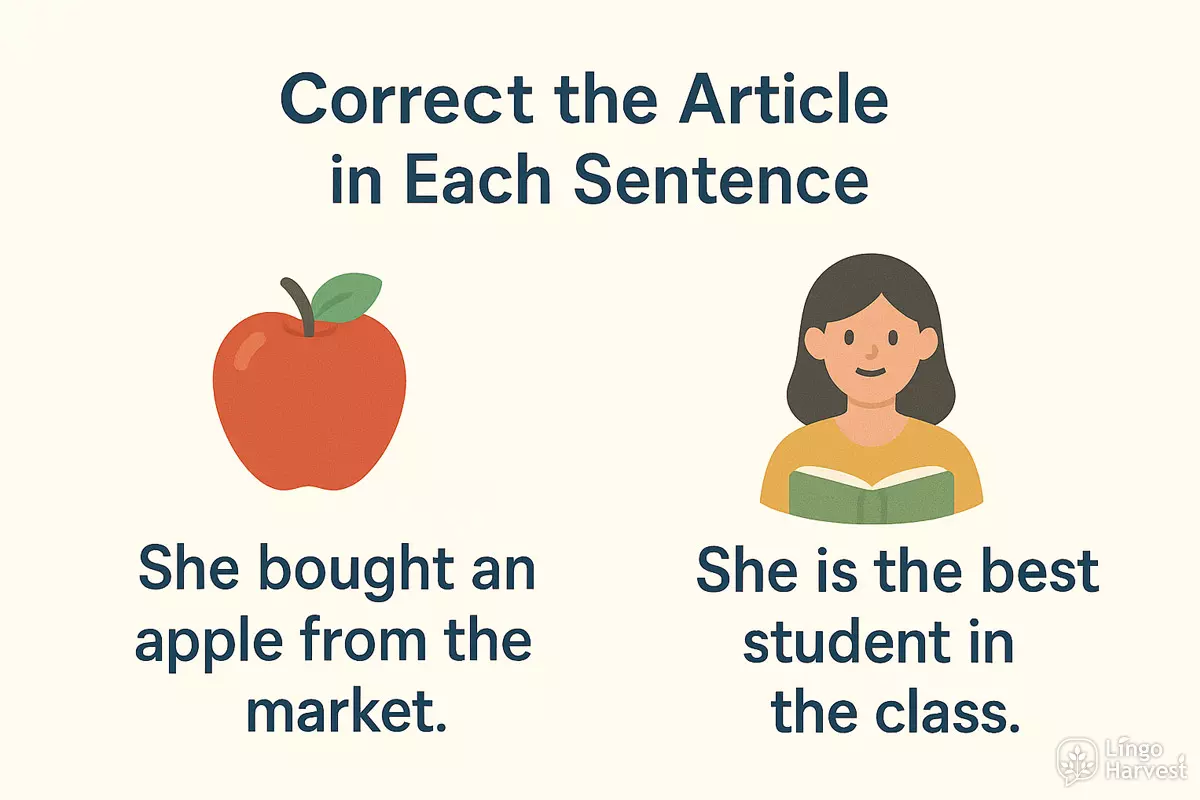
- Incorrect: She bought apple from market.
Correct: She bought an apple from the market.
Explanation: "An apple" uses "an" because "apple" starts with a vowel sound. "The market" refers to a specific place, so "the" is required. - Incorrect: I saw cat in garden.
Correct: I saw a cat in the garden.
Explanation: "A cat" means any cat (not a specific one). "The garden" is a particular garden, so use "the." - Incorrect: She is best student in class.
Correct: She is the best student in the class.
Explanation: Superlatives ("best") need "the." "The class" refers to a specific group. - Incorrect: I have umbrella in my bag.
Correct: I have an umbrella in my bag.
Explanation: "An" is used before words starting with a vowel sound. - Incorrect: Sun rises in east.
Correct: The sun rises in the east.
Explanation: Unique objects ("the sun") and specific directions ("the east") need "the." - Incorrect: She is doctor.
Correct: She is a doctor.
Explanation: Professions require "a" or "an" unless already specified. - Incorrect: He went to school.
Correct: He went to the school (if a specific school is meant) or He went to school (if speaking generally).
Explanation: "The" is used for a particular place; no article is needed when talking about the institution in general. - Incorrect: I need information.
Correct: I need some information.
Explanation: "Information" is uncountable, so use "some" instead of "a" or "an." - Incorrect: She is reading interesting book.
Correct: She is reading an interesting book.
Explanation: "An" is needed before "interesting" (a vowel sound). - Incorrect: I visited London last year.
Correct: I visited London last year.
Explanation: No article is needed before most city names.
Quick reference: Article usage patterns
| Form | When to use |
|---|---|
| a / an | Before singular, countable nouns when mentioning something for the first time; "an" is used before vowel sounds. |
| the | For specific nouns already known to the reader or unique objects (e.g., the sun, the best). |
| no article | With most plural and uncountable nouns when speaking generally, and before most proper names (cities, countries). |
| some | With uncountable or plural nouns when the amount or number is not specified (e.g., some water, some apples). |
By reviewing these corrected sentences and explanations, you’ll become more confident in choosing the right article or leaving it out when necessary. Practice identifying the rules in real examples to reinforce your understanding.
Extra practice set for self-study
Improve your understanding of English articles with these targeted exercises. Try to correct the article (a, an, the, or zero article) in each sentence. This will help you spot common mistakes and strengthen your grasp of when and how to use articles correctly.
Correct the article in the sentences below
- She adopted cat from animal shelter last week.
- Can you pass me salt, please?
- He’s engineer in local company.
- We visited London Eye during our trip.
- Mount Everest is highest mountain in world.
- I have never seen elephant before.
- They went to Italy for vacation.
- She is reading interesting book about history.
- Could you open window, please?
- My mother is doctor.
- We had delicious dinner yesterday.
- Sun rises in east.
- He wants to be artist when he grows up.
- We saw old castle by river.
- She goes to work by bus.
- I usually have coffee in morning.
- There is university near my house.
- They live in small village in countryside.
- She plays piano very well.
- He is looking for job.
Show answers
- She adopted a cat from an animal shelter last week.
- Can you pass me the salt, please?
- He’s an engineer in a local company.
- We visited the London Eye during our trip.
- Mount Everest is the highest mountain in the world.
- I have never seen an elephant before.
- They went to Italy for vacation. (No article)
- She is reading an interesting book about history.
- Could you open the window, please?
- My mother is a doctor.
- We had a delicious dinner yesterday.
- The sun rises in the east.
- He wants to be an artist when he grows up.
- We saw an old castle by the river.
- She goes to work by bus. (No article)
- I usually have coffee in the morning. (No article before "coffee")
- There is a university near my house.
- They live in a small village in the countryside.
- She plays the piano very well.
- He is looking for a job.
Common patterns for article usage
Review these typical situations with their correct article usage:
| Situation | Example |
|---|---|
| First mention, singular countable noun | I saw a dog in the park. |
| Specific/known item | Can you close the door? |
| General plural or uncountable nouns | Dogs are friendly. / Water is important. |
| Unique objects | The sun is bright. |
| Jobs/professions | She is a teacher. |
| Meals, places, transport (general) | We have breakfast at eight. / He goes to school by bus. |
Quick self-check: Zero article or not?
- Names of countries: Brazil, Japan
- Meals: lunch, dinner (unless specific)
- Languages: English, French
- Abstract nouns (in general): happiness, information
- Sports: play football, do yoga