Article Choice in Short Texts: Narratives and Emails

 This article explains how using articles improves clarity in short texts like stories and emails. It covers article patterns, first and later mentions, formal and informal usage, editing tips, and offers practice with sample texts.
The choice between "a" and "the" in everyday writing, whether in personal stories or digital messages, plays a significant role in shaping meaning and clarity. By examining how people use these articles in short narratives and emails, we can observe subtle patterns that reveal individual linguistic habits. Such exploration highlights not only the importance of article selection in effective communication but also how these small words contribute to the overall tone and precision of our writing.
How articles create clarity in short texts
Articles like "a," "an," and "the" help readers understand which objects or people are being discussed, especially in brief communications such as narratives and emails. Without these small words, it can be unclear whether we mean something in general or something specific. This distinction is crucial in short messages, where every word carries more weight.
Why articles matter in concise writing
In short formats, such as emails or storytelling snippets, context is often limited. Articles signal to the reader whether information is new or already known. For example, "I saw a dog" tells the reader about any dog, while "I saw the dog" refers to a specific animal, perhaps already mentioned or known to both writer and reader.
- "A/an" introduces something for the first time or refers to any one of a group.
- "The" points to a particular item already introduced or assumed to be known.
- Omitting articles can lead to confusion about which item is meant.
- Articles help distinguish between general statements and specific references.
- They streamline communication by reducing the need for extra explanation.
- Correct usage prevents ambiguity, especially when details are scarce.
- They clarify relationships between objects and people in the text.
- Articles make it easier for readers to follow the flow of information.
- They support logical progression in narratives and instructions.
- In emails, articles ensure requests or updates are accurately understood.
Examples of clarity with and without articles
Consider how meaning shifts with article use:
- Send report. ❌ (Unclear: which report?)
- Send the report. ✅ (Clear: a specific report is meant)
- I met a client today. (Any client, not previously mentioned)
- I met the client today. (A particular client, likely known to the reader)
Patterns in article choice
Writers often follow certain patterns to achieve clarity. The table below summarizes common article selection strategies in short texts:
| Purpose | Article Use |
|---|---|
| Introducing something new | a or an ("I have a question.") |
| Referencing something known | the ("Please see the attachment.") |
| Making general statements | Omit article ("Coffee is popular.") |
| Emphasizing uniqueness | the ("She is the manager.") |
By choosing articles thoughtfully, writers ensure their short texts are easy to understand and free from misunderstandings. This attention to detail is especially valuable in fast-paced communication, where readers rely on every word to grasp the intended message.
Patterns in personal stories and emails
When analyzing how articles ("a," "an," "the," or none) appear in short texts, notable distinctions emerge between narrative accounts and email communication. Each genre shows its own tendencies in article usage, reflecting the speaker’s intent, level of formality, and the text’s purpose.
Common tendencies in narratives
Personal stories, whether written for blogs or social media, often favor vivid description and chronological order. Article choice in these texts usually highlights new versus known information, and helps build context for the reader. Some frequent patterns include:
- Introducing new characters or items with "a" or "an": "I saw a dog."
- Switching to "the" when something is mentioned again: "The dog started barking."
- Omitting the article for generic or plural references: "Dogs can be noisy."
- Using "the" for unique or specific references: "The sun was setting."
- Choosing zero article with institutions or means of transport: "She went to school by bus."
- Employing "a" or "an" in expressions of frequency: "Once a week."
- Zero article with meals and times of day: "We had dinner at sunset."
- Definite article for shared experiences: "The party was amazing."
- Indefinite article to introduce ideas: "It was a surprise."
- Zero article with abstract nouns: "Happiness is important."
Email conventions and article usage
Emails, especially in informal contexts, often prioritize clarity and brevity. People may drop articles in subject lines or bullet points, but use them more consistently in the main body. Patterns seen in electronic messages include:
- Omitting articles in headers: "Meeting Update" instead of "The Meeting Update"
- Using "the" for shared workplace references: "The report is attached."
- Indefinite articles for new requests: "Can you send me a file?"
- Zero article in lists or instructions: "Check document, reply by Friday."
- Definite article for specific, previously discussed matters: "The deadline has changed."
- Indefinite article for non-specific items: "I need a signature."
- Zero article with mass nouns: "Please provide feedback."
- Using "the" with superlatives: "The best option is..."
- Omitting articles for brevity in reminders: "See attachment."
- Articles in polite requests: "Could you send me the details?"
Comparison: Narrative vs. Email Article Usage
| Narrative Stories | Emails |
|---|---|
| Context-building with articles is common | Articles sometimes omitted for brevity |
| Frequent shifts from "a/an" to "the" as information becomes familiar | "The" used for shared or previously mentioned items |
| Zero article with generalizations and institutions | Zero article in headers, lists, or instructions |
| More narrative flow, full sentences | Shorter phrases, bullet points, or fragments |
By observing these patterns, it's easier to understand why article usage in short texts can vary so much—even between genres as similar as personal storytelling and email exchanges. The context and communicative goals play a significant role in shaping these choices.
First mention vs later mention in narratives
In narrative texts, how we introduce and then subsequently refer to entities shapes the flow and clarity of the story. Typically, when a character, object, or concept appears for the first time, writers use an indefinite article ("a" or "an") or sometimes a demonstrative ("this," "that") to signal newness to the reader. As the narrative progresses and that same entity is referenced again, the definite article ("the") becomes standard, reflecting the assumption that the reader now recognizes the referent.
Patterns in article usage for narrative reference
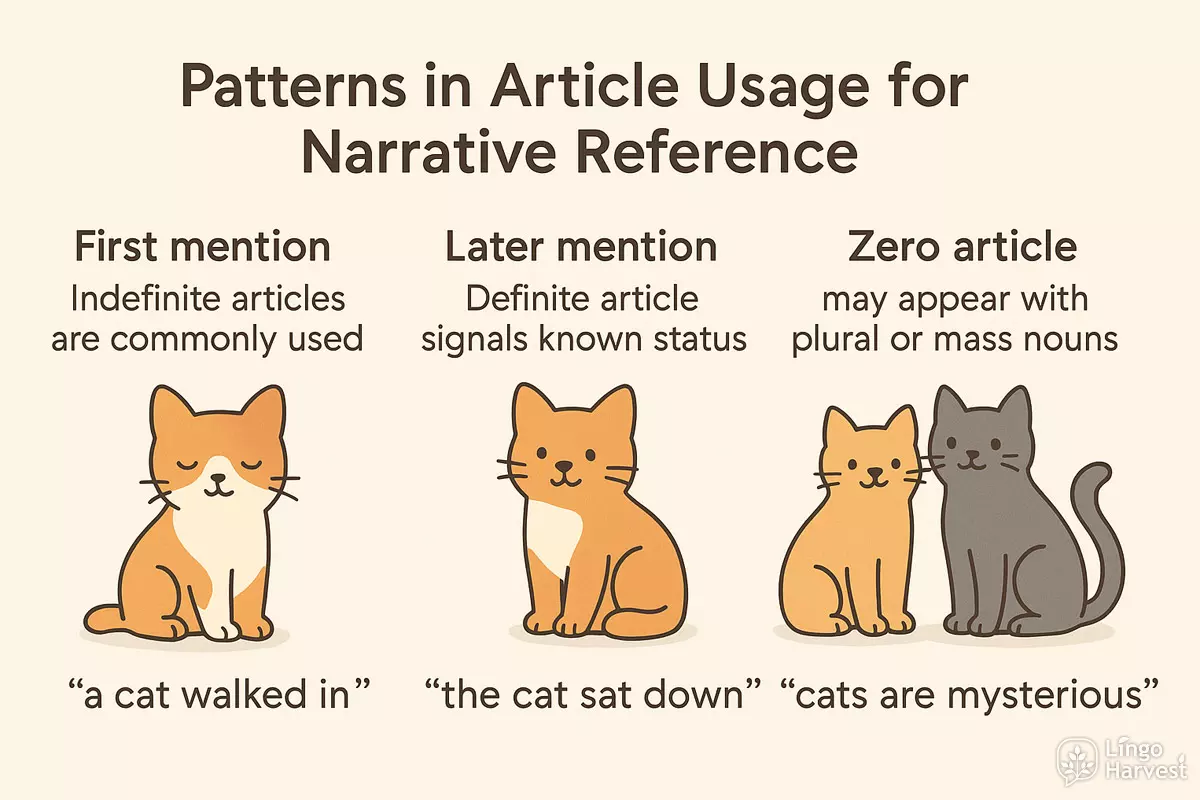
- First mention: Indefinite articles are commonly used ("a cat walked in").
- Later mention: Definite article signals known status ("the cat sat down").
- Zero article may appear with plural or mass nouns ("cats are mysterious").
- Demonstratives can add emphasis or point to something specific ("that old book").
- Proper nouns generally do not take articles unless specified ("Mount Everest," but "the Amazon").
- Switching articles can indicate a change in reference or introduce ambiguity.
- Reintroducing an entity after a long gap may return to indefinite articles, especially if context has shifted.
- Modifiers (adjectives or relative clauses) can affect article choice ("a boy who wore glasses" vs. "the boy who wore glasses").
- Generic reference uses ("a dog is loyal" vs. "the dog barked") show contrast between type and individual.
- Contrastive focus sometimes allows for "a" even with known entities ("not the dog, but a cat was responsible").
- Repetitive or formulaic narrative structures (as in fairy tales) may follow predictable article shifts.
- Articles interact with possessives, often dropping when a possessive is present ("her house," not "the her house").
Examples of article shift in narrative context
Writers rely on article switching to guide the reader’s attention and signal what is new versus what is already familiar. Consider the following sequence:
- A man entered the room. The man looked nervous.
- She picked up a book. The book was covered in dust.
- They saw an owl outside. The owl hooted loudly.
These shifts are not arbitrary; they help organize information in a way that supports coherence and reader understanding.
Summary of distinctions
The distinction between initial and subsequent references is a fundamental organizing principle in English narrative style. While the first introduction often uses an indefinite article to mark newness, later mentions employ the definite article to reinforce familiarity. Recognizing and mastering these patterns can improve both comprehension and production of clear, natural-sounding narratives.
Formal vs informal article use in emails
How we choose articles ("a," "an," "the") in email messages often depends on the level of formality. In professional communication, grammatical precision is expected, so articles are used according to standard rules. In contrast, quick or informal emails—especially among colleagues or friends—tend to show relaxed usage, with articles sometimes omitted for brevity or informality.
Patterns in formal email communication
In more official correspondence, writers typically:
- Use definite and indefinite articles correctly to maintain clarity (e.g., "Please send the report by Friday.").
- Avoid article omission, even with familiar nouns ("A meeting is scheduled for Monday," not "Meeting is scheduled...").
- Follow conventional grammar to show respect and professionalism.
Common tendencies in informal email exchanges
Informal messages, particularly in fast-paced or internal settings, often display:
- Article dropping, especially with common nouns ("Need update on project" instead of "Need an update on the project").
- Shortened phrases for efficiency ("Will send info soon" vs. "I will send the information soon").
- Flexible grammar reflecting spoken language habits.
Comparison: Article usage in formal vs. informal emails
| Formal Email Example | Informal Email Example |
|---|---|
| Could you please send the document by end of day? | Send doc by EOD? |
| I have attached a proposal for your review. | Attached proposal for review. |
| The meeting will be held in the conference room at 3 pm. | Meeting in conf room 3pm. |
| Please let me know if you have any questions. | Questions? Let me know. |
Typical article omission in brief messages
Writers often omit articles in subject lines or quick notes. Here are phrases where articles are commonly dropped in casual email contexts:
- Need feedback
- Have update
- Request info
- Schedule meeting
- Share details
- Missed call
- Send files
- Review draft
- Arrange call
- Confirm time
- Follow up
- Find attached
- Provide input
- Join discussion
- Change deadline
Considerations for clarity
While dropping articles may save time, it can sometimes cause confusion, especially for non-native speakers or in international settings. For important or sensitive topics, using full grammatical forms is recommended to ensure the message is clear and professional. Striking a balance between efficiency and clarity is key when choosing how strictly to follow article rules in email communication.
Editing short texts for better article use
Improving how articles like "a," "an," and "the" are used in brief narratives or emails can make the text clearer and more professional. Short messages often skip articles or use them inconsistently, which may confuse readers or make the writing sound abrupt. Paying attention to these small words can help the message flow better and avoid misunderstandings.
Common issues with articles in short texts
- Articles are omitted for brevity, leading to awkward phrasing ("I sent report" instead of "I sent the report").
- Incorrect article choice changes meaning ("an email" vs. "the email").
- Unnecessary use of articles before proper nouns or plural nouns ("the John," "the informations").
- Mixing up "a" and "an" before vowel/consonant sounds.
Strategies for editing articles in short communications
When reviewing brief texts, focus on the core message and scan for places where an article clarifies intent or makes the sentence more natural. Consider the following:
- Read the text aloud to spot missing articles or odd phrasing.
- Decide if a noun is specific (needs "the") or general (needs "a" or "an").
- Look for repeated nouns; the first mention often gets "a/an," later mentions use "the."
- Remove articles before uncountable nouns unless context requires specificity.
- Check for article use in set phrases or idioms ("in a hurry," "on the way").
Examples of article edits in short texts
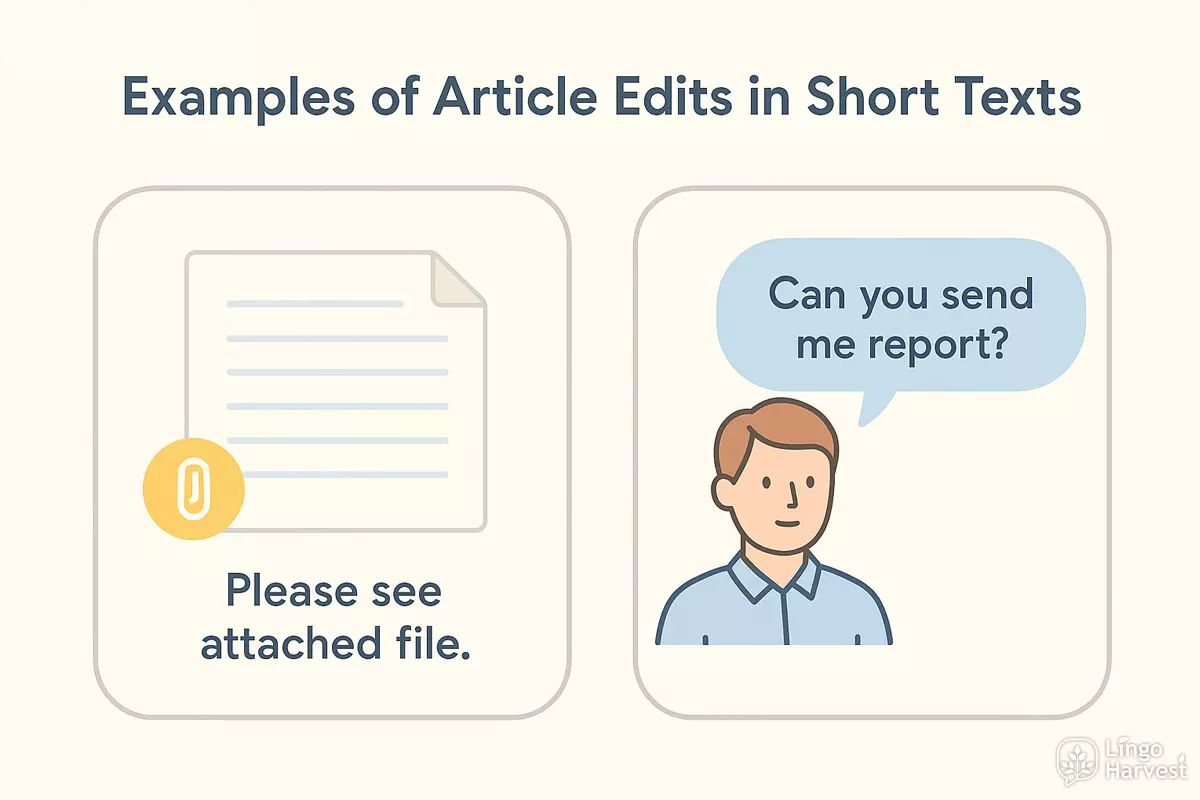
- Original: "Please see attached file." → Revised: "Please see the attached file."
- Original: "I need answer." → Revised: "I need an answer."
- Original: "Can you send me report?" → Revised: "Can you send me the report?"
- Original: "She is in meeting." → Revised: "She is in a meeting."
- Original: "We discussed project." → Revised: "We discussed the project."
- Original: "Let’s schedule call." → Revised: "Let’s schedule a call."
- Original: "Update was sent." → Revised: "The update was sent."
- Original: "He bought umbrella." → Revised: "He bought an umbrella."
- Original: "Do you have time?" (Correct, no article needed for "time" here.)
- Original: "She gave advice." (Correct, since "advice" is uncountable and general.)
- Original: "I will join call." → Revised: "I will join the call."
- Original: "Please find information below." → Revised: "Please find the information below."
Quick reference for article correction in short texts
| Incorrect Example | Corrected Version |
|---|---|
| Send me update. | Send me the update. |
| I have question. | I have a question. |
| Meeting is at 10. | The meeting is at 10. |
| He is on way. | He is on the way. |
| She bought apple. | She bought an apple. |
By carefully reviewing and editing short texts for article use, writers can improve clarity and maintain a professional tone, even in the briefest messages.
Practice: improve article choice in sample texts
Selecting the correct articles ("a," "an," "the," or zero article) can be challenging, especially in short texts like narratives and emails. This section provides targeted practice to help you recognize and correct article errors in real-world examples. By analyzing sample sentences, you’ll strengthen your intuition for article usage and learn to avoid common pitfalls.
Identify and Correct Article Errors
Read each sentence and decide if the articles are used correctly. If not, make the necessary corrections. This will help you internalize patterns for both definite and indefinite articles, as well as when to omit them.
- She sent email to her manager yesterday.
- He bought umbrella before rain started.
- Sun is shining brightly today.
- I saw cat in garden this morning.
- Could you please send me report by end of day?
- They visited museum last weekend.
- I received interesting message from old friend.
- She is engineer at local company.
- Did you read book I recommended?
- Let’s have lunch at new cafe near office.
Show answers
- She sent an email to her manager yesterday.
- He bought an umbrella before the rain started.
- The sun is shining brightly today.
- I saw a cat in the garden this morning.
- Could you please send me the report by the end of the day?
- They visited the museum last weekend.
- I received an interesting message from an old friend.
- She is an engineer at a local company.
- Did you read the book I recommended?
- Let’s have lunch at the new cafe near the office.
Common Patterns and Article Usage in Short Texts
Familiarize yourself with typical contexts where articles are often used incorrectly in narratives and emails. The following list highlights frequent patterns and helps reinforce correct usage:
- Jobs and roles: "She is a doctor."
- First mention: "I bought a car."
- Subsequent mention: "The car is blue."
- Unique objects: "The sun is hot."
- Superlatives: "He is the best player."
- Meals (general): "Let's have lunch." (no article)
- Organizations: "She works for a bank."
- Specific locations: "They visited the park."
- Abstract nouns (general): "Happiness is important." (no article)
- Proper names: "I met John." (no article)
- Days/months: "See you on Monday." (no article)
- Emails/documents (specific): "Did you get the email?"
- Zero article with languages: "She speaks English."
- Indefinite for countable, singular: "I saw a bird."
- Plural, general: "Dogs are friendly." (no article)
- Definite for known items: "Pass me the salt."
- Uncountable, general: "Information is useful." (no article)
- Definite with ordinal numbers: "He was the first guest."
- Indefinite with professions: "She is a teacher."
- Definite with only one: "The president arrived."
Mini-Quiz: Choose the Correct Article
Select the appropriate article for each blank. If no article is needed, write "–".
- ___ apple a day keeps ___ doctor away.
- She is ___ best candidate for ___ job.
- I need ___ information about ___ project.
- We are meeting at ___ airport.
- ___ water in this lake is clean.
- He bought ___ umbrella because ___ weather was bad.
- ___ honesty is important in any relationship.
- Can you close ___ window, please?
- They visited ___ museum that opened last year.
- She wants to become ___ engineer.
- ___ Earth goes around ___ Sun.
- He gave me ___ advice yesterday.
- I saw ___ interesting movie yesterday.
- She took ___ bus to get to ___ city center.
- They spent ___ week in ___ Alps.
Show answers
- An apple a day keeps the doctor away.
- She is the best candidate for the job.
- I need – information about the project.
- We are meeting at the airport.
- The water in this lake is clean.
- An umbrella, the weather.
- – honesty, a relationship.
- the window.
- the museum.
- an engineer.
- The Earth, the Sun.
- – advice (uncountable).
- An interesting movie.
- the bus, the city center.
- a week, the Alps.