Review Quiz: Mixed Article Practice for Intermediate Learners

 The article summarizes essential concepts about English articles, features mixed multiple-choice and gap-fill questions using realistic examples, provides a self-check answer key with brief notes, guides on analyzing mistakes, and suggests next steps for improvement.
Are you looking to improve your grammar skills? This set of interactive exercises is crafted specifically for intermediate learners who want to strengthen their understanding of definite and indefinite words. Each activity offers a practical and enjoyable approach to mastering these concepts, allowing you to test your knowledge and track your progress. By working through these exercises, you'll gain greater confidence in your grammar abilities and be able to use definite and indefinite words more accurately in everyday communication.
Overview of what has been learned about articles
Understanding how to use articles (“a,” “an,” and “the”) is a fundamental part of English grammar, especially for intermediate learners. Through practice and review, students typically gain clarity on the basic rules, common exceptions, and patterns that govern article usage. This knowledge helps build confidence in both speaking and writing English more naturally.
Key Principles of Article Usage
- Definite Article (“the”): Used for specific or previously mentioned nouns.
- Indefinite Articles (“a”/“an”): Used for non-specific, singular countable nouns. “A” precedes consonant sounds; “an” precedes vowel sounds.
- No Article: Sometimes, especially with plural or uncountable nouns in a general sense, no article is needed.
Common Patterns and Examples
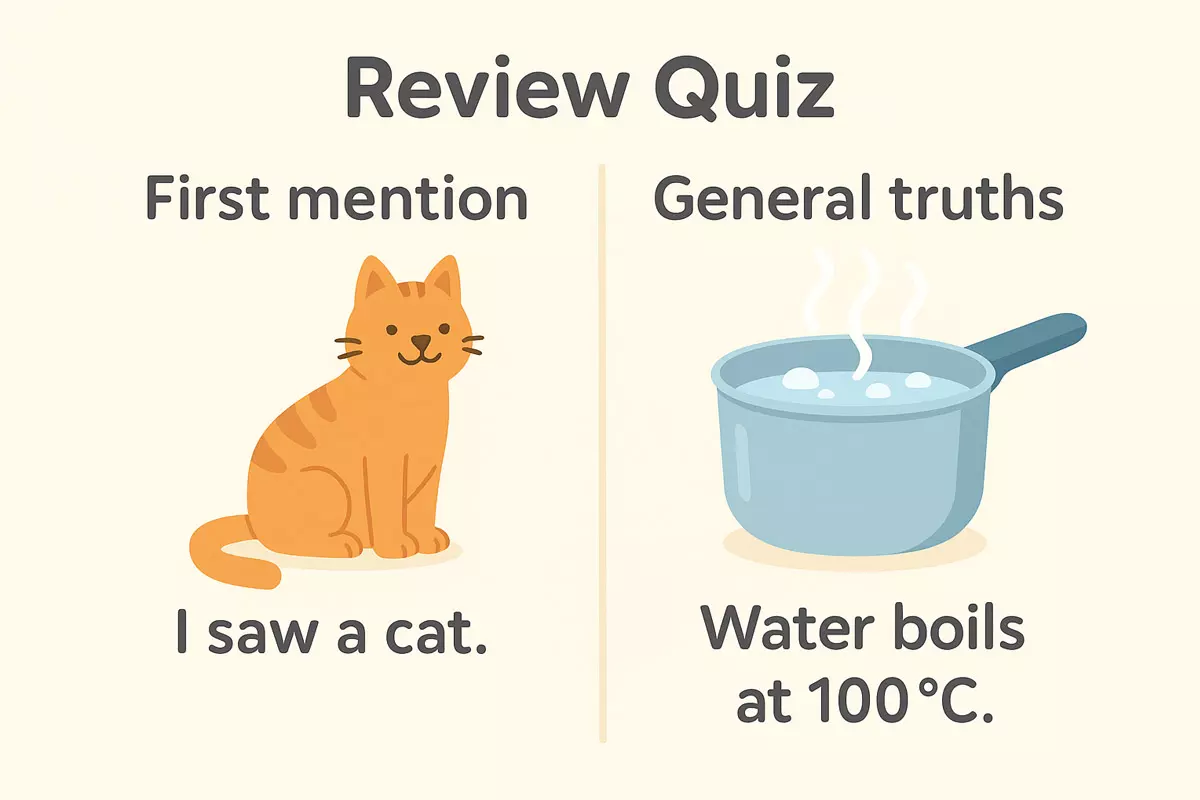
- First mention: Use “a” or “an” (e.g., I saw a cat).
- Subsequent mention: Use “the” (e.g., The cat was black).
- Unique objects: Use “the” (e.g., The sun is bright).
- General truths: No article (e.g., Water boils at 100°C).
- Jobs and professions: Use “a” or “an” (e.g., She is a doctor).
- Superlatives: Always use “the” (e.g., The fastest runner).
- Nationalities and groups: Use “the” (e.g., The French).
- Meals, languages, and sports: Usually, no article (e.g., I play tennis).
- Days and months: No article (e.g., Monday is busy).
- Buildings/places: Sometimes with “the” (e.g., The bank), sometimes without (e.g., school).
Article Forms at a Glance
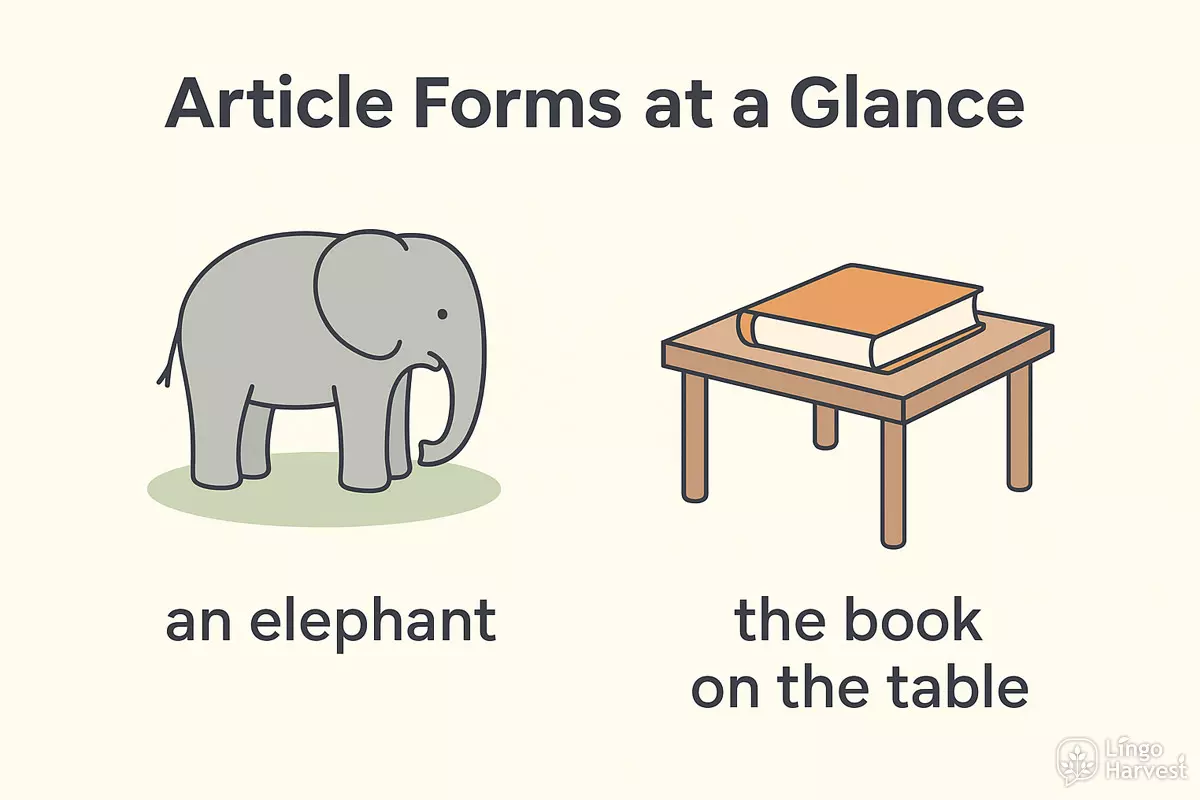
| Article | Usage Example | Rule/Context |
|---|---|---|
| a | I bought a pen. | Singular, non-specific, consonant sound |
| an | She saw an elephant. | Singular, non-specific, vowel sound |
| the | The book on the table is mine. | Specific or already mentioned noun |
| — | Cats are friendly animals. | Plural or uncountable noun in a general sense |
Typical Challenges and How to Overcome Them
Learners often struggle with article omission, especially in phrases like “go to school” or “at home,” and with choosing between “a”/“an” and “the.” Regular practice, exposure to authentic English, and reviewing example sentences can help reinforce these distinctions. Recognizing set phrases and exceptions is also important for accuracy.
By consolidating these patterns and reviewing common usage, intermediate students can avoid frequent mistakes and communicate more precisely in English.
Mixed multiple-choice and gap-fill questions
Practicing with a combination of question types helps reinforce grammar, vocabulary, and reading skills. Multiple-choice items test your ability to recognize the correct answer among distractors, while gap-fill tasks encourage you to actively recall and produce language. Together, they offer a balanced approach to review.
Common formats you might see
- Choose the correct word: Select the right option from a list.
- Fill in the blank: Complete the sentence with the correct word or phrase.
- Match the pairs: Connect questions and answers or beginnings and endings of sentences.
- Find the error: Identify and correct mistakes in a sentence.
Example topics and patterns
You’ll encounter a range of language points in these quizzes. Here are some typical examples you might practice:
- Verb tenses (past, present, future)
- Prepositions (in, on, at, for, since)
- Comparatives and superlatives (bigger, the most interesting)
- Articles (a, an, the, or no article)
- Modal verbs (can, must, should)
- Countable vs. uncountable nouns
- Word order in questions
- Synonyms and antonyms
- Collocations (make a decision, do homework)
- Conditional sentences (If I were you...)
- Reported speech
- Common phrasal verbs
- Pronouns and possessives
- Subject-verb agreement
- Adverbs of frequency (always, usually, never)
- Time expressions (last week, recently, next month)
Sample mixed question types
- Which word completes the sentence? “She ______ to the gym every morning.” (go / goes / going)
- Choose the correct preposition: “He arrived ___ the airport at 7 pm.” (in / on / at)
- Fill in: “If it ______ tomorrow, we’ll stay inside.”
- Which sentence is correct?
A. I am agree.
B. I agree.
C. I am agreeing. - Choose the best synonym for “happy”: (sad / joyful / angry)
- Find the mistake in the sentence: “She don’t like chocolate.”
- Which article is correct? “He bought ___ umbrella.” (a / an / the)
- Choose the correct verb form: “We ______ dinner when she called.” (were eating / eat / are eating)
- Pick the correct sentence:
A. There is much people here.
B. There are many people here. - Select the right pronoun: “This is the girl ______ won the prize.” (who / which / whose)
- Fill in: “I haven’t seen him ______ last week.” (for / since / at)
- Choose the correct comparative form: “This book is ______ than the last one.” (more interesting / interestinger / most interesting)
Show answers
- goes
- at
- rains
- B
- joyful
- don’t → doesn’t
- an
- were eating
- B
- who
- since
- more interesting
Typical error types to watch for
- Confusing verb forms (eat/ate/eaten)
- Misused articles (“I have a homework” instead of “I have homework”)
- Wrong prepositions (“interested on” vs. “interested in”)
- Incorrect plural forms (“childs” instead of “children”)
- Subject-verb agreement (“They goes” instead of “They go”)
Comparison of question formats
| Format | What it tests | Example |
|---|---|---|
| Multiple-choice | Recognition, quick thinking | Choose the correct answer: “He ___ to school every day.” (go/goes) |
| Gap-fill | Active recall, production | Fill in the blank: “They ______ (eat) lunch at noon.” |
| Error correction | Editing, attention to detail | Find and fix the mistake: “She don’t likes apples.” |
| Matching | Associative memory | Match: “hungry” → “want to eat” |
Working with this variety of questions can help you see your strengths and areas for improvement. As you complete these tasks, focus on understanding why each answer is correct or incorrect. This approach will deepen your language skills and build your confidence for real-life communication.
Realistic sentence and text-based items
When practicing for intermediate-level quizzes, working with authentic sentences and short passages is especially useful. Instead of isolated words or artificial phrases, these items present language in a form you’re likely to encounter in real conversations, books, emails, or media. This helps learners connect grammar and vocabulary to context, improving both understanding and recall.
Why practice with real-world examples?
- Contextual clues make it easier to infer meaning, especially for new vocabulary.
- Common sentence structures and idioms become more familiar through repetition in realistic materials.
- Understanding how words and grammar choices change with tone or situation is best seen in natural texts.
- It prepares you for actual language use, not just test questions.
Typical item types found in mixed quizzes
- Choosing the correct word or phrase to complete a sentence based on context
- Identifying the main idea of a short paragraph
- Finding grammatical errors in a realistic message or dialogue
- Matching sentences to their likely responses
- Reordering jumbled sentences to form a logical paragraph
- Reading a short email and answering comprehension questions
- Spotting formal vs. informal language in sample text exchanges
- Paraphrasing sentences without changing their meaning
- Selecting sentences with the correct register for a situation
- Interpreting implied meaning or emotion in a dialogue excerpt
Common sentence patterns and text features
| Pattern/Feature | Example |
|---|---|
| Conditional | If you need help, let me know. |
| Indirect request | Could you send me the report by Friday? |
| Reported speech | She said she would arrive at 3 PM. |
| Contrast connector | Although it was raining, we went for a walk. |
| Sequencing | First, read the instructions. Then, start the exercise. |
| Polite refusal | I’m afraid I can’t join you this evening. |
| Giving advice | You should try restarting your computer. |
| Expressing preference | I’d rather have tea than coffee. |
| Making suggestions | How about meeting at the library? |
| Describing routine | He usually takes the bus to work. |
Tips for effective practice
Try to read and answer without translating every word. Focus on the overall meaning and pay attention to clues like tone, connectors, and verb forms. Reviewing your mistakes in these realistic tasks is one of the fastest ways to spot patterns and boost your language skills for both exams and everyday communication.
Self-check answer key with brief notes
Below you’ll find concise explanations and sample answers to help you review your responses from the mixed article quiz. Use these notes for quick reference and to clarify any uncertainties about article usage in English. Remember, practice with real sentences is key to mastering these patterns.
Common Article Choices in Context
- a — Used before singular, countable nouns when mentioning something for the first time or when it’s not specific. Example: a book (any book, not a particular one).
- an — Like “a,” but used before vowel sounds. Example: an apple.
- the — Used when referring to something specific or previously mentioned. Example: the teacher (the one already known to the listener).
- — (zero article) — No article is used before most plural nouns and uncountable nouns when speaking in general. Example: Cats are independent.
Quiz Answer Highlights
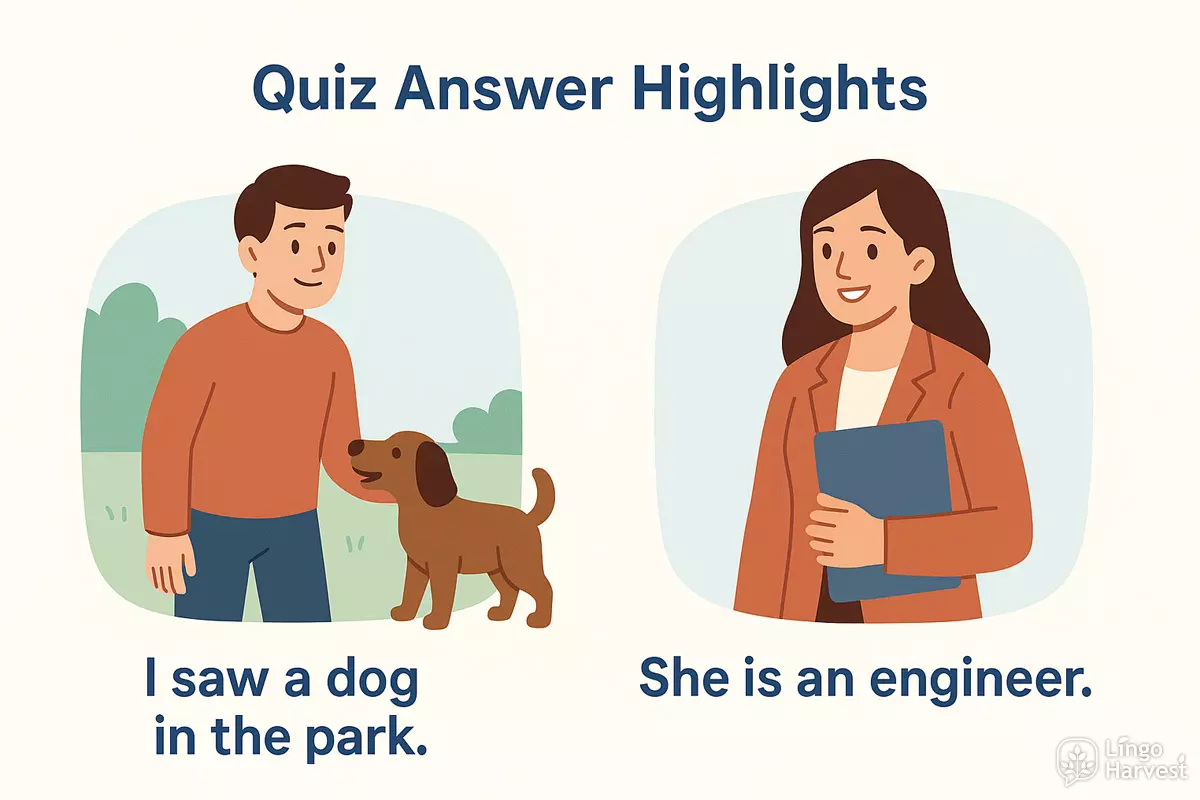
- I saw a dog in the park. “A” is correct because the dog is not previously known.
- The sun rises in the east. “The” is used for unique objects.
- She is an engineer. “An” is used before a vowel sound.
- We bought some bread. No article for uncountable nouns in general statements.
- He plays the piano. “The” is used with musical instruments.
- Do you like chocolate? No article when speaking about things in general.
- They have a new car. “A” for something mentioned for the first time.
- The books on the table are mine. “The” for specific books already identified.
- She wants to be a doctor. “A” for professions.
- The water in this glass is cold. “The” for something specified (the water in this glass).
Key Patterns: Article Use at a Glance
| Article | When to Use |
|---|---|
| a / an | First mention; singular countable nouns; jobs or professions; before vowel/consonant sounds |
| the | Something specific or already known; unique objects; superlatives; musical instruments |
| — (no article) | Plural nouns in general; uncountable nouns in general; meals, languages, most places |
| some | Unspecified quantity of plural or uncountable nouns (mainly in positive sentences) |
Quick Reminders
- Use “the” when both speaker and listener know what is meant.
- Omit articles before most countries, languages, and meals: English, breakfast, France.
- Pay attention to exceptions: the Netherlands, the United States.
- Remember: “a university” (because “university” starts with a “juː” sound, not a vowel sound).
Review your quiz responses with these points in mind to reinforce your understanding of English article usage. If you made a mistake, check whether the noun was countable, specific, or general. Practice will help these rules become automatic!
How to analyze your mistakes
Understanding the reasons behind your quiz errors is essential for making progress as an intermediate learner. Instead of simply checking which answers are wrong, take time to reflect on each incorrect response. This process helps you recognize patterns in your learning and target specific areas for improvement.
Step-by-step approach to reviewing errors
- Identify the type of mistake: Was it grammar, vocabulary, spelling, or misunderstanding the question?
- Check the correct answer: Compare your answer with the correct one and note the difference.
- Analyze why you made the mistake: Did you guess, misremember a rule, or overlook a keyword?
- Review the relevant rule or concept: Look up explanations or examples to clarify your confusion.
- Practice similar questions: Reinforce the concept by solving more questions of the same type.
Common reasons for errors
- Confusing articles ("a," "an," "the")
- Misusing prepositions
- Incorrect verb tense
- Spelling mistakes
- Overlooking exceptions to rules
- Literal translation from your native language
- Omitting necessary words
- Misreading instructions
- Forgetting irregular forms
- Choosing similar-sounding words
- Not noticing context clues
- Guessing without reasoning
- Skipping difficult questions
- Rushing through the quiz
- Misunderstanding question vocabulary
- Applying rules inconsistently
- Ignoring word order
- Focusing only on one part of the sentence
Tracking your progress
Recording your mistakes over time can reveal trends in your learning. Use a notebook or digital document to log errors and corrections. This habit makes it easier to notice improvement and prevents repeating the same errors.
| Mistake Type | Strategy to Improve |
|---|---|
| Incorrect article usage | Review article rules; practice with fill-in-the-blank exercises |
| Verb tense confusion | Make a timeline of tenses; write example sentences |
| Vocabulary mix-up | Create flashcards with definitions and sample sentences |
| Spelling errors | Write and spell out words regularly; use dictation exercises |
| Preposition mistakes | Study common collocations; note prepositions in context |
Turning mistakes into learning opportunities
Reflecting on your errors can be a valuable part of your study routine. Focus on understanding the reason behind each incorrect answer, not just memorizing the right one. Over time, this mindful review will help you build accuracy and confidence.
Next steps to move toward advanced article control
Building on your intermediate skills with articles, it’s helpful to focus on more complex usage, subtle distinctions, and exceptions that often challenge even advanced learners. Rather than drilling only the basics, aim to analyze authentic language and notice how native speakers use articles in context.
Practice with real-world materials
Reading varied texts—such as news stories, opinion columns, and fiction—exposes you to article use in different genres. Pay attention to patterns where articles are omitted or used unexpectedly. Try keeping a language journal where you note unusual examples.
Deepen your awareness of tricky cases
Articles become especially nuanced with abstract nouns, unique objects, and idiomatic expressions. Here are some areas worth extra attention:
- Abstract vs. concrete nouns (e.g., life vs. a life)
- Geographical names (e.g., the United States, Mount Everest)
- Institutional phrases (at school, in the hospital)
- Meals and times of day (at breakfast, in the morning)
- Fixed phrases and idioms (in a hurry, by car)
- Generalizations with plurals and uncountables (Dogs are friendly, Water is essential)
- When “the” signals uniqueness or shared knowledge
- Zero article in headlines or instructions
- Switches in meaning based on article choice (a doctor vs. the doctor)
- Proper names that take articles (the Amazon, the Hague)
- “The” with musical instruments (play the piano)
- With superlatives and sequence words (the best, the first)
- With ordinal numbers (the second chapter)
- With groups of people (the rich, the French)
- Titles and roles (the president, a president)
- Omission in lists (Bring pen, paper, eraser)
- “A” for one of many; “the” for something known
Compare article patterns in context
It’s easier to notice differences in meaning when you see similar sentences side by side. The table below highlights how small changes in article use can shift the message:
| Sentence | Meaning |
|---|---|
| I saw a movie. | Any movie (not specified which one) |
| I saw the movie. | A specific movie both speaker and listener know |
| I like music. | Music in general, all music |
| I like the music. | Specific music (e.g., at a party now) |
| She is a teacher. | Her profession—one of many teachers |
| She is the teacher. | The particular teacher relevant to the context |
| He went to school. | He attended as a student |
| He went to the school. | He visited the building (not as a student) |
Tips for mastering advanced usage
- Test yourself by rewriting sentences with different articles to see how meaning changes.
- When listening or reading, pause to predict which article should be used, then check the actual usage.
- Discuss challenging examples with teachers or peers to clarify subtle points.
- Use grammar reference books for in-depth explanations of exceptions and regional differences.
- Practice writing short texts (emails, stories, descriptions) and review them for article accuracy.
Progress comes with noticing, analyzing, and experimenting. Over time, you’ll find your confidence with articles growing as you move toward more natural, nuanced expression.