The Little Words That Change Meaning: Master a / an / the Fast

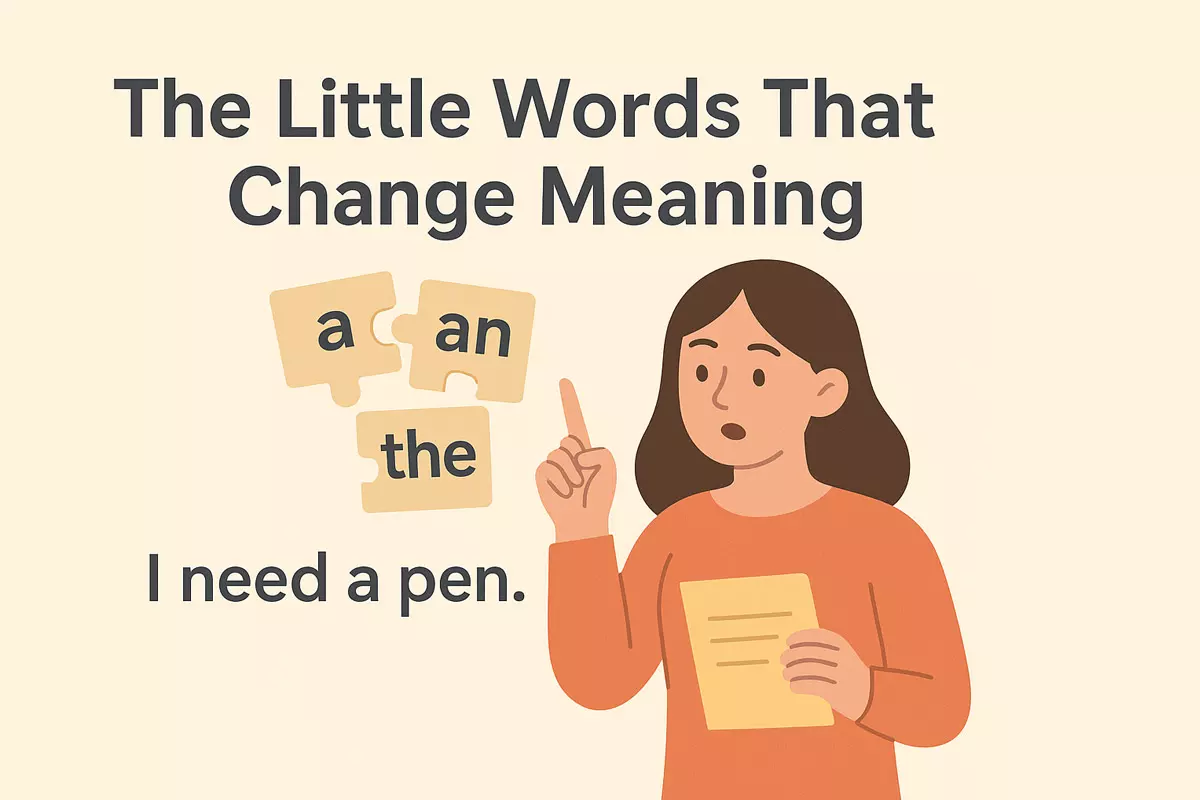 This article explains how using a, an, and the can change the meaning, tone, or focus of a sentence. It covers minimal pairs, shifts between general and specific reference, typical mistakes, and gives practice with real examples.
Small words such as "a," "an," and "the" might appear unimportant, but selecting the right article can significantly change the meaning of your sentences. Many people find themselves uncertain about which article to use, and this confusion is quite common. However, understanding how to apply these simple terms correctly is crucial for expressing yourself clearly and making sure your message is understood as intended. Mastering articles enhances both your writing and speaking, helping you communicate with confidence and precision.
How a, an, and the change meaning
The choice between "a," "an," and "the" is more than grammar—it’s about what you want to say. These small words can signal whether you’re talking about something new, something known, or something unique. Using them accurately helps your listener or reader understand exactly what you mean.
Indefinite vs. Definite Reference
When you use "a" or "an," you’re introducing something for the first time or talking about one example out of many. "The" is used when it’s clear which thing you mean, often because it’s already been mentioned or is unique in the situation.
- a dog — any dog, not a specific one
- an apple — any apple, not one in particular
- the dog — a specific dog, perhaps one you’ve already talked about
- the sun — the only sun we know
How Meaning Changes in Context
Even a tiny word can flip the meaning of a sentence. Consider these examples:
- I saw a movie. → Any movie, no details given.
- I saw the movie. → A particular movie, maybe one you both know about.
- She’s a teacher. → Her profession is teaching, but you don't know which teacher.
- She’s the teacher. → The specific teacher you expected or discussed.
- He found an answer. → One possible solution, not necessarily the best.
- He found the answer. → The correct or expected solution.
- Give me a pen. → Any pen will do.
- Give me the pen. → The specific pen, maybe the only one in sight.
- I’d like a coffee. → Any cup of coffee.
- I’d like the coffee. → The coffee we talked about or ordered earlier.
- There’s a problem. → Some problem exists, not specified.
- There’s the problem. → This is the known or main problem.
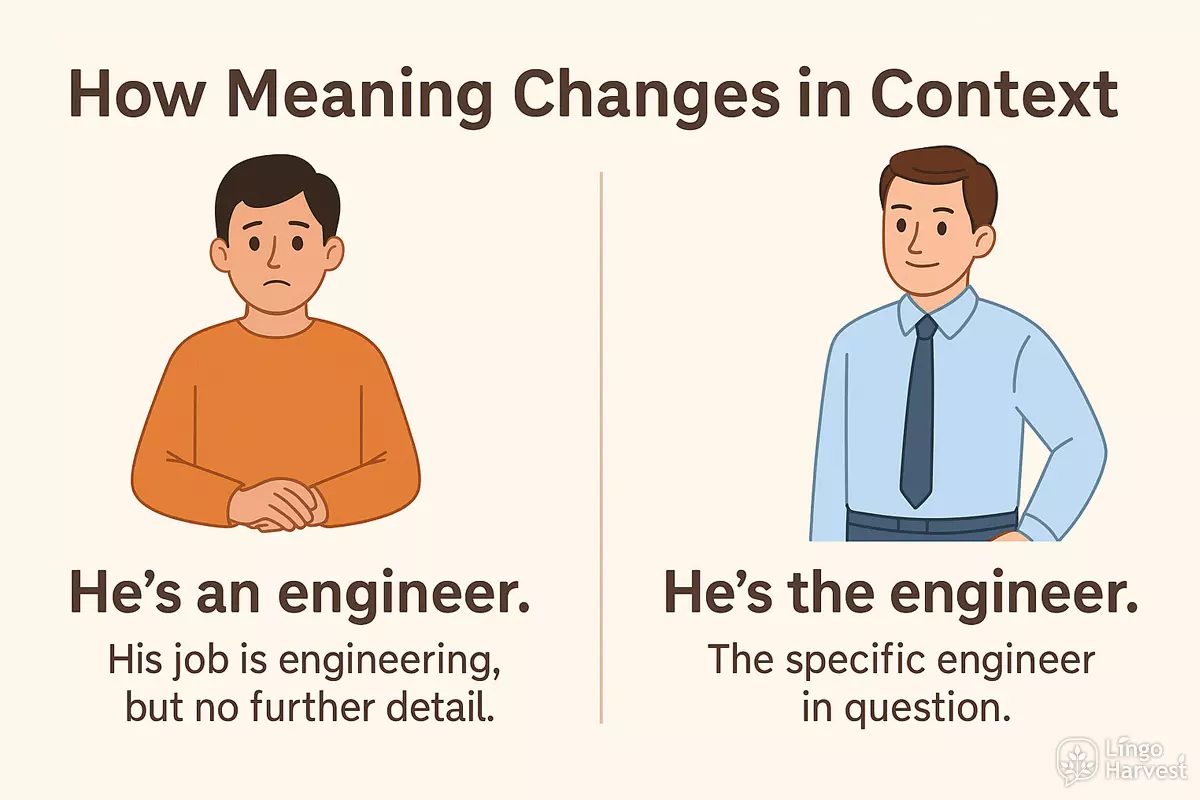
- He’s an engineer. → His job is engineering, but no further detail.
- He’s the engineer. → The specific engineer in question.
- I have a plan. → One possible plan.
- I have the plan. → The specific plan we discussed.
Quick Comparison
| Article | What it signals | Example |
|---|---|---|
| a / an | Any one; not specific | I saw a cat. |
| the | A specific one; known to listener | I saw the cat. |
| (no article) | General idea or plural/uncountable noun | Cats are cute. / Water is cold. |
Using these little words thoughtfully makes your meaning clearer and more precise. The difference between "a," "an," and "the" may be small, but it’s essential for accurate communication.
Minimal pairs: same noun, different article
Choosing between "a," "an," and "the" can completely change the meaning of a sentence, even when the noun stays the same. These little words often signal whether we are talking about something in general, introducing it for the first time, or referring to something specific and known to both the speaker and the listener.
How articles shift meaning
Native speakers often switch articles without thinking, but for learners, recognizing how each one alters a phrase is crucial. Consider the difference between "a cat," "the cat," and just "cat" (sometimes with no article at all). Each version tells the listener something different about which cat you mean—or whether you mean any cat at all.
Common examples: one noun, several meanings
Here are some real-life examples where simply changing the article changes the meaning:
- a book = any book, not specific
- the book = a specific book both people know about
- a doctor = any doctor, not a particular one
- the doctor = the doctor we mentioned before, or the one we both know
- a table = any table, could be any in the room
- the table = a particular table, maybe the only one or one already discussed
- an apple = any apple, not a special one
- the apple = a specific apple, maybe the only one on the table
- a friend = one friend, not particular
- the friend = the friend we both know
- a teacher = any teacher
- the teacher = the specific teacher for this class
- a plan = any plan
- the plan = the plan we have been talking about
- a movie = any movie
- the movie = the movie we saw last night
- a car = any car
- the car = the car you own
- a question = any question
- the question = the main question of the discussion
Article comparison: subtle but important
Notice how the presence or absence of an article can signal whether you are speaking generally or about something specific. This is why even small changes in these words can cause confusion or clarify your meaning.
| With "a" / "an" | With "the" |
|---|---|
| I saw a dog in the park. (Any dog, not specific) |
I saw the dog in the park. (A particular dog, maybe one we both know) |
| She wants a job in tech. (Any job, not a particular one) |
She wants the job in tech. (A specific job, maybe one advertised) |
| Can I have an orange? (Any orange) |
Can I have the orange? (A specific orange, maybe the last one) |
| He is a manager at the company. (Any manager, one of several) |
He is the manager at the company. (The only manager, or the one relevant here) |
Understanding these differences helps to avoid misunderstandings and makes your English sound more natural. Pay attention to which article you use, because even a small word can have a big effect on your meaning.
Shifts between general and specific reference
English articles—“a,” “an,” and “the”—let us move smoothly between talking about something in general and pointing to a particular example. This shift is a subtle but vital part of how meaning changes in a sentence. Choosing the right article isn’t just about grammar rules; it’s about signaling whether you mean any member of a group or a specific thing your listener already knows about.
How articles signal general or specific meaning
When you use “a” or “an,” you’re usually introducing something for the first time—something not known to the listener. In contrast, “the” signals that you and your reader or listener share knowledge of the object or idea. Sometimes, the same noun can be general in one sentence and specific in the next, depending on which article you use.
- A dog can be a great companion. (any dog, in general)
- The dog barked all night. (a particular dog—maybe one just mentioned or known)
- She wants to buy a car. (any car, not specified)
- The car she bought is red. (a specific car)
- An apple a day keeps the doctor away. (any apple, general advice)
- The apple on the table is yours. (a particular apple)
- He dreams of becoming an astronaut. (any astronaut, general aspiration)
- The astronaut who visited our school was inspiring. (a known, specific astronaut)
- Let’s get a pizza. (any pizza, general suggestion)
- The pizza we ordered has arrived. (the specific one you ordered)
- A student asked a question. (any student, not identified yet)
- The student then left early. (now we know which student)
- She is a doctor. (any doctor, her profession)
- The doctor at the clinic is very kind. (a specific doctor)
- A book can change your life. (books in general)
- The book on the shelf is mine. (a particular book)
- He heard a noise outside. (any noise, not specified)
- The noise was loud. (now it’s clear which noise)
Switching reference within a conversation
Writers and speakers often introduce something generally, then refer back to it specifically. This pattern helps the listener follow the story or explanation, and it’s a key to clear communication in English.
| General Reference | Specific Reference |
|---|---|
| I saw a cat in the garden. | The cat was chasing a butterfly. |
| She bought a cake for the party. | The cake looked delicious. |
| We found a key on the floor. | The key opened the old chest. |
| He met a friend at the store. | The friend gave him a ride home. |
| They adopted a puppy last week. | The puppy is very playful. |
Quick tips for recognizing the difference
- Use “a/an” when mentioning something for the first time or when it’s not important which one.
- Switch to “the” when both you and your listener know which thing you’re talking about, or you’ve already mentioned it.
- No article is needed for general ideas with plural or uncountable nouns: “Books are useful.” “Information is key.”
- Notice how context determines whether you move from general to particular reference, especially in stories or instructions.
Understanding these moves between broad and narrow focus helps you master how articles alter meaning. This subtle skill makes your English clearer and more natural.
Subtle differences in tone and focus
When choosing between “a,” “an,” and “the,” the effect is more than just grammatical correctness—it subtly shapes what the listener pays attention to. These small words can signal whether you’re introducing something new, referring to something specific, or making a general statement. Understanding these nuances helps you communicate with more precision and clarity.
How articles guide the listener’s attention
“A” or “an” tell the listener something is one of many, or not previously mentioned. “The” points to something already known or unique in context. Changing the article can shift the focus and even the meaning of your sentence.
- A cat sat on the mat. → Any cat, not specified before.
- The cat sat on the mat. → A specific cat, likely already mentioned or visible.
- She wants a cookie. → Any cookie will do.
- She wants the cookie. → A particular cookie is meant.
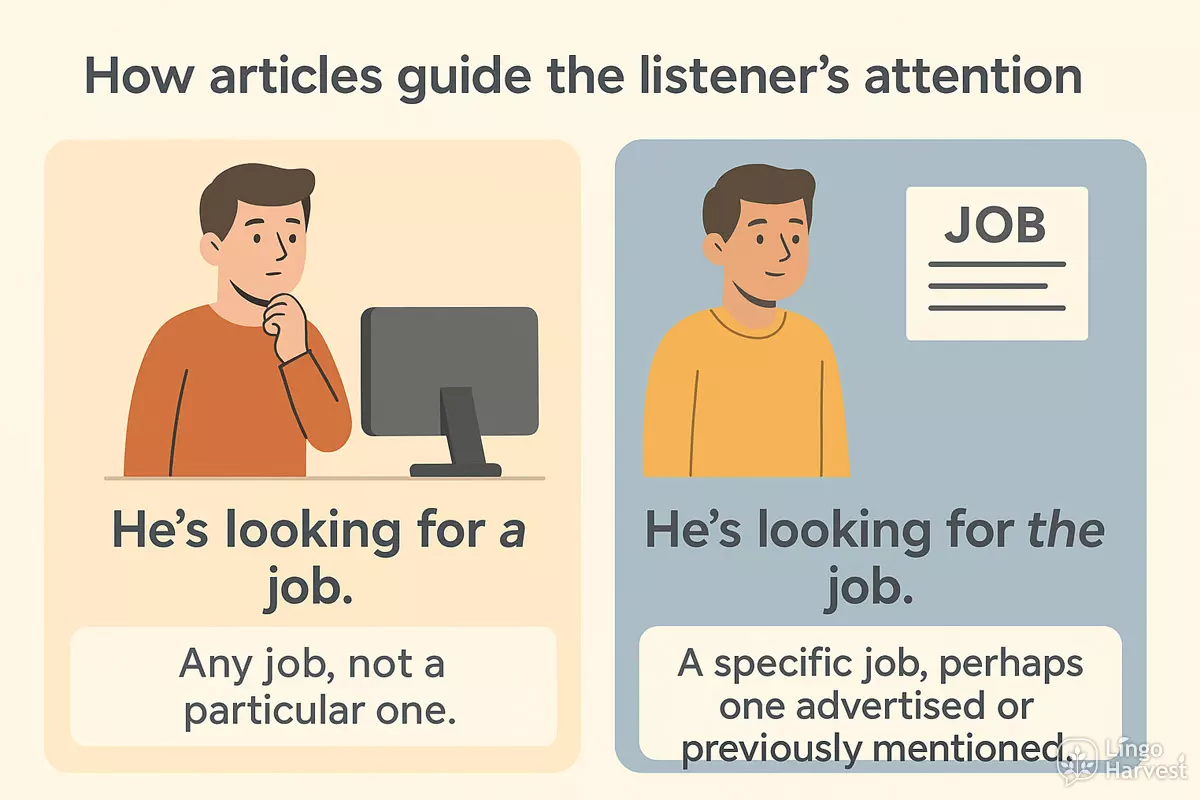
- He’s looking for a job. → Any job, not a particular one.
- He’s looking for the job. → A specific job, perhaps one advertised or previously mentioned.
- Let’s find a solution. → Any solution that works.
- Let’s find the solution. → The right or best solution, possibly already discussed.
- She became a doctor. → She joined the group of doctors.
- She became the doctor. → She took on the specific role of doctor in a particular context.
- Can you pass me a pen? → Any pen is fine.
- Can you pass me the pen? → There is a particular pen meant.
- I saw a movie last night. → Not important which one.
- I saw the movie last night. → Refers to a specific movie, probably known to both speaker and listener.
- The sun is bright today. → There’s only one sun for Earth, so it’s unique.
- A sun (rarely used) might describe a sun in another solar system.
Comparing tone and emphasis
Swapping these small words can change the feel of your message. Using the definite article often adds a sense of importance or exclusivity, while the indefinite article keeps things open or non-specific.
| Sentence | Effect and Focus |
|---|---|
| I need a phone. | Any phone will do; not particular about which one. General focus. |
| I need the phone. | A particular phone is meant; both know which one. Specific focus. |
| She’s a manager. | Describes her profession, one among many managers. Broad context. |
| She’s the manager. | Identifies her as the only or main manager in this setting. Narrow, exclusive context. |
| He wrote a book. | He wrote one book, not specified which. Introduction of new information. |
| He wrote the book. | Everyone knows which book; perhaps famous or previously discussed. Recognition or emphasis. |
Key takeaways
Paying attention to these small distinctions helps you sound more natural and clear. The right article doesn’t just follow a rule—it helps listeners grasp exactly what you mean, whether you’re speaking generally, introducing something, or referring to something familiar.
Typical advanced mistakes with basic articles
Even learners with strong English skills sometimes slip up with articles. These errors can sneak in when you use complex ideas, rely too much on rules from your native language, or get comfortable and overlook subtle shifts in meaning. Here’s a look at where even advanced speakers get tripped up with "a," "an," and "the."
Overgeneralizing Article Rules
It's easy to think you’ve mastered articles, but English has plenty of exceptions. Advanced learners often over-apply the rules, missing nuances like generic versus specific references.
- Using "the" with general statements: Incorrect: The life is short. Correct: Life is short.
- Forgetting "the" when referring to something unique: Incorrect: Sun rises in east. Correct: The sun rises in the east.
Confusing Countable and Uncountable Nouns
Some nouns change meaning with or without articles. Advanced users sometimes misuse articles with uncountable nouns or treat plural countable nouns as singular.
- Incorrect: I have a good news. ❌
- Correct: I have good news. ✅
- Incorrect: She gave me an advice. ❌
- Correct: She gave me advice. ✅
Mixing Up "A/An" and "The" in Context
Choosing between indefinite and definite articles can be tricky when the context changes mid-discussion. Compare:
| Incorrect Usage | Correct Usage |
|---|---|
| He adopted a dog. The dog was playful. (Correct) | He adopted a dog. Dog was playful. (Incorrect: missing "the") |
| She found an umbrella. The umbrella was broken. (Correct) | She found umbrella. Umbrella was broken. (Incorrect: missing articles) |
| I saw a film. The film was interesting. (Correct) | I saw film. Film was interesting. (Incorrect: missing articles) |
| They bought a house. The house needs repairs. (Correct) | They bought house. House needs repairs. (Incorrect: missing articles) |
Articles with Proper Nouns and Place Names
Proper nouns sometimes take "the," but not always. Advanced users may overuse or omit "the" with place names and institutions.
- Incorrect: The Mount Everest is high. ❌
- Correct: Mount Everest is high. ✅
- Correct: The Netherlands is beautiful. ✅
- Incorrect: I visited the London. ❌
- Correct: I visited London. ✅
Summary: Common Pitfalls
Here are some frequent advanced-level slips:
- Using "the" for general truths or abstract concepts (e.g., "the love is important")
- Dropping articles after introducing a noun (e.g., "a cat" becomes just "cat" in the next sentence)
- Incorrectly inserting "a/an" before uncountable nouns
- Omitting "the" with unique objects or groups (e.g., "the Internet," "the elderly")
- Misusing articles with countries, organizations, and geographical names
- Applying article rules from your native language without adapting to English exceptions
- Forgetting that some plural nouns never take articles ("Children like sweets," not "The children like the sweets" unless specific children and sweets are meant)
- Overusing "the" in lists and with superlatives ("He is smartest student" instead of "He is the smartest student")
Mastering these subtleties helps your English sound natural and precise. With awareness and practice, you can avoid these advanced-level article traps.
Practice: compare sentences with different articles
Understanding how “a,” “an,” and “the” can shift meaning is essential for clear communication. Let’s look at sentence pairs where changing the article changes the meaning, sometimes subtly, sometimes completely. Read each example and think about why the meaning is different.
How articles change the message
Notice how the use of “a,” “an,” or “the” can make a sentence refer to something general, something new, or something specific that’s already known. Compare the examples below and reflect on the difference:
- I saw a dog in the park. → Any dog, not a specific one.
- I saw the dog in the park. → A particular dog, maybe one we both know.
- She wants to buy a car. → Any car, not a specific one.
- She wants to buy the car. → A particular car, probably already mentioned.
- Can you pass me a pen? → Any pen will do.
- Can you pass me the pen? → A specific pen, maybe the only one on the table.
- He is a teacher. → His profession, general.
- He is the teacher. → The specific teacher for this class/group.
- We saw a movie last night. → One of many possible movies.
- We saw the movie last night. → A particular movie, likely already discussed.
- There is a problem. → Some problem, not specified yet.
- There is the problem. → A specific problem, probably already known.
- She’s looking for a job. → Any job, not a particular one.
- She’s looking for the job. → A specific job, maybe one she applied for.
- He brought an apple. → Any apple, not specified.
- He brought the apple. → The apple we talked about earlier.
- Let’s go to a restaurant. → Any restaurant, not a specific choice.
- Let’s go to the restaurant. → A particular restaurant, maybe our favorite.
- She is an engineer. → Her profession, general.
- She is the engineer. → The specific engineer for this project.
Quick comparison table: “a/an” vs. “the”
| Sentence with “a/an” | Sentence with “the” |
|---|---|
| He found a key on the street. | He found the key on the street. |
| I need an umbrella. | I need the umbrella. |
| Let’s choose a book to read. | Let’s choose the book to read. |
| She adopted a cat. | She adopted the cat. |
| He’s looking for a solution. | He’s looking for the solution. |
| They visited a museum. | They visited the museum. |
| We saw a star in the sky. | We saw the star in the sky. |
| She met a friend at the café. | She met the friend at the café. |
| He bought an ice cream. | He bought the ice cream. |
| I heard a noise outside. | I heard the noise outside. |
Try it yourself: choose the correct article
- _____ apple on the table is red.
- She wants to be _____ artist.
- Can you open _____ window, please?
- He bought _____ umbrella because it was raining.
- Did you see _____ movie we talked about?
- We stayed at _____ hotel near the beach.
- My brother is _____ engineer.
- _____ sun rises in the east.
- There is _____ cat in the garden.
- She is reading _____ book you lent me.
- He drank _____ cup of tea before work.
- They visited _____ museum yesterday.
- She adopted _____ dog from the shelter.
- Tom is looking for _____ job in marketing.
- _____ water in this bottle tastes strange.
Show answers
- The apple on the table is red.
- She wants to be an artist.
- Can you open the window, please?
- He bought an umbrella because it was raining.
- Did you see the movie we talked about?
- We stayed at a hotel near the beach.
- My brother is an engineer.
- The sun rises in the east.
- There is a cat in the garden.
- She is reading the book you lent me.
- He drank a cup of tea before work.
- They visited the museum yesterday.
- She adopted a dog from the shelter.
- Tom is looking for a job in marketing.
- The water in this bottle tastes strange.