Zero Article in Academic Writing: Style and Convention

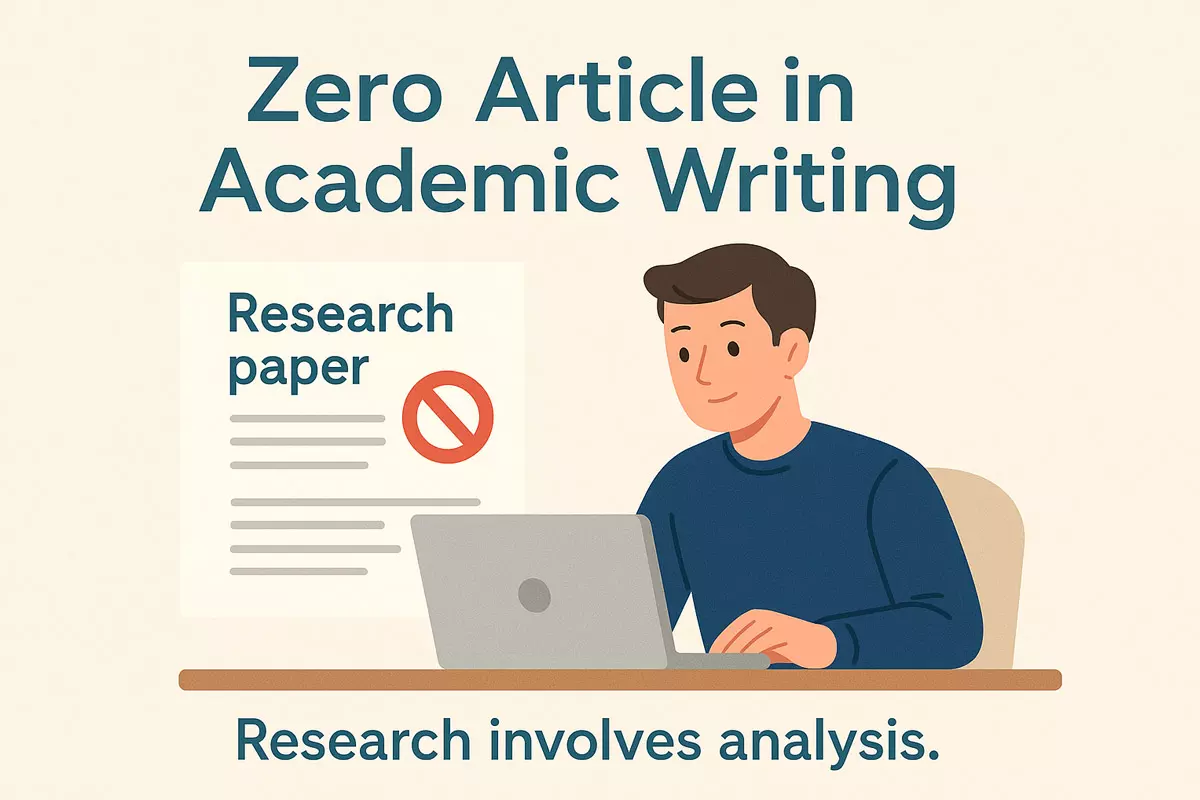 Here we why academic texts often use zero article, when to omit articles with fields, processes, and concepts, discipline-specific preferences, frequent article errors in research papers, and provides editing practice for proper zero article usage.
Mastering the use of articles in academic writing is more challenging than it may first appear, as authors often struggle with determining when a noun should appear with or without a definite or indefinite article. This subtle aspect of grammar plays a crucial role in ensuring clarity and precision, as the presence or absence of an article can significantly alter the meaning of a sentence. Developing a keen awareness of article usage helps scholars convey their arguments more effectively and maintain a professional tone throughout their work.
Why academic texts often use zero article
Academic writing frequently omits articles for reasons rooted in clarity, convention, and efficiency. Specialized discourse values directness and precision, which often leads to dropping "the," "a," or "an" before certain nouns. This tendency is not random; it’s shaped by both linguistic rules and stylistic preferences unique to scholarly communication.
Common contexts for zero article usage
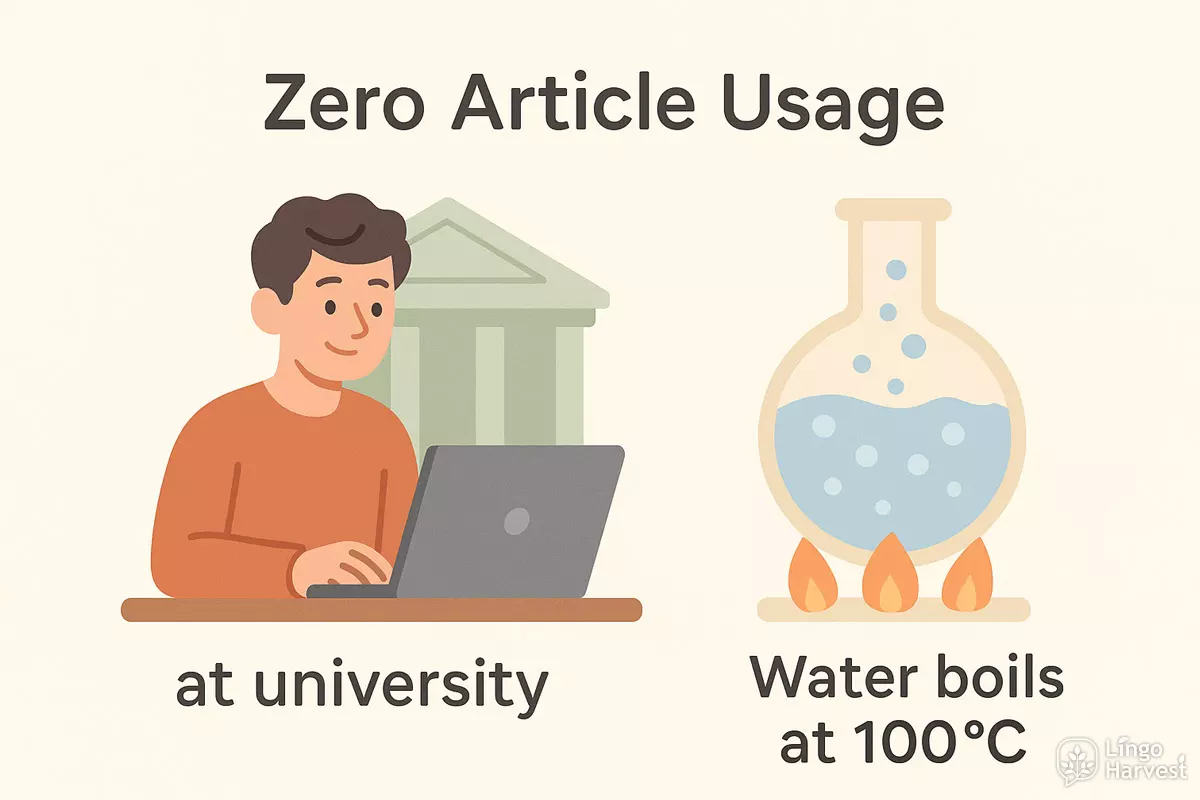
Writers in academia typically leave out articles in several recurring situations:
- Abstract nouns used in a general sense (e.g., Research shows…)
- Names of disciplines and fields (Biology, Linguistics, Mathematics)
- Uncountable nouns when referring to concepts broadly (Information is essential)
- Plural countable nouns referring to things in general (Studies indicate…)
- Names of languages (French, English)
- Meals and times of day (after breakfast, before lunch)
- Most institutional nouns when used generically (at university, in hospital)
- Names of substances (Water boils at 100°C)
- Abstract processes (Development requires time)
- Proper names (countries, continents, planets – Europe, Mars)
- Titles or roles when used generally (Professor, Doctor)
- Headings, labels, and lists
Underlying reasons for omitting articles
The preference for zero article in scholarly texts has several motivations:
- Generalization: Academic writing often discusses concepts or categories as wholes, rather than specific instances.
- Economy of language: Omitting unnecessary words keeps sentences concise and focused.
- International standards: Many academic style guides and journal conventions favor bare nouns for clarity and universality.
- Influence of discipline: Certain fields, especially in science and technology, are more likely to use zero article due to tradition and shared understanding.
Examples: Patterns of zero article in academic prose
Notice how the omission of articles streamlines meaning and avoids ambiguity:
- Data suggest correlation between variables.
- Future research should address limitations.
- Climate change affects agriculture worldwide.
- Society benefits from education.
- Technology advances rapidly.
- Water is essential for life.
- Students attend lecture every week.
- Analysis reveals trend in results.
- Policy impacts public health.
- Understanding evolves over time.
When to avoid zero article
While omitting articles is common, it is not universal. Writers should use "the," "a," or "an" when referring to specific, known, or previously mentioned entities. Overuse of zero article can cause confusion, so it’s important to follow the conventions of your discipline and context. In summary, zero article in academic writing helps maintain brevity, clarity, and adherence to disciplinary norms. Recognizing the contexts where this occurs empowers writers to produce more effective and conventional scholarly texts.
Fields of study, processes, and concepts without articles
In academic writing, certain nouns are used without an article, especially when discussing broad disciplines, scientific processes, or abstract concepts. This convention reflects the idea that these terms are understood in a general, non-countable sense, rather than as specific instances or subtypes.
Academic disciplines and branches of knowledge
When referring to entire areas of study, the zero article is standard. For instance, we say "Biology is a fascinating subject," not "The biology is a fascinating subject." This usage signals that the term refers to the field as a whole, not a particular aspect or course.
- mathematics
- history
- physics
- philosophy
- engineering
- economics
- psychology
- chemistry
- linguistics
- architecture
- literature
- sociology
- medicine
- law
- anthropology
- politics
- statistics
- education
Processes and methodologies
The zero article also applies to processes, especially when referring to them in a general or theoretical sense. For example, "Photosynthesis occurs in plants," or "Data analysis is essential in research." The absence of an article here underscores the general applicability.
- observation
- measurement
- evaluation
- computation
- translation
- classification
- development
- production
- distribution
- communication
- interpretation
- comparison
- calculation
Abstract concepts
Abstract ideas and phenomena often do not require an article. In scholarly contexts, this helps maintain clarity and generality. For example, "Freedom is a fundamental human right," rather than "The freedom is a fundamental human right."
- justice
- truth
- knowledge
- creativity
- power
- change
- growth
- innovation
- culture
- identity
- environment
- security
- responsibility
Comparing usage: Zero article vs. definite/indefinite article
Using or omitting the article can change the meaning. For structured examples, see the table below.
| Zero Article | With Article |
|---|---|
| She studies physics. | She studies the physics of sound. |
| Observation is key in science. | An observation was recorded yesterday. |
| Justice must be served. | The justice of this decision is debated. |
| They are interested in architecture. | They admired the architecture of the museum. |
In summary, omitting articles with fields, processes, and concepts is a stylistic norm in scholarly English. This approach ensures clarity and avoids unnecessary specificity when discussing broad or abstract ideas.
Noun phrases with zero article in abstracts and headings
Writers in academic contexts frequently omit the definite and indefinite articles before noun phrases in abstracts and headings. This stylistic choice creates concise, direct statements that align with conventions for scientific communication. The omission is especially common when referencing broad concepts, processes, or fields, rather than specific, countable items.
Why articles are dropped in academic titles and summaries
Academic English often prioritizes brevity. Using zero article—leaving out "a," "an," or "the"—reduces word count and shifts focus to the core idea or subject. In titles and abstracts, this helps readers quickly scan for relevant information. For example, rather than writing "The Effects of the Climate Change on the Agriculture," a journal might title a paper "Effects of Climate Change on Agriculture."
Typical patterns in article omission
Zero article is most frequent with:
- Uncountable nouns (e.g., information, research, progress)
- Plural countable nouns used generically (e.g., results, trends, methods)
- Abstract concepts (e.g., sustainability, development, innovation)
- Technical terms or processes (e.g., data analysis, error correction, signal processing)
- Fields of study (e.g., linguistics, chemistry, psychology)
- Materials or substances (e.g., water quality, iron content)
- Named phenomena (e.g., global warming, quantum entanglement)
- Institutional contexts (e.g., university policy, government regulation)
- Generalized populations (e.g., patients, students, respondents)
- Time expressions (e.g., future work, previous studies)
- Processes or events (e.g., data collection, model validation)
Examples: Article omission in practice
Writers often use concise noun phrases in the following ways:
- Impact of technology on education
- Role of enzymes in metabolism
- Trends in renewable energy adoption
- Advances in artificial intelligence
- Challenges in data privacy
- Analysis of survey responses
- Factors influencing job satisfaction
- Comparison of treatment outcomes
- Development of new materials
- Assessment of environmental risk
- Application of machine learning
- Evaluation of intervention strategies
- Measurement of public opinion
- Design of experimental protocol
- Exploration of genetic diversity
- Prediction of climate trends
- Investigation of protein structure
- Optimization of resource allocation
Comparison: Full sentence vs. heading/abstract style
| Full Sentence (with articles) | Heading/Abstract (zero article) |
|---|---|
| The analysis of the data revealed significant trends. | Analysis of data reveals significant trends |
| The development of a new algorithm improved accuracy. | Development of new algorithm improves accuracy |
| The impact of the intervention on the results was notable. | Impact of intervention on results notable |
| The evaluation of the patient outcomes was comprehensive. | Evaluation of patient outcomes comprehensive |
Discipline-specific patterns and preferences
Academic writing showcases a variety of conventions when it comes to the use of the zero article, and these conventions often depend on the field of study. The expectations for article usage in scientific writing, for example, can be quite different from those in literary analysis or social sciences. Understanding these nuances is essential for producing clear and stylistically appropriate texts.
Variation across academic fields
Writers in the hard sciences (such as biology, chemistry, or physics) frequently omit articles before uncountable nouns and technical terms. This practice is partly driven by the desire for conciseness and partly by established discipline norms. In contrast, humanities disciplines, like history or philosophy, may favor more explicit article use to clarify meaning or reference specific instances.
Common zero article patterns in academic genres
Certain patterns for omitting articles are widespread, but the frequency and acceptability may shift depending on the field. Here are typical contexts where the zero article appears:
- Before general concepts: “evidence suggests,” “future research is needed”
- With plural countable nouns: “results indicate,” “data show,” “studies reveal”
- With uncountable nouns: “information was collected,” “progress has been made”
- In set phrases and technical terms: “in vitro analysis,” “case study approach”
- With names of disciplines: “in linguistics,” “in mathematics”
- Before names of substances or materials: “water samples,” “iron content”
- For methodologies or procedures: “survey method,” “regression analysis”
- With institutional or geographical terms (when used generically): “university policy,” “government intervention”
- For abstract qualities or phenomena: “justice is served,” “change occurs”
- With time expressions: “by day,” “at night,” “in winter”
- Before acronyms and initialisms (when used generically): “DNA structure,” “GDP growth”
- In reference to tools or equipment: “microscope was calibrated,” “software update”
- With names of diseases (in medical writing): “diabetes affects,” “cancer research”
- For processes or activities: “data collection,” “peer review”
- With proper nouns used as adjectives: “Newton method,” “Oxford protocol”
- Before certain organizational roles: “president of committee,” “editor in chief”
- For natural phenomena: “gravity affects,” “evolution occurs”
- With languages: “English proficiency,” “French literature”
- For most names of meals: “after lunch,” “before dinner”
- With modes of transport: “by car,” “by train”
Comparing article omission in selected disciplines
| Discipline | Typical Zero Article Usage |
|---|---|
| Natural Sciences | Technical terms, substances, processes (e.g., “protein synthesis,” “oxygen uptake”) |
| Social Sciences | General concepts, plural forms, abstract nouns (e.g., “social norms,” “policies change”) |
| Humanities | Disciplines, periods, and abstract ideas (e.g., “Renaissance literature,” “human behavior”) |
| Engineering | Methods, equipment, materials (e.g., “compression test,” “steel beam”) |
| Medicine | Diseases, procedures, plurals (e.g., “diabetes management,” “patients receive care”) |
| Mathematics | Formulas, theorems, general terms (e.g., “mean value theorem,” “solution exists”) |
Key takeaways for writers
Awareness of these discipline-driven tendencies helps writers maintain both clarity and conformity to academic expectations. It’s advisable to consult style guides specific to one’s field, but observing published literature in the target discipline can also provide practical insight into how article omission shapes scholarly tone and precision.
Frequent article errors in research papers
Omitting or misusing articles is a persistent challenge for scholars, especially for those writing in English as a second language. Even experienced academics may overlook article conventions, particularly when dealing with abstract nouns, uncountable concepts, or institutional terms. These mistakes can subtly change meaning or make writing seem less polished.
Common patterns of article misuse
Writers often struggle with when to use "a," "an," "the," or no article at all. The so-called "zero article" (no article) is particularly tricky in academic writing. Some typical issues include:
- Leaving out "the" before unique or specific nouns (e.g., study shows instead of the study shows)
- Adding unnecessary articles to abstract or uncountable nouns (the information instead of just information)
- Incorrect use with plural countable nouns (a data instead of data or the data)
- Using "the" with general references where zero article is needed (the technology advances rapidly vs. technology advances rapidly)
- Omitting articles before adjectives describing a unique noun (important result instead of an important result)
- Confusing institutional terms (the university vs. university when referring to the concept generally)
- Misusing articles with geographic names (the Europe instead of Europe)
- Overusing "the" before disciplines or fields (the biology instead of biology)
- Leaving out "the" with ordinal numbers (first experiment instead of the first experiment)
- Incorrectly omitting articles before singular countable nouns (experiment showed instead of the experiment showed)
- Using "a/an" with proper nouns (a Einstein instead of Einstein)
- Applying zero article where definite article is needed (results demonstrate instead of the results demonstrate)
- Adding "the" before languages (the English instead of English)
Zero article: Where and why errors happen
In academic contexts, the absence of an article is often required but easily mishandled. This is especially true with:
- Abstract nouns: Knowledge is essential (not The knowledge is essential unless specific knowledge is meant)
- Uncountable nouns: Research requires patience
- Plural countable nouns in general statements: Students benefit from feedback
- Names of institutions when used generally: She attends university
Article usage comparison table
| Article Error | Correct Form |
|---|---|
| the information is limited | information is limited |
| a data was collected | data were collected |
| the technology advances | technology advances |
| the Europe | Europe |
| the biology is complex | biology is complex |
| first experiment showed | the first experiment showed |
| important result was found | an important result was found |
| the English is spoken | English is spoken |
How to avoid typical mistakes
Reading published articles in your field helps internalize correct patterns. Double-checking sentences with abstract or general nouns can reduce zero article errors. Remember, article use is not just a matter of grammar—it's about clarity and academic credibility.
Practice: edit academic sentences for zero article
Academic English often omits the definite and indefinite articles (“the,” “a,” “an”) before certain nouns, especially when referring to general concepts, fields of study, or plural and uncountable nouns in a generic sense. This practice helps make scholarly writing concise and formal. Below, you’ll find hands-on exercises to help you identify and correct unnecessary articles in sample sentences typical of research papers and reports.
Task: Identify and Remove Unnecessary Articles
Read each sentence below. Decide whether the highlighted article (“the,” “a,” or “an”) should be removed to follow academic writing conventions. Rewrite the sentence with the correct usage.
- The the climate change remains a major challenge for policy makers.
- She specializes in the the sociology of education.
- This paper discusses the the water scarcity in urban regions.
- He conducted research in the the physics laboratory.
- We investigated the the plant growth under controlled conditions.
- The the information was collected from various sources.
- She majors in the the economics at university.
- The the data suggest a positive correlation.
- He is interested in the the history and culture of East Asia.
- They focus on the the language acquisition among adults.
Show answers
- Climate change remains a major challenge for policy makers.
- She specializes in sociology of education.
- This paper discusses water scarcity in urban regions.
- He conducted research in physics laboratory.
- We investigated plant growth under controlled conditions.
- Information was collected from various sources.
- She majors in economics at university.
- Data suggest a positive correlation.
- He is interested in history and culture of East Asia.
- They focus on language acquisition among adults.
Common Academic Contexts for Zero Article
Here are typical situations where articles are usually omitted in scholarly writing. Review these patterns to strengthen your editing skills:
- Subjects of study: Biology is a complex science.
- Abstract concepts: Information is essential for analysis.
- Plurals in general: Results indicate improvement.
- Uncountable nouns in a general sense: Research shows progress.
- Institution names (when used generically): She attends university in London.
- Means of transport or communication: He travels by train.
- Meals: They discussed results after lunch.
- Languages: She studies English and Japanese.
- Sports: He plays football regularly.
- Diseases (most): Cancer is a global concern.
- Seasons (in general): Winter brings cold weather.
- Academic fields: Mathematics underpins engineering.
- Days, months, years (when general): Monday is busy.
Editing Task: Improve Academic Sentences
Revise the following sentences by removing articles where appropriate to match formal academic style:
- Students often struggle with the mathematics in the first year.
- The Knowledge is essential for the progress in science.
- She attended the conference to present the research.
- He is interested in the linguistics and the anthropology.
- The Biology is becoming more interdisciplinary today.
- They analyzed the data using the statistics from last year.
- The Psychology helps us understand human behavior.
- The Education is important for children’s development.
- She wants to study the architecture at university.
- The Engineering requires strong problem-solving skills.
Show answers
- Students often struggle with mathematics in the first year.
- Knowledge is essential for progress in science.
- She attended conference to present research.
- He is interested in linguistics and anthropology.
- Biology is becoming more interdisciplinary today.
- They analyzed the data using statistics from last year.
- Psychology helps us understand human behavior.
- Education is important for children’s development.
- She wants to study architecture at university.
- Engineering requires strong problem-solving skills.
Practicing these edits will help you internalize zero article conventions, leading to clearer and more professional academic writing.