Articles with Generic Reference: The Tiger vs Tigers vs A Tiger

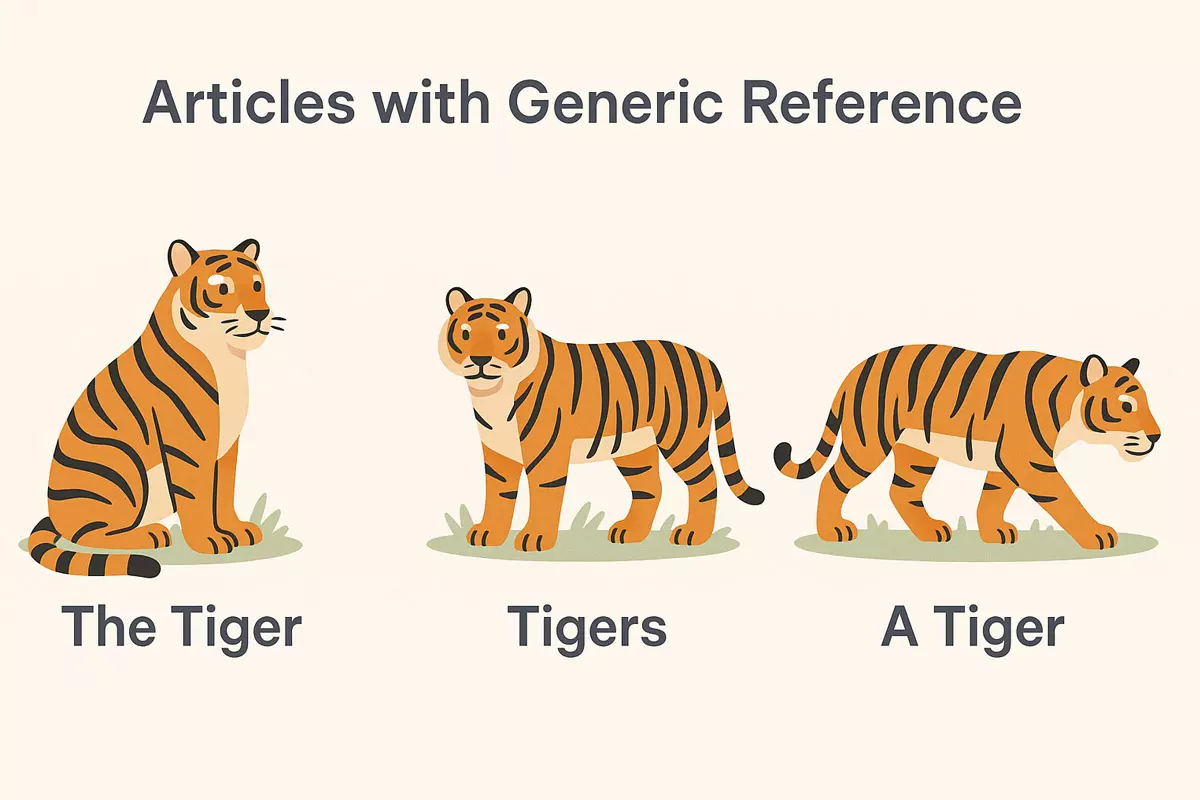 The article defines generic reference in English, compares the forms the tiger, tigers, and a tiger, explains their nuanced differences, shows their use in writing, points out common mistakes, and provides practice on choosing the correct generic form.
- What generic reference means in English
- Three generic patterns: the + singular, a + singular, bare plural
- Nuance differences between the tiger, tigers, a tiger
- Generic reference in scientific and general writing
- Common mistakes with generalizing statements
- Practice: choose the best generic form in context
Selecting between phrases such as the tiger, tigers, or a tiger can subtly alter the meaning of a sentence, particularly when discussing animals in a general context. Using the tiger often refers to the species as a whole, while tigers indicates multiple individual animals, and a tiger points to a single, unspecified animal. Recognizing how these article choices influence your message is important for achieving clarity and precision in communication, especially when aiming to convey your ideas accurately to your audience.
What generic reference means in English
In English, a generic reference is a way of talking about an entire class or category, rather than a particular individual or specific group. Instead of pointing to one tiger at the zoo, for example, generic reference lets us make statements about all tigers as a species. This is especially common when discussing facts, habits, or characteristics that apply broadly, such as “Tigers are endangered” or “The tiger is a solitary animal.”
How generic meaning is expressed
There are a few main ways English speakers signal this broad, category-wide sense. The choice of article (or none at all) plays a big role, and each option subtly shifts the meaning:
- Plural noun without an article: “Tigers live in Asia.” (All tigers in general)
- Singular noun with ‘the’: “The tiger is a predator.” (The species as a whole)
- Singular noun with ‘a/an’: “A tiger can swim well.” (Any typical member of the species)
Why use generic reference?
Writers and speakers use generic reference to state universal truths, scientific facts, or to discuss general characteristics. It’s common in encyclopedic writing, classroom explanations, and everyday speech when talking about types of things rather than individuals.
Examples of generic reference in action
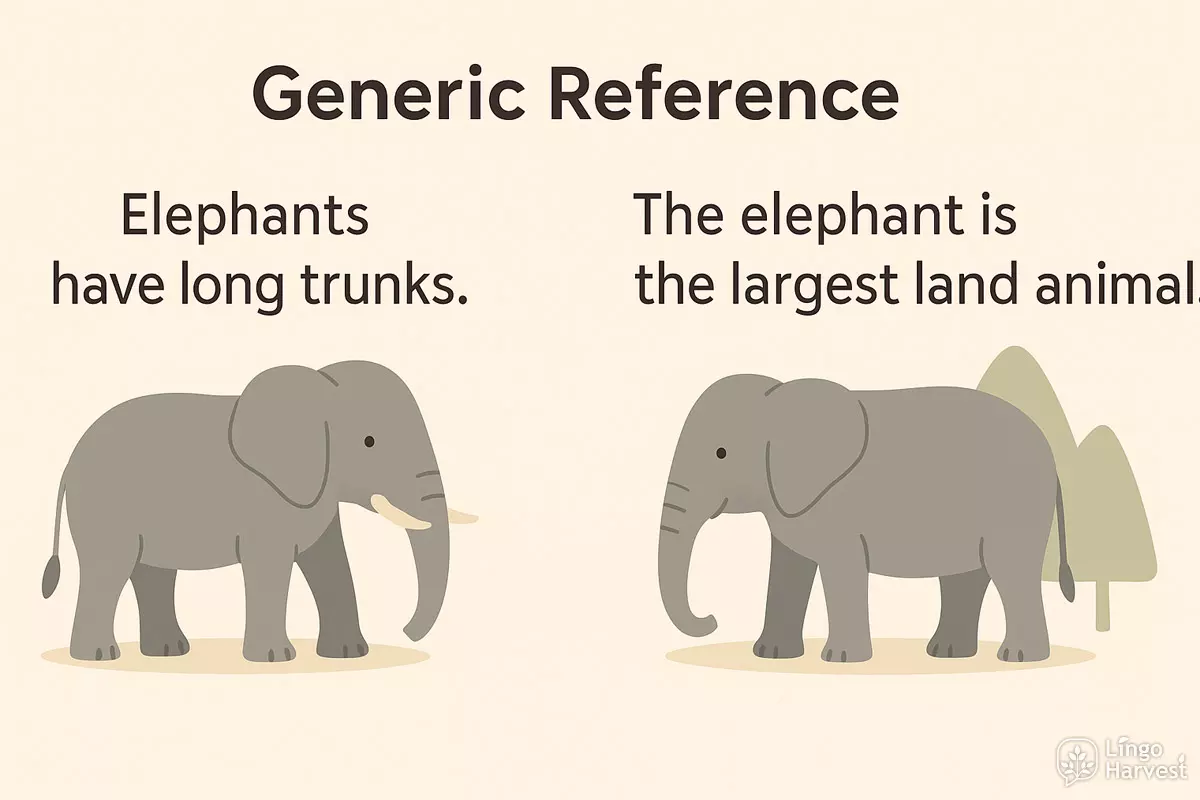
Here are some sentences that illustrate this idea, using various articles and noun forms:
- Elephants have long trunks.
- The elephant is the largest land animal.
- A dog makes a loyal pet.
- Dogs are known for their sense of smell.
- The computer has changed the world.
- Computers process information quickly.
- A smartphone can access the internet.
- The rose is a popular flower.
- Roses bloom in the spring.
- A bicycle is good for exercise.
- The bicycle was invented in the 19th century.
- Cars pollute the air.
- The car is a common mode of transport.
- A cat purrs when happy.
- Cats are independent animals.
Comparing forms of generic reference
| Form | Example Sentence | Meaning |
|---|---|---|
| Plural with no article | Tigers hunt at night. | All members of the group |
| Singular with "the" | The tiger is endangered. | The species as a whole |
| Singular with "a" | A tiger can swim well. | Any representative member |
Understanding which form to use depends on the nuance you want. Talking about the species? “The tiger.” Discussing typical features? “A tiger.” Want to make a general statement? Plural with no article often works best. Each structure gives English speakers flexibility in expressing general truths.
Three generic patterns: the + singular, a + singular, bare plural
When talking about classes of things or general truths in English, writers and speakers often use three main forms: definite singular, indefinite singular, and plural without an article. Each one has its own nuance and is chosen depending on what aspect of the group or concept needs to be highlighted.
The + singular noun
Using "the" with a singular noun (for example, "the tiger") refers to the species or class as a whole, treating it as a single, unified concept. This pattern is common in scientific or formal writing, especially when discussing characteristics or behaviors shared by all members of a group.
- The whale is the largest mammal.
- The computer has changed the way we work.
- The eagle can see very far.
- The piano is a versatile instrument.
- The ant is a social insect.
This form may sound a bit formal or old-fashioned in everyday conversation, but remains frequent in generalizations about animals, inventions, or roles.
A + singular noun
With "a" plus a singular noun ("a tiger"), the focus shifts to any single representative of the group. This construction suggests that the statement applies to all members because it is true for any individual example.
- A lion can run at high speed.
- A dolphin is an intelligent creature.
- A smartphone lets you access the internet.
- A student should study regularly.
- A bird builds its nest in spring.
This pattern feels more neutral and is often used when explaining general facts or habits.
Bare plural noun
The plural form without any article ("tigers") is the most direct way to make a broad statement about a whole group. It is the most common pattern in modern English for generalizations, especially in informal contexts.
- Tigers are endangered.
- Computers have revolutionized communication.
- Dogs are loyal companions.
- Books provide knowledge.
- Students need motivation.
- Cars pollute the air.
- Doctors help people get well.
- Apples are good for you.
- Children love stories.
- Plants need sunlight.
- Teachers inspire learning.
- Musicians practice daily.
Comparison of the three generic forms
The table below illustrates the distinctions and typical usage for each pattern, helping you choose the right form for different contexts.
| Pattern | Example Sentence | Typical Contexts | Implied Meaning |
|---|---|---|---|
| the + singular | The tiger is a fierce animal. | Scientific writing, formal generalizations | Refers to the species as a whole, as a concept |
| a + singular | A tiger has stripes. | Explanations, definitions, instructions | Any typical representative of the group |
| bare plural | Tigers live in Asia. | Everyday speech, modern writing | All members of the group in general |
Choosing between these options depends on context, focus, and style. Understanding their subtle differences helps you communicate general ideas more precisely.
Nuance differences between the tiger, tigers, a tiger
When talking about animals in English, the choice between "the tiger," "tigers," or "a tiger" can subtly shift the meaning of a sentence. Each phrase carries a different implication about specificity, generality, and quantity. Understanding these distinctions is important for clear and accurate communication, especially in academic or descriptive writing.
“The tiger”: Specific or generic?
Using "the tiger" often signals that we are speaking about the species as a whole in a general or scientific sense. For example, "The tiger is endangered" refers not to a particular animal, but to all tigers as a species. Occasionally, it can also mean a specific, previously mentioned animal, though this is less common in scientific contexts.
“Tigers”: Plural and general
The simple plural "tigers" is used when talking about the group in a non-specific way, usually focusing on the animals collectively. For instance, "Tigers live in Asia" states a fact about the species in general, without implying every single member of the species or one in particular.
“A tiger”: Indefinite and singular
"A tiger" points to any single, unspecified member of the species. It’s useful for hypothetical or illustrative scenarios. "A tiger can swim" doesn’t refer to a particular animal, but to the abilities of any typical member of the species.
Comparing usage at a glance
| Form | Typical Usage/Implication | Example Sentence |
|---|---|---|
| The tiger | Generalizing about the species as a whole; also, a specific previously mentioned animal | The tiger is the largest wild cat. |
| Tigers | Referring to the group in general (plural); facts or characteristics | Tigers have distinctive stripes. |
| A tiger | Any one example of the species; hypothetical or illustrative | A tiger can swim long distances. |
Common patterns and examples
- The tiger symbolizes strength in many cultures.
- Tigers are excellent hunters.
- A tiger escaped from the zoo yesterday.
- Conservationists are working to save the tiger.
- Did you know a tiger can leap over 10 meters?
- Tigers rarely form groups in the wild.
- The tiger has a unique pattern of stripes.
- Spotting a tiger in the wild is rare.
- Tigers are native to Asia.
- The tiger plays a crucial role in the ecosystem.
- A tiger may weigh up to 300 kg.
- Tigers need large territories to survive.
Summary of distinctions
Choosing between these forms depends on whether you want to generalize about the species, refer to any member, or discuss a specific or collective group. Paying attention to these nuances helps avoid ambiguity and ensures your statements are both precise and natural.
Generic reference in scientific and general writing
Writers in academic, technical, and general contexts frequently need to refer to entire classes of things—such as species, materials, or abstract concepts—in a way that is clear and unambiguous. English offers three main strategies for this: using a plural noun without an article ("Tigers"), a singular noun with the definite article ("The tiger"), or, less commonly, a singular countable noun with the indefinite article ("A tiger"). Each form carries subtle distinctions in meaning and stylistic tone.
Usage patterns and preferences
In scientific writing, the definite singular ("The tiger") is often used when referring to a species as a whole, especially at the beginning of a discussion or in a taxonomic context. General writing, on the other hand, may favor the plural ("Tigers") to evoke the idea of all members of the group. The indefinite singular ("A tiger") is less common for generic reference but can appear in illustrative statements or when making generalizations about an individual as representative of its kind.
Comparison of forms
The choice between these constructions can affect precision and style. Here’s a structured comparison:
| Form | Example | Typical Use | Notes |
|---|---|---|---|
| Definite singular | The tiger is endangered. | Scientific, taxonomic, formal | Refers to the species as a whole; common in zoological texts. |
| Plural | Tigers are endangered. | General, informal, journalistic | Emphasizes all members of the group; widely used in everyday English. |
| Indefinite singular | A tiger is a carnivorous animal. | Illustrative, explanatory | Describes a typical member; less common for generic reference in formal writing. |
Common examples of generic reference

Writers often use these patterns for various nouns beyond animal species. Here are several examples illustrating the breadth of generic reference forms:
- The dolphin is known for its intelligence.
- Dolphins communicate using clicks and whistles.
- A dolphin can swim at high speeds.
- The computer has revolutionized information processing.
- Computers are essential in modern research.
- A computer can process data rapidly.
- The rose symbolizes love in many cultures.
- Roses require careful cultivation.
- A rose needs sunlight to thrive.
- The atom consists of protons, neutrons, and electrons.
- Atoms make up all matter.
- An atom can be split in nuclear reactions.
- The child learns language quickly.
- Children adapt to new environments.
- A child needs support during development.
Guidelines for choosing a form
Selecting the right structure depends on context, formality, and audience. In scientific papers, the definite singular often signals a precise, taxonomic sense, while the plural suits broader, less formal summaries. The indefinite singular works for definitions, hypothetical scenarios, or when highlighting typical characteristics. Understanding these nuances helps writers convey information more efficiently and accurately.
Common mistakes with generalizing statements
Writers and speakers often stumble when trying to make statements about a whole group using English articles. The difference between "the tiger," "tigers," and "a tiger" can be subtle, but using the wrong form sometimes causes confusion or even changes the intended meaning. Below are some of the most frequent pitfalls and misunderstandings when expressing general truths or making broad claims.
Mixing up article usage for generic meaning
People sometimes use the definite article "the" or the indefinite article "a" when they actually mean to refer to all members of a group, or vice versa. Each form has its own nuance:
- "The tiger" can refer to the species as a whole, but sometimes is misused to refer to a specific animal or a known group.
- "Tigers" is the plural form and is typically used for making general statements about all tigers.
- "A tiger" is used to refer to any single, typical member of the group, but can be mistakenly used when a broader reference is needed.
Overgeneralization or unintended specificity
Choosing the wrong article can lead to making a statement that is too broad or too narrow. For example, "The tiger is endangered" is a correct generalization, but "A tiger is endangered" might sound like only one random tiger is at risk.
Common errors and their consequences
Writers sometimes make mistakes such as:
- Using "the" when the plural would be clearer (e.g., "The tigers are fast" vs. "Tigers are fast")
- Applying the singular indefinite article for a general truth (e.g., "A tiger has stripes" instead of "Tigers have stripes")
- Switching between forms within the same paragraph, causing inconsistency
- Assuming all three forms are always interchangeable
- Forgetting that some animals or objects are typically discussed in the plural when making general statements
- Adding unnecessary articles to uncountable or abstract nouns
- Using "the" with plural nouns for generic reference, which can sound odd or overly formal
- Translating directly from other languages, leading to unnatural article use in English
- Confusing the use of articles in negative statements (e.g., "A tiger doesn't fly" vs. "Tigers don't fly")
- Making claims about a group but using a singular noun incorrectly (e.g., "A tiger live in the jungle")
- Neglecting subject-verb agreement when switching between singular and plural forms
- Mixing up article usage with proper nouns or unique objects (e.g., "The Mount Everest" instead of "Mount Everest")
- Omitting articles altogether when one is needed for clarity
- Using articles with names of languages or academic subjects where none is needed
- Incorrectly inserting "a" before plural nouns (e.g., "A tigers are dangerous")
- Using "the" in proverbs or idiomatic expressions where it is not required
Comparison of forms for generic reference
When making generalizations, it helps to understand how each form is used and what meaning it conveys. The following table provides a structured comparison:
| Form | Example | Meaning | Typical Use |
|---|---|---|---|
| Definite singular ("the tiger") | The tiger is a magnificent animal. | Refers to the species as a whole, often in formal or scientific contexts. | General truths about the species |
| Plural without article ("tigers") | Tigers are endangered. | Refers to all members of the group in a general sense. | Everyday generalizations |
| Indefinite singular ("a tiger") | A tiger can run fast. | Refers to any single, typical example of the group. | General characteristics of one member |
| Incorrect form | A tigers are dangerous. | Mixes singular article with plural noun — grammatically incorrect. | Common learner error |
Tips for avoiding mistakes
To express generalizations clearly, always match the article and noun form to your intended meaning. Double-check for consistency and don't hesitate to compare your sentences with established examples. If unsure, reading native texts or consulting style guides can help clarify the correct patterns.
Practice: choose the best generic form in context
Understanding when to use "the tiger," "tigers," or "a tiger" for general statements can be tricky. The form you choose depends on whether you mean the whole species, any member of the group, or a typical representative. Let's try some practice exercises to build your confidence.
Choose the right form
For each sentence, select the most natural option: "the tiger," "tigers," or "a tiger."
- ______ is a dangerous animal.
- ______ can swim very well.
- ______ has stripes on its body.
- ______ are endangered in the wild.
- ______ usually hunts alone.
- ______ is found in Asia and parts of Russia.
- ______ is the largest cat species.
- ______ eat meat.
- ______ can weigh over 300 kilograms.
- ______ is often a symbol of strength.
Show answers
- 1. The tiger / A tiger
- 2. Tigers / The tiger
- 3. A tiger / The tiger
- 4. Tigers
- 5. The tiger / A tiger
- 6. The tiger
- 7. The tiger
- 8. Tigers
- 9. A tiger / The tiger
- 10. The tiger / A tiger
Patterns for generic reference
English uses several forms to refer to a whole group or concept. Here's a comparison of the main patterns for animals like "tiger":
| Form | Typical Use & Example |
|---|---|
| the + singular noun (the tiger) |
Refers to an entire species as a whole. Example: The tiger is endangered. |
| plural noun (tigers) |
Refers to all members of the group, or the group in general. Example: Tigers live in Asia. |
| a + singular noun (a tiger) |
Means any one member of the group; emphasizes a typical example. Example: A tiger can swim well. |
| no article (uncountable/abstract) | Used for substances or concepts, not for animals like "tiger." |
Tips for mastering generic reference
- Use the + singular for species as a whole (The tiger is fierce).
- Use plural for general truths (Tigers eat meat).
- Use a + singular to describe a typical example (A tiger has stripes).
- Don't use "a tigers" or "the tigers" unless you mean specific tigers.
Quick challenge
Fill in each blank with "the tiger," "tigers," or "a tiger" as fits best:
- ______ is a solitary hunter.
- ______ have powerful jaws.
- ______ can leap long distances.
- ______ is admired for its beauty.
- ______ lives mainly in Asia.
- ______ are endangered in many regions.
- ______ is the largest cat species.
- ______ rely on camouflage when hunting.
- ______ are often featured in folklore.
- ______ needs large territories to survive.
Show answers
- 1. The tiger / A tiger
- 2. Tigers
- 3. A tiger / The tiger
- 4. The tiger / A tiger
- 5. The tiger / A tiger
- 6. Tigers
- 7. The tiger
- 8. Tigers
- 9. Tigers
- 10. The tiger / A tiger
Practicing with real contexts helps you internalize which generic form sounds right. Review the examples above and notice how the choice shapes the meaning.