Articles in Complex Noun Phrases: Pre- and Postmodification

 The article reviews how to use articles with premodifiers and postmodifiers in noun phrases, explains article placement in long phrases, covers multiple adjectives and compounds, discusses relative clauses and prepositional phrases, and provides practice exercises.
- Review of premodifiers and postmodifiers in noun phrases
- Where the article sits in long noun phrases
- Articles with multiple adjectives and compounds
- Relative clauses and prepositional phrases after nouns
- Avoiding double articles and unclear reference
- Practice: insert articles into complex noun phrases
Examining the use of definite and indefinite markers in complex noun groups, particularly when modifiers appear before or after the main noun, provides valuable insights into the structure of English. Recognizing these patterns not only helps clarify how meaning is constructed in sentences but also enhances both writing precision and reading comprehension. By paying attention to how articles and other determiners interact with nouns and their modifiers, learners can develop a more nuanced understanding of English grammar and communicate more effectively.
Review of premodifiers and postmodifiers in noun phrases
Understanding how noun phrases are expanded by elements before and after the head noun is crucial for analyzing complex structures in English. Premodifiers and postmodifiers both add detail, but they do so in different ways and positions.
Premodifiers: What Comes Before the Noun
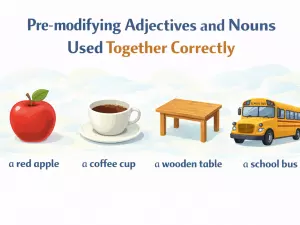
Premodifiers are words or groups of words that appear before the main noun, helping to specify or limit its meaning. They often include adjectives, determiners, numerals, and sometimes nouns acting as modifiers. For example:
- determiners: the, this, my
- quantifiers: many, some, several
- adjectives: beautiful, old, French
- participles: broken, running
- nouns as modifiers: chicken soup, summer vacation
Premodifiers can be stacked, as in three large wooden boxes, where each word narrows the meaning of "boxes".
Postmodifiers: What Follows the Noun
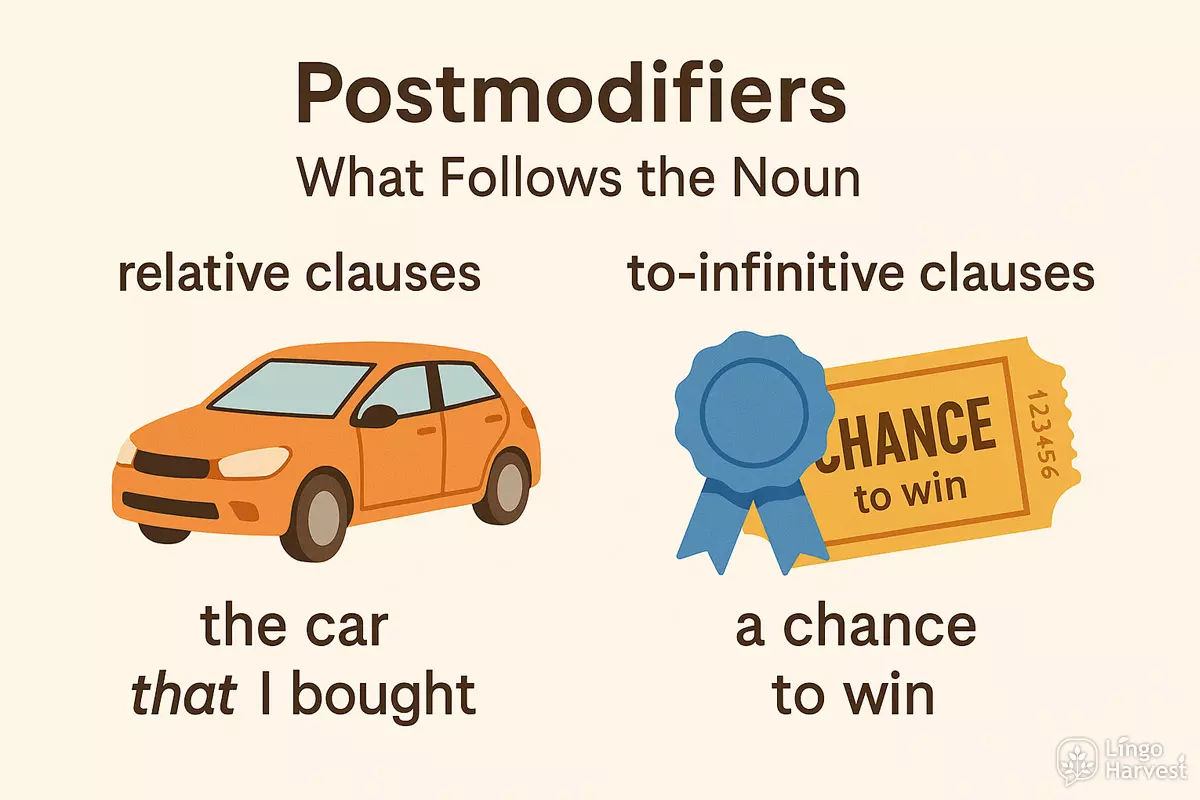
Postmodifiers come after the noun and give extra information, often making the phrase more precise. They are commonly prepositional phrases, relative clauses, or participial phrases. Examples include:
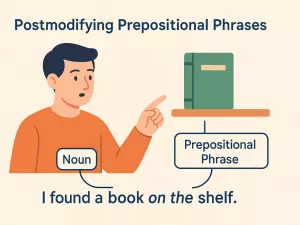
- prepositional phrases: a book on the table
- relative clauses: the car that I bought
- to-infinitive clauses: a chance to win
- participial phrases: students arriving late
- appositive phrases: my friend, a talented musician
These elements help to identify or describe the noun further, often providing essential or non-essential information.
Comparing Premodifiers and Postmodifiers
| Type | Common Forms & Examples |
|---|---|
| Premodifiers | Articles (the cat), adjectives (old house), participles (broken window), noun modifiers (history teacher), numbers (three books) |
| Postmodifiers | Prepositional phrases (the man in the suit), relative clauses (the book that you lent me), to-infinitives (something to eat), participial phrases (the girl sitting near the door) |
Practice: Identify the Modifiers
For each noun phrase below, state whether the underlined part is a premodifier or a postmodifier:
- The red car
- The book on the shelf
- A recently published article
- The students waiting outside
- My old friend
- The house that Jack built
- A long journey
- The woman standing by the door
- His new project
- The documents you requested
- An interesting idea
- The man in the blue jacket
Show answers
- Premodifier
- Postmodifier
- Premodifier
- Postmodifier
- Premodifier
- Postmodifier
- Premodifier
- Postmodifier
- Premodifier
- Postmodifier
- Premodifier
- Postmodifier
By recognizing the role and placement of modifiers, you can better interpret and construct complex noun phrases in English, whether for speaking, writing, or analysis.
Where the article sits in long noun phrases
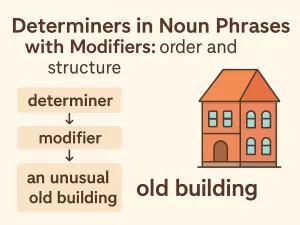
In extended noun phrases, the definite or indefinite article typically appears at the very start, preceding any premodifiers such as adjectives or quantifiers. This placement helps set the scope of reference for the entire phrase, regardless of how much detail is added by modifiers. Even when a noun group contains multiple descriptive layers, the article anchors the reference point for the reader or listener.
Basic Positioning
The article almost always comes before all descriptive words attached to the main noun. For example:
- the tall, old oak tree in the garden
- a rapidly developing urban neighborhood
- an interesting book about modern architecture
No matter how many adjectives or other modifiers are present, the article leads the phrase.
Postmodification and Article Placement
Postmodifiers (like prepositional phrases or relative clauses) follow the noun and do not affect where the article is placed. The article remains attached to the main noun group, not inserted elsewhere. For example:
- the students who finished early
- an email from my professor
- a solution to the challenging problem
Common Patterns in Lengthy Noun Phrases
Here are some common structures showing how articles interact with complex noun groups:
- the first big decision of the year
- an unexpected result from yesterday’s experiment
- the best chocolate cake you’ve ever tasted
- a series of important historical events
- the only available seat in the auditorium
- an old friend from primary school
- the most difficult exam I’ve ever taken
- a new approach to solving the issue
- the tallest building in the city
- an idea that changed everything
- the main road leading out of town
- a book with a blue cover
- the last piece of chocolate on the plate
Premodifiers and Article Placement
When premodifiers like numbers, quantifiers, or adjectives are present, the article still comes first. See the examples below for clarity:
| Article + Premodifier(s) + Noun | Example |
|---|---|
| the + two + large + boxes | the two large boxes on the shelf |
| a + beautiful + old + house | a beautiful old house by the river |
| an + interesting + new + theory | an interesting new theory about language |
| the + only + possible + answer | the only possible answer to the question |
| a + long + complicated + process | a long complicated process of negotiation |
| the + main + research + topic | the main research topic this year |
Summary
To sum up, no matter how complex a noun phrase becomes, the article’s position remains stable: it precedes any descriptive elements and directly signals the reference of the core noun. This consistency aids both in comprehension and in constructing clear, grammatically correct sentences.
Articles with multiple adjectives and compounds
When a noun phrase contains several adjectives or compound modifiers, the placement and use of articles can become less straightforward. Determining whether to use "a," "an," or "the" often depends on the meaning and structure of the entire phrase, not just the head noun. For example, in “a long, complicated process,” the article relates to the whole phrase, not to "long" or "complicated" individually.
Order and Scope of the Article
The article typically comes before any adjectives or compound modifiers, and it applies to the entire noun phrase. The choice of article depends on whether the noun is specific or general, and whether it is countable or uncountable. When multiple adjectives are present, remember that the article is not repeated for each one.
- a big red balloon
- an interesting old book
- the well-known British scientist
- the first successful moon landing
- a highly respected medical journal
- an award-winning French film
- the three-mile walking route
- a two-hour online meeting
- the recently discovered ancient city
- a state-of-the-art kitchen appliance
- an up-to-date reference guide
- the last-minute travel deal
- a much-debated political question
- the brightly-lit conference room
- an all-inclusive holiday package
Compounds and Hyphenated Modifiers
Compound adjectives and hyphenated modifiers, like "well-known" or "three-story," do not change the article’s position. The article still comes first and covers the entire noun phrase. The presence of more than one modifier does not require additional articles.
Comparing Patterns with Multiple Modifiers
In complex noun phrases, the article’s role and placement remain consistent even when several descriptive elements are present. The following table illustrates this with a range of structures:
| Example Phrase | Explanation |
|---|---|
| a small wooden box | Article "a" applies to the whole phrase; both adjectives describe the box. |
| the newly renovated city center | "The" specifies a particular center, with two modifiers before the noun. |
| an easy-to-follow recipe | Hyphenated compound modifier; article "an" covers the full noun phrase. |
| the twenty-year-old tradition | Definite article applies to a specific tradition, with a compound adjective. |
| a well-organized international event | Article "a" precedes two modifiers, one hyphenated, one not. |
| the high-risk investment strategy | "The" refers to a specific strategy, with a compound modifier. |
Key Points to Remember
- Use a single article before all modifiers in the noun phrase.
- Do not repeat the article for each adjective or compound.
- The article’s type (definite or indefinite) depends on meaning, not on the number of modifiers.
- Compound or hyphenated adjectives do not change article placement.
In summary, the article always comes at the start of the complex noun phrase and applies to the entire unit, regardless of how many descriptive words or compounds are used.
Relative clauses and prepositional phrases after nouns
Complex noun phrases often expand with information that comes after the noun, such as descriptive clauses or prepositional groups. These postmodifiers add detail, specify which item is meant, or clarify relationships. Understanding how these elements interact with articles is crucial for accurate and natural English.
Relative Clauses: Adding Specificity
Relative clauses (beginning with words like who, which, that) follow nouns to describe or identify them. The use of the definite or indefinite article often depends on whether the clause restricts (defines) or simply adds extra information.
- Restrictive: The book that you lent me (specifies which book)
- Non-restrictive: A student, who was late, missed the test (adds extra information)
- The man who called you
- A painting that hangs in the gallery
- The car which broke down
- Students who study hard
Articles are typically omitted in general references but included when the noun is specified by the clause.
Prepositional Phrases: Providing Context
Prepositional phrases (like in the garden, with blue stripes) follow nouns to give location, possession, or other context. The choice of article before the noun is influenced by whether the phrase makes the noun unique or still one of many.
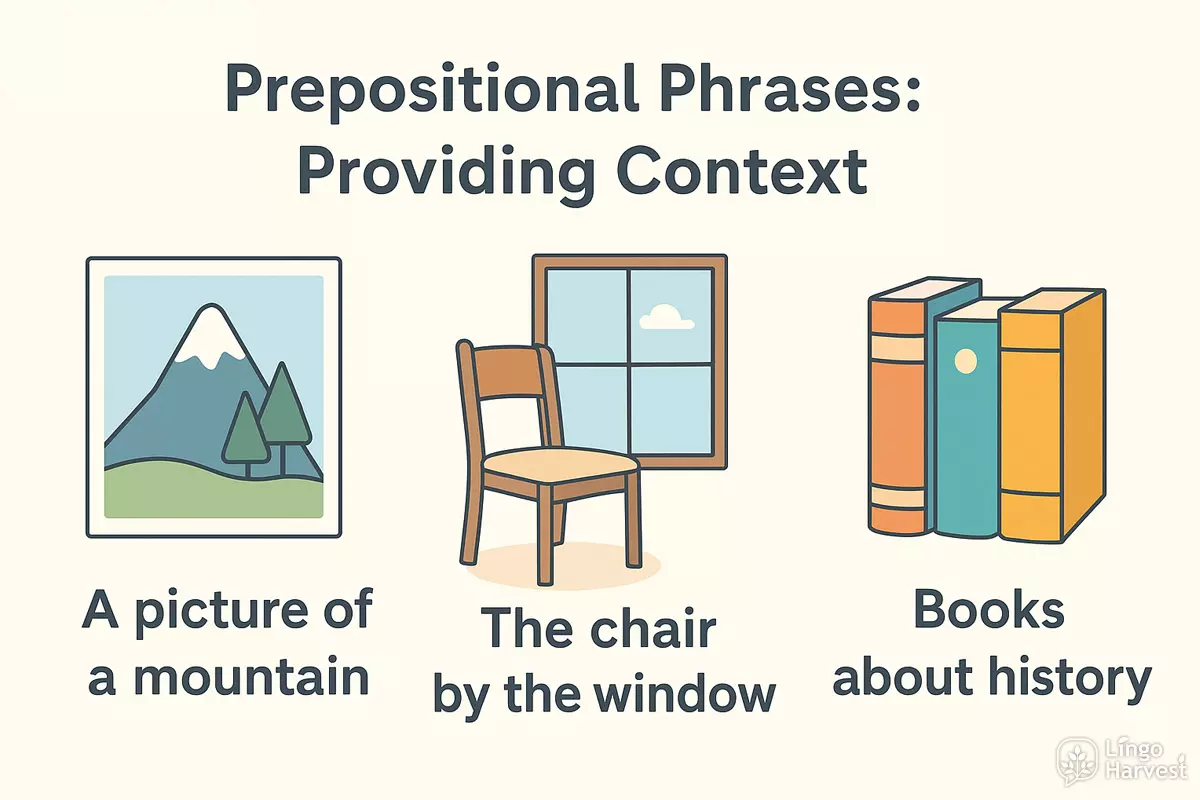
- The house on the corner
- A picture of a mountain
- The chair by the window
- Books about history
- The girl with the red hat
- A letter from my friend
- The bottle on the table
- Friends from college
- The keys under the mat
- A song by the river
Article Use with Postmodifiers: Patterns and Effects
The presence and type of postmodifier often determine which article is correct:
| Noun Phrase | Article Choice & Reason |
|---|---|
| A car with tinted windows | Indefinite article: Refers to any car with this feature |
| The car that you bought | Definite article: Identifies a specific car known to both speaker and listener |
| Books on the shelf | Zero article (plural): Refers to some or all such books in general |
| The meeting in Room 12 | Definite article: Specifies the exact meeting by location |
| A student from Canada | Indefinite article: Any one student fitting the description |
| The teacher with the glasses | Definite article: Uniquely identifies the teacher among others |
In summary, postmodifying elements like relative clauses and prepositional phrases are central to how complex noun groups are formed and interpreted. They often determine whether the noun is seen as specific or general, guiding the appropriate article choice.
Avoiding double articles and unclear reference
Writers often stumble when combining articles (a, an, the) with complex noun phrases, especially when both premodifiers and postmodifiers are present. Overusing articles or placing them incorrectly can create confusion or redundancy, making it hard for readers to follow which noun is being referenced.
Common Problems with Articles in Complex Noun Phrases
When multiple modifiers surround a noun, it's easy to accidentally insert more than one article or to leave the reference ambiguous. This can occur with both definite and indefinite articles, particularly when adjectives, participial phrases, or prepositional phrases are involved. Consider these issues:
- Using two articles in one noun phrase (e.g., an the old house ❌)
- Inserting an article before both the premodifier and the head noun (e.g., a beautiful a painting ❌)
- Omitting an article when one is needed, leading to unclear reference (e.g., report submitted yesterday instead of the report submitted yesterday)
- Adding an article before a postmodifier that doesn’t require one (e.g., the manager of the a company ❌)
How to Place Articles Correctly
The article should normally come before the entire noun phrase, regardless of how many modifiers are present. Only one article is needed for each complete noun phrase. Here are some patterns to clarify placement:
- The newly renovated house at the corner
- A well-written report on climate change
- The students in the library
- An unexpected outcome of the experiment
- The first chapter of the book
Examples: Correct vs. Incorrect Usage
| Incorrect | Correct |
|---|---|
| The a large building near the park | The large building near the park |
| A the interesting article about linguistics | An interesting article about linguistics |
| The report the prepared by John | The report prepared by John |
| A the student with the highest score | The student with the highest score |
| The a project on urban design | The project on urban design |
Tips for Clear Reference
- Use just one article per noun phrase, before all modifiers.
- Check if your noun phrase already starts with an article before adding another.
- When in doubt, simplify the phrase and rebuild it, ensuring clarity and correctness.
- Watch for complex postmodifiers (e.g., prepositional or relative clauses) that might tempt you to repeat an article.
- Remember: articles signal whether your reader should know which noun you mean—misplacing them can make your meaning ambiguous.
Practice: insert articles into complex noun phrases
Understanding how to use articles with complex noun phrases—especially those with several adjectives, prepositional phrases, or relative clauses—requires close attention. Articles (“a,” “an,” “the,” or zero article) interact with both premodifiers (words before the noun) and postmodifiers (words or phrases after the noun). The following tasks will help you practice choosing the correct article in context.
Insert the correct article: fill-in-the-blank
Add a, an, the, or leave the space blank (zero article) where necessary. Consider all modifiers in the noun phrase.
- _____ interesting book on the shelf belongs to my friend.
- She bought _____ elegant vase with blue patterns from Italy.
- Did you see _____ students who won the competition?
- He is looking for _____ job that will allow him to travel.
- I have never visited _____ museum dedicated to modern art.
- _____ large, old oak tree near my house was cut down.
- We watched _____ documentary about endangered species last night.
- _____ advice you gave me was very helpful.
- She wore _____ unusual dress made of recycled materials.
- _____ people living in this area are mostly farmers.
Show answers
- The interesting book on the shelf belongs to my friend.
- an elegant vase with blue patterns from Italy.
- the students who won the competition?
- a job that will allow him to travel.
- a museum dedicated to modern art.
- The large, old oak tree near my house was cut down.
- a documentary about endangered species last night.
- The advice you gave me was very helpful.
- an unusual dress made of recycled materials.
- The people living in this area are mostly farmers.
Common patterns in complex noun phrases: quick reference
Here are some typical structures with articles and modifiers. Use this list to check your understanding and compare forms.
| Pattern | Example |
|---|---|
| Article + adjective(s) + noun + prepositional phrase | a beautiful painting of the sunset |
| Article + noun + relative clause | the book that I borrowed |
| Article + noun + of-phrase | an example of good leadership |
| Article + superlative adjective + noun | the most expensive restaurant in town |
| Article + quantifier + noun + postmodifier | the many challenges facing students |
| Zero article + plural noun + postmodifier | students interested in science |
Spot the error: choose the correct option
Select the correct article for each sentence. Only one answer is correct per item.
- (a / the / —) report on climate change was published yesterday.
- (A / The / —) children playing in the park are my neighbors.
- (A / The / —) unique opportunity arose during the meeting.
- (A / The / —) old castle on the hill is now a museum.
- (A / The / —) information you sent was very helpful.
- (A / The / —) man standing at the door wants to speak to you.
- (A / The / —) music in this café is too loud.
- (A / The / —) answer you gave is correct.
- (A / The / —) city bus arrives every 10 minutes.
- (A / The / —) new policy will affect all employees.
- (A / The / —) students in this class work very hard.
- (A / The / —) letter from my friend arrived today.
Show answers
- A report on climate change was published yesterday.
- The children playing in the park are my neighbors.
- A unique opportunity arose during the meeting.
- The old castle on the hill is now a museum.
- The information you sent was very helpful. (uncountable, specific)
- The man standing at the door wants to speak to you.
- The music in this café is too loud. (specific music that is playing now)
- The answer you gave is correct.
- The city bus arrives every 10 minutes. (specific system/bus type)
- The new policy will affect all employees. (specific policy being introduced)
- The students in this class work very hard.
- A letter from my friend arrived today.
As you work with longer noun phrases, always identify the head noun and its modifiers. This helps you decide which article, if any, is needed—especially when extra information is added before or after the noun. Practicing with varied structures will build your confidence in using articles accurately in complex contexts.