Typical Article Problems in Advanced Writing (C1)

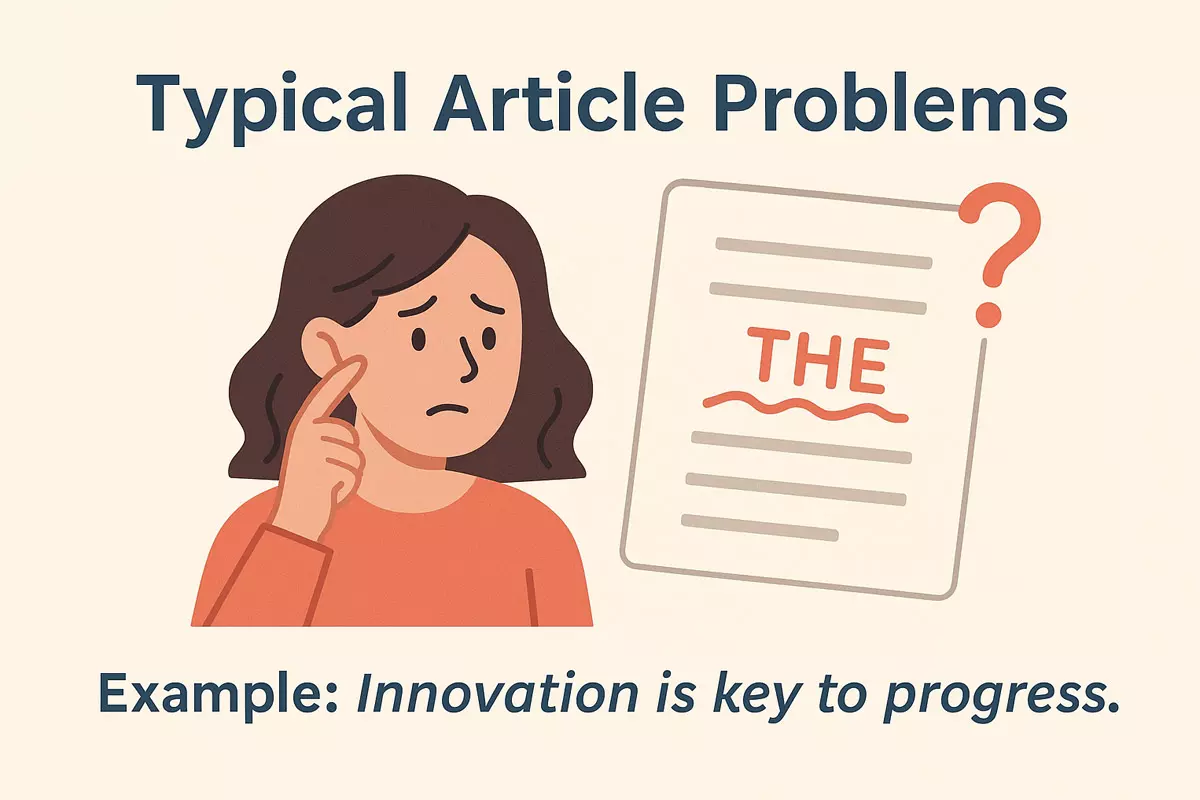 This article reviews common C1-level article mistakes, including overusing the with abstract or generic nouns, missing articles in complex noun phrases, and L1 transfer effects. It also suggests self-checking strategies and provides practice correcting errors.
Even experienced writers at the C1 level often encounter recurring issues in their writing, ranging from minor grammatical errors to sentences that lack clarity or flow. These mistakes can make even well-researched articles seem less polished and may distract readers from the intended message. By paying close attention to common pitfalls such as subject-verb agreement, proper use of linking words, and maintaining consistent tone, you can significantly improve your writing and ensure your ideas are communicated clearly and professionally.
Overview of advanced article issues at C1
At the C1 level, article use becomes less about basic correctness and more about subtlety, flexibility, and context. Writers often face challenges in deciding when to omit articles, when to use definite or indefinite forms, and how articles interact with abstract concepts, countable and uncountable nouns, and idiomatic phrases. Problems can also arise with advanced noun phrases, especially when modifiers or quantifiers are involved.
Common Advanced Article Mistakes
Writers at this stage may still encounter a range of nuanced issues, such as:
- Overusing "the" with general or abstract nouns (e.g., the happiness instead of happiness)
- Omitting "the" with unique objects or specific references (e.g., Earth instead of the Earth)
- Confusion with zero article in set phrases (e.g., at university, go to bed)
- Incorrect article use with geographical names (e.g., the Netherlands, Lake Baikal)
- Mistakes with plural and uncountable nouns (e.g., a news, an advice)
- Problems with superlatives and ordinal numbers (the best solution, the first time)
- Inconsistency in parallel structures (e.g., a pen and pencil vs. a pen and a pencil)
- Article errors in combinations with adjectives (e.g., the poor, a rich)
- Misuse in relative clauses (e.g., the people who vs. people who)
- Complex noun phrases with multiple modifiers
- Choosing articles before acronyms and abbreviations (e.g., an MBA, a UNESCO report)
Article Use in Complex Noun Phrases
As sentences become more sophisticated, so do the structures that require careful article choice. Consider the differences in meaning conveyed by article variation:
| Example Phrase | Effect/Meaning |
|---|---|
| a solution to the problem | Any possible solution; not specified |
| the solution to a problem | Specific solution, but the problem is general |
| the solution to the problem | Both solution and problem are specific and known |
| solutions to problems | General statement, no articles needed |
Advanced Patterns and Pitfalls
Mastering article use at this stage means paying attention to patterns that are not always intuitive. Some of the trickiest areas include:
- Abstract nouns: the beauty of music vs. beauty is subjective
- Institutional nouns: in hospital (as a patient), in the hospital (the building)
- Names of meals: at lunch vs. the lunch we had yesterday
- Media and communication: on television vs. the television is broken
- Proper nouns with defining phrases: the London of Dickens
- Using articles with adjectives as nouns: the rich, the unknown
- Fixed expressions: by car, in the car
- Titles and roles: the president (specific), president of a company (any)
- Zero article with plural or uncountable nouns in generalizations: Books are expensive
- Switching article use for emphasis or contrast
Developing awareness of these advanced article patterns is essential for clear, idiomatic, and precise academic or professional writing at the C1 level.
Overuse of the with abstract and generic nouns
Writers at the C1 level often struggle with definite article use, especially before abstract concepts and nouns that refer to things in general. While "the" is needed for specific or previously mentioned items, it should be omitted with most uncountable or plural nouns when speaking generally. This area is a common source of unnatural or awkward English in advanced writing.
When to Omit "the" with Abstract and Generic Nouns
It’s important to remember that abstract ideas, general categories, and uncountable nouns usually do not require an article. For instance, we say "Freedom is essential," not "The freedom is essential," unless referring to a particular type of freedom. Overusing the definite article can make sentences sound overly formal or incorrect.
Common Examples of Incorrect and Correct Usage
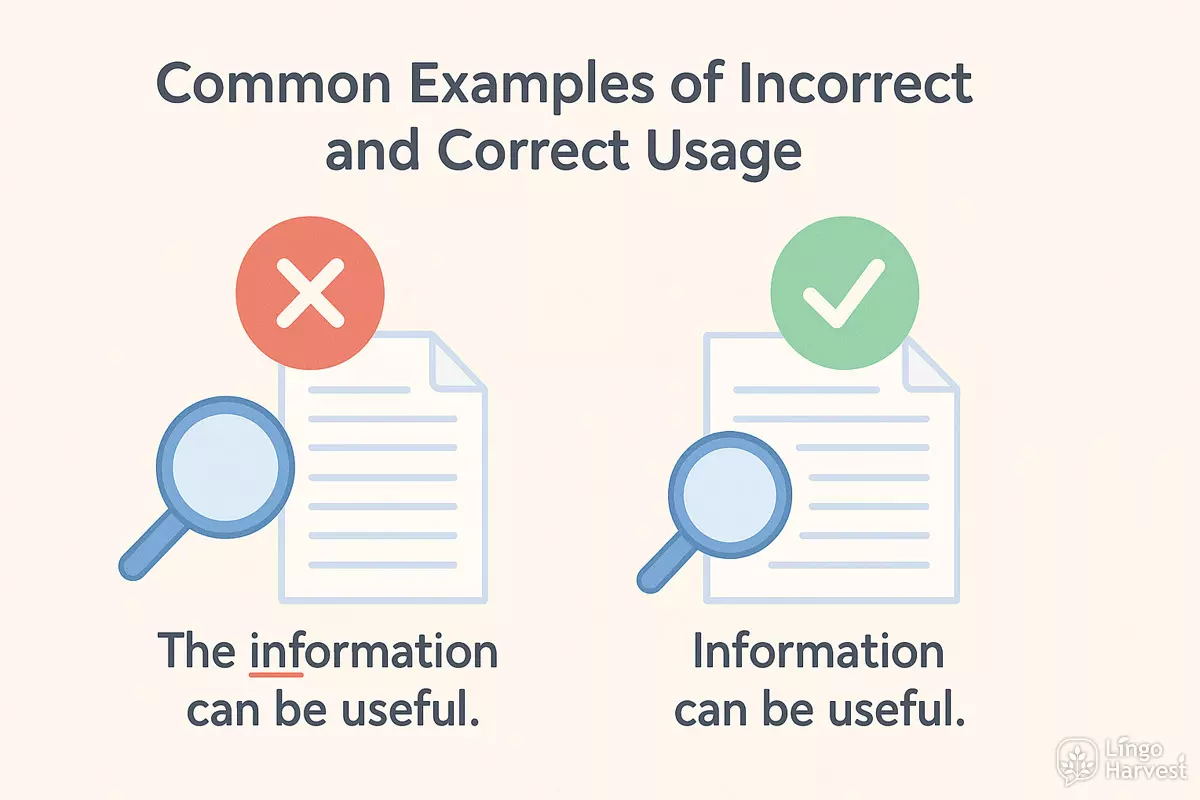
- ❌ The love is important in life. → ✅ Love is important in life.
- ❌ The technology develops quickly. → ✅ Technology develops quickly.
- ❌ The information can be useful. → ✅ Information can be useful.
- ❌ The education opens doors. → ✅ Education opens doors.
- ❌ The patience is a virtue. → ✅ Patience is a virtue.
- ❌ The progress is slow. → ✅ Progress is slow.
- ❌ The happiness depends on attitude. → ✅ Happiness depends on attitude.
- ❌ The society is changing. → ✅ Society is changing.
- ❌ The science is fascinating. → ✅ Science is fascinating.
- ❌ The air is polluted. (when speaking generally) → ✅ Air is polluted.
- ❌ The life is unpredictable. → ✅ Life is unpredictable.
- ❌ The music helps me relax. → ✅ Music helps me relax.
- ❌ The crime is a problem. → ✅ Crime is a problem.
- ❌ The art inspires us. → ✅ Art inspires us.
- ❌ The water is essential for survival. (in general) → ✅ Water is essential for survival.
How to Decide: Is "the" Necessary?
Ask yourself: Am I talking about a specific instance or the concept as a whole? If you mean something in general, leave out "the." Use "the" only when you are referring to a particular example or a previously identified group.
Quick Reference: Abstract and Generic Nouns
- Use no article: Happiness, education, science, technology, love, music, information, progress, patience, society, art, crime, water, air, life (when talking about them in general)
- Use "the" only when specifying: The information you gave, the education system in France, the technology of the 21st century
Summary Tips
- Omit "the" with general/abstract nouns unless you mean something specific.
- Review sentences for unnecessary definite articles before abstract ideas.
- Practice by comparing sentences with and without "the" to feel the difference in meaning.
Missing articles in complex noun phrases
Writers at the C1 level often stumble when using articles in longer or more intricate noun groups. As sentences become more advanced, noun phrases tend to include adjectives, quantifiers, or even embedded clauses. This complexity can make it harder to decide whether to use "a," "an," or "the," or to omit the article altogether. Such mistakes can subtly change meaning or make writing sound unnatural.
Where problems occur
Errors frequently appear in phrases with multiple modifiers or when an abstract noun is qualified by extra information. For example, learners might forget the article in "He is expert in field" instead of "He is an expert in the field." These slips are especially common after possessives, quantifiers, or when prepositional phrases follow the noun.
Common patterns that cause confusion
- Adjective + noun combinations: "She has interesting idea" → "an interesting idea"
- Noun + of + noun: "Development of technology" → "the development of technology"
- Superlative forms: "He is best player on the team" → "the best player"
- Quantifier + noun: "Few students passed" (correct), but "Most students passed" (no article needed)
- Abstract nouns with modifiers: "Importance of education" → "the importance of education"
- Job titles with modifiers: "She is manager of project" → "the manager of the project"
- Singular countable noun: "He bought car" → "a car"
- First mention/second mention: "I saw cat. Cat was black." → "a cat. The cat was black."
- With relative clauses: "He is student who studies hard" → "a student who studies hard"
- Organizations or institutions: "He works at university" → "a university" or "the university" (depending on context)
- Geographical names with modifiers: "He visited old city of Prague" → "the old city of Prague"
- With prepositional phrases: "She is author of book" → "the author of the book"
- Unique objects: "Sun is shining" → "The sun is shining"
- Generalizations with singular countable nouns: "A dog is friendly" (correct), not "Dog is friendly"
- Time periods: "In morning" → "In the morning"
How to check your writing
Slowing down to analyze each noun phrase helps catch missing determiners. Ask yourself: Is this noun countable or uncountable? Is it specific or general? Does it have modifiers that change its meaning? Reading your text aloud can also highlight awkward phrases where an article is missing.
Quick reference: Article use in complex noun groups
| Incorrect Phrase | Corrected Version |
|---|---|
| He is expert in field. | He is an expert in the field. |
| Importance of education cannot be ignored. | The importance of education cannot be ignored. |
| She has unique perspective on issue. | She has a unique perspective on the issue. |
| It was best decision of project. | It was the best decision of the project. |
| He works as manager of company. | He works as the manager of the company. |
Paying close attention to these patterns can make advanced writing smoother and more accurate. Mastery of article use in longer noun structures is a key step toward native-like fluency.
L1 transfer effects on article choice
Learners often bring habits from their native languages into English, especially when it comes to using articles. For advanced writers, these ingrained patterns can create persistent errors, even after years of study. The influence of a person's first language (L1) can result in both omission and overuse of articles, depending on whether their L1 has a comparable system.
Common Patterns Based on Native Language
Writers whose languages lack articles—such as Russian, Chinese, Japanese, or Korean—often struggle to decide when to include "the," "a," or "an." Meanwhile, speakers of languages with definite/indefinite articles, like Spanish or German, may apply their own rules, which don’t always match English usage. This can lead to errors that are systematic and persistent at the C1 level.
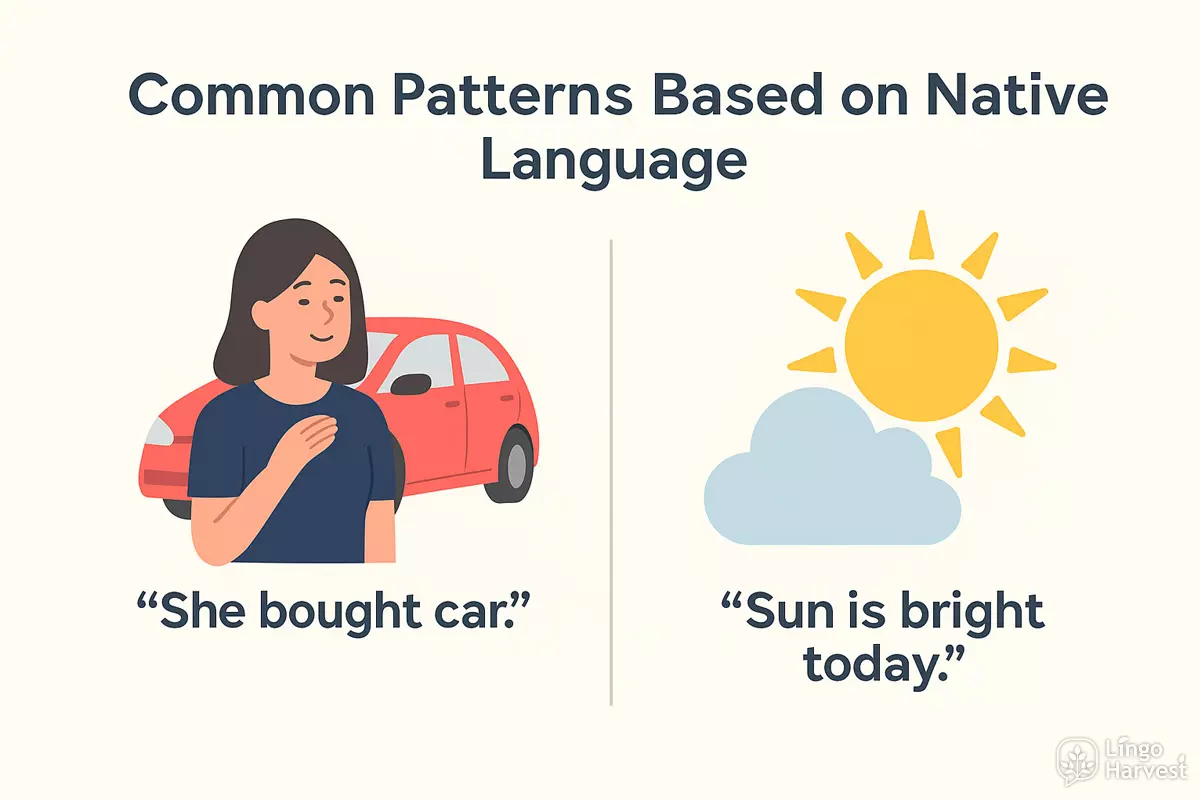
- Leaving out "a/an" with singular countable nouns ("She bought car")
- Dropping "the" with shared knowledge or unique objects ("Sun is bright today")
- Adding "the" unnecessarily with abstract nouns ("The happiness is important")
- Using "a" with uncountable nouns ("a information")
- Transferring word order from L1, affecting article position
- Confusing generic and specific reference ("A dogs are friendly")
- Overusing definite articles before names ("The John is here")
- Omitting articles in fixed expressions ("go to hospital" vs. "go to the hospital")
- Translating L1 expressions literally, resulting in incorrect article use
- Applying rules from L1 where English makes exceptions
- Assuming plural nouns never take articles ("Children are playing in park")
- Inserting articles before countries or cities ("The France," "The Paris")
- Overgeneralizing article use after possessives ("My the book")
- Using articles with proper nouns unnecessarily
- Neglecting the difference between first mention (a/an) and subsequent mention (the)
- Incorrectly using "an" before words starting with vowels but pronounced with consonant sounds ("an university")
Contrast: Languages With vs. Without Articles
Learners’ article choices are shaped by whether their native language uses articles, has a partially similar system, or lacks them altogether. The following table compares common tendencies among learners from different L1 backgrounds:
| L1 Background | Typical Article Issues |
|---|---|
| Languages without articles (e.g. Russian, Chinese, Japanese) |
Frequent omission of "a," "an," and "the"; confusion about when articles are necessary; literal translations resulting in missing articles. |
| Languages with definite/indefinite articles (e.g. Spanish, French, German) |
Incorrect transfer of L1 article rules; overuse of "the" with abstract concepts or proper nouns; mismatching English-specific patterns. |
| Languages with partial or different systems (e.g. Turkish, Polish, Scandinavian languages) |
Mixing up article use in contexts where L1 uses other determiners; inconsistent application in English due to partial familiarity. |
| L1s with zero article but contextual markers (e.g. Korean, Thai) |
Relying on context or particles instead of articles; frequent omission in both written and spoken English. |
Key Takeaways for Advanced Writers
Awareness of these transfer effects can help writers self-monitor and target problem areas. Regular feedback, focused revision, and exposure to authentic English texts are essential for overcoming L1-driven habits and achieving more accurate article usage in advanced writing.
Strategies for self-checking article use
Reviewing your own use of articles in advanced writing requires deliberate attention and targeted techniques. It's common to overlook small words like "a," "an," and "the," especially when focusing on complex ideas or sophisticated vocabulary. However, methodical self-checks can highlight overlooked mistakes and foster lasting improvement.
Common self-editing techniques
- Pause and isolate noun phrases: Read each sentence and pause at every noun. Ask yourself if the noun is specific or general, singular or plural, and whether it needs an article.
- Read aloud for naturalness: Hearing your sentences can reveal awkwardness or missing determiners that your eyes might skip.
- Underline or highlight all articles: During revision, mark every "a," "an," and "the." This makes it easier to spot patterns or inconsistencies.
- Check for omitted articles in lists: Articles are often accidentally dropped in enumerations or before adjectives.
- Compare with native examples: If unsure, search for similar phrases in reputable sources and compare their article use to yours.
- Use targeted questions: For each noun, ask: "Is this something known to the reader?" or "Is it one of many, or the only one?"
- Review for set expressions: Watch for collocations and idioms where article rules differ (e.g., "in a hurry," "at the office," "go to school").
- Employ grammar-checking tools cautiously: Automated tools can help, but always verify their suggestions against your understanding.
Article usage checklist
To catch typical mistakes, use a concise checklist while revising:
- Did I use "the" for specific, known items?
- Did I use "a/an" for non-specific, countable nouns?
- Are uncountable and plural nouns correctly left without an article where needed?
- Have I avoided double articles (e.g., "the a book")?
- Is article usage consistent throughout parallel structures?
Typical article problem areas
Advanced writers often struggle with certain patterns. Review these examples to spot frequent missteps:
- Omitting "the" before unique objects (e.g., the Internet, the sun)
- Misusing "a/an" with abstract nouns (a knowledge ❌ vs. knowledge ✅)
- Forgetting "the" before ordinal numbers (the first time, not first time)
- Incorrectly adding articles to proper nouns (the London ❌ vs. London ✅)
- Leaving out "the" in phrases like the same, the only, the best
- Confusion with geographical names (the Netherlands, the Alps, but France)
- Unnecessary articles with meals, languages, or sports (breakfast, English, football)
- Problems with institutions and locations (at school vs. at the school)
- Inconsistent article use in repeated references (a book → the book in later mentions)
- Omitting articles in time phrases (in the morning, in a minute)
Quick reference: Article decision guide
| Type of noun/phrase | Typical article use | Example |
|---|---|---|
| Singular, countable, unknown | a/an | a solution to the issue |
| Singular, countable, known/specified | the | the solution we discussed |
| Plural or uncountable, general | No article | solutions are necessary; information is vital |
| Unique objects, superlatives, ordinals | the | the sun; the best option; the first step |
Final tip: Build a "personal error list"
Keep a running list of article mistakes you make most often. Reviewing your typical errors before writing or editing can make self-correction more efficient and help you internalize correct usage over time.
Practice: diagnose and correct errors in C1-level texts
Advanced writers often face subtle challenges, such as misused collocations, wordiness, and inappropriate register. Improving these areas requires careful analysis and targeted correction. This section provides hands-on exercises to help you recognize and amend common issues in sophisticated texts.
Identify and Fix Typical Advanced Writing Mistakes
Below are several sentences that contain errors typical of C1-level English. Review each one and try to spot the problems, then rewrite the sentence to make it clearer, more concise, or more natural.
- Despite of the fact that the results were inconclusive, the researchers decided to proceed.
- There are many problems which are caused by the overuse of technology in today society.
- The project was completed in a quick and efficient manner.
- It is important to take into account every possible aspects before making a decision.
- More better solutions need to be proposed by the team.
- He succeeded to finish the assignment ahead of the deadline.
- The company’s profits increased dramatically, what was unexpected.
- She has a strong knowledge in international law.
- Many people is concerned about the environmental impact of fast fashion.
- His argument lacks of sufficient evidence to be convincing.
Show answers
- Despite the fact that the results were inconclusive, the researchers decided to proceed.
- There are many problems caused by the overuse of technology in today's society.
- The project was completed quickly and efficiently.
- It is important to take into account every possible aspect before making a decision.
- Better solutions need to be proposed by the team.
- He succeeded in finishing the assignment ahead of the deadline.
- The company’s profits increased dramatically, which was unexpected.
- She has strong knowledge of international law.
- Many people are concerned about the environmental impact of fast fashion.
- His argument lacks sufficient evidence to be convincing.
Common C1-Level Writing Errors: Quick Reference List
- Incorrect preposition usage (e.g., "succeeded to" instead of "succeeded in")
- Redundant expressions and unnecessary wordiness
- Subject-verb agreement mistakes, especially with complex noun phrases
- Misuse of collocations (e.g., "strong knowledge in" instead of "strong knowledge of")
- Register mismatches—mixing formal and informal language
- Wrong relative pronoun or conjunction ("what" vs. "which")
- Inconsistent or incorrect article usage
- Double comparatives or superlatives ("more better")
- Pluralization errors
- Improper use of phrasal verbs or idioms
- Ambiguous reference in pronouns
- Unnecessary passive constructions
- Incorrect noun-verb collocations
- Word order mistakes in complex sentences
- Improper linking words or connectors
- Inconsistent tense usage in narrative
Spot the Error: Register and Conciseness
Choose the sentence that is more appropriate for an academic article.
Spot the Error: Register and Conciseness
Choose the sentence (a or b) that is more appropriate for an academic article.
- a) The results kind of show that there’s a big issue with the current system.
b) The results indicate a significant issue with the current system. - a) We found out that students don’t really like the new schedule.
b) The findings reveal that students are generally dissatisfied with the new schedule. - a) There were a bunch of problems during the experiment.
b) Several issues were observed during the experiment. - a) The numbers show that pollution is getting way worse.
b) The data demonstrate a notable increase in pollution levels. - a) We messed up the measurements, so the results aren’t super accurate.
b) Measurement inconsistencies may have affected the accuracy of the results. - a) The survey shows people are kind of unhappy with public transport.
b) The survey indicates a general dissatisfaction with public transportation. - a) The computers broke down a lot, which was a big problem.
b) Frequent computer malfunctions presented a significant challenge. - a) Lots of kids didn’t understand the task.
b) A substantial number of students had difficulty understanding the task.
Show answers
- 1 – b
- 2 – b
- 3 – b
- 4 – b
- 5 – b
- 6 – b
- 7 – b
- 8 – b
Advanced Error Correction Table: Collocation and Word Choice
| Incorrect Usage | Corrected Version |
|---|---|
| make a research | do/conduct research |
| highly big problem | major/serious problem |
| take an advice | take advice |
| strongly believe to | strongly believe in/that |
| pay attention on | pay attention to |
| provide suggestion | make/give a suggestion |
| discuss about | discuss (no "about") |
| effect on the result | effect of the result / effect on the outcome |
| according with | according to |
| in the other hand | on the other hand |
Reflection
When editing advanced texts, focus on clarity, precision, and natural phrasing. Spotting small but significant errors can make your writing more professional and effective. Regular practice with identifying and correcting these issues will help you write with greater confidence and accuracy at a high level.