Final Master Test: Articles in Academic and Everyday English

 This article offers a complete review of English article rules, with tasks blending academic and everyday contexts. It includes error correction, gap-fills, transformations, timed practice, an answer key, and tips for ongoing improvement.
This final assessment is designed to test your understanding of definite and indefinite articles, focusing on how their use varies between scholarly writing and everyday conversation. By completing this challenge, you will demonstrate your ability to identify and apply these essential elements of English grammar in different contexts, which is crucial for clear and effective communication. Prepare to analyze examples, make distinctions, and show how articles contribute to meaning and clarity in both academic and informal language.
Mixed review of all major article rules
Understanding how to use definite, indefinite, and zero articles is crucial for both academic and everyday English. Each type of article shapes the meaning and clarity of your sentences. Below, we’ll review key points, highlight frequent challenges, and provide a variety of examples to reinforce your understanding.
Summary of article usage
Articles help specify whether we mean something in a general or specific sense. In English, there are three main forms:
- The definite article (the): Refers to a specific noun known to both speaker and listener.
- The indefinite articles (a/an): Used with singular, countable nouns when referring to something non-specific.
- Zero article: Sometimes, no article is used, especially with plural or uncountable nouns when speaking generally.
When to use each article
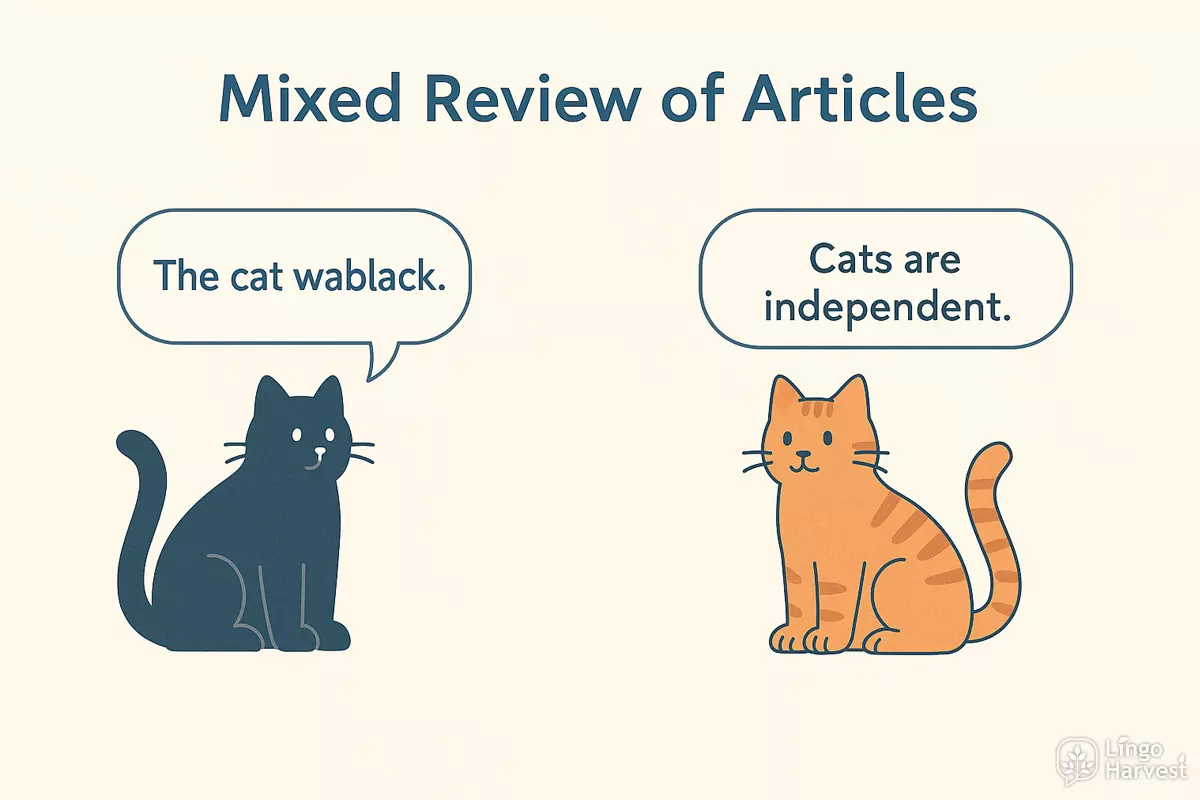
Choosing the correct article depends on context and noun type. The table below organizes common situations and the articles they require:
| Situation | Article Example | Notes |
|---|---|---|
| First mention of a countable singular noun | a/an | “I saw a cat.” |
| Specific or previously mentioned noun | the | “The cat was black.” |
| Generic plural or uncountable noun | (zero article) | “Cats are independent.” / “Water is essential.” |
| Names of unique objects/places | the | “The sun rises in the east.” |
| Meals, languages, most countries | (zero article) | “She speaks French.” / “We had lunch.” |
| Jobs or professions (singular) | a/an | “He is a doctor.” |
Common mistakes and tricky cases
- Uncountable nouns: Do not use a/an (“Advice is helpful,” not “an advice”).
- Geographical names: Use the with rivers, oceans, and some regions (“the Amazon,” “the Netherlands”), but not with most countries or cities (“Italy,” “Paris”).
- Superlatives: Always use the (“the best solution”).
- Unique things: Use the (“the internet,” “the moon”).
- Abstract nouns: Usually zero article unless specified (“Happiness is important”).
Quick practice: Choose the correct article
- ___ university in my city is famous for science.
- I’d like ___ apple, please.
- ___ Nile is the longest river in Africa.
- ___ honesty is a valuable trait.
- She became ___ engineer after graduation.
- ___ information you gave me was very helpful.
- He adopted ___ puppy from the shelter.
- ___ Mount Everest attracts climbers from around the world.
- Can you turn off ___ lights, please?
- She wants to be ___ artist one day.
Show answers
- The university
- An apple
- The Nile
- (Zero article) Honesty
- An engineer
- The information
- A puppy
- (Zero article) Mount Everest
- the lights
- An artist
Patterns to remember
- Use the for something unique or already mentioned.
- Use a/an for something new or non-specific.
- Skip the article with most plural or uncountable nouns when speaking generally.
- Don’t use an article with most names of people, cities, or countries.
Mastering article usage requires attention to context and practice. Review these patterns regularly and check your writing for article errors to communicate more precisely in both formal and informal English.
Tasks combining academic and everyday contexts
Blending formal, scholarly English with practical language use helps learners master articles in diverse situations. Realistic tasks often require switching between textbook rules and natural conversation, so it's important to practice both registers side by side. Below, you'll find activities that encourage this flexibility, including sentence transformation, gap-filling, and error correction. These exercises are designed to reflect how articles function in both academic writing and daily communication.
Practice: Choosing the Correct Article
Decide whether to use a, an, the, or leave the space blank. Consider if the context is formal (academic) or informal (everyday).
- _____ university in my city is famous for its research.
- I need to buy _____ umbrella. It's raining.
- She read _____ interesting article about climate change.
- _____ dogs are loyal animals.
- In _____ introduction, the author defines key terms.
- They moved to _____ small village near the coast.
- He is writing _____ paper on bilingual education.
- _____ information we received was incomplete.
- Students often struggle in _____ first year at university.
- She hopes to work for _____ international organization in the future.
Show answers
- 1. The university
- 2. an umbrella
- 3. an interesting article
- 4. (no article) Dogs are loyal animals.
- 5. the introduction
- 6. a small village
- 7. a paper
- 8. the information
- 9. the first year
- 10. an international organization
Transforming Sentences: Formal vs. Informal Contexts
Change each sentence from academic to everyday English, and vice versa. Focus on article use.
- Academic: The hypothesis was tested in the laboratory.
Everyday: _________________________________ - Everyday: I saw a movie yesterday.
Academic: _________________________________ - Academic: The results indicate a significant difference.
Everyday: _________________________________ - Everyday: She bought an apple at the store.
Academic: _________________________________ - Academic: The data were collected over a three-month period.
Everyday: _________________________________ - Everyday: He talked about the problem with his friend.
Academic: _________________________________ - Academic: The participants completed a short questionnaire.
Everyday: _________________________________ - Everyday: They started the project last week.
Academic: _________________________________ - Academic: The study focuses on the behavior of children.
Everyday: _________________________________ - Everyday: We found a solution to the issue.
Academic: _________________________________
Show answers
- 1. They checked the idea in a lab.
- 2. A film was viewed yesterday.
- 3. The results show there’s a big difference.
- 4. An apple was purchased at the store.
- 5. The information was gathered over three months.
- 6. He discussed the problem with a friend.
- 7. The people in the study filled in a short form.
- 8. The project was initiated last week.
- 9. The study looks at how children behave.
- 10. A solution to the problem was identified.
Common Article Patterns: Academic vs. Everyday Usage
Some words take different articles depending on context. Here’s a comparison of typical patterns:
| Phrase (Everyday) | Phrase (Academic) |
|---|---|
| go to the store | visit the facility |
| read a book | analyze the text |
| have a meeting | attend the conference |
| find a solution | identify the solution |
| take a break | pause the experiment |
| get an idea | formulate the hypothesis |
| write a letter | compose the report |
| make a plan | develop the strategy |
| ask a question | pose the question |
| do a test | conduct the experiment |
Error Correction: Context Matters
Find and correct the article mistakes. Think about whether the context is academic or everyday.
- She submitted a report to professor.
- He went to university after lunch.
- The knowledge is important for the students.
- I need a information about this topic.
- She wants to be engineer in future.
- Library is closed on Sunday.
- We discussed problem in class.
- They live in small village near sea.
- A happiness is important in life.
- I bought a furniture for the my new apartment.
Show answers
- She submitted a report to the professor.
- He went to the university after lunch.
- Knowledge is important for students. (Remove both articles.)
- I need information about this topic. (No article with uncountable nouns.)
- She wants to be an engineer in the future.
- The library is closed on Sundays.
- We discussed the problem in class.
- They live in a small village near the sea.
- Happiness is important in life. (No article with abstract nouns.)
- I bought furniture for my new apartment. (No article with “furniture”; remove “the”.)
By working with both formal and informal situations, learners develop a flexible understanding of how articles operate in English. This approach not only prepares you for academic writing but also boosts your confidence in everyday conversations.
Error correction, gap-fill, and transformation items
Mastery of articles in both academic and everyday English often relies on targeted practice with error correction, fill-in-the-blank, and sentence transformation exercises. These types of tasks help learners internalize rules and develop intuition for when to use a, an, the, or no article at all. By engaging with these formats, students can address common mistakes and reinforce correct patterns.
Common Error Types with Articles
- Missing articles before singular countable nouns (He bought a book).
- Unnecessary use of articles with uncountable nouns (She has the information ❌).
- Confusing definite and indefinite articles (I saw the man yesterday vs I saw a man yesterday).
- Incorrect omission in fixed expressions (at the university).
- Errors with geographical names (The Amazon, the United Kingdom).
Gap-Fill Practice (Sample Sentences)
Gap-fill items are a practical way to test understanding. Here are sample sentences where the correct article must be supplied:
- ___ apple a day keeps the doctor away.
- She is ___ expert in quantum physics.
- They visited ___ Louvre in Paris.
- ___ water in this glass is cold.
- He became ___ president last year.
- We saw ___ interesting movie last night.
- ___ Mount Everest is the highest mountain.
- She went to ___ university in London.
- ___ information you gave was helpful.
- There is ___ cat on the roof.
Show answers
- An apple a day keeps the doctor away.
- She is an expert in quantum physics.
- They visited the Louvre in Paris.
- The water in this glass is cold.
- He became _ president last year. (No article with titles used as roles.)
- We saw an interesting movie last night.
- _ Mount Everest is the highest mountain. (No article with most mountain names.)
- She went to _ university in London. (No article when referring to purpose — studying.)
- The information you gave was helpful.
- There is a cat on the roof.
Transformation Examples
Transformation items require rephrasing a sentence to test article usage in different contexts. This encourages flexible thinking and deeper understanding.
- Change from singular to plural: She bought a book. → She bought books.
- Make general statements: A tiger is a dangerous animal. → Tigers are dangerous animals.
- Specify known information: She saw a dog in the yard. → She saw the dog in the yard.
- Omit articles with proper nouns: The London is a big city. → London is a big city.
Article Use Patterns: Academic vs. Everyday English
Differences sometimes emerge between formal and informal usage, especially with generic references or institutional nouns. The following table illustrates typical patterns:
| Context | Example | Article Rule |
|---|---|---|
| Academic writing (generalization) | Knowledge is essential. | No article with uncountable nouns for general ideas |
| Everyday speech (specific) | Pass me the salt. | Definite article for shared context |
| Institutional nouns | She is at university. | No article for certain institutions (BrE) |
| Unique objects | The sun is shining. | Definite article with unique entities |
Timed practice to test automatic control
Effective mastery of English articles requires quick, nearly instinctive choices between "a," "an," "the," or zero article. Structured, time-limited drills can help solidify this skill, especially for academic and everyday contexts. The following exercises are designed to simulate real-world speed and pressure, so set a timer for each one and focus on making your decisions swiftly.
Rapid-fire article insertion
Fill in each blank with the correct article ("a," "an," "the," or leave blank). Try to complete the list in under 60 seconds:
- ______ university in my city is very old.
- She bought ______ umbrella yesterday.
- ______ apples on the table are fresh.
- He doesn't have ______ car.
- ______ information you gave was useful.
- We saw ______ interesting film last night.
- ______ sun rises in the east.
- I read ______ article in Nature magazine.
- ______ children love playing outside.
- She is ______ honest person.
- ______ water in this bottle is cold.
- He wants to become ______ engineer.
- ______ history of this place is fascinating.
- There is ______ dog in the yard.
- ______ milk is in the fridge.
- ______ students passed the exam.
- ______ European country has strict laws.
- She has ______ unique perspective.
- ______ books on the shelf belong to me.
- ______ air is fresh today.
Show answers
- The university in my city is very old.
- an umbrella yesterday.
- The apples on the table are fresh.
- a car.
- The information you gave was useful.
- an interesting film last night.
- The sun rises in the east.
- an article in Nature magazine.
- — Children love playing outside. (zero article)
- an honest person.
- The water in this bottle is cold.
- an engineer.
- The history of this place is fascinating.
- a dog in the yard.
- The milk is in the fridge.
- The students passed the exam.
- A European country has strict laws.
- a unique perspective.
- The books on the shelf belong to me.
- The air is fresh today.
Spot the error
Identify and correct the article mistakes in each sentence. Aim for 2 minutes total:
- She is a best student in the class.
- I have the homework to do tonight.
- Can you pass me an salt, please?
- They visited an United States last summer.
- The lions are dangerous animals.
- She plays a piano very well.
- He wants to be the doctor in the future.
- I read a news about the election.
- She gave me an advice yesterday.
- Children need the love and attention.
Show answers
- She is the best student in the class.
- I have homework to do tonight. (no article)
- Can you pass me the salt, please?
- They visited the United States last summer.
- Lions are dangerous animals. (no article with plural generic)
- She plays the piano very well. (the + instrument for general ability)
- He wants to be a doctor in the future. (no “the” with professions)
- I read the news about the election. (“news” is uncountable; “the” for specific news)
- She gave me advice yesterday. (no article with “advice”)
- Children need love and attention. (no article with abstract uncountable nouns)
Academic vs. everyday article use
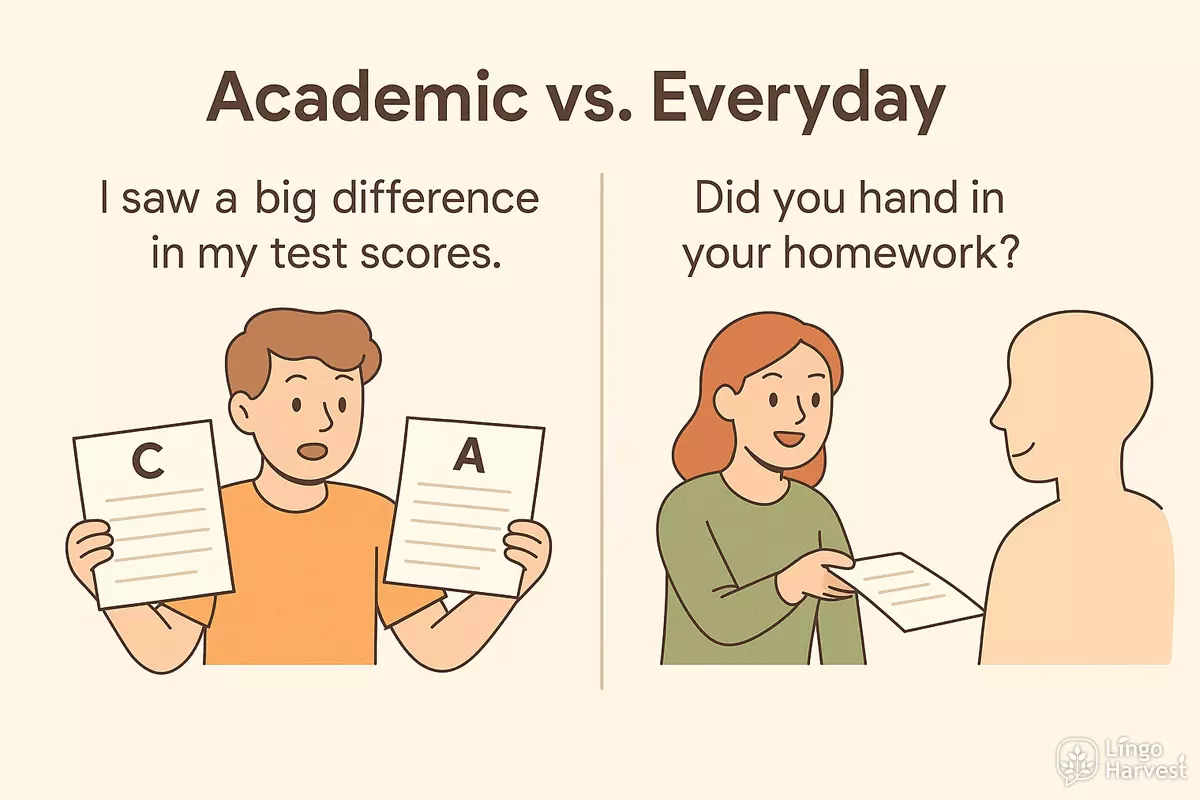
Compare how articles appear in different contexts. Observe distinctions between formal and informal usage:
| Academic English | Everyday English |
|---|---|
| The results indicate a significant difference. | I saw a big difference in my test scores. |
| Students must submit the assignment by Monday. | Did you hand in your homework? |
| Research shows an increase in the number of cases. | There's a lot more cases these days. |
| The experiment was conducted in a controlled environment. | We did the experiment in class. |
| A hypothesis was formulated before the study. | I guessed what would happen before we started. |
Timed drills can help make article choices more automatic, especially when you practice with both academic phrases and everyday expressions. Regular, focused practice improves both speed and accuracy, building confidence for exams, writing, and conversation.
Answer key with brief comments
Here you’ll find the correct responses for the "Final Master Test: Articles in Academic and Everyday English," along with brief explanations to clarify each choice. This should help you review not just what the right answer is, but also why it fits best in context—especially useful for those refining their grasp of article usage in both scholarly and casual settings.
Common Patterns and Explanations
- Zero article is used before plural or uncountable nouns when speaking generally (e.g., "Research shows…", "Students need feedback.").
- 'The' is needed for specific references, especially when both the writer and reader know which item is meant (e.g., "the data presented in Table 1").
- 'A/an' introduces something new or nonspecific (e.g., "A hypothesis was proposed.").
- Academic English often omits articles with abstract, general concepts (e.g., "Education is important.").
- Everyday English frequently uses 'the' for shared knowledge ("I went to the store.").
Typical Test Items with Comments
- She is a researcher at the university.
'A' is used for professions when first mentioned; 'the' specifies a known institution. - ___ Water boils at 100°C.
No article – general scientific fact. - He read the article you recommended.
'The' refers to a specific, previously mentioned article. - ___ Students often struggle with deadlines.
No article – talking about students in general. - They found a solution to the problem.
'A' for one of many possible solutions; 'the' for a specific, known problem. - ___ Honesty is a virtue.
No article for uncountable noun 'honesty'; 'a' for one of many virtues. - She gave an excellent presentation.
'An' used before vowel sound; new information. - I need to buy ___ bread.
No article – 'bread' is uncountable and general. - He is the manager of the team.
Both refer to specific, unique roles/groups. - ___ Literature can shape the way we think.
No article for literature in general; 'the' for a specific way.
Comparison of Article Usage in Academic vs. Everyday English
| Academic English | Everyday English |
|---|---|
| Zero article for general concepts ("Knowledge is power.") | 'The' for shared experience ("Let’s go to the park.") |
| 'The' for specific data/figures ("See the results in Table 2.") | 'A/an' for introducing new objects ("I saw a dog.") |
| Omission with abstract nouns ("Justice must be served.") | 'The' for unique items ("Turn off the light.") |
| 'A/an' for one among many ("A study suggests...") | Frequent use of 'the' for known items ("Where is the remote?") |
Keep in mind these patterns as you review your test. Mastery of article use comes from understanding both the rules and the exceptions, especially as context shifts between academic writing and conversational English.
How to continue improving article use after the test
Mastering English articles is a long-term process that extends beyond any individual test. To build lasting confidence, it's important to integrate focused practice into your daily routine and academic work. This section offers practical strategies, resources, and activities designed to help you refine your use of a, an, and the in both academic and everyday contexts.
Read and Notice Patterns
Reading widely helps you internalize how articles function in different genres. Pay special attention to how native writers use articles in:
- Academic journals
- News articles
- Popular science magazines
- Fiction and non-fiction books
- Blogs and opinion pieces
As you read, highlight or note sentences where article use seems unusual or particularly clear. This can reveal patterns you might not notice otherwise.
Practice with Structured Exercises
Targeted exercises help reinforce correct usage. Try filling in the blanks, rewriting sentences, or correcting errors in short texts. Here’s a quick practice task:
- ___ university near my house is famous for its library.
- She bought ___ umbrella and ___ apple from the store.
- ___ water in this bottle is cold.
- I saw ___ interesting movie yesterday.
- ___ sun rises in the east.
- He wants to become ___ engineer in the future.
- They live in ___ small village near ___ sea.
- ___ information you sent was very helpful.
- She adopted ___ dog and ___ cat last month.
- ___ Mount Everest attracts climbers from all over the world.
Show answers
- The university near my house is famous for its library.
- an umbrella and an apple
- The water in this bottle is cold.
- an interesting movie
- The sun rises in the east.
- He wants to become an engineer in the future.
- They live in a small village near the sea.
- The information you sent was very helpful.
- She adopted a dog and a cat last month.
- _ Mount Everest attracts climbers from all over the world. (No article with most mountains.)
Compare Common Article Patterns
Understanding frequent article combinations and exceptions is key to fluency. The table below summarizes common patterns and typical uses:
| Pattern | Example |
|---|---|
| Definite article + unique noun | the moon, the president |
| Indefinite article + singular countable noun | a book, an idea |
| No article + plural or uncountable noun (general meaning) | Books are useful. Water is essential. |
| Definite article + superlative | the best day, the most important point |
| Zero article with most proper nouns | John, London, Russia |
| Definite article + geographical features | the Nile, the Alps |
Integrate Articles into Your Writing
After practicing in isolation, apply your knowledge to real writing. When drafting essays, emails, or reports, consciously check your use of articles. Try these strategies:
- Review sentences for missing or unnecessary articles.
- Read your text aloud; awkwardness often signals a problem with article choice.
- Ask a peer or teacher to highlight article errors.
- Keep a personal checklist of article rules that often trip you up.
Expand Your Awareness with Speaking Practice
Articles can be especially tricky in spontaneous speech. To build fluency:
- Describe pictures or tell short stories out loud, focusing on article accuracy.
- Record yourself and listen for errors.
- Practice with a language partner who can give feedback.
Useful Tips for Ongoing Improvement
- Notice exceptions and idiomatic expressions (e.g., “in the morning,” “at work”).
- Make flashcards for tricky noun phrases.
- Set aside a few minutes each week for focused article review.
- Reflect on feedback from teachers or editors.
- Don’t be discouraged by mistakes—use them as learning opportunities.
Consistent, mindful practice will gradually make article use more natural and automatic in all types of English writing and speaking.