Articles for Beginners: a, an, the Explained Simply

 Here we how to use a, an, and the in English, explains the sound rule, when to use or omit articles for general ideas, points out common beginner mistakes, and provides practice exercises with explanations.
Learning the basics of English grammar can be challenging, particularly when it comes to using small words such as a, an, and the. These words, known as articles, are essential for clear communication and are used in almost every sentence. Understanding when and how to use them correctly is an important step for beginners. This guide simplifies the rules and provides practical tips to help new learners use these articles with greater confidence and accuracy in everyday English.
What Articles Do in English
English articles—like a, an, and the—help make sentences clear by showing whether we’re talking about something specific or something more general. These little words come before nouns, and their job is to let the listener or reader know which thing we mean.
Why Use Articles?
Articles add important information about nouns. They tell us if we’re talking about one particular thing or any example of that thing. For example, saying “a cat” means any cat, while “the cat” points to a specific one, maybe one we already mentioned.
Main Purposes of Articles
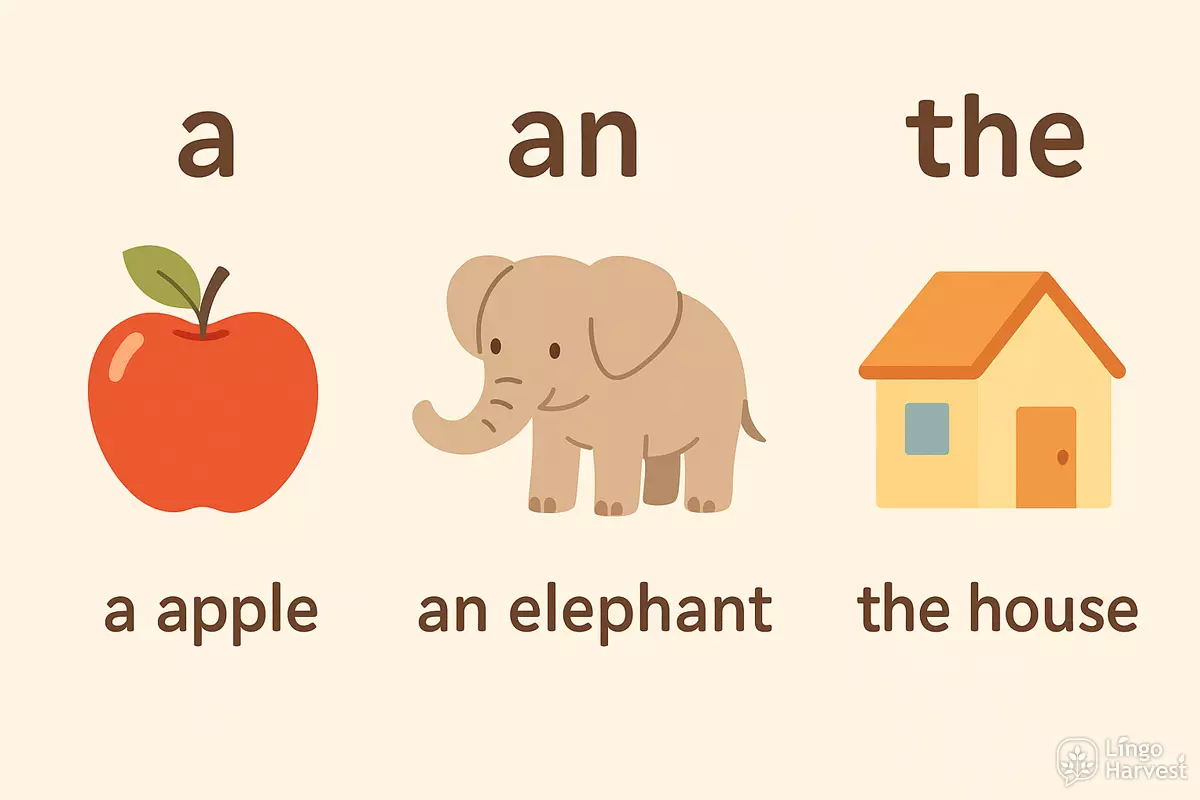
- Introduce new things: Use a or an when talking about something for the first time.
- Refer to something known: Use the when it’s clear which thing you mean or when you’ve already talked about it.
- Show general ideas: Sometimes, no article is needed at all, especially when speaking about things in general or in plural.
- Clarify meaning: Articles help listeners or readers understand exactly what you are talking about.
Examples in Context
- I saw a dog in the park. (any dog, not specific)
- The dog was chasing a ball. (a specific dog, maybe already mentioned)
- She wants an apple. (any apple, not a particular one)
- The apples are on the table. (specific apples, likely known to speaker and listener)
- Books are important. (in general, no article)
- The books on the shelf are new. (specific books)
- He became a doctor. (any doctor, not one in particular)
- Where is the nearest bank? (the one closest to us)
- She bought a car. (any car)
- The car is blue. (the specific car she bought)
Summary Table: How Articles Change Meaning
| Form | What It Means | Example |
|---|---|---|
| a / an | Any one thing, not specific | a dog, an apple |
| the | One specific thing, already known | the dog, the apple |
| No article | General ideas, plurals, or uncountable nouns | Dogs are friendly. Water is essential. |
In short, articles help us communicate clearly. They make it easier to know exactly what someone means, whether they’re talking about something new, something known, or something in general.
When to Use a/an (first mention + sound rule)
Understanding how to use "a" and "an" correctly is all about the sound that begins the following word, not just the spelling. These indefinite articles are used when mentioning something for the first time or when talking about a nonspecific item. This is one of the most basic, but also most easily confused, points in English grammar for beginners.
First Mention: Introducing Something New
Use "a" or "an" when you speak about something for the first time, before your listener knows which one you mean. For example:
- I saw a cat in the garden. (This is the first time you mention the cat.)
- She wants to buy an umbrella. (The umbrella is new information.)
Sound Rule: Vowel or Consonant?
The choice between "a" and "an" depends on the sound at the start of the next word:
- Use a before words that begin with a consonant sound: a book, a university (here, 'university' starts with a 'y' sound).
- Use an before words that begin with a vowel sound: an apple, an hour (silent 'h', so it sounds like 'our').
Common Examples: "a" vs. "an"
Here are some typical cases to help clarify:
- a dog
- a house
- a one-way street (the "o" sounds like "w")
- a European city (the "E" sounds like "y")
- an orange
- an honest person (the "h" is silent)
- an egg
- an hour
- an umbrella
- an MP3 player (the "M" is pronounced "em")
- a uniform (the "u" sounds like "y")
- an FBI agent (the "F" is pronounced "ef")
Quick Reference Table: Choosing "a" or "an"
| Word | Correct Article |
|---|---|
| apple | an apple |
| car | a car |
| hour | an hour |
| university | a university |
| honest mistake | an honest mistake |
| European trip | a European trip |
| umbrella | an umbrella |
| one-time offer | a one-time offer |
Remember, the key is to listen for the first sound of the next word, not just look at the first letter. This approach helps you avoid common mistakes and sound more natural in everyday English.
When to Use the (specific things)
Understanding the right time to use “the” in English can make your sentences clearer and more precise. “The” is known as the definite article, and it points to a specific noun that is already known to the listener or reader. Let’s break down the situations where this article is necessary.
1. When the Listener Knows What You Mean
Use “the” when you’re talking about something both you and your audience are already aware of. This could be something previously mentioned or something obvious in the context.
- The book on the table is mine. (Both know which book.)
- Can you close the door? (The specific door in the room.)
2. Unique or One-of-a-Kind Things
Apply “the” for things that are unique or there’s only one of them in the world or situation.
- The sun rises in the east.
- The president will speak tonight.
- The internet is slow today.
3. Superlatives and Ordinals
Superlatives (the best, the oldest) and ordinal numbers (the first, the second) always use “the.”
- The tallest building
- The first time I met her
- The most delicious cake
4. With Specific Groups or Classes
When referring to an entire group or class in a general sense, “the” is used.
- The rich should help the poor.
- The elderly often need assistance.
5. With Certain Places and Geographical Names
Some locations require “the,” especially when the name includes words like “republic,” “kingdom,” “states,” or is a plural place.
- The United States
- The Netherlands
- The Alps
- The Pacific Ocean
6. With Things Mentioned Earlier
Use “the” when you mention something for the second time, or after introducing it with “a/an.”
- I saw a dog. The dog was friendly.
- She bought a dress. The dress is blue.
Summary Table: “The” vs. “A/An”
| Use “the” | Use “a” or “an” |
|---|---|
| When the noun is specific or already known | When the noun is not specific or mentioned for the first time |
| With unique things (the sun, the moon) | With any one of a group (a dog, an apple) |
| With superlatives and ordinals (the best, the first) | With jobs or roles (a teacher, an engineer) |
| With certain places (the UK, the Amazon) | When it doesn’t matter which one (a car, an idea) |
Knowing when to use “the” takes practice, but focusing on whether your listener knows exactly which thing you mean is a helpful guide. Pay attention to context, uniqueness, and whether it’s the first or second mention, and you’ll get it right more often.
Zero Article for General Ideas
When talking about things in a general sense, English often skips using "a," "an," or "the." This is called the zero article. It’s common with uncountable nouns and plural countable nouns when you mean them in general, not as a specific example.
When Do We Use No Article?

No article is needed with broad, abstract ideas, topics, or groups. For instance, when discussing concepts like "happiness" or "technology," or when referring to entire categories such as "dogs" or "students," the zero article is used. This helps clarify that you’re not talking about one specific item, but about the whole group or idea.
- People need water to survive. (all water in general, not a specific glass)
- Music can be very soothing. (talking about music as a concept)
- Children love playing outside. (all children in general)
- Information is important. (all information, not just some)
- Books are expensive nowadays. (books in general)
- Coffee keeps me awake. (the drink in general)
- Love is universal. (the idea or feeling, not a specific instance)
- Teachers work hard. (the whole group, not certain individuals)
- Technology changes quickly. (as a broad idea)
- Cars are getting more efficient. (all cars, not specific ones)
- Patience is a virtue. (the quality, not a specific example)
- Dogs are loyal animals. (dogs as a species)
- Time passes quickly. (time in general)
- Ideas can change the world. (any ideas, not particular ones)
- Air pollution is a problem. (all air in general)
Zero Article vs. Definite & Indefinite Articles
| No Article (Zero) | With Article | Meaning |
|---|---|---|
| Books are useful. | The books are useful. | All books in general → Only certain books |
| Children need sleep. | The children need sleep. | All children → A specific group of children |
| Coffee is popular. | A coffee is on the table. | The drink in general → One cup of coffee |
| Patience is important. | The patience you showed was amazing. | The quality in general → Specific instance of patience |
In summary, skipping the article helps express ideas, things, or groups as a whole, not as individual or specific items. This is a simple but powerful way to make your English sound more natural when discussing general topics.
Common Beginner Mistakes
Many learners find English articles confusing at first, especially because their use can feel unpredictable. The most frequent slip-ups come from translating directly from a first language or applying rules inconsistently. Below are some typical problems to watch out for, along with clear examples and explanations.
Mixing Up "a" and "an"
Choosing between "a" and "an" is all about the sound that follows, not just the first letter. Beginners often pick the wrong form when the next word starts with a silent letter or a vowel sound.
- a university (the "u" sounds like "you")
- an hour (the "h" is silent, so it starts with a vowel sound)
- a European country (again, "Eu" sounds like "you")
- an apple (begins with a vowel sound)
Omitting Articles Entirely
Some languages don’t use articles, so learners may leave them out in English. This often makes sentences sound unnatural or confusing.
- Incorrect: I bought car.
- Correct: I bought a car.
- Incorrect: She is teacher.
- Correct: She is a teacher.
Using "the" When It’s Not Needed
Beginners often add "the" before general nouns or proper names, even though it’s only for specific things.
- Incorrect: The Mount Everest is high.
- Correct: Mount Everest is high.
- Incorrect: The dogs are friendly animals. (when talking about dogs in general)
- Correct: Dogs are friendly animals.
Confusing Specific and General Meaning
It’s easy to mix up when to use no article, "a/an," or "the." The difference can change the whole meaning.
| Sentence | Meaning |
|---|---|
| I saw a cat. | Any single cat; not specific. |
| I saw the cat. | A particular cat, known to both speaker and listener. |
| Cats are playful. | All cats in general. |
| The cats are playful. | Specific group of cats, probably already mentioned. |
Overusing Articles With Plurals and Uncountables
Articles are not always needed with plural or uncountable nouns when speaking generally. Here are some examples of what to avoid:
- Incorrect: The water is important for life. (when you mean water in general)
- Correct: Water is important for life.
- Incorrect: The books are useful. (if talking about books in general)
- Correct: Books are useful.
Quick Review: Frequent Article Errors
- Using "the" with most country names: the France ❌ → France ✅
- Forgetting "a/an" with professions: She is doctor ❌ → She is a doctor ✅
- Adding "the" before meals: I ate the breakfast ❌ → I ate breakfast ✅
- Using "a/an" with uncountable nouns: a milk ❌ → milk ✅
- Placing "the" before names: the John ❌ → John ✅
- Omitting "the" with unique things: Earth goes around Sun ❌ → The Earth goes around the Sun ✅
- Using "an" before words starting with a consonant sound: an university ❌ → a university ✅
Carefully noticing these patterns and exceptions will help you avoid the most common pitfalls and make your English sound more natural.
Practice: Fill In and Explain Choice
To get comfortable with using "a," "an," and "the," try filling in the blanks in these sentences. After each one, think about why your choice is correct. This helps you understand the basic logic behind article use in English.
Fill in the Article
Read each sentence and decide which article fits best. Consider whether the noun is specific, general, or being mentioned for the first time.
- I saw ____ elephant at the zoo.
- Can you pass me ____ salt, please?
- She wants to buy ____ umbrella.
- ____ book on the table is mine.
- We visited ____ museum in the city.
- He is ____ honest man.
- ____ sun rises in the east.
- They adopted ____ dog from the shelter.
- ____ apple a day keeps the doctor away.
- Is there ____ university in this town?
- ____ Nile is a long river.
- She found ____ euro on the street.
- ____ cars outside belong to my neighbors.
- He wants to become ____ engineer.
- ____ internet is a powerful tool.
- I need ____ hour to finish this.
- ____ chair you are sitting on is broken.
- We saw ____ eagle flying above.
- ____ Amazon rainforest is huge.
- She has ____ idea for the project.
Show answers
- an elephant (first mention, starts with a vowel sound)
- the salt (specific, known to both speaker and listener)
- an umbrella (first mention, starts with a vowel sound)
- the book (specific, identified by location)
- a museum (not specified which one, first mention)
- an honest man (starts with a silent "h", vowel sound)
- the sun (unique, only one)
- a dog (not specific, first mention)
- an apple (starts with a vowel sound)
- a university (starts with a "ju:" sound, consonant sound)
- the Nile (unique, only one Nile river)
- a euro (starts with "j" sound, consonant sound)
- the cars (specific, already known or identified)
- an engineer (starts with a vowel sound)
- the internet (unique, only one internet)
- an hour (silent "h", vowel sound)
- the chair (specific, identified by location)
- an eagle (vowel sound at the start)
- the Amazon rainforest (unique, specific place)
- an idea (vowel sound at the start)
Explain Your Choice
Now, choose any 3 sentences from above and briefly explain why you picked that article. Think about whether the noun is something new, already known, unique, or described by its sound.
- Example: "an apple" – "Apple" starts with a vowel sound, and the apple is not specific, so we use "an."
- Try explaining your own choices for three different sentences.
Show answers
- "the sun" – There is only one sun, so we use "the" for something unique.
- "a museum" – It's not a specific museum, and it's the first mention, so "a" is used.
- "an hour" – "Hour" starts with a silent "h," making a vowel sound, so we use "an."
Common Patterns for Choosing Articles
Here are some typical cues that help you decide which article to use. Review these patterns and refer back to them as you practice:
- Use "a" before words beginning with a consonant sound: a cat, a house, a university (sounds like "ju:").
- Use "an" before words beginning with a vowel sound: an apple, an hour, an honest person.
- Use "the" when referring to something specific or unique: the moon, the first time, the car we bought.
- No article is used with most plural or uncountable nouns when talking about things in general: Books are useful. Sugar is sweet.