Zero Article: When We Use No Article at All

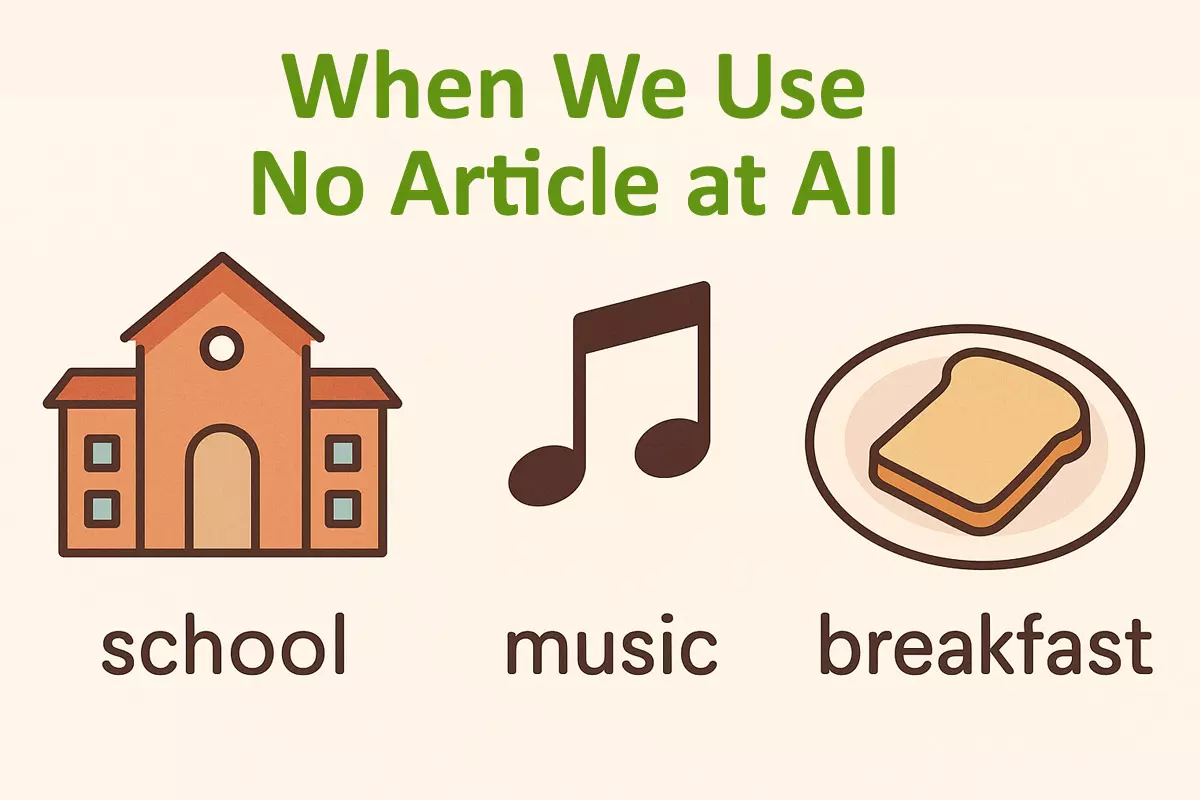 This article explains when to omit articles in English, such as with general statements, meals, sports, languages, places, transport, and set phrases. It also highlights common errors and offers exercises for practice.
Have you ever noticed how we sometimes skip using a, an, or the before certain words in English? Knowing when to omit these small words, known as articles, is a subtle skill that can significantly improve the flow and naturalness of both your writing and speech. For example, we often leave them out before proper nouns, uncountable nouns in a general sense, or when speaking in headlines and bullet points. Mastering the use and omission of articles takes practice, but paying attention to how native speakers use them can help you develop a more authentic and fluent style.
General Statements and Plurals
When we talk about things in a broad, general sense, English often omits the article entirely. This is especially common with plural nouns and uncountable nouns. Using no article helps express ideas that apply to all members of a group, not just specific examples. For instance, when speaking about categories, habits, or truths that are universally accepted, the zero article is standard.
Plural Nouns Without Articles
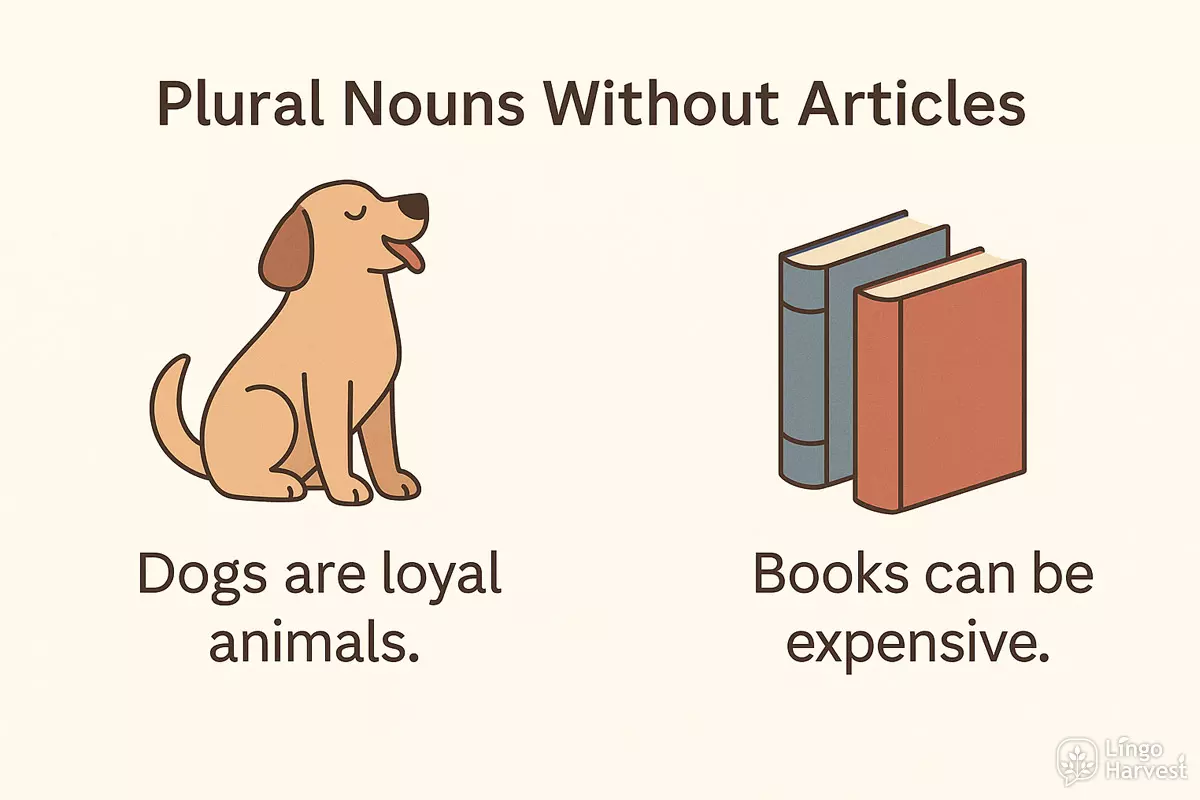
Plural countable nouns frequently appear without any article when referring to a whole class or category. This construction allows us to make statements about all items in that group, rather than a particular subset. Here are some common patterns:
- Dogs are loyal animals. ✅
- Books can be expensive. ✅
- Cars pollute the air. ✅
- Computers make life easier. ✅
- Children need guidance. ✅
- Teachers help students learn. ✅
- Apples are good for you. ✅
- Ideas change the world. ✅
- Friends support each other. ✅
- Mountains attract hikers. ✅
- Trains run on tracks. ✅
- Questions lead to answers. ✅
- Doctors save lives. ✅
- Houses provide shelter. ✅
- Languages evolve over time. ✅
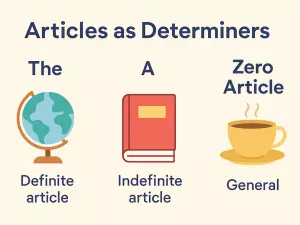
Comparing: Zero Article vs. Definite/Indefinite Articles
Choosing whether to use an article or not changes the meaning. When you add the or a/an, you no longer refer to things in general but to something specific or a single example. Here’s a structured comparison:
| Zero Article (General) | Definite Article | Indefinite Article |
|---|---|---|
| Dogs bark. | The dogs bark (the specific dogs). | A dog barks (any one dog). |
| Books inform people. | The books inform people (certain books). | A book informs people (a single book). |
| Apples are healthy. | The apples are healthy (those apples). | An apple is healthy (one apple). |
| Trains are fast. | The trains are fast (the specific trains). | A train is fast (one train). |
Uncountable Nouns and Generalization
Uncountable nouns, such as water, information, or music, also drop the article when used in a general sense. For example:
- Information is power.
- Music soothes the soul.
- Water boils at 100°C.
- Time flies.
- Love heals.
In all these examples, the zero article signals that we are making a broad, universal claim rather than pointing to something specific.
Meals, Sports, and Languages
When talking about daily routines, hobbies, and communication, English often skips the article entirely. This is especially true for references to eating occasions, athletic activities, and methods of speaking. In these contexts, omitting “a,” “an,” or “the” is standard. Let’s take a closer look at how this works in practice.
Meals: No Article Needed
Names of mealtimes—such as breakfast, lunch, and dinner—are used without an article when speaking in general terms. For example, we say, “I have breakfast at 7 a.m.” rather than “I have a breakfast.” However, if you specify or describe the meal, an article may appear: “The breakfast we had was delicious.”
- We ate lunch together.
- She never skips dinner.
- Let’s meet after breakfast.
- He invited me to supper.
Sports: Playing Without an Article
When referring to sports in a general sense, English also drops the article. You “play football,” “watch tennis,” or “go swimming”—not “the football” or “a swimming.” The exception is when talking about a specific event or match, where an article might be needed.
- Do you play basketball?
- She goes jogging every morning.
- We watched volleyball at the beach.
- He’s good at chess.
- They enjoy hiking in the mountains.
- I learned karate as a child.
- He practices yoga daily.
- We went skiing last winter.
- She teaches gymnastics.
- They train for marathons.
Languages: Article-Free Communication
When mentioning languages, omit the article. For example, “She speaks Spanish,” not “She speaks the Spanish.” This rule applies whether discussing ability or the act of using a language. However, “the” is sometimes used for dialects or when referring to the language as a subject (“the English of Shakespeare”).
- He is learning German.
- Do you speak French?
- They understand Russian.
- We teach Chinese at school.
- She reads Japanese novels.
- He writes in Italian.
- I studied Arabic at university.
- She can translate from Portuguese.
- Many people speak Hindi.
- He listens to songs in Korean.
Quick Reference Table: When We Use No Article
| Type | Correct Usage (No Article) |
|---|---|
| Meals | Have breakfast, skip lunch, after dinner |
| Sports | Play tennis, go swimming, watch baseball |
| Languages | Speak English, learn Spanish, teach German |
| Exceptions | The dinner was formal, the French of Paris |
Remember: zero article is the norm for these categories, unless you’re specifying or describing something unique or particular.
Places and Transport
When talking about locations and ways of getting around, English often drops the article entirely. This zero article usage is especially common with certain nouns and set phrases, especially where the place or mode of transport is understood in a general sense.
Common Locations Without Articles
We usually omit "a," "an," or "the" with many public places or institutions when describing their main purpose. For example, we say "go to school," "be at home," or "arrive at work" without any article, because the focus is on the activity or function rather than a specific building.
- at school
- go to bed
- in prison
- to church
- at home
- to hospital (BrE)
- at sea
- in class
- go to university
- at work
- in town
- to college
- go to court
- in jail
- in hospital (BrE)
Remember, if you specify which one, you need an article: "the hospital on Main Street," or "a school near my house."
Transport: Getting Around Without Articles
Modes of transport also commonly appear without an article when preceded by "by." This pattern signals a general means, not a particular vehicle.
- by car
- by bus
- by train
- by plane
- by bicycle
- by taxi
- by boat
- by tram
- by subway
- by motorcycle
- by ship
But if you refer to a specific vehicle, you do use an article: "I waited for the bus," or "We took a taxi."
Comparison of Zero Article Patterns
The following table summarizes and compares typical zero article constructions for both places and means of transport:
| Zero Article Phrase | Typical Usage |
|---|---|
| go to school | Describes attending as a student |
| at home | Being in one’s own residence |
| by bus | Describes general method of travel |
| in prison | Refers to someone serving a sentence |
| by train | Means of transportation, not a specific train |
| in hospital (BrE) | Receiving medical care (not just visiting) |
Zero article usage in these contexts is driven by function and general meaning, not by the need to specify a particular location or object. This pattern helps English speakers communicate efficiently and naturally about routine activities, destinations, and ways of traveling.
Fixed Expressions and Set Phrases
Many English phrases and idioms use no article at all, following established patterns that native speakers recognize instantly. These standard forms often come up in everyday speech, instructions, and even in formal writing. Their structure is set, so adding “a,” “an,” or “the” would sound unnatural or even change the meaning.
Common Examples Without Articles
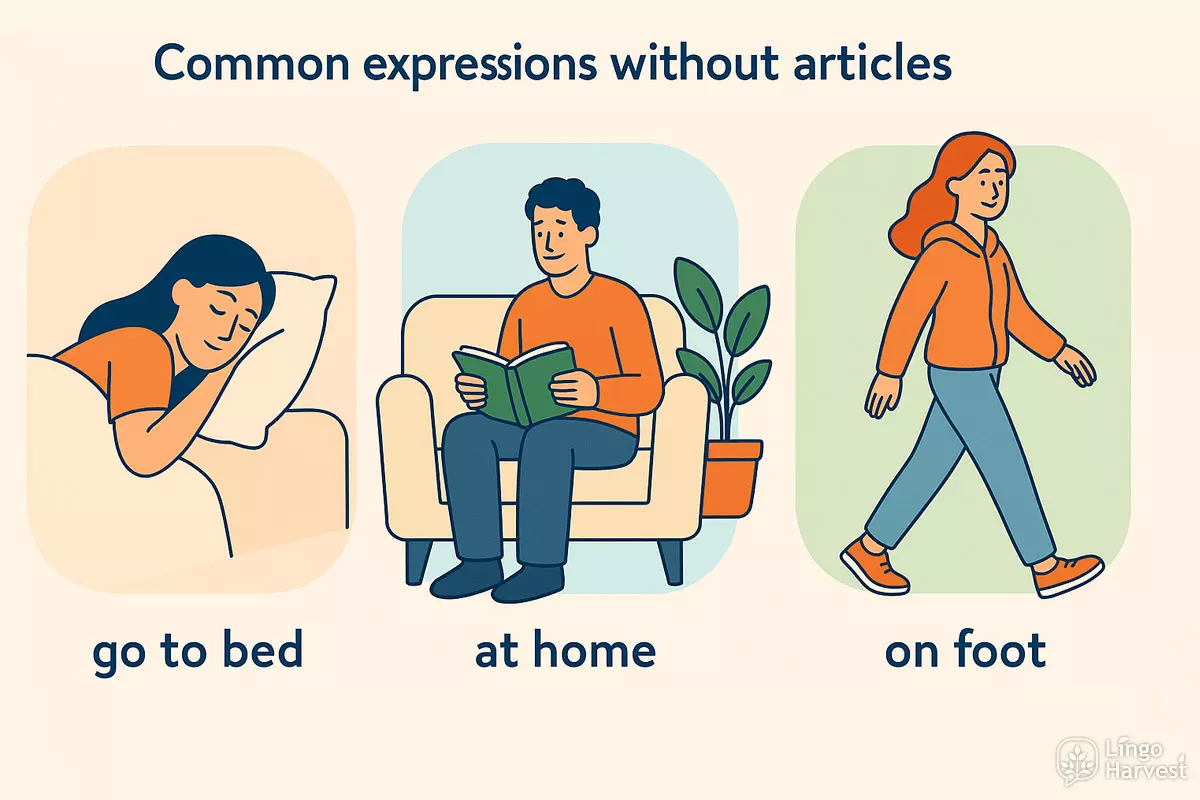
In certain expressions, omitting the article is not just possible—it’s required. These phrases are memorized as whole units, and their meaning depends on this exact wording. Here are several widely used examples:
- go to bed
- at home
- on foot
- in prison
- by car
- at school
- go to church
- go to work
- in hospital (BrE)
- by bus
- from start to finish
- at sea
- on holiday
- to go home
- after work
- in class
- leave school
- by mistake
- in trouble
- under pressure
Patterns and Typical Contexts
Zero article is especially common in time expressions (“at night”, “by day”), institutional places (“in school”, “in jail”), and some set collocations that refer to general activities or states rather than specific instances. For example, “go to bed” refers to the activity, not a particular bed.
| Expression | Typical Usage |
|---|---|
| go to bed | Describes the activity of sleeping, not a specific bed |
| at school | Refers to being engaged in school activities, not just present in the building |
| in hospital (BrE) | Means being there as a patient, not simply inside the hospital |
| on foot | Describes the means of travel, not referring to any particular foot |
| at home | Indicates being in one’s place of residence, not a specific house |
| by car | Describes the mode of transportation, not a particular car |
| on holiday | Means being away for vacation, not a specific holiday event |
| in trouble | Refers to a state or condition, not a specific problem |
Why These Phrases Matter
Learning these fixed patterns helps you sound more natural and avoids common mistakes. Trying to use an article in these situations often leads to awkward or incorrect English. Memorizing such collocations, especially those related to travel, institutions, and idiomatic time expressions, is a practical way to master article usage.
Common Errors and How to Avoid Them
Many English learners struggle with knowing when not to use any article at all. The absence of “a,” “an,” or “the” can feel strange, especially for those whose native languages always require a definite or indefinite article. Here are some frequent mistakes and advice on how to use the zero article correctly.
Typical Mistakes with the Zero Article
- Adding “the” before names of languages: Incorrect: the English is difficult. ❌ Correct: English is difficult. ✅
- Using an article with meals: Incorrect: I had the lunch at noon. ❌ Correct: I had lunch at noon. ✅
- Placing “the” before countries (unless plural or with "of"): Incorrect: She lives in the France. ❌ Correct: She lives in France. ✅
- Using an article with academic subjects: Incorrect: He studies the physics. ❌ Correct: He studies physics. ✅
- Adding “the” before professions: Incorrect: She is the doctor. ❌ Correct: She is a doctor. (but: She is doctor Smith.) ✅
- Inserting articles with uncountable nouns in general meaning: Incorrect: I like the music. ❌ Correct: I like music. ✅
- Using “the” before names of sports: Incorrect: He plays the tennis. ❌ Correct: He plays tennis. ✅
- Adding articles to continents: Incorrect: The Asia is huge. ❌ Correct: Asia is huge. ✅
- Using articles with seasons (in general): Incorrect: The summer is hot. ❌ Correct: Summer is hot. ✅
- Placing “the” before streets or parks (most cases): Incorrect: I live on the Oxford Street. ❌ Correct: I live on Oxford Street. ✅
- Using articles with “home,” “church,” “school” (when referring to their primary function): Incorrect: She is at the school. ❌ Correct: She is at school. ✅
- Adding “the” to plural countable nouns in general: Incorrect: The cars are expensive. ❌ Correct: Cars are expensive. ✅
Quick Reference: When to Omit the Article
| Typical Context | Example (Zero Article) |
|---|---|
| Languages | She speaks Spanish. |
| Meals | We have breakfast at 8. |
| Countries/Continents | They visited Africa. |
| Academic Subjects | Math is difficult. |
| Sports | He plays football. |
| General Plural Nouns | Cats are curious. |
| Uncountable Nouns (General) | Water is essential. |
| Proper Names (Most) | Mount Everest is high. |
| Institutions (Function) | Children go to school. |
| Transport (by + mode) | She goes by bus. |
Remember that context matters. When speaking generally about a group, language, or concept, skip the article. Review these patterns and compare with your native language to spot differences. Practice will help you develop a natural sense for when the zero article is needed.
Practice: Rewrite Without Articles
Let’s see how sentences change when we remove articles (a, an, the) in situations where English grammar requires the zero article. This is especially common with certain nouns, set expressions, and when speaking generally about things in plural or uncountable forms. Use these tasks to sharpen your awareness of when no article is needed.
Task 1: Edit Sentences to Use No Article
- I have the homework to finish tonight.
- We went to the school by bus.
- She drinks a coffee every morning.
- He is in the prison for robbery.
- Can you play the piano?
Rewrite each sentence, removing any unnecessary articles.
Show answers
- I have homework to finish tonight.
- We went to school by bus.
- She drinks coffee every morning.
- He is in prison for robbery.
- Can you play piano?
Common Contexts for Zero Article
Here are several cases where the zero article is standard. Try to spot the pattern:
- Meals: We had lunch at noon.
- Languages: She speaks French.
- Subjects: He studies mathematics.
- Places used for their main purpose: Children go to school.
- Most countries and cities: They live in Canada.
- Sports: He plays football.
- Abstract nouns: Love is important.
- Plural countable nouns in general: Cats are independent.
- Uncountable nouns in general: Information is valuable.
- Transport by means: She goes by train.
- Days and months: We start work Monday.
- Materials: Gold is expensive.
Task 2: Rewrite for the Zero Article
Rewrite the following phrases, omitting articles where appropriate.
- the milk
- a history
- the happiness
- an English
- the dogs (when speaking about all dogs in general)
- the water
- a breakfast
- the freedom
- the Canada
- the tennis
Show answers
- milk
- history
- happiness
- English
- dogs
- water
- breakfast
- freedom
- Canada
- tennis
Quick Reference: When to Use No Article
| Type of Noun/Context | Example with Zero Article |
|---|---|
| Meals | I had dinner. |
| Languages | She studies Chinese. |
| Subjects/Academic Fields | He likes biology. |
| General Plurals | Books are useful. |
| Uncountables (general) | Time is precious. |
| Countries/Cities (most) | They live in France. |
| Transport by "by" | We travel by car. |
| Abstract Concepts | Peace is necessary. |
| Materials | Steel is strong. |
| Sports | He plays basketball. |
| Days/Months | School starts September. |
| Institutions (purpose) | She goes to hospital (as a patient). |