the with Unique Things: the Sun, the Internet, the Police

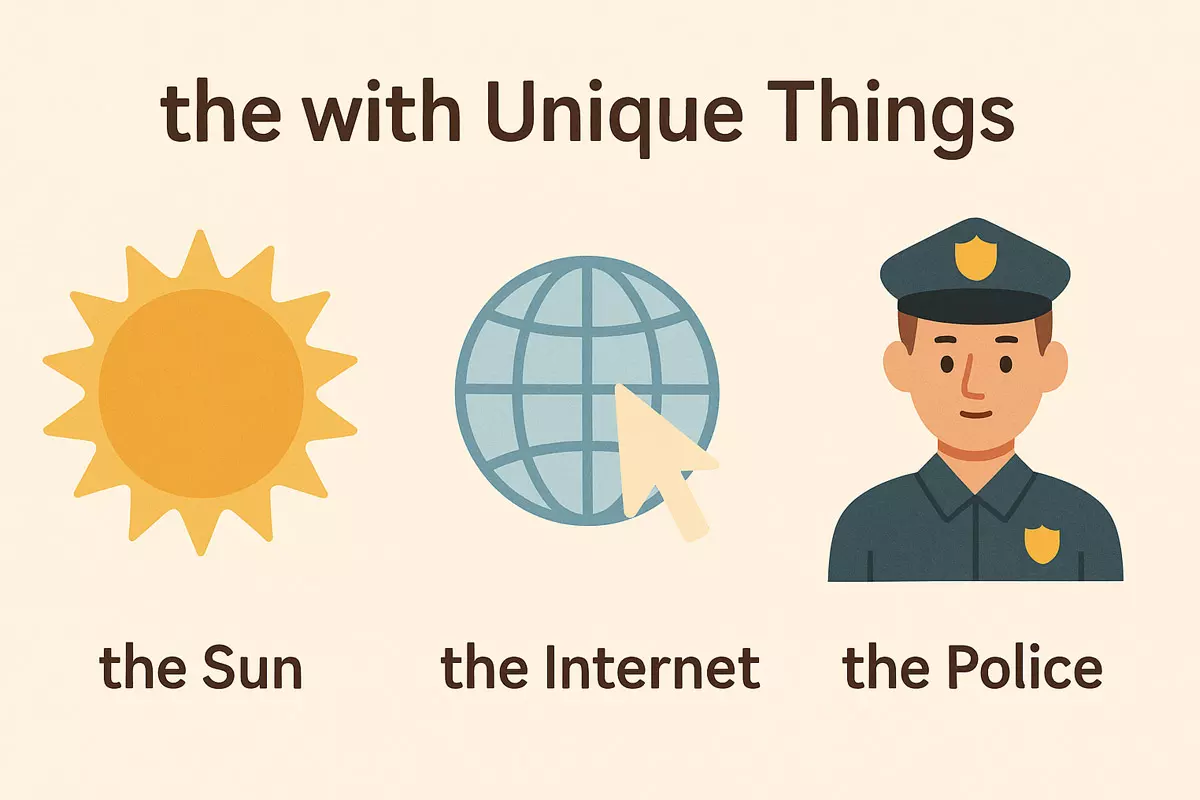 Here we when to use "the" with unique things, compares its use with natural objects and institutions, explains regional differences like Internet vs. internet, discusses people groups such as the rich, highlights common errors, and provides practice.
Certain aspects of everyday life have a profound impact on our world, often in ways that go unnoticed. The sun, as our essential source of energy, sustains life and influences our environment. Meanwhile, the vast network of information available online connects people globally, transforming how we communicate and learn. Additionally, those who maintain public order play a crucial role in ensuring safety and stability. Together, these elements highlight the intricate and dynamic nature of modern society.
What Counts as Unique or One-of-a-Kind
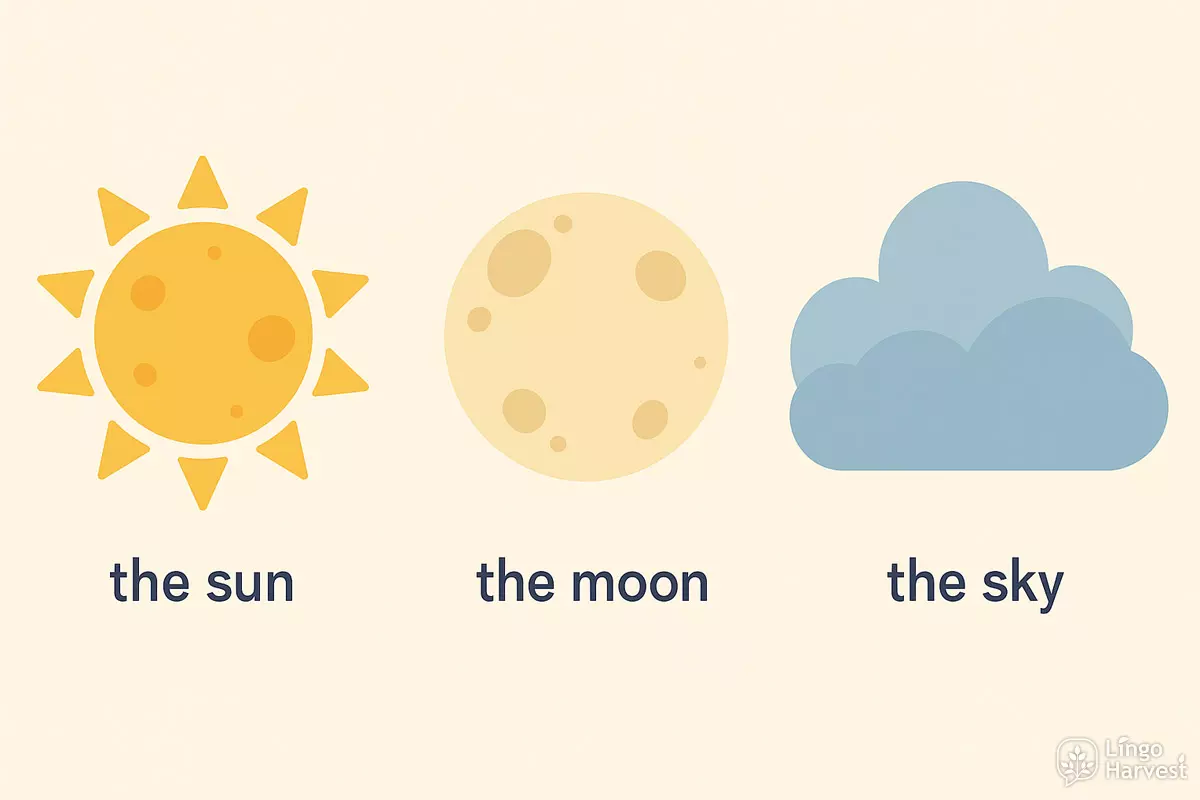
When we talk about something being truly unique, we’re describing things that have no direct equivalent or substitute. These are entities, objects, or concepts that stand alone due to their singular nature, function, or existence. For example, the Sun is considered unique for our solar system—it is the only star providing light and warmth to our planet. Similarly, the Internet, though made up of countless networks and servers, is often treated as a single, global system unlike any other.
Key Characteristics of Singular Entities
Some objects or concepts are treated as one-of-a-kind because they meet certain criteria:
- There is only one in existence within a defined context (e.g., the Sun for Earth).
- They serve a unique, irreplaceable function (e.g., the Internet as a global network).
- They are recognized by society or language as singular (e.g., the police as an institution).
- Their name or title is always used with a definite article (“the”).
- They cannot be pluralized or divided into comparable items (e.g., “the universe”).
- They often represent a collective or abstract concept (e.g., the government, the press).
Common Examples of Unique Nouns
Below is a list of nouns and terms typically regarded as unique or one-of-a-kind in English usage:
- the Sun
- the Moon
- the Earth
- the Internet
- the sky
- the universe
- the horizon
- the equator
- the ozone layer
- the police
- the government
- the press
- the army
- the weather
- the past/future/present
- the environment
- the atmosphere
- the North Pole/South Pole
- the law
- the economy
How Language Signals Uniqueness
Some words are always paired with “the” to indicate their singular status. This signals to listeners or readers that the noun is unique in its context. For instance, we naturally say “the police arrived” or “the Sun rises,” not “a police” or “a Sun,” because these refer to institutions or objects with no direct alternatives.
Comparing Unique and Non-Unique Nouns
| Unique (Always Singular) | Non-Unique (Can Be Plural/Counted) |
|---|---|
| the Sun | a star / stars |
| the police | a police officer / police officers |
| the Internet | a network / networks |
| the government | a ministry / ministries |
| the universe | a galaxy / galaxies |
| the sky | a cloud / clouds |
| the law | a rule / rules |
| the press | a journalist / journalists |
Understanding what makes something unique helps clarify why certain nouns always take “the” and are treated as singular, irreplaceable elements in language and thought.
Natural Objects vs Institutions
When we consider why we say “the Sun” but also “the Internet” or “the police,” it helps to look at the distinction between things that exist independently in nature and those that are created by societies. This difference shapes how we talk about them in English and highlights why certain nouns take the definite article “the.”
Defining Features
Natural entities, like the sun, are unique by virtue of their existence; there is only one sun for our planet, just as there is only one moon in our sky. These are not invented or organized by humans, but rather discovered and experienced. In contrast, institutions such as the police or the Internet are constructed by people. They are systems or organizations, not physical objects, yet we still refer to them as singular and unique within our shared context.
Examples of Unique Natural Objects
- the Sun
- the Moon
- the Earth
- the sky
- the ocean
- the atmosphere
- the equator
- the North Pole
- the Milky Way
- the universe
Examples of Unique Institutions
- the Internet
- the police
- the government
- the army
- the press
- the media
- the United Nations
- the Supreme Court
- the Senate
- the Church
Comparing Natural Phenomena and Human-Made Systems
| Feature | Natural Object | Institution |
|---|---|---|
| Origin | Exists independently of humans | Created by society |
| Examples | the Sun, the Moon, the ocean | the Internet, the police, the army |
| Physical/Abstract | Usually physical (can be observed/touched) | Usually abstract (a system or organization) |
| Uniqueness | Only one in our context (e.g., the Earth) | One key system in a region or globally (e.g., the Internet) |
Why Use “The”?
We use the definite article “the” for both categories because each is understood to be unique in our context. For natural phenomena, it’s about physical singularity (there is only one sun that affects us). For institutions, it’s about social singularity (there is one main Internet, one police force serving us). Even though their origins differ, the sense of uniqueness is what unites their grammatical treatment. Understanding this helps explain why “the Sun” and “the police” both feel natural in English, even though one is a star and the other is a human organization.
the Internet vs Internet (regional usage)
The way people write about the global network varies depending on where they are and which style guide they follow. In some places, "the Internet" with a capital "I" is standard, while in other regions or publications, a lowercase "internet" is preferred. This distinction isn’t just stylistic; it reflects changing attitudes toward how unique or generic the network is considered.
Historical and Regional Differences
When the global network first became widely known, it was seen as a unique, world-changing entity—hence, "the Internet" with both a definite article and a capital letter. In the United States and other regions influenced by American English, this form dominated for decades. However, as internet connections became ubiquitous and users began to view the network as a basic utility, some publications and style guides (especially in the UK and Australia) started to drop the capital letter, using "internet" as a generic noun.
- Traditional American usage: "the Internet" (capitalized, with "the")
- Modern British/Australian usage: "the internet" (lowercase, with "the")
- Some technical contexts: "internet" (lowercase, sometimes without "the")
- Russian and other languages: Vary between capital and lowercase, often influenced by English trends
When to Use the Definite Article
Most English-language guides recommend "the Internet" or "the internet" because it refers to one specific, global network. Unlike "email" or "websites," which are countable or generic, the network itself is usually treated as unique. Still, some technical texts might omit "the" entirely, especially when referring to multiple internets (private networks).
Style Guide Recommendations
| Style Guide / Region | Preferred Form |
|---|---|
| Associated Press (AP, US) | the internet (lowercase, with "the") |
| New York Times Manual of Style | the Internet (capitalized, with "the") |
| Oxford English Dictionary (UK) | the internet (lowercase, with "the") |
| Australian Government Style Manual | the internet (lowercase, with "the") |
| IEEE (technical) | varies; often "the Internet" when unique, "internet" for general networks |
Summary of Common Patterns
- Use the Internet when treating it as a single, unique entity (older or formal style).
- Use the internet when following modern British or some American guides.
- Omit "the" only in rare, technical contexts.
- Check your audience: academic, journalistic, and technical writing may follow different conventions.
People Groups (the rich, the elderly)
When discussing singular and unique entities like the Sun, the Internet, or the Police, it's helpful to consider how certain segments of society—such as affluent individuals and older adults—interact with or perceive these concepts. Their experiences and priorities often differ, shaping their relationship with these distinctive things.
Different Interactions with Unique Entities

Some groups, especially those with considerable resources or life experience, may interact with singular institutions or phenomena in unique ways. For example, wealth can influence access to technology and personal security, while age might affect how one views authority or adopts new tools.
- The wealthy may have private security instead of relying solely on public police.
- Older adults might prefer in-person communication over the Internet for important matters.
- Affluent individuals often have advanced solar technology at home, changing their reliance on the Sun as an energy source.
- Retired people may have a deeper appreciation for public services like the Police, remembering times of change.
- High-net-worth individuals sometimes access exclusive online networks not available to the general public.
- Some elderly individuals may feel left behind by rapid technological change, making the Internet seem more daunting.
- Access to the Sun—think luxurious vacations or winter homes—can be a status symbol among the rich.
- Concerns about online safety and privacy often increase with age, influencing how seniors use the Internet.
- Philanthropists may fund community policing efforts, shaping how the Police serve neighborhoods.
- Some older adults remember life before the Internet, offering unique perspectives on its value and drawbacks.
Comparison of Perspectives
Below is a comparison of how these groups might relate to the Sun, the Internet, and the Police:
| Group | Unique Thing | Typical Perspective or Interaction |
|---|---|---|
| Affluent Individuals | The Sun | Use solar panels, travel for sun exposure, consider sunlight in property investments |
| Affluent Individuals | The Internet | Access to high-speed, secure networks; early adopters of smart-home tech |
| Affluent Individuals | The Police | May interact via private security firms; influence through philanthropy |
| Older Adults | The Sun | Seek sunlight for health; may recall past climate conditions |
| Older Adults | The Internet | Adopted later in life; may face usability barriers, value privacy |
| Older Adults | The Police | Long-term perspective; may prioritize community trust and safety |
Summary
How distinct groups interact with singular institutions or phenomena depends on various factors like resources, experience, and personal values. Recognizing these differences can offer nuanced insight into society’s relationship with the Sun, the Internet, and the Police, and help tailor solutions or communication for each audience.
Common Confusions and Overuse
Many English learners and even native speakers sometimes get tripped up when deciding whether to use "the" before unique nouns like "Sun," "Internet," or "Police." This happens because rules about definite articles can appear inconsistent or context-dependent. Understanding the subtle differences can help avoid awkward or incorrect usage.
When "the" Is Essential
Some nouns refer to one-of-a-kind entities or universally recognized institutions, making "the" necessary. For example, we say "the Sun" because there is only one Sun in our sky. Similarly, "the Internet" refers to the global network, not just any network.
- the Sun (our star)
- the Internet (the global system)
- the police (law enforcement as an institution)
- the moon (Earth's moon specifically)
- the government (a specific governing body)
- the atmosphere (Earth’s envelope of gases)
- the universe (all of space and time)
- the sky (the visible expanse above us)
- the Queen (when referring to a specific monarch)
- the ocean (the collective body of salt water)
Typical Overuses and Mistakes
Overusing "the" often happens when speakers generalize a unique noun, or forget that some words are treated as proper nouns without an article. For example, "the Earth" is correct in many contexts, but we don’t say "the Mars"—just "Mars." Similarly, "Internet" is sometimes used without "the" in modern tech circles, but traditional formal English still uses "the Internet."
- Saying "the Mars" instead of "Mars" ❌
- "The Google" instead of just "Google" ❌
- Omitting "the" in "the police" when referring to law enforcement ❌
- Using "the" before names: "the London", "the John" ❌
- Writing "the nature" when talking about nature in general ❌
Comparing Contexts: When to Use or Skip "the"
Sometimes, whether you include the article depends on how specific or general you are being. Here are some examples:
- “The Sun rises in the east.” (specific star)
- “Suns in other galaxies may be very different.” (general concept, no article)
- “The police have arrived.” (specific institution)
- “Police are investigating.” (used as a plural noun, no article)
- “The Internet is down.” (refers to the global network)
- “He works in internet security.” (general concept, no article)
Summary Table: Article Use with Unique Things
| Noun | Correct Usage |
|---|---|
| Sun | the Sun (our star), but “a sun” in other galaxies |
| Internet | the Internet (global network); “internet” (adjective or general concept) |
| Police | the police (institution); “police” (as plural, no article) |
| Mars | Mars (no article, proper noun) |
| Queen | the Queen (specific monarch); “Queen Elizabeth” (no article) |
| Sky | the sky (the visible expanse above Earth) |
| Nature | nature (no article, when speaking generally) |
| Government | the government (specific); “government” (general) |
Paying attention to context and the uniqueness of the noun helps decide when to use "the." If in doubt, check whether the noun describes something one-of-a-kind in our world or a unique institution. If it does, you probably need the definite article. Otherwise, it may be best to leave it out.
Practice: Identify and Correct Usage
Understanding when to use "the" with unique nouns is a key part of mastering English articles. The following activities help you recognize and apply the correct usage with words like "the Sun," "the Internet," and "the police." Review each example or question, paying attention to why "the" is used—or not used—in each context.
Spot the Correct Usage
Read the sentences below. Decide if the use of "the" before the noun is correct. If not, think about how you would fix it.
- The Sun rises in east.
- Internet has changed how we communicate.
- The police were called to the scene.
- Sun is very bright today.
- I found the information on the Internet.
- Police helps keep our community safe.
- The Moon orbits the Earth.
- The Everest is the highest mountain in the world.
- The water in the Pacific Ocean is warm.
- She reported the theft to police.
Show answers
- 1. Incorrect: Should be "The Sun rises in the east."
- 2. Incorrect: Should be "The Internet has changed how we communicate."
- 3. Correct.
- 4. Incorrect: Should be "The Sun is very bright today."
- 5. Correct.
- 6. Incorrect: Should be "The police help keep our community safe."
- 7. Correct.
- 8. Incorrect: Should be "Everest is the highest mountain in the world." (No "the" before Everest)
- 9. Correct.
- 10. Incorrect: Should be "She reported the theft to the police."
Choose the Right Article
Select the correct article ("the," "a," or none) for each blank. Think about whether the noun is unique or general.
- ______ police arrived quickly after the alarm sounded.
- I spend too much time on ______ Internet.
- We saw ______ Moon through the telescope.
- ______ Sun sets at 6 p.m. today.
- He called ______ police when he lost his wallet.
Show answers
- 1. The police
- 2. the Internet
- 3. the Moon
- 4. The Sun
- 5. the police
Common Patterns: Article Usage with Unique Nouns
Notice these typical patterns for using "the" with unique entities and institutions. These examples can help you remember correct forms:
- The Sun is a star at the center of our solar system.
- The Internet allows global communication.
- The police are investigating the case.
- The Earth orbits the Sun.
- The United Nations meets annually.
- The Pacific Ocean is vast.
- The Queen addressed the nation.
- The government announced new policies.
- The sky is clear tonight.
- The future is uncertain.
- The world is changing rapidly.
- The media reported the story.
Quick Check: Unique or Not?
Identify which nouns are usually preceded by "the" because they are unique or institutions. Mark with ✅ for correct use, ❌ if "the" is not needed.
- the police ✅
- the sky ✅
- the water (general, not unique) ❌
- the Moon ✅
- the Everest ❌
- the government ✅
Show answers
- the police: correct
- the sky: correct
- the water: incorrect (unless referring to a specific body of water)
- the Moon: correct
- the Everest: incorrect ("Everest" is used without "the")
- the government: correct