How to Use “They” as a Singular Pronoun Correctly

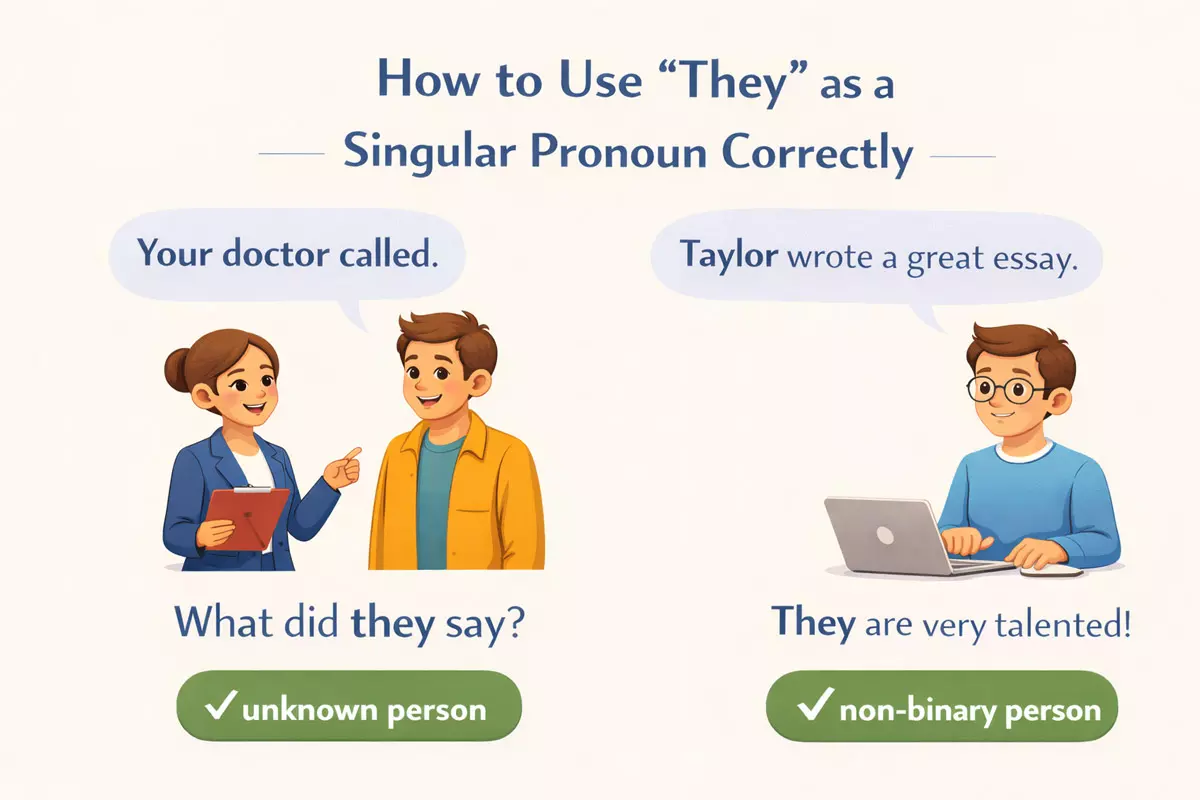 Here we the meaning and history of singular they, its use with indefinite pronouns and verbs, guidance from style guides, avoiding confusion with plural they, common mistakes, and practice tips for using singular they correctly.
Navigating language changes can be challenging, especially when deciding how to refer to a single person without specifying gender. As society becomes more inclusive, the ways we address individuals in both conversation and writing are evolving to reflect this shift. Many people now use gender-neutral pronouns like they or them when the gender of a person is unknown or when someone prefers not to be identified by traditional male or female pronouns. This change aims to respect everyone's identity and foster a more welcoming environment in communication.
What singular they means
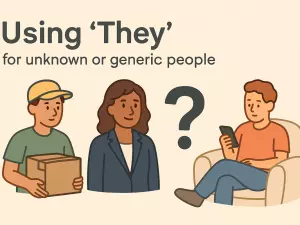
When people talk about “they” as a singular pronoun, they’re referring to its use for one person rather than a group. This can happen when the person’s gender is unknown, irrelevant, or when someone specifically asks to be referred to with “they/them” pronouns. Although “they” started as a plural word, it’s been used in the singular for centuries—think of sentences like, “Someone left their umbrella here.”
Using “they” for individuals helps avoid assumptions about gender. It’s common in sentences where you don’t know who you’re talking about, or where the person’s gender identity doesn’t fit “he” or “she.” For instance, if you find a wallet, you might say, “I hope they come back for it,” even if you haven’t met the owner.
Common contexts for singular “they”
- When the gender of a person is unknown: “If anyone calls, tell them I’ll call back.”
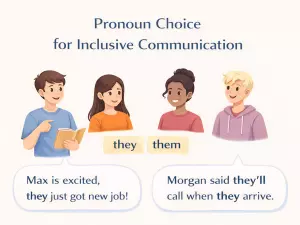
- Referring to people who use “they/them” pronouns: “Alex said they will join us later.”
- When gender is irrelevant or unspecified: “Every student should bring their own lunch.”
- To avoid awkward or repetitive language: “Each participant must sign their form.”
How singular “they” works in sentences

The pronoun “they” and its related forms (“them,” “their,” “theirs,” “themselves”) can all be used for one person. Here’s how it looks in practice:
| Form | Example Sentence |
|---|---|
| They | They are waiting outside. |
| Them | I called them yesterday. |
| Their | This is their book. |
| Theirs | The keys are theirs. |
| Themselves | They did it themselves. |
Why it matters
Recognizing the singular use of “they” is important for both clarity and respect. It lets us talk about people accurately without making assumptions. Many style guides now recommend this usage because it’s both practical and inclusive.
Historical background of singular they
English speakers have used “they” as a substitute for a singular pronoun for centuries. Writers and speakers reached for this flexible word when a person’s gender was unknown, irrelevant, or deliberately left unspecified. Even in the 14th century, literary sources show “they” filling gaps where “he” or “she” would be too specific.
Throughout history, this usage appeared in works by renowned authors. Geoffrey Chaucer, William Shakespeare, and Jane Austen all relied on “they” and “their” to refer to a single, indefinite person. The practice wasn’t controversial at first—only in the 18th and 19th centuries did some grammarians start to object, promoting “he” as the so-called universal pronoun. Despite these prescriptive rules, people continued to use “they” in everyday speech and writing.
Examples of singular “they” in historical texts
- “And every one to rest themselves betake.” (Chaucer, 14th century)
- “There's not a man I meet but doth salute me / As if I were their well-acquainted friend.” (Shakespeare, Comedy of Errors)
- “Nobody felt their loss more than I did.” (Austen, Emma)
- “If anybody calls, tell them I am out.” (Victorian usage)
- “Each student must hand in their assignment.” (Modern educational contexts)
- “No one should forget their umbrella.”
- “Someone left their wallet behind.”
- “If anyone asks, tell them to wait.”
- “Whoever finds the keys should bring them to the office.”
- “A person can do what they like.”
Over time, the use of this pronoun in the singular has persisted, especially when referring to hypothetical or unknown individuals. In recent decades, it has also become an important tool for respecting people’s identities, especially for those who don’t identify with binary gender pronouns.
Changes in acceptance
Attitudes toward this usage have shifted significantly. In the 20th and 21st centuries, style guides and dictionaries have increasingly recognized the legitimacy of singular “they.” The American Dialect Society even named it Word of the Year in 2015. Today, its use is widely accepted in both formal and informal contexts.
| Period | Attitude Toward Singular "They" |
|---|---|
| Middle English (1300s–1500s) | Common, uncontroversial usage |
| Early Modern English (1500s–1700s) | Used by major writers; rarely questioned |
| Prescriptive Era (1700s–1900s) | Some grammarians objected, but usage persisted |
| Modern English (1900s–present) | Increasing acceptance and endorsement |
The journey of “they” from a practical solution in medieval English to a modern marker of respect and inclusivity illustrates its enduring usefulness and adaptability in the language.
Singular they with indefinite pronouns
English speakers frequently use they to refer to an unknown or generic person when paired with words like someone, anybody, or nobody. This usage avoids assuming gender and keeps language inclusive and natural. Instead of defaulting to “he” or “she,” using they with indefinite pronouns is both grammatically accepted and widely understood in contemporary English.
Common indefinite pronouns with singular “they”
When you don’t know who you’re talking about, or the person could be anyone, these pronouns often appear in sentences where “they” is the natural choice:
- anyone → Anyone who wishes to appeal must submit the request in writing.
- everyone → Everyone involved in the negotiation was informed of the outcome.
- someone → Someone with sufficient expertise should review the proposal.
- no one → No one is exempt from the established compliance standards.
- nobody → Nobody who examined the evidence disputed the final conclusion.
- somebody → Somebody familiar with the regulatory framework is required.
- each → Each of the submitted applications is evaluated independently.
- everybody → Everybody present acknowledged the procedural change.
- whoever → Whoever assumes responsibility must ensure full transparency.
- whomever → The committee will consult whomever the board recommends.
- anybody → Anybody meeting the criteria may apply for the position.
- either → Either of the proposed solutions is acceptable under current guidelines.
- neither → Neither of the arguments adequately addresses the core issue.
- one → One must consider the broader implications before reaching a decision.
- who → The researcher who conducted the analysis will present the findings.
Examples of use in sentences
To see how this works in practice, notice how “they” fits seamlessly after these pronouns:
- If anyone calls, tell them I’ll be back soon.
- Someone left their umbrella in the hallway.
- Everybody should bring their own lunch.
- Did anybody say when they would arrive?
- No one wants to admit they made a mistake.
- If either of you needs help, let them know.
- Whoever finds the keys should return them to the office.
Comparison: Traditional vs. inclusive forms
| Traditional (gendered) | Inclusive (singular “they”) |
|---|---|
| If anyone calls, tell him or her I’m busy. | If anyone calls, tell them I’m busy. |
| Everyone must bring his or her ID. | Everyone must bring their ID. |
| Someone left his or her coat here. | Someone left their coat here. |
| Each student should do his or her homework. | Each student should do their homework. |
This shift away from older, gendered constructions makes speech and writing smoother and more respectful of everyone’s identity. Writers and speakers use this pattern in both formal and informal contexts, reflecting its acceptance in modern English.
Agreement patterns with verbs
When “they” is used as a singular pronoun, it still usually takes the same verb forms as plural “they.” This can feel counterintuitive if you expect verb forms to change depending on whether the subject is singular or plural. However, English treats singular “they” differently from other singular pronouns like “he” or “she” when it comes to verbs.
How verb agreement works with singular “they”
With singular “they,” verbs are conjugated just as they would be for the plural case. For example, you would say “They are here,” even if “they” refers to one person whose gender is unknown or unspecified—not “They is here.” This pattern holds for most verbs in both present and past tenses.
Common patterns and examples
Here are some sample sentences showing how verb forms match singular “they”:
- They are coming to the meeting. (not “is coming”)
- They have finished the assignment.
- They want to speak with you.
- They were at the event yesterday.
- They do not agree with that decision.
- They will call you later.
- They need more information.
- They can help if you ask.
- They should arrive soon.
- They feel strongly about this issue.
- They don’t know the answer.
- They like to read before bed.
- They expect a reply soon.
- They prefer tea over coffee.
- They weren’t aware of the change.
Comparison with other pronouns
To clarify how “they” aligns with verbs compared to “he” or “she,” see the table below:
| Pronoun | Verb Example |
|---|---|
| They (singular or plural) | They are late. |
| He/She | He is late. / She is late. |
| They (singular or plural) | They have finished. |
| He/She | He has finished. / She has finished. |
Special notes and exceptions
While the verb forms stay plural, possessive and reflexive pronouns follow the same pattern: “their phone,” “themself.” Some speakers may find “themself” less familiar, but it’s increasingly accepted. Context usually clarifies whether “they” refers to one person or several, so mismatches rarely cause confusion in conversation.
Formal writing and style guide positions
Perspectives on using “they” as a singular pronoun have evolved significantly in academic, professional, and publishing circles. For many years, traditional grammar rules discouraged singular “they,” but recent updates in major style manuals reflect growing acceptance. Today, guidance varies by publication, region, and context, but there is a clear trend toward inclusivity and flexibility.
Guidance from major style guides
Several influential writing manuals and editorial authorities have updated their recommendations regarding the singular use of “they.” Some have fully embraced it to promote gender neutrality, while others allow it only in specific circumstances, such as when referring to a person whose gender is unknown or to respect nonbinary identities. Here’s a summary of current positions from prominent guides:
| Style Guide | Position on Singular “They” |
|---|---|
| APA (American Psychological Association) | Fully endorses singular “they” for generic and specific use, including for nonbinary individuals. |
| Chicago Manual of Style | Accepts singular “they” for persons whose gender is unknown or nonbinary; recommends rewording when possible in formal contexts. |
| Associated Press (AP) | Permits singular “they” for clarity and accuracy, especially for nonbinary references, with a note to explain usage if it could be confusing. |
| MLA (Modern Language Association) | Supports using singular “they” for nonbinary individuals and when gender is unspecified. |
| Oxford (Oxford University Press) | Allows singular “they” in many contexts, particularly to avoid awkward constructions or to respect personal pronouns. |
Common recommendations and cautions
- Use “they” as a singular pronoun when referring to someone whose gender is unknown or unspecified.
- Respect an individual’s stated pronouns, including “they/them.”
- Reword sentences to avoid confusion if clarity is at risk.
- In highly formal or academic writing, check the style guide in use for specific rules.
- Be consistent throughout a document with pronoun use.
- Provide a brief explanation if singular “they” might be unfamiliar to your audience.
- Do not use awkward constructions like “he or she” if it can be avoided.
- Recognize that singular “they” is now widely accepted in most mainstream publications.
- Consider the preferences of the person being referred to whenever possible.
- Review organizational or institutional policies if writing for a specific group.
Examples in formal writing
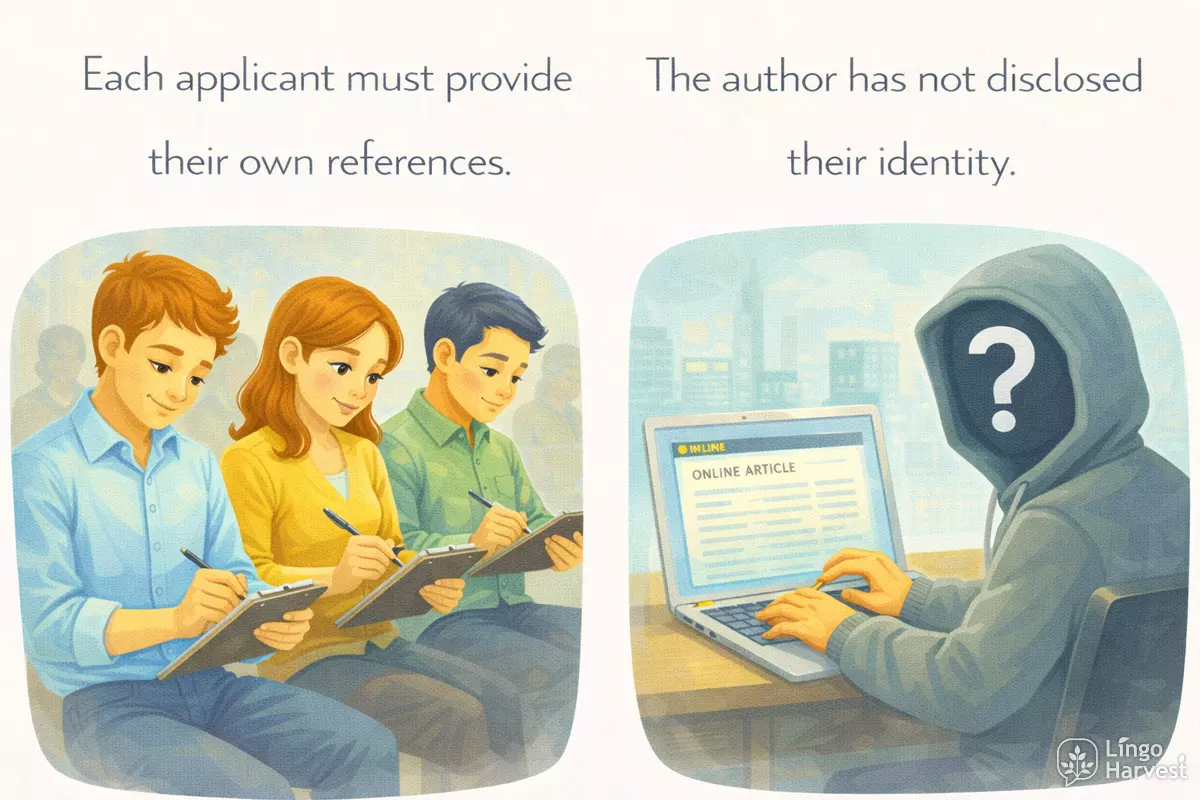
Writers often encounter situations where a singular, gender-neutral pronoun is needed. Here are examples of how singular “they” can be applied in formal contexts:
- If a student wishes to submit their assignment late, they should contact the instructor.
- Each applicant must provide their own references.
- The author has not disclosed their identity.
- Every participant should sign in when they arrive.
- Someone left their umbrella in the lobby.
Overall, the trend in editorial practice is clear: using “they” as a singular pronoun is accepted and encouraged when it promotes clarity, inclusivity, and respect for individual identity.
Avoiding ambiguity with plural they
When “they” is used in a sentence, it isn’t always immediately clear whether it refers to a single person or multiple people. This can sometimes cause confusion, especially in writing where there are no visual or contextual cues. Being mindful of context, sentence structure, and clarity helps readers understand exactly who is being referred to.
Strategies for clear communication
- Clarify the subject early: Introduce the person or group before using “they” to establish who is being referenced.
- Use names when possible: Repeating a person’s name instead of “they” can remove uncertainty.
- Provide context clues: Add details or descriptors that signal whether “they” refers to one individual or more.
- Revise for clarity: If a sentence could be read either way, consider rephrasing.
- Group references: If you’ve mentioned multiple people, specify which one you mean before using “they.”
Examples: Singular vs. plural “they” in context
Consider these sentences. Notice how context and wording help identify whether “they” is singular or plural:
| Ambiguous Example | Clearer Alternative |
|---|---|
| The doctor said they would call. | Dr. Lee said they would call. (singular) The doctors said they would call. (plural) |
| When the student arrived, they were tired. | When Alex arrived, they were tired. (singular) |
| They finished the project on time. | The team finished the project on time. (plural) Jamie finished the project on time. They worked hard. (singular) |
| Ask Sam or Pat if they want dessert. | Ask Sam if they want dessert. (singular) Ask Sam and Pat if they want dessert. (plural) |
Common scenarios where confusion arises
- After mentioning both individuals and groups in the same paragraph.
- In instructions or policies that apply to both single users and groups.
- When switching between singular and plural references without signaling a change.
When in doubt, reword for clarity: specify names, restructure sentences, or add context. The goal is always to help the reader avoid misinterpretation without overcomplicating your writing.
Common learner mistakes
Many English learners struggle with using “they” as a singular pronoun, especially when it comes to agreement, clarity, and formality. These challenges often lead to errors that can confuse listeners or readers. Below are some of the most frequent issues and how to recognize them.
Agreement errors
One frequent issue is mismatching verb forms. When “they” refers to a single person, some learners mistakenly use singular verbs. Remember, even as a singular pronoun, “they” still takes plural verb forms.
- ❌ They is coming to the meeting.
- ✅ They are coming to the meeting.
Confusion in context
Ambiguity can arise when it’s unclear whether “they” refers to one person or a group. If the context doesn’t make it obvious, readers might get confused. Always set up your sentences so that the reference is clear, especially in stories or instructions.
- When Alex arrives, they will explain the project. (Who is “they”? Make sure the reader knows Alex’s pronouns.)
Incorrect pronoun forms
Mixing up subject, object, and possessive forms is another pitfall. “They,” “them,” and “their” should be used as you would for plural subjects, even if you mean one person.
- ❌ Each student should bring his or her notebook. (This can be unnecessarily gendered.)
- ✅ Each student should bring their notebook.
Mixing pronouns in the same sentence
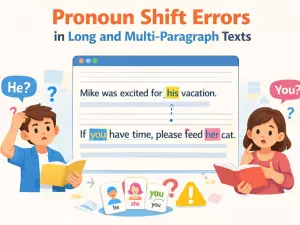
Switching between “he/she” and “they” in the same context is confusing and grammatically incorrect. Consistency is important for clarity.
- ❌ If someone wants to join, he or they should sign up.
- ✅ If someone wants to join, they should sign up.
Overusing “they” when not necessary
Some writers use “they” for people whose gender is known, which can sound awkward or impersonal. Use names or gendered pronouns when the person’s identity and preference are clear and appropriate.
Confusing “they” with “it” for inanimate objects
Remember, “they” is not used for a single inanimate object. For things (not people), use “it.”
- ❌ The book is on the table. They are interesting.
- ✅ The book is on the table. It is interesting.
Summary of correct and incorrect usage
| Incorrect Example | Corrected Version |
|---|---|
| They is my friend. | They are my friend. |
| Someone left their bag. He should claim it. | Someone left their bag. They should claim it. |
| If a student wants help, she or they can ask. | If a student wants help, they can ask. |
| The cat is hungry. They want food. | The cat is hungry. It wants food. |
Tips to avoid mistakes
- Double-check verb agreement when using “they” for one person.
- Be consistent—don’t mix pronoun forms for the same subject.
- Clarify who “they” refers to early in your writing.
- Use “it” for objects and animals (unless the animal’s gender is known and relevant).
- Practice with real examples to build confidence in natural usage.
Practice: choose singular they naturally
Getting comfortable with using “they” in the singular form often requires seeing it in context and trying it out for yourself. Below, you’ll find practical exercises, example sentences, and quick decision tasks to help you recognize where singular “they” fits smoothly and why it’s the best choice in those situations.
Quick identification: When is “they” singular?
Look at the following sentences and decide if “they” refers to a single person whose gender is unknown or unspecified. This helps you become familiar with the contexts where singular “they” is preferred.
- If anyone calls, tell them I’ll be back soon.
- The winner will receive their prize tomorrow.
- Alex said they need more time to finish the report.
- Each student should submit their assignment by Friday.
- Somebody left their umbrella here.
Show answers
- Singular “they” is used in every example above, each time referring to a person whose gender isn’t specified (1–5).
Choose the right pronoun
Select the most natural pronoun for each blank. Sometimes “he” or “she” might feel awkward or exclusive—notice when “they” fits better.
- Someone forgot ___ keys on the table.
- Every applicant must include ___ resume.
- Jordan said ___ will join us later.
- If a customer has questions, direct ___ to the help desk.
- Whoever arrives first should let ___ in.
- Everyone must submit ___ assignment by Friday.
- If anybody calls, tell ___ that the office is closed.
- Each student should bring ___ own materials.
- When someone makes a mistake, encourage ___ to try again.
- No one should forget ___ responsibilities.
Show answers
- their
- their
- they
- them
- them
- their
- them
- their
- them
- their
Common singular “they” patterns
Here are some typical sentence structures where singular “they” is commonly used. Familiarize yourself with these patterns to boost your confidence:
- Someone left their phone in the hall.
- Each participant should bring their own materials.
- If a guest arrives early, give them a seat.
- No one said they were unhappy.
- The doctor said they would call back.
- Every child must wear their badge.
- Every voter should check their registration.
- Whoever made this cake, they did a great job.
- When an employee is sick, they should notify HR.
- Any reader can submit their feedback.
- If your friend needs help, offer them support.
- Anyone can choose what they want for lunch.
- Each artist has their own style.
- The winner will find out when they’re announced.
- Anyone who finishes early can hand in their test.
- If a person calls after hours, direct them to voicemail.
- Every guest should enjoy their visit.
- Someone said they would be late.
Comparison: Singular “they” vs. gendered pronouns
See how using “they” naturally replaces “he or she” or avoids awkward repetition. This helps clarify why singular “they” is often smoother and more inclusive.
| Gendered or awkward | Natural with singular “they” |
|---|---|
| If a student forgets his or her ID, he or she can’t enter. | If a student forgets their ID, they can’t enter. |
| Each employee should submit his/her timesheet. | Each employee should submit their timesheet. |
| Someone left his umbrella here. | Someone left their umbrella here. |
| The winner will receive his or her award tonight. | The winner will receive their award tonight. |
With practice, choosing singular “they” will feel more intuitive and help your language remain clear, natural, and welcoming to everyone.