The Little Words That Change Meaning: Master a/an/the Fast

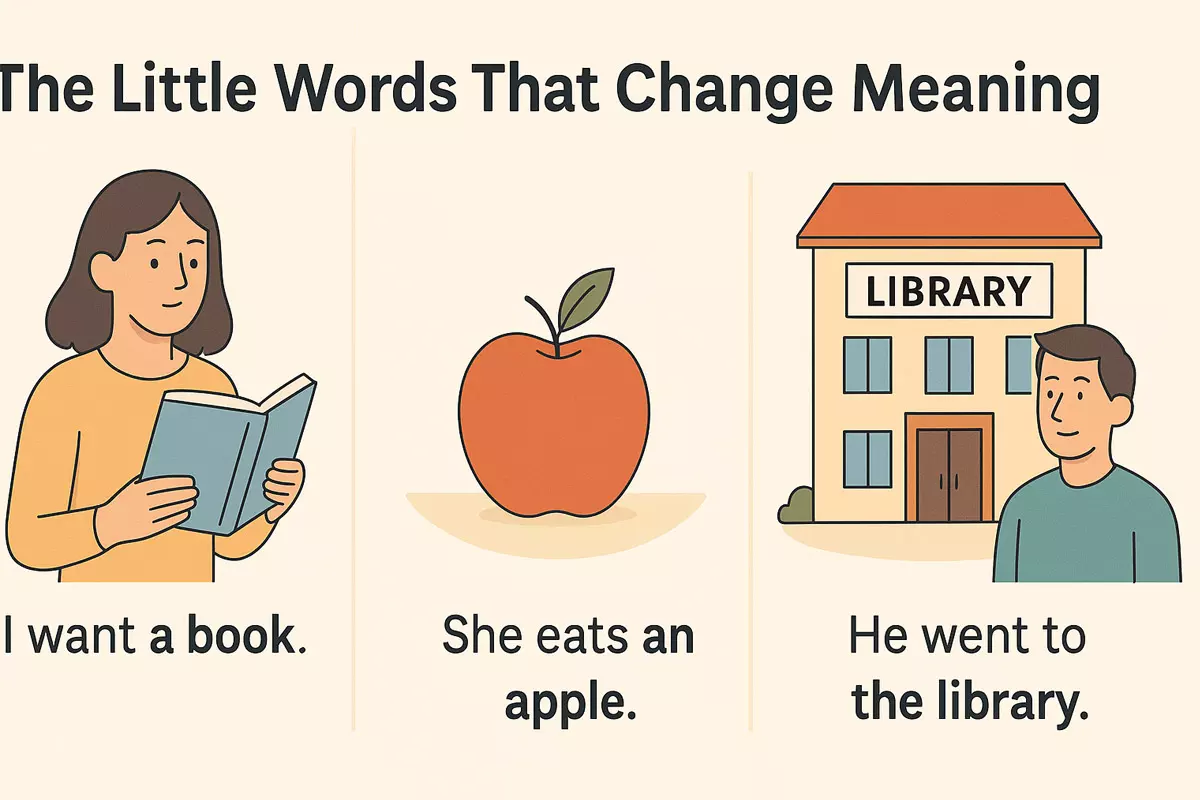 The article explains how using a, an, and the changes meaning, compares similar sentences for clarity, and gives a quick decision guide. It also covers common learner problems and provides practice to help you choose the right article.
Small words such as a, an, and the may appear unimportant, but they can subtly change the meaning of a sentence. Mastering the use of these articles not only helps you communicate more clearly but also makes your English sound more natural and confident. By practicing their correct usage, you can avoid misunderstandings and express your ideas more precisely, which is essential for effective communication in both writing and speaking.
Why Articles Change Meaning
When you use “a,” “an,” or “the,” you’re not just picking a random word—each one signals something specific about the noun it comes before. These little words decide whether we’re talking about something general or something very particular. Swapping one for another can shift the entire sense of a sentence, sometimes in subtle ways, sometimes with a big impact.
How Context Shapes Article Use
Articles are sensitive to context. For example, “a dog” introduces any dog, while “the dog” points to a specific animal everyone knows about. If you say, “I saw a movie,” you’re introducing something new into the conversation. If you say, “I saw the movie,” you’re referring back to a film already discussed or known.
Why the Choice Matters
Using the right article helps listeners or readers understand whether you mean something unique, something previously mentioned, or just any example. This is why misusing articles can cause confusion or even change the meaning entirely. Consider these examples:
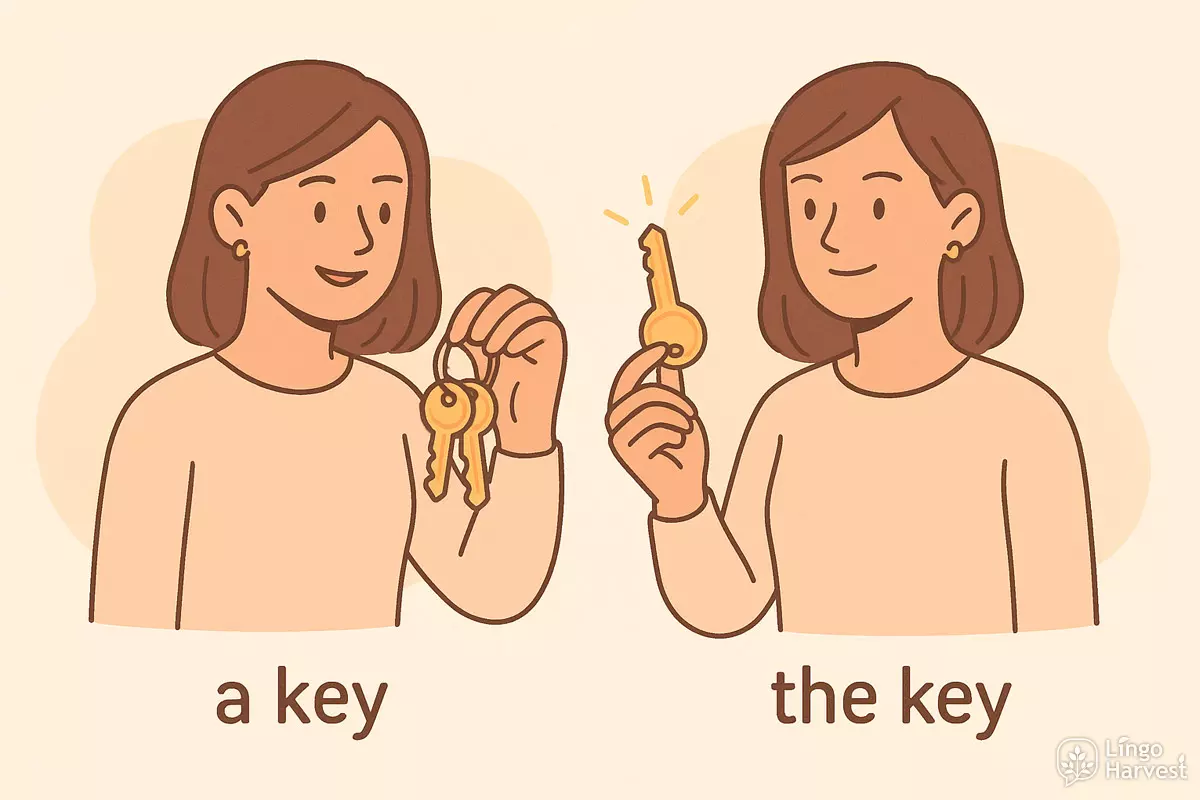
- “She found a key.” (any key, possibly unknown)
- “She found the key.” (a specific key, probably expected or discussed)
- “Can I have an apple?” (any apple, not a particular one)
- “Can I have the apple?” (a specific apple, maybe the only one)
Common Patterns That Shift Meaning
Articles interact with nouns in predictable ways, but they also create exceptions and special cases. Here are some patterns to watch for:
- With professions: “She is a doctor.” (any doctor, not a known one)
- With inventions: “The telephone changed the world.” (referring to the invention itself)
- With superlatives: “He is the best player.” (only one ‘best’ in the group)
- With unique objects: “The sun rises in the east.” (only one sun for Earth)
- With first mentions: “I saw a bird. The bird was singing.” (first “a,” then “the” for the same bird)
- With places: “She went to the hospital.” (specific, or the only one in context)
- With plural nouns: “Lions are dangerous.” (general class, no article)
- With uncountable nouns: “Water is essential.” (no article needed)
- With musical instruments: “He plays the piano.” (the instrument type in general)
- With meals: “We had breakfast.” (no article for meals in general)
Comparing the Impact
Often, the only thing that changes in a sentence is the article—but that’s enough to change what you mean. Here’s a quick comparison:
| Phrase | What It Means |
|---|---|
| A teacher entered the room. | Some teacher, identity not important or unknown. |
| The teacher entered the room. | A specific teacher, known to the listener. |
| I need a pen. | Any pen, no particular one. |
| I need the pen. | A specific pen, maybe already mentioned. |
| Life is short. | Speaking about life in general (no article). |
| The life of a butterfly is short. | Focusing on the specific life of a butterfly. |
Summary
Choosing between “a,” “an,” and “the” is more than a grammar rule—it’s a way to guide your reader’s understanding. Whether you’re introducing something new, referring to something known, or talking about things in general, articles are key to clarity and precision in English.
Comparing Similar Sentences
Small words like a, an, and the can completely shift the meaning of a sentence, and understanding these shifts is key to mastering English articles. Let's look at how changing the article changes the message, feeling, or specificity in similar-looking sentences.
How Articles Change Meaning
When you swap out one article for another, you don't just change the grammar—you may alter the entire sense of what you're saying. For example, "I saw a cat" introduces something new or unknown, while "I saw the cat" refers to a particular, likely familiar, feline. Sometimes, the difference is subtle but important.
- I need a pen. → Any pen will do.
- I need the pen. → A specific pen is needed (the listener knows which one).
- She is a teacher. → Her occupation is teaching, one of many teachers.
- She is the teacher. → She is the specific teacher relevant to the situation.
- He found an answer. → One possible answer, not necessarily the only one.
- He found the answer. → The correct or expected answer.
- I want an apple. → Any apple, not particular.
- I want the apple. → A specific apple, possibly visible or discussed earlier.
- She has a dog. → She owns one dog, not a specific one.
- She has the dog. → She owns (or is holding) a particular dog already known.
- I'm looking for a job. → Any job, open options.
- I'm looking for the job. → A specific job, perhaps one mentioned before.
- He is an artist. → His profession or hobby, part of a group.
- He is the artist. → The particular artist being discussed.
- She bought a car. → One car, not specified.
- She bought the car. → A specific car, likely already identified.
- There's a problem. → Some problem, not previously defined.
- There's the problem. → The specific problem, possibly already known.
- I saw a movie. → Any movie, no details.
- I saw the movie. → A particular movie, maybe previously discussed.
Comparative Table: Article Usage in Context
| Sentence with "a"/"an" | Sentence with "the" | Meaning Difference |
|---|---|---|
| I met a doctor. | I met the doctor. | Unknown which doctor → Specific doctor, possibly already mentioned |
| She opened a window. | She opened the window. | Any one of several windows → A certain window, already identified |
| He wants a book. | He wants the book. | Any book will do → A particular book, already known |
| We saw an elephant. | We saw the elephant. | Any elephant, not specified → A specific elephant, probably mentioned earlier |
| She is an engineer. | She is the engineer. | Her profession, one of many → The particular engineer relevant to the situation |
By comparing these pairs, you can see how articles guide the listener’s understanding. The indefinite articles (a, an) introduce something new or non-specific, while the singles out what’s already familiar or previously identified. Careful use of these little words leads to clearer, more precise communication.
Clarity and Specificity in Context
Getting articles right—knowing when to use "a," "an," or "the"—is essential for making your meaning clear. These little words don’t just fill space; they guide listeners or readers to understand whether you’re talking about something general, specific, or new in the conversation. Even native speakers sometimes trip up, especially in more abstract or technical contexts.
How Articles Shape Meaning
The definite, indefinite, and zero articles help signal if you mean one thing in particular, any example of a thing, or all things in general. Choosing the wrong one can lead to confusion or even change what you’re trying to say. For example, "I saw a dog" means any dog, while "I saw the dog" refers to one specific, known dog. Leaving out an article entirely, as in "Dogs are friendly," shifts the meaning to all dogs as a group.
Common Scenarios and Their Effects
- First mention vs. known information: "A book" (any book, first time mentioned) vs. "the book" (a specific book already discussed).
- General statements: "The whale is a mammal" (refers to the species as a whole).
- Unique items: "The sun," "the internet"—there’s only one, so "the" is required.
- Jobs and roles: "She is an engineer" (one of many, not a specific person).
- Meals and languages: No article: "We eat breakfast at eight." / "He speaks French."
- Superlatives: "The best solution," "the tallest building."
- Geographical names: "The Amazon," but "Mount Everest" (no article with most mountains).
- Organizations: "The United Nations," but "Microsoft" (no article).
- Abstract ideas: Often no article: "Love is important."
- Plural and uncountable nouns: No article for general ideas: "Books are useful." / "Water is essential."
Quick Reference: Article Choice and Meaning
| Article | Typical Use & Example |
|---|---|
| a / an | First mention; any one of something. She saw an owl in the tree. |
| the | Specific or previously mentioned; unique items. The owl flew away. |
| (no article) | General truths, plural or uncountable nouns, proper names. Owls are nocturnal. Water is vital. |
| Zero article exceptions | Meals, languages, most countries. We had lunch. She speaks Spanish. He visited France. |
Quick Decision Guide
Choosing between a, an, and the can seem tricky, but there are simple cues to help you decide on the spot. The choice depends on how specific you are, and whether your listener knows which thing you mean. Let’s break it down with clear steps and examples so you can make the right call every time.
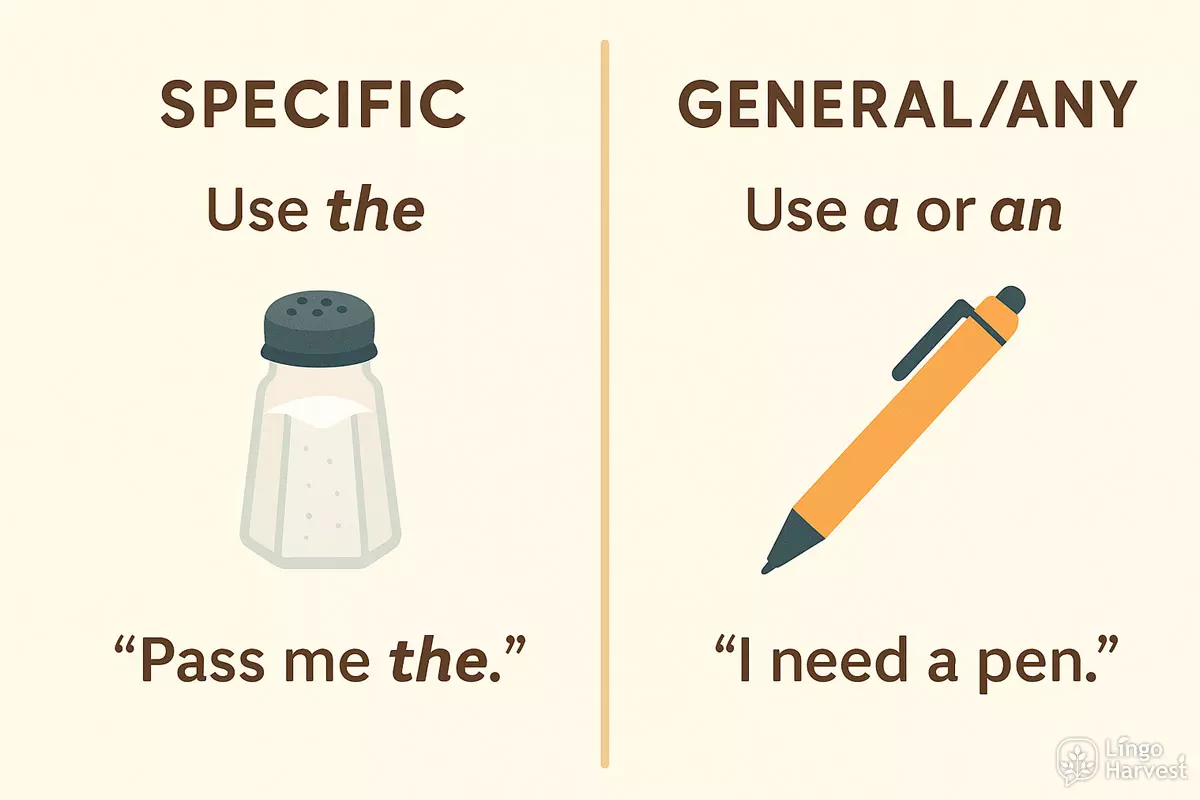
Step 1: Is it Specific or General?
- Specific: Use the when talking about something your listener already knows about or when there’s only one possible thing you could mean. Example: “Pass me the salt.”
- General/Any: Use a or an when you mean any one of a group, not a particular one. Example: “I need a pen.”
Step 2: Vowel or Consonant Sound?
- a: Before words that start with a consonant sound. Example: “a cat.”
- an: Before words that start with a vowel sound. Example: “an apple.”
- Tip: It’s the sound that matters, not just the letter. “an hour” (because the ‘h’ is silent).
Step 3: Special Situations
- Use the with unique things: “the sun”, “the president”.
- Use the for superlatives: “the best day”.
- Don’t use any article with most plural or uncountable nouns when speaking generally: “Books are useful.” “Water is important.”
Common Examples at a Glance
| Article | When to Use | Example |
|---|---|---|
| a | Before consonant sound, non-specific, singular | a dog, a book, a university (sounds like “yu”) |
| an | Before vowel sound, non-specific, singular | an apple, an hour, an umbrella |
| the | Specific item already known, or unique | the car (we both know which), the moon |
| (no article) | General plurals/uncountables | Cars are fast. Water is clear. |
Quick-Check List for Everyday Use
- ✅ If it’s one of many and new: a/an
- ✅ If it’s already mentioned or unique: the
- ✅ If it’s plural or uncountable and general: no article
- ❌ Don’t use the with names (usually): “I saw John” not “the John”
With these steps, you’ll quickly know which small word to use for clear, natural English. Practice with everyday sentences to build your confidence.
Common Learner Problems
Choosing the right article—a, an, or the—often trips up English learners, even at higher levels. The confusion usually starts with rules that seem simple but hide plenty of exceptions and subtle meanings. Understanding when to use each word, or when to leave an article out entirely, is a challenge that can make sentences sound awkward or even change their meaning.
Mixing Up When to Use Articles
Many learners struggle to decide if a noun needs an article, and if so, which one. For example, it’s easy to say “I have cat” instead of “I have a cat,” or “She is the doctor” instead of “She is a doctor.” The difficulty increases when switching between general and specific meanings.
- Forgetting to use a or an with singular, countable nouns (e.g. “He bought car” ❌ → “He bought a car” ✅)
- Adding the unnecessarily (e.g. “I love the pizza” when talking about pizza in general)
- Confusing a vs an (e.g. “an university” ❌ instead of “a university” ✅)
- Dropping articles in set phrases (e.g. “go to the school” vs “go to school”)
Overgeneralizing Rules
Learners often memorize a rule and then apply it everywhere, leading to mistakes. For example, always using the before every noun, or thinking that all country names need an article (“the France” ❌). Articles in English are not always logical or parallel to those in other languages.
Problems with Abstract and Plural Nouns
It’s common to be unsure about articles for abstract concepts and plural nouns. Should it be “the information” or just “information”? Is it “the children” or “children”? The answer depends on whether you mean something specific or general.
Table: Typical Mistakes with Articles
| Incorrect Example | Corrected Version |
|---|---|
| I saw an elephant in zoo. | I saw an elephant in the zoo. |
| She is the teacher. | She is a teacher. |
| He is eating the breakfast. | He is eating breakfast. |
| I have the information for you. | I have information for you. |
| Can you give me a advice? | Can you give me advice? |
| She went to the hospital for work. | She went to hospital for work. |
| He is an honest man. | He is an honest man. (correct!) |
| She is a engineer. | She is an engineer. |
| I like the dogs. | I like dogs. |
| It’s the best day. | It’s the best day. (correct!) |
Translating Directly from Other Languages
Direct translation often leads to errors. Many languages use articles differently, or not at all, so learners may add or drop them incorrectly in English. For example, Russian and Chinese speakers often omit articles, while Spanish and French speakers may overuse them.
Summary of Frequent Mistakes
- Leaving out articles where they’re needed
- Adding them when they don’t belong
- Confusing definite and indefinite forms
- Not adjusting for vowel/consonant sounds (a/an)
- Using articles with uncountable nouns
- Relying on word-for-word translation
Mastering these tiny words takes time and practice. Paying attention to context and patterns in real English will help you avoid the most common pitfalls.
Practice: Explain Your Choice
Understanding when to use "a," "an," or "the" can be challenging, but practice makes it second nature. Take a close look at each sentence and think about why a particular article is correct. Is it because the noun is mentioned for the first time? Is it a specific object, or just any one of many?
Choose the Correct Article
For each sentence, decide which article ("a," "an," or "the") fits best. Then, explain your reasoning in a short phrase or sentence.
- ___ apple a day keeps ___ doctor away.
- She adopted ___ cat and ___ dog from the shelter.
- ___ sun rises in ___ east.
- He found ___ umbrella in ___ hallway.
- Can you hand me ___ pen on ___ table?
- ___ university nearby has ___ excellent library.
- ___ elephant is ___ large animal.
- We visited ___ museum yesterday.
- ___ book you lent me was fascinating.
- Is there ___ answer to this question?
Show answers
- An apple a day keeps the doctor away. (First mention of apple, specific group of doctors.)
- She adopted a cat and a dog from the shelter. (First mention, not specific animals.)
- The sun rises in the east. (Unique things, only one sun and one east.)
- He found an umbrella in the hallway. (First mention of umbrella, specific hallway.)
- Can you hand me the pen on the table? (Both are specific—the listener knows which pen and table.)
- The university nearby has an excellent library. (Specific university, first mention of library.)
- An elephant is a large animal. (First mention, general category.)
- We visited a museum yesterday. (First mention, not a specific one.)
- The book you lent me was fascinating. (Specific book that both know.)
- Is there an answer to this question? (First mention, any answer.)
Common Patterns: When to Use Each Article
Look at some typical situations where these small words are used. Notice what triggers the choice:
- a/an before singular, countable nouns when mentioning them for the first time or when it doesn't matter which one.
- the with nouns that are already known, unique, or previously mentioned.
- No article for general ideas with plural or uncountable nouns ("Books are expensive," "Milk is healthy").
Quick Reference: Article Usage Examples
| Type of Noun | Article Example | Reason |
|---|---|---|
| Singular, first mention | a dog | Any one dog, not specific |
| Singular, vowel sound | an apple | Any one apple, starts with vowel sound |
| Specific, known to listener | the teacher | Both speaker and listener know which teacher |
| Unique object | the moon | Only one moon |
| General, plural | cats | No article; talking about all cats in general |
| General, uncountable | water | No article; talking about water in general |
Explaining your choice out loud or in writing helps reinforce the patterns. Try making your own sentences and justifying the article you choose each time.