Using If in Conditional Sentences

 This article explains conditional sentences, focusing on the zero and first conditionals. It covers when to use if or when, provides guidance on punctuation and word order, and includes practice exercises to complete sentences.
Being able to express possibilities, results, and hypothetical situations is a crucial skill in English, as these scenarios often depend on the effective use of the word "would." Knowing when and how to use "would" helps you communicate ideas about what could happen, what might have happened, or what you would do in certain situations. This not only improves your clarity but also allows you to engage in more nuanced and accurate conversations, making your English sound both natural and sophisticated.
What Are Conditional Sentences?
Conditional sentences are statements that describe a situation and its possible result. They often use "if" to express a condition and what will happen if that condition is met. In English, these sentences help us talk about real or imagined situations, predictions, advice, warnings, and consequences.
Typically, a conditional sentence has two parts:
- The condition clause (usually starting with "if")
- The main clause (the result or outcome)
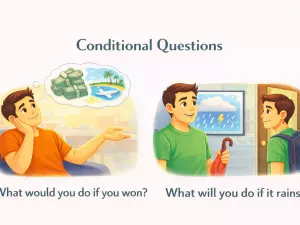
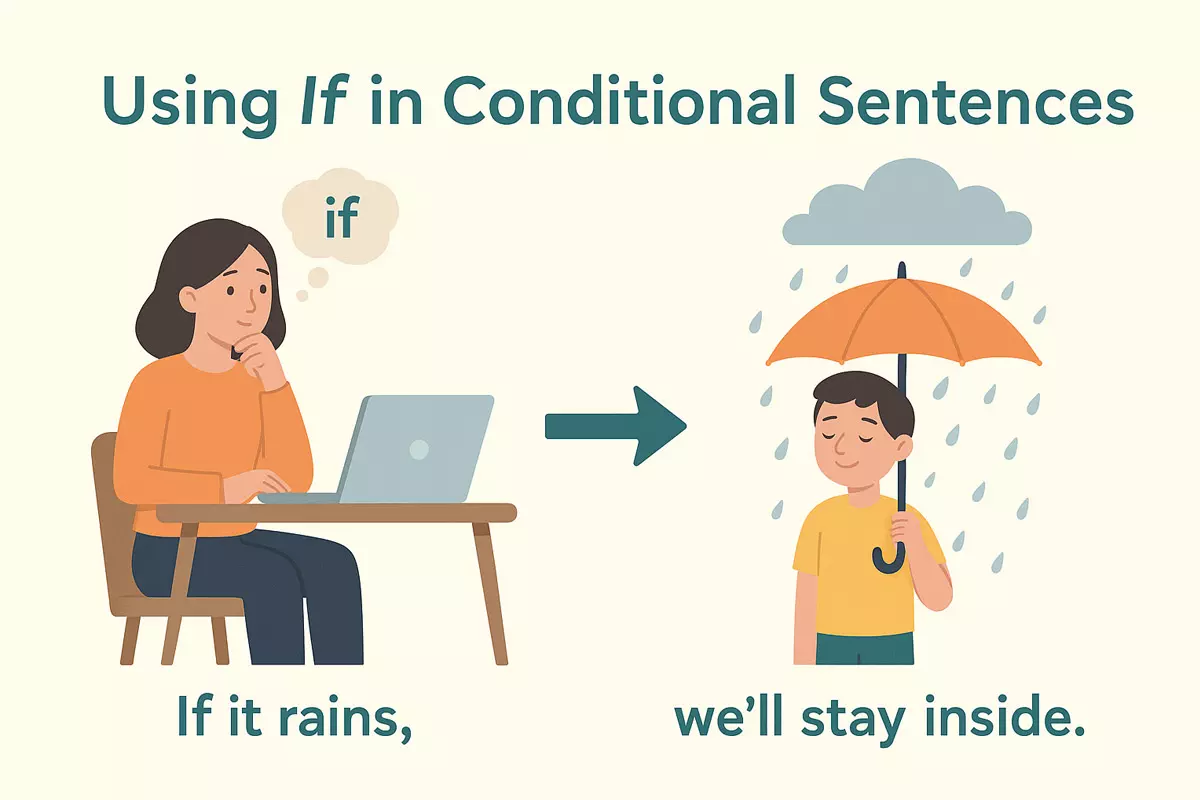
For example: "If it rains, we will stay inside." Here, "if it rains" is the condition, and "we will stay inside" is the result.
Common Uses of Conditional Sentences
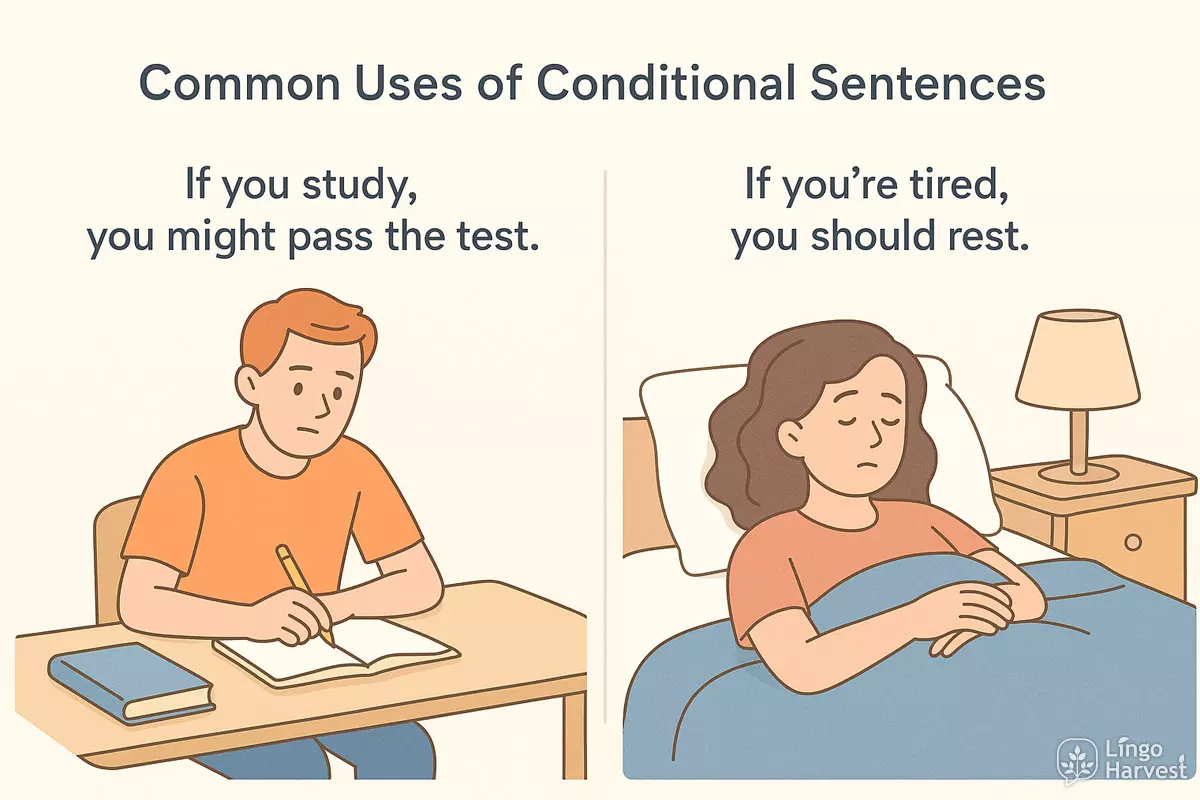
- Expressing possibilities: If you study, you might pass the test.
- Giving advice: If you’re tired, you should rest.
- Making offers: If you need help, I can assist.
- Warning about consequences: If you touch that, you’ll get hurt.
- Discussing unreal situations: If I were rich, I would travel the world.
- Talking about the past: If he had left earlier, he would have caught the train.
- Describing general truths: If you heat water, it boils.
- Imagining future events: If it snows tomorrow, we’ll build a snowman.
- Setting rules: If the light is red, stop.
- Making polite requests: If you have a moment, could you help me?
Main Types of Conditionals
English features several conditional patterns, each with its own meaning and structure. The most common are:
| Type | Example Sentence | Meaning/Use |
|---|---|---|
| Zero Conditional | If you mix red and blue, you get purple. | General truths, scientific facts |
| First Conditional | If it rains, I will take an umbrella. | Real, possible future situations |
| Second Conditional | If I won the lottery, I would travel. | Unreal, hypothetical present or future |
| Third Conditional | If she had known, she would have called. | Imagined past situations, regrets |
Key Features
- The word "if" usually introduces the condition, but sometimes "when" or "unless" is used for similar structures.
- Verb tense in the condition and result clauses signals the type of conditional (real, unreal, past, etc.).
- The order of clauses can be switched: If you hurry, you’ll catch the bus → You’ll catch the bus if you hurry.
Understanding how to form and use conditional sentences allows you to communicate a wide range of ideas, from certainty to possibility, advice, and even regrets.
Zero and First Conditionals
Conditional sentences with if can express facts, general truths, or possible future events. Two of the most commonly used structures are the so-called "zero" and "first" types. They differ in both their meaning and verb forms, so it's important to know when and how to use each one.
When to Use Each Conditional
- Zero conditional is best for stating facts, scientific laws, or things that are always true. It’s used for situations that happen every time a condition is met.
- First conditional is used for real or likely situations in the future. The result is possible if the condition happens.
Form and Examples
| Type | Structure | Example | Usage |
|---|---|---|---|
| Zero | if + present simple, present simple | If water boils, it turns into steam. | General truths, scientific facts |
| First | if + present simple, will + base verb | If it rains, we will stay inside. | Real future possibilities |
Common Patterns and Examples
- If you heat ice, it melts. ✅
- If students study, they get better grades.
- If you mix red and blue, you get purple.
- If the sun sets, it gets dark.
- If you don’t water plants, they die.
- If you press this button, the light turns on.
- If you eat too much, you feel sick.
- If you touch fire, it burns you.
- If I see her tomorrow, I will tell her the news. →
- If he finishes early, he will call you.
- If they invite us, we will go to the party.
- If you don’t hurry, you will miss the bus.
- If she studies hard, she will pass the exam.
- If it snows, we will build a snowman.
- If you ask, I will help you.
- If the shop is open, we will buy bread.
Notice that in both structures, the order of the clauses can be reversed without changing the meaning. For example, "We will stay inside if it rains" is just as correct as "If it rains, we will stay inside." Commas are used when the if clause comes first.
While both types use if to introduce a condition, the zero form is for things that always happen, while the first form is for possible events in the future. Recognizing which to use helps you sound more natural and accurate in English.
When to Use If vs When
Choosing between "if" and "when" depends on how certain the outcome is. Use "if" to talk about situations that might happen, while "when" refers to events you expect will definitely occur. This distinction helps make your meaning clearer in both spoken and written English.
Understanding Certainty and Possibility
"If" introduces a condition that is possible but not guaranteed. It's often used for hypothetical or uncertain scenarios. In contrast, "when" signals that something is expected or inevitable—it’s just a matter of time before it happens.
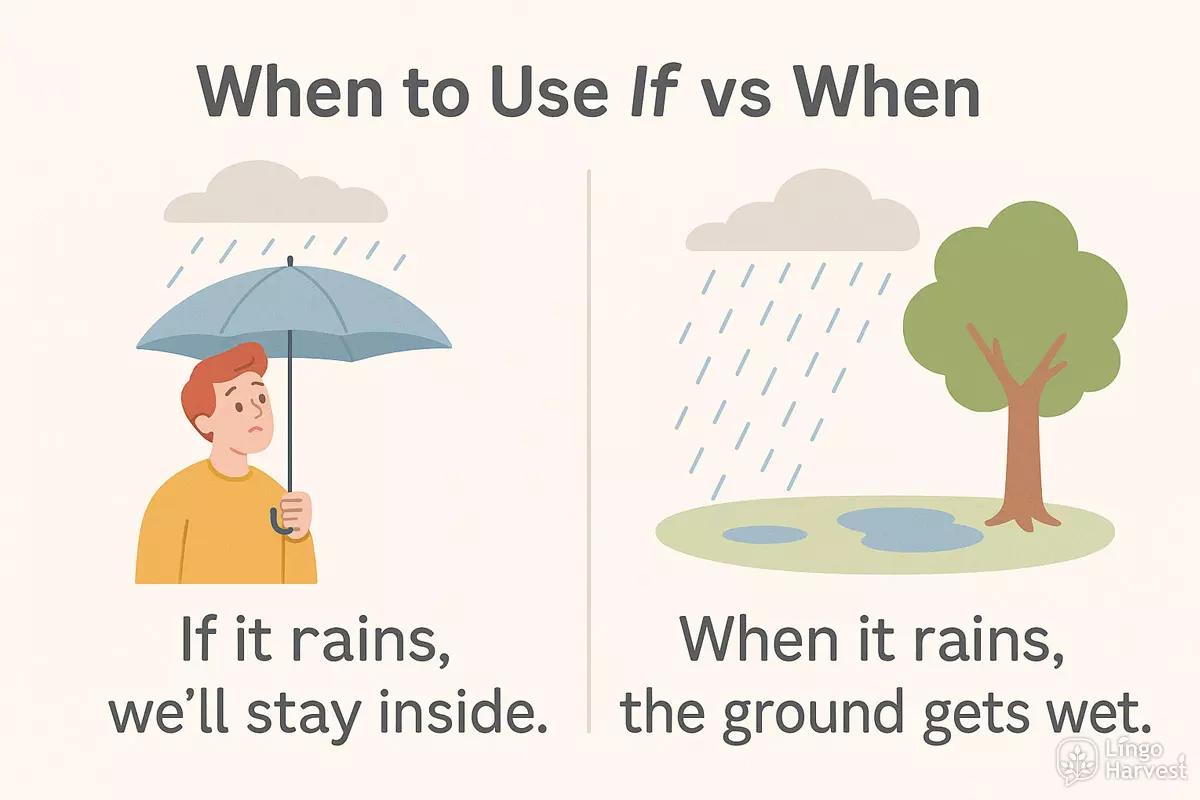
- If it rains, we’ll stay inside. (It might rain, or it might not.)
- When it rains, the ground gets wet. (Rain is certain at some point.)
- If you see Anna, tell her I called. (You may or may not see Anna.)
- When you arrive, call me. (Your arrival is expected.)
- If I win the lottery, I’ll travel the world. (Winning is only possible.)
- When I finish work, I’ll meet you. (Finishing work is definite.)
- If you press this button, the alarm will sound. (Only if the button is pressed.)
- When the sun sets, it gets dark. (The sun always sets eventually.)
- If you cook dinner, I’ll wash the dishes. (Cooking dinner is optional.)
- When the meeting ends, we’ll go for coffee. (The meeting will end.)
Quick Comparison
| Word | Typical Use |
|---|---|
| If | Possible situations or events; outcome is uncertain or conditional. |
| When | Events that are expected, scheduled, or inevitable; outcome is certain. |
Tips for Deciding Which to Use
- Ask yourself: Is the event sure to happen, or only possible?
- For routines or scheduled events, "when" is usually correct.
- For uncertain, imagined, or conditional situations, choose "if".
- In instructions, use "when" if the action is expected, "if" if it depends on something else.
Mastering the difference between these words helps your conditional sentences sound natural and precise. Think about the likelihood of the event before choosing which word to use.
Punctuation and Word Order
When working with conditional sentences using "if", it's important to pay attention to how clauses are arranged and where commas are placed. The structure of these sentences not only affects clarity, but also determines whether punctuation like commas is necessary.
Comma Placement with "If" Clauses
A comma is typically required when the "if" clause comes at the beginning of the sentence. This helps to separate the condition from the result, making the sentence easier to read. However, when the main clause appears first, a comma is usually omitted.
- If it rains, we will cancel the picnic. ✅
- We will cancel the picnic if it rains. ✅
- If you study hard, you will pass the exam. ✅
- You will pass the exam if you study hard. ✅
Typical Word Order Patterns
The order of clauses in a conditional sentence is flexible, but there are conventional patterns that native speakers tend to follow. Both forms are correct, but the use of a comma is influenced by which part comes first.
| Condition First (Comma Needed) | Result First (No Comma) | Comment |
|---|---|---|
| If you call me, I will help you. | I will help you if you call me. | Both correct; comma only in the first. |
| If she finishes early, she can join us. | She can join us if she finishes early. | Same meaning; comma use differs. |
| If they hurry, they’ll catch the bus. | They’ll catch the bus if they hurry. | Position affects punctuation. |
| If you don’t mind, I’ll open the window. | I’ll open the window if you don’t mind. | Comma required only if "if" clause leads. |
Quick Tips for Clarity
- Don’t use a comma if the "if" clause is second.
- Always use a comma after an initial "if" phrase.
- Never put a comma between verb and object in either clause.
- Avoid splitting the "if" clause; keep it together for readability.
- Use parallel verb forms in each clause (e.g., present + will, past + would).
- Don’t insert extra punctuation within the "if" clause.
- Rely on natural pauses—if you pause after the condition, a comma is likely needed.
- Do not use semicolons to separate "if" clauses from result clauses.
- Keep the sentence order consistent for formal writing, but remember flexibility is possible in spoken English.
- Check for subject-verb agreement in both parts of the sentence.
Understanding these conventions helps your conditional sentences remain clear and correct. The main rule: comma after a leading "if" clause, no comma if it comes second, and maintain a logical order between condition and result for smooth communication.
Practice: Complete Conditional Sentences
Understanding how to finish conditional sentences helps you use "if" clauses more naturally in conversation and writing. Below, you'll find a variety of exercises to challenge your knowledge of zero, first, second, and third conditionals. Try to supply the correct endings or choose the best options to make each sentence complete and meaningful.
Fill in the Blanks
Complete each conditional sentence by adding the correct result clause:
- If it rains tomorrow, ____________________________________________.
- If you heat ice, ________________________________________________.
- If I had more free time, ________________________________________.
- If they had left earlier, _________________________________________.
- If you study hard, ______________________________________________.
- If I were you, _________________________________________________.
- If we don’t hurry, ______________________________________________.
- If he had known about the meeting, ______________________________.
- If the weather is nice, __________________________________________.
- If she calls, _________________________________________________.
Show answers
- we will stay at home.
- it melts.
- I would travel more.
- they would have caught the train.
- you will pass the exam.
- I would talk to my manager.
- we will miss the bus.
- he would have attended.
- we will go for a walk.
- tell her I am busy.
Choose the Correct Verb Form
Select the appropriate verb tense for each result clause:
- If she _______ (invite) me, I will go to her party.
- If I _______ (be) rich, I would travel the world.
- If you _______ (not hurry), you will be late.
- If they had studied harder, they _______ (pass) the test.
- If water _______ (reach) 100°C, it boils.
Show answers
- invites
- were
- don’t hurry
- would have passed
- reaches
Common Patterns for Conditional Sentences
Here are some typical ways to complete an "if" statement. Use these as references when practicing or creating your own sentences:
- …I will (won’t) + base verb.
- …I would (wouldn’t) + base verb.
- …I would have + past participle.
- …it + present simple (for facts).
- …someone + can/could + base verb.
- …there is/are/was/were…
- …I might + base verb.
- …I’m going to + base verb.
- …he/she/they + present continuous.
- …imperative form (e.g., call me, let me know).
- …I feel + adjective (e.g., happy, sad).
- …I have to + base verb.
- …somebody should + base verb.
- …I wish + past simple/past perfect.
- …someone gets + adjective (e.g., tired, angry).
- …I decide to + base verb.
- …we need to + base verb.
Matching Exercise: Types of Conditionals
Match each example to the correct conditional type:
| Example | Type |
|---|---|
| If you mix blue and yellow, you get green. | |
| If you call me tonight, I will tell you the news. | |
| If I were taller, I would play basketball. | |
| If he had seen the sign, he would have stopped. | |
| If it rains, the grass gets wet. |
Show answers
- If you mix blue and yellow, you get green. → Zero conditional
- If you call me tonight, I will tell you the news. → First conditional
- If I were taller, I would play basketball. → Second conditional
- If he had seen the sign, he would have stopped. → Third conditional
- If it rains, the grass gets wet. → Zero conditional