Conditional Forms in Questions and Polite Requests

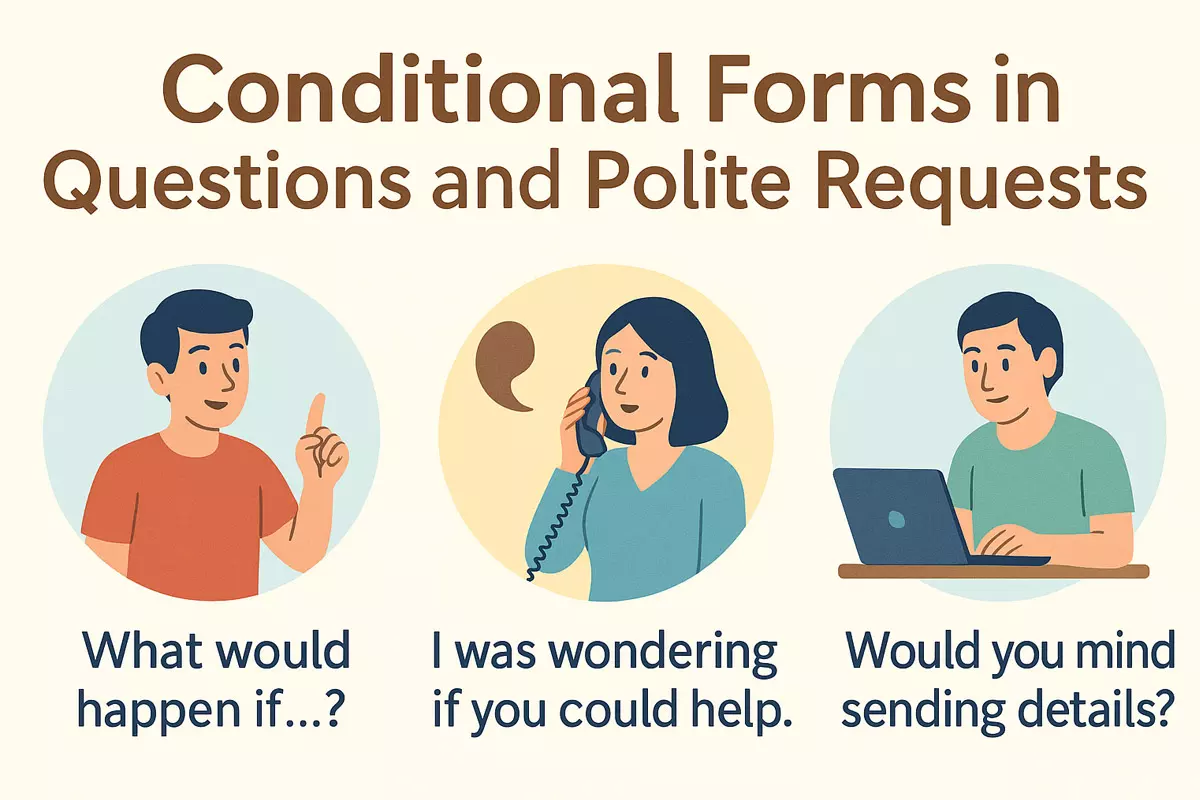 Here we how to use conditionals in indirect or polite questions, including patterns with would, could, and might.
- How conditionals appear in indirect or polite questions
- Patterns with would, could, and might
- Using conditionals to soften requests and suggestions
- Examples from customer service, travel, and workplace contexts
- Common errors with word order in conditional questions
- Practice: rewrite direct questions as conditional polite requests
Navigating everyday conversations involves knowing how to ask for things or seek information politely, and learning to use if-clauses and hypothetical structures can make your questions and requests sound much more courteous. For example, instead of making direct statements or demands, you might say, If you have a moment, could you help me with this? or I would appreciate it if you could send me the details. Using these structures not only shows respect for the other person's time and effort but also helps build positive interactions in both personal and professional settings.
How conditionals appear in indirect or polite questions
When English speakers want to sound more considerate or tactful, they often use conditional forms within indirect questions or requests. Rather than asking directly, the sentence structure becomes softer and more respectful. This is especially common in formal settings, customer service, or when speaking to strangers.
Typical Patterns for Indirect Conditional Questions
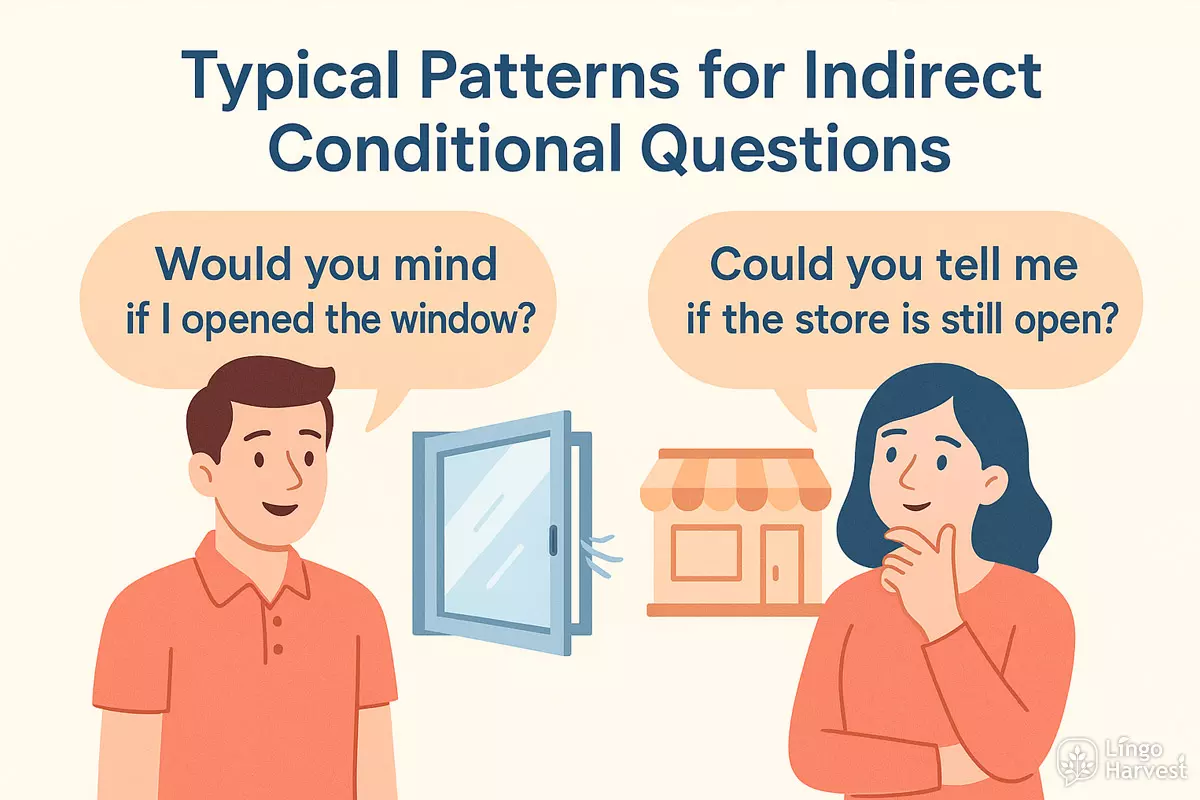
Several patterns are frequently used to build indirect questions with conditionals. Here are some common ways these sentences are structured:
- Would you mind if…? → Would you mind if I opened the window?
- Could you tell me if…? → Could you tell me if the store is still open?
- Do you know whether…? → Do you know whether he has arrived?
- I was wondering if… → I was wondering if you could help me with this task.
- Is it possible that…? → Is it possible that we misunderstood the instructions?
- Would it be all right if…? → Would it be all right if I joined your group?
- Might I ask whether…? → Might I ask whether you have seen my keys?
- Do you think you could…? → Do you think you could lend me your notes?
- Would it bother you if…? → Would it bother you if I sat here?
- If it’s not too much trouble, could you…? → If it’s not too much trouble, could you email me the file?
- Would you be able to… if I…? → Would you be able to watch my bag if I step outside?
- Can you let me know if…? → Can you let me know if anything changes?
- Could you possibly… if…? → Could you possibly help me if I get stuck?
- If you don’t mind, would you…? → If you don’t mind, would you close the door?
- Is there any chance you could… if…? → Is there any chance you could drive me if it rains?
- I’d appreciate it if you could… → I’d appreciate it if you could check this document.
- Would it be possible for you to… if I…? → Would it be possible for you to pick me up if I arrive late?
- May I ask if…? → May I ask if you have finished the report?
How Conditional Forms Change in Polite Requests
In polite language, the modal verbs “would,” “could,” and “might” are often used to introduce a hypothetical or conditional element. The verb tense may shift to the past simple or past continuous to increase politeness. For example:
- Direct: “Can you help me?” → Indirect: “I was wondering if you could help me.”
- Direct: “Will you open the window?” → Indirect: “Would you mind if I opened the window?”
- Direct: “Did you see my email?” → Indirect: “Could you tell me if you saw my email?”
Comparing Direct and Indirect Conditional Questions
| Direct Question | Indirect/Polite Version |
|---|---|
| Can you help me? | I was wondering if you could help me. |
| Will you join us? | Would you be able to join us if you have time? |
| Do you know the answer? | Could you tell me if you know the answer? |
| Is it raining? | Do you know whether it is raining? |
| Can I use your phone? | Would it be all right if I used your phone? |
Tips for Using Conditional Forms in Polite Requests
- Use modal verbs (would, could, might) to create a sense of possibility or politeness.
- Change the verb tense to the past to soften the request (e.g., “if you had time”).
- Start with phrases like “I was wondering if…” to make the question less direct.
- Combine conditional clauses with polite language for extra courtesy.
- Remember that too much indirectness can sometimes cause confusion, so choose the level of formality that fits the situation.
Polite questions using conditionals are a key part of English etiquette, helping speakers show respect and consideration for others.
Patterns with would, could, and might
When forming conditional questions or polite requests in English, using "would," "could," and "might" helps create a softer, more indirect tone. These modal verbs are commonly used to express possibility, permission, or hypothetical situations, making them essential tools for both spoken and written communication. Their placement and combinations can subtly change the meaning or politeness of a sentence.
Common Sentence Structures
Several typical patterns appear when using these modals in questions or requests. Note the placement of the subject and the modal verb:
- Would + subject + base verb...? (e.g., Would you help me?)
- Could + subject + base verb...? (e.g., Could I ask a question?)
- Might + subject + base verb...? (e.g., Might we reschedule?)
- Question word (What/When/Where/How) + would/could/might + subject + base verb...? (e.g., How could I improve this?)
Levels of Formality and Politeness
The choice among "would," "could," and "might" can signal varying degrees of politeness or tentativeness. "Would" often sounds more direct but still polite, "could" suggests ability or permission, and "might" implies the greatest uncertainty or politeness.
| Modal | Typical Use in Questions & Requests |
|---|---|
| Would | Polite requests, offers, or asking preferences (e.g., Would you like some tea?) |
| Could | Seeking permission, polite possibility, or ability (e.g., Could you pass the salt?) |
| Might | Very tentative suggestions or possibilities (e.g., Might I suggest an alternative?) |
Expanded Examples for Practice
To see how these modals function in context, here are some practical examples, ranging from everyday requests to more formal inquiries:
- Would you mind closing the window?
- Could I borrow your notes?
- Would you be able to join us for dinner?
- Might I interrupt for a moment?
- Could you tell me the time?
- Would it be possible to extend the deadline?
- Could you help me with this form?
- Might we discuss this later?
- Would you prefer coffee or tea?
- Could I leave a message?
- Would you explain that again?
- Might I ask a personal question?
- Could you clarify your point?
- Would anyone like to volunteer?
- Could we meet tomorrow?
- Might there be another solution?
- Would you consider another option?
- Could you repeat that, please?
These modal-based structures are useful for making requests sound considerate and for forming conditional questions that avoid directness, which is often valued in English-speaking environments. Adjusting your choice of modal can help you express the right degree of politeness or tentativeness in any situation.
Using conditionals to soften requests and suggestions
When we want to ask for something or make a suggestion in English, using conditional forms can make our language sound more polite and less direct. Instead of issuing commands or making blunt requests, speakers often rely on structures like "could," "would," or "if" clauses. This approach helps avoid sounding too demanding, and it gives the listener more freedom to accept or decline.
Common Conditional Patterns for Politeness
People often choose conditional sentences to gently phrase requests or proposals. Here are some typical patterns:
- If you could send me the report, I would appreciate it.
- Would you mind opening the window?
- Could you help me with this problem?
- If it isn’t too much trouble, would you check this for me?
- I was wondering if you could join us tomorrow.
- If possible, could you call me back?
- Would it be okay if I left a little early today?
- If you have time, could you look over my notes?
- Could I ask you to explain this part again?
- If I were you, I would double-check the figures.
- Do you think you could lend me a hand?
- If you don’t mind, would you close the door?
- Would you be able to finish this by Friday?
- If you happen to see John, could you give him this message?
- Could we possibly reschedule our meeting?
- If you need any help, I’d be happy to assist.
- Would it be possible to get an extension?
- If you’re available, would you like to join us for lunch?
Comparing Direct and Conditional Requests
Direct requests can sometimes sound abrupt, while using conditional language softens the tone and shows consideration. Here’s a comparison of common direct forms and their more tactful conditional equivalents:
| Direct Request/Suggestion | Conditional/Polite Form |
|---|---|
| Send me the file. | If you could send me the file, I’d appreciate it. |
| Help me solve this. | Could you help me solve this? |
| Close the window. | Would you mind closing the window? |
| Meet me at 3 PM. | If you’re free, could we meet at 3 PM? |
| Check this document. | If possible, would you check this document? |
Why Conditional Forms Matter in Communication
Being polite in English is not just about using "please." Conditionals help create space for the other person’s response and show respect for their time or willingness. This is especially important in professional settings, with strangers, or in emails and messages where tone can be easily misunderstood. By using conditional language, speakers can express requests, suggestions, and advice in a way that maintains good relationships and positive interactions.
Examples from customer service, travel, and workplace contexts
Understanding how conditional forms are used in different real-life situations helps learners communicate more effectively and politely. In service industries, travel scenarios, and professional environments, indirect questions and polite requests are common. These forms not only show respect but also help avoid misunderstandings.
Common Patterns in Polite Requests and Questions
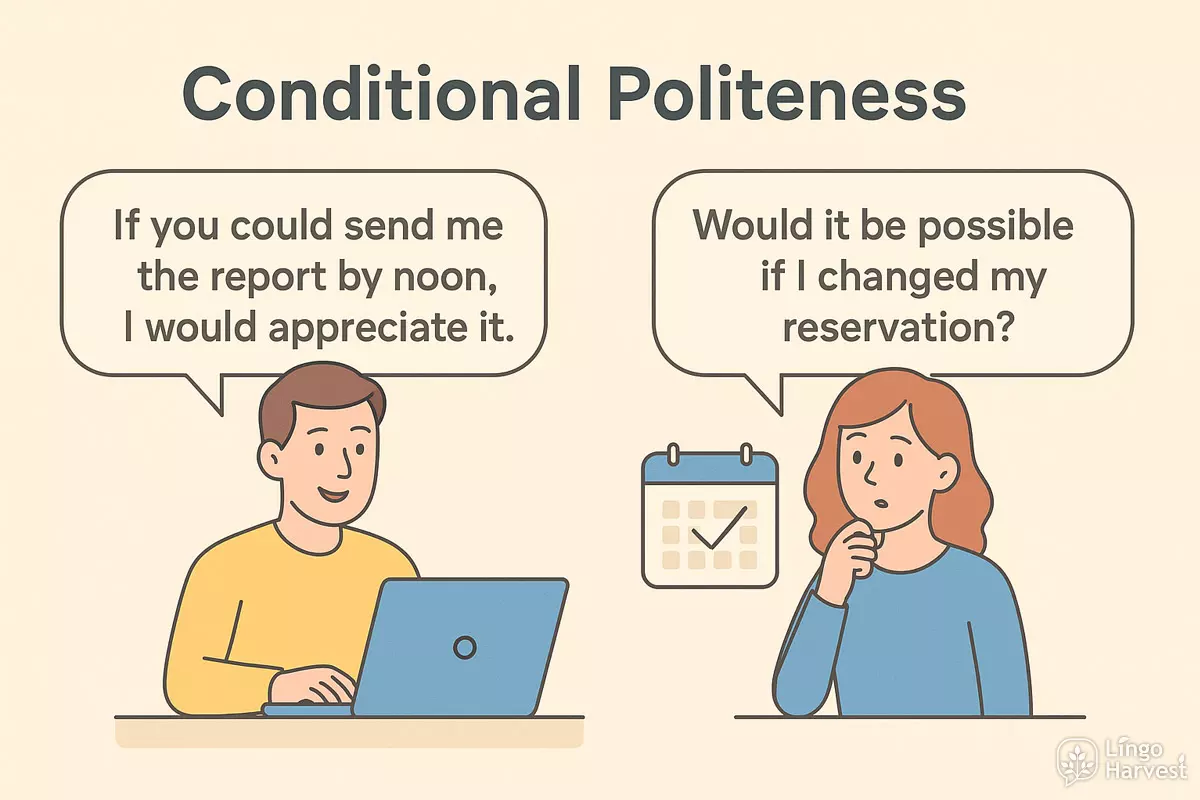
Conditional structures often soften requests or inquiries. Here are some typical patterns you might encounter:
- If you could send me the report by noon, I would appreciate it.
- Would it be possible if I changed my reservation?
- If you happen to have a moment, could you help me with this?
- If there is any way to upgrade my seat, I would be grateful.
- Could you let me know if my package has arrived?
- If you wouldn’t mind, may I ask you a few questions?
- If you need any assistance, please let me know.
- If I could speak to your manager, that would be helpful.
- Would you mind if I joined the meeting remotely?
- If it’s not too much trouble, could you resend the invoice?
- If you are available, would you like to join us for lunch?
- Can you tell me if this flight is on time?
- If you require further information, feel free to contact me.
- Would it be alright if I took tomorrow off?
- If you have any dietary restrictions, please inform the staff.
- If you could hold the line for a moment, I’ll check that for you.
- If you see any errors in the document, could you highlight them?
- If I may ask, how long will the process take?
Comparing Direct and Conditional Requests
Sometimes the difference between a direct request and a more polite, conditional form is subtle but important. The table below shows how these forms can change the tone in various situations:
| Direct Form | Conditional/Polite Form |
|---|---|
| Send me the details. | If you could send me the details, that would be great. |
| I need a late check-out. | Would it be possible if I had a late check-out? |
| Give me a refund. | If a refund is possible, I would appreciate it. |
| Can I sit here? | Would you mind if I sat here? |
| Resend the file. | If it’s not too much trouble, could you resend the file? |
Contextual Tips
When working with people from different backgrounds, using conditional forms can help maintain a positive tone. In customer service, these structures build rapport. When traveling, they show respect for local customs. In the workplace, they help foster collaboration and goodwill. Remember, the choice of form depends on your relationship with the listener and the level of formality needed.
Common errors with word order in conditional questions
Misplacing words in conditional questions is a frequent issue for learners, especially when forming polite requests or hypothetical scenarios. English has specific patterns for these structures, and even small errors can lead to confusion or make a question sound unnatural.
Typical word order mistakes
- Placing the subject before the auxiliary verb (e.g., If you would come, instead of If would you come,).
- Omitting the auxiliary verb in indirect questions (e.g., Could you tell me where is the station? ❌ instead of ...where the station is? ✅).
- Using statement word order in direct questions (e.g., Would you help me if you have time? ✅ vs. You would help me if you have time? ❌).
- Repeating the subject unnecessarily (If would you you help me?).
- Forgetting inversion in polite requests (Could you help me if you would have time? ❌).
- Using "if" at the start of yes/no questions when it is not needed (If will you be coming? ❌).
- Mixing up question and conditional forms (Do you know if will she come? ❌).
- Incorrect order with modal verbs (If can you help me? ❌ instead of Can you help me if...? ✅).
- Using double auxiliaries (If would you can help?).
- Omitting "if" in real conditional questions (Will you come tomorrow you have time? ❌).
Comparing correct and incorrect structures
| Incorrect Example | Correct Example |
|---|---|
| If would you like some tea? | Would you like some tea if...? |
| If can you help me? | Can you help me if...? |
| Would you help me if you will have time? | Would you help me if you had time? |
| Do you know if will she come? | Do you know if she will come? |
| If you would come, I will be happy? | If you came, I would be happy. |
| Could you tell me where is the station? | Could you tell me where the station is? |
Tips to avoid mistakes
- Remember that in direct questions, the auxiliary (would, could, can) comes before the subject.
- In indirect questions, keep the subject before the verb.
- Use "if" to introduce a condition, not to start a yes/no question.
- Do not use more than one auxiliary verb in a single clause.
- Practice with common patterns to build confidence.
Paying attention to these details makes your questions sound more natural and polite, especially in formal or written English. Consistent practice with these structures will help you avoid common pitfalls.
Practice: rewrite direct questions as conditional polite requests
Turning direct questions into conditional forms is a key strategy for sounding more polite in English. Instead of asking someone directly, we often use conditional language to soften the request and make it more indirect. This practice helps in both spoken and written communication, especially in formal or semi-formal situations.
How to Transform Direct Questions
Begin by identifying the main verb and subject of your direct question. Then, rephrase it using conditional forms such as “Could you…”, “Would you mind if…”, or “If possible, could…”. This approach makes your language sound more considerate and less demanding.
- Direct: “Can you help me?” → Conditional: “Could you help me, please?”
- Direct: “Where is the nearest station?” → Conditional: “Would you be able to tell me where the nearest station is?”
- Direct: “Do you have the time?” → Conditional: “Would you happen to have the time?”
- Direct: “Will you send me the document?” → Conditional: “Would you mind sending me the document?”
- Direct: “Is there a bathroom here?” → Conditional: “Could you let me know if there is a bathroom here?”
- Direct: “Can I borrow your pen?” → Conditional: “Would it be possible for me to borrow your pen?”
- Direct: “Are you free tomorrow?” → Conditional: “I was wondering if you might be free tomorrow?”
- Direct: “Do you know his address?” → Conditional: “Would you happen to know his address?”
- Direct: “Will you join us for dinner?” → Conditional: “Would you like to join us for dinner?”
- Direct: “Can you repeat that?” → Conditional: “Could you please repeat that?”
- Direct: “Can you close the window?” → Conditional: “Would you mind closing the window?”
- Direct: “Are you coming to the meeting?” → Conditional: “Would you be able to attend the meeting?”
- Direct: “Do you have a minute?” → Conditional: “If you have a moment, could I speak with you?”
- Direct: “Can I ask you a question?” → Conditional: “Would it be alright if I asked you a question?”
- Direct: “Will you help me move this?” → Conditional: “Would you be willing to help me move this?”
- Direct: “Is this seat taken?” → Conditional: “Would it be okay if I sat here?”
- Direct: “Do you accept credit cards?” → Conditional: “Could you tell me if you accept credit cards?”
- Direct: “Can you explain this?” → Conditional: “Would you mind explaining this to me?”
- Direct: “Are you finished?” → Conditional: “Would you let me know when you’re finished?”
- Direct: “Will you pick me up?” → Conditional: “Would it be possible for you to pick me up?”
Practice Exercise
Try rewriting the following direct questions as polite, conditional requests. Think about which conditional form best fits each situation.
- Can you open the door?
- Do you know where the library is?
- Will you call me later?
- Can I use your phone?
- Is this the right way to the station?
- Can you help me with this?
- Do you know what time it is?
- Can you lend me a pen?
- Will you wait for me?
- Can you show me the menu?
Show answers
- Could you open the door, please?
- Would you happen to know where the library is?
- Would you mind calling me later?
- Would it be alright if I used your phone?
- Could you tell me if this is the right way to the station?
- Would you be able to help me with this?
- Could you tell me what time it is?
- Might you lend me a pen?
- Would you mind waiting for me?
- Could you show me the menu, please?
Common Patterns for Conditional Requests
Using a variety of conditional phrases can help you sound more natural. Here are some useful patterns:
- Would you mind + verb-ing…? → Would you mind closing the window?
- Could you + base verb…? → Could you help me with this task?
- Would it be possible to…? → Would it be possible to reschedule the meeting?
- If you have a moment, could you…? → If you have a moment, could you check this file?
- May I ask if…? → May I ask if you received my message?
- Would you be willing to…? → Would you be willing to join our team?
- Do you think you could…? → Do you think you could explain this again?
- I was wondering if you could… → I was wondering if you could help me move this box.
Practicing these forms will help you communicate requests and questions more politely and effectively in English.