Will and Would as Modal Verbs: Uses and Differences

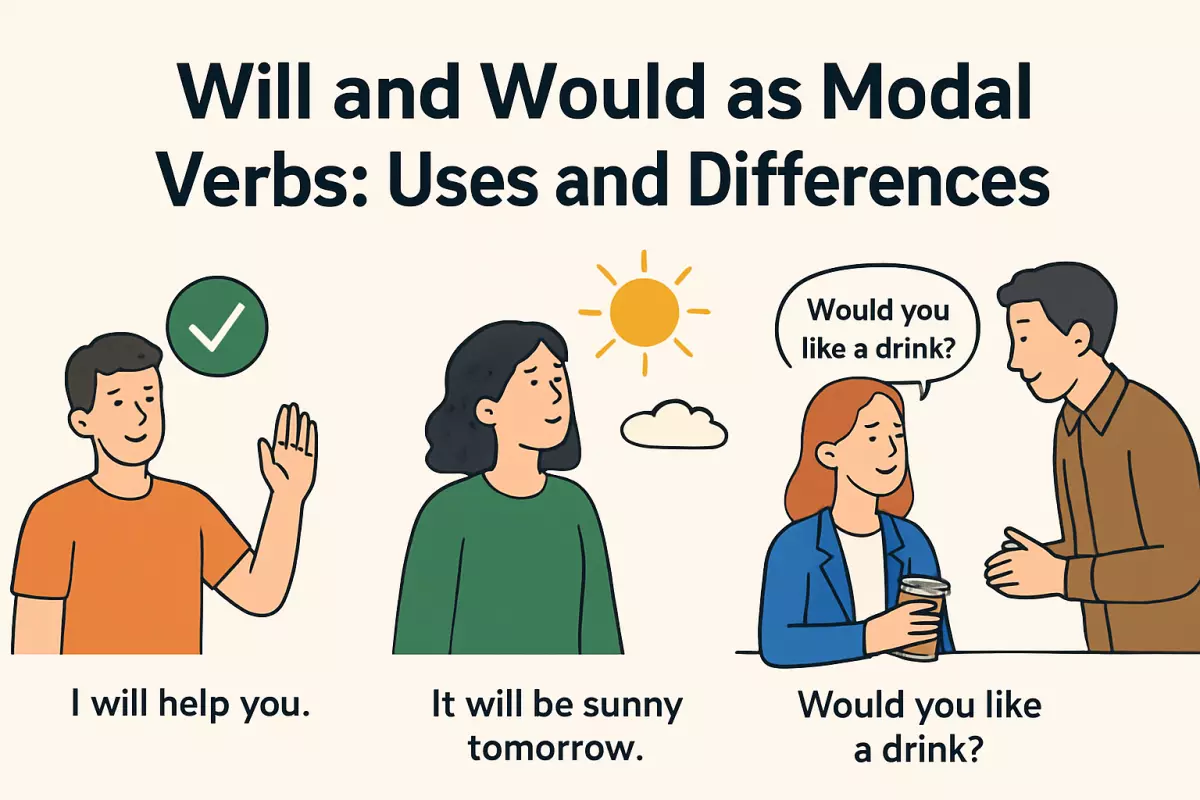 This article explains the basic meanings of will and would, including future predictions and decisions, requests and offers, and past habits with would.
Will and would often puzzle learners because they can express time, intention, preference, or polite distance in everyday speech. This article explains how each one works in real conversations, helping you choose the right form for the situation so you sound clear, natural, and respectful when speaking or writing.
Basic meanings of will and would
Will and would are modal verbs that add meaning such as prediction, intention, willingness, or imagined situations. In many patterns, would is the “more distant” form: it often sounds more polite, more hypothetical, or more tied to a past viewpoint than will.
Core uses of will
Will commonly points to the present or future and is used when the speaker treats something as expected, intended, or decided.
- Prediction / expectation: “It will rain later.”
- Instant decision: “I’ll call you back in five minutes.”
- Promise / commitment: “I will send the file tonight.”
- Offer: “I’ll help you carry that.”
- Request (neutral): “Will you open the window?”
- Willingness: “She will talk to anyone.”
- Refusal (negative willingness): “The car won’t start.”
- Habit (often with emphasis): “He will leave his keys on the table.”
- Certainty about a present situation: “That will be the delivery driver.”
- General truth / typical result: “Oil will float on water.”
- Formal instruction / rule: “Employees will wear ID badges.”
- Strong insistence: “You will apologize.”
Core uses of would
Would often signals distance: it can express a hypothetical idea, a polite stance, or a future-in-the-past perspective. It is also common for repeated past behavior.
- Polite request: “Would you mind closing the door?”
- Polite offer: “Would you like some tea?”
- Preference: “I’d rather stay home.”
- Hypothetical result: “I would travel more if I had time.”
- Imagined situation: “That would be amazing.”
- Advice (softened): “I would wait until tomorrow.”
- Future in the past: “He said he would call later.”
- Past habit / repeated action: “When we were kids, we would play outside for hours.”
- Typical behavior (often critical or ironic): “You would forget your password.”
- Willingness in a conditional sense: “I would help if I could.”
- Refusal in the past: “She wouldn’t listen.”
- Reported speech (backshift): “They promised they would arrive early.”
Quick comparison: what each modal tends to signal
| Meaning area | More typical with will | More typical with would |
|---|---|---|
| Time reference | Present/future viewpoint: “I’ll do it now.” | Past viewpoint or “future in the past”: “He said he’d do it.” |
| Certainty vs. distance | More direct/definite: “That will be John.” | More tentative/hypothetical: “That would be John, I think.” |
| Requests and offers | Neutral: “Will you help me?” | More polite/softened: “Would you help me?” |
| Conditionals | Real/likely condition: “If you call, I’ll answer.” | Unreal/imagined condition: “If you called, I’d answer.” |
| Habit | Typical behavior (often present): “He will interrupt.” | Repeated past action: “He would interrupt in meetings.” |
Common patterns to notice
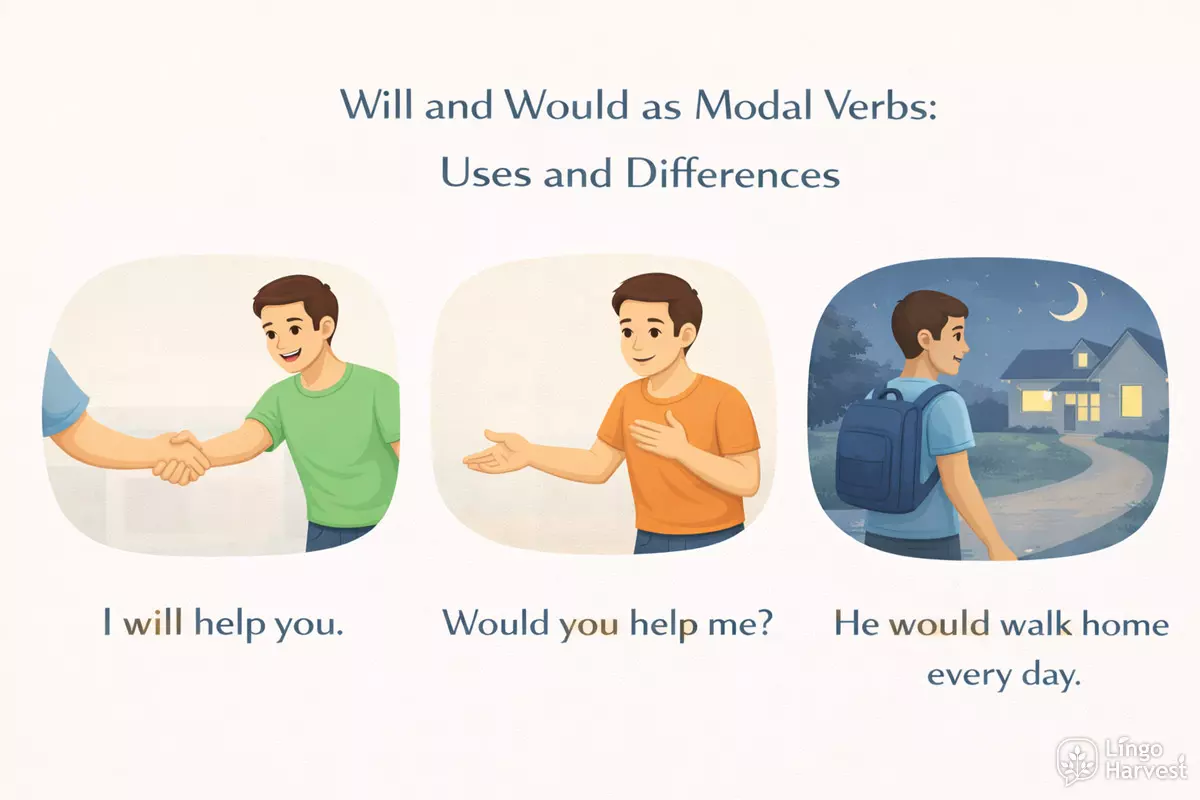
These patterns help you choose the right modal quickly:
- Will + base verb for decisions, promises, predictions: “I’ll email you.”
- Would + base verb for polite language and hypotheticals: “I’d appreciate your help.”
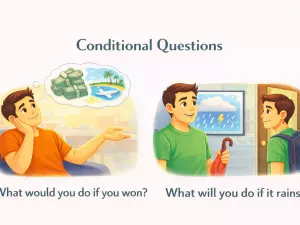
- If + present, will for likely results: “If it rains, we’ll stay in.”
- If + past, would for imagined results: “If it rained, we’d stay in.”
- Say/think + would to report a past plan: “She thought it would be easy.”
Future predictions and decisions
Will is the default modal for talking about what you expect to happen and for making an on-the-spot choice. It often signals a present viewpoint about the future: a forecast, a promise, an offer, or a quick decision made at the moment of speaking.
Using will for predictions
Use will when you are making a general forecast, especially when it is based on your opinion, typical patterns, or what you know right now (not on visible evidence in the moment).
- It will rain later (speaker’s expectation about later).
- Sales will increase next quarter (projection).
- You’ll feel better after some rest (reasonable expectation).
- That plan will fail without more funding (judgment/prediction).
- They’ll arrive around eight (estimate).
- Prices will go up if demand stays high (prediction with condition).
- He’ll probably call tonight (probability marker + will).
- Don’t worry, it will be fine (reassuring forecast).
- In ten years, people will use different tools (future trend).
- If you keep practicing, you’ll improve quickly (future result).
Using will for decisions, offers, and promises
Use will when the decision is made as you speak, or when you commit yourself to an action. This is common in offers, promises, and willingness.
- I’ll answer it (decision made now).
- I’ll help you carry that (offer).
- We’ll send the report today (commitment).
- I’ll call you after the meeting (promise/plan stated as commitment).
- I won’t tell anyone (negative promise).
- Will you open the window? (request).
- I’ll have the salad, please (choice at ordering time).
- Don’t worry, I’ll handle it (taking responsibility).
- I’ll take a look (immediate decision).
- We’ll see what we can do (willingness, not a firm guarantee).
Where would fits: “future in the past” and conditional outcomes
Would is used when the “future” is viewed from a past point in time, or when the outcome depends on a condition. It often appears in reported speech, narratives, and if-clauses (second/third conditional).
- She said she would call later (future from a past viewpoint).
- I knew it would happen eventually (past expectation about a later event).
- They promised they would finish by Friday (reported promise).
- He thought the meeting would be short (past belief).
- If I had time, I would travel more (conditional result).
- I would help if I could (willingness limited by a condition).
- If it rained, the game would be canceled (hypothetical outcome).
- Without your support, we would fail (imagined result).
- It would take hours to fix (estimated consequence in a scenario).
- I would have called, but I lost your number (unreal past result).
Quick pattern cues
- Use will for a present-time forecast or a decision made now: I’ll do it.
- Use would for a later event described from the past: He said he would do it.
- Use would for outcomes that depend on conditions: I would do it if I could.
- In reported speech, will → would is a common backshift: “I will call” → She said she would call.
Requests and offers with will and would
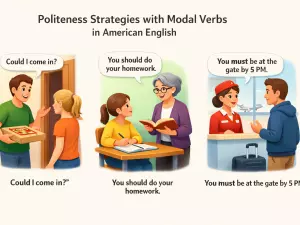
Will and would are common choices for asking someone to do something or offering help. The main difference is tone: will is more direct and practical, while would is more polite, more tentative, or more “distance-creating” (useful with strangers, customers, or formal situations).
Core patterns
These are the most frequent structures. In requests, both modals are followed by the base verb (no to).
- Will you + base verb…? → direct request: “Will you close the window?”
- Would you + base verb…? → polite request: “Would you close the window?”
- Will you please…? → firm but still polite: “Will you please speak more slowly?”
- Would you mind + -ing…? → very polite: “Would you mind waiting a moment?”
- Would you like + to-infinitive…? → offer/invitation: “Would you like to sit down?”
- Will you have…? → offer/order-taking (service contexts): “Will you have tea or coffee?”
- I’ll + base verb… → spontaneous offer: “I’ll carry that for you.”
- Shall I + base verb…? → offer (especially BrE): “Shall I open the door?”
Choosing will vs would (tone and context)
Use will when the situation is informal, urgent, or you expect cooperation. Use would when you want to sound more respectful, when you are asking a favor, or when you are addressing someone you do not know well.
- ✅ “Will you send me the file today?” (workable, direct)
- ✅ “Would you send me the file when you have a moment?” (softer, less pushy)
- ✅ “Will you stop that, please?” (firm; can sound annoyed depending on intonation)
- ✅ “Would you please keep your voice down?” (polite but still clear)
- ❌ “Would you close the window now!” (would clashes with a commanding tone; use a calmer wording or switch to will)
Request examples (common, useful variations)
- Will you hold the door?
- Will you call me when you arrive?
- Will you help me with this box?
- Will you turn the music down?
- Will you check these numbers?
- Would you help me for a minute?
- Would you explain that again, please?
- Would you email me the details?
- Would you be able to meet tomorrow?
- Would you mind speaking a little slower?
- Would you mind not using your phone here?
- Would you please take a seat?
Offers and invitations
For offers, I’ll… often signals a quick decision made at the moment of speaking. Would you like…? is a standard, polite way to offer choices or invite someone to do something.
- I’ll get you a glass of water.
- I’ll give you a hand with that.
- I’ll call a taxi for you.
- Would you like some coffee?
- Would you like to come in?
- Would you like me to take a look?
- Will you have dessert? (service/hosting)
- Will you have a seat? (more formal hosting; can sound brisk in some contexts)
Politeness and clarity tips
- Use please to soften both forms, especially with will: “Will you please wait here?”
- Use could or would when asking for favors from strangers: “Would you tell me where the station is?”
- Avoid over-softening when you need a clear instruction; choose a direct form and keep it respectful: “Will you sign here, please?”
- For negative requests, would you mind not + -ing is often smoother than won’t you: “Would you mind not blocking the doorway?”
Habits in the past with would
Use would to describe repeated actions in earlier times, especially when you are telling a story or recalling routines. It highlights something that happened again and again, not a single event. This use is close in meaning to used to, but it often feels more narrative and is common in sequences of past behavior.
Core pattern and meaning
The basic structure is would + base verb to show a regular action in the past:
- ✅ would + verb: “After school, we would play football in the park.”
- ✅ Often introduced by a past-time frame: “Back then,” “When I was a child,” “In those days,” “Every summer.”
- ❌ Not for single completed events: “I would lose my keys yesterday.” (sounds wrong for a one-time past event)
When it works well (and when it doesn’t)
Would is strongest for actions (things people did). It is less natural for long-term states (things that were true over time), where used to is usually better.
- ✅ Repeated actions: “On Fridays, she would order takeout.”
- ✅ Storytelling sequences: “He would knock, wait, then leave a note.”
- ❌ Past states (often awkward): “We would live near the sea.” → Prefer: “We used to live near the sea.”
- ✅ Past states are possible only in special contexts (often with a clear contrast or repeated situation), but they are not the default choice.
Common time markers and framing
To avoid confusion with conditional would (“I would go if…”), speakers often include a clear past frame. These openers make the habitual meaning immediate:
- When I was younger, …
- Back in college, …
- In those days, …
- Every weekend, …
- Each summer, …
- Whenever it rained, …
- On long winter nights, …
- After dinner, …
- Before work, …
- During the holidays, …
Example sentences (action-focused)
- After lunch, my grandfather would take a short nap in his chair.
- On Sundays, we would visit my aunt and stay for tea.
- Whenever the phone rang, he would jump up to answer it.
- In the summer, they would drive to the lake at dawn.
- At the end of each lesson, the teacher would give us a quick quiz.
- When the train was late, commuters would crowd around the notice board.
- Every New Year’s Eve, our neighbors would set off fireworks.
- During exams, I would study in the library until closing time.
- After practice, the team would stop for sandwiches.
- If the baby cried at night, she would rock him back to sleep.
- On long walks, we would tell the same jokes and laugh anyway.
- In those days, customers would pay in cash and keep the receipt in a wallet.
- Whenever the power went out, we would light candles and play cards.
- Before school, he would feed the dog and fill its water bowl.
- At the first sign of snow, children would run outside to catch flakes.
- After the movie, we would talk about the ending all the way home.
Negatives and questions
For habitual meaning, negatives and questions are possible, but they are less common than affirmative storytelling. Use them when you want to emphasize a repeated absence of behavior or ask about a past routine.
- ✅ Negative: “He wouldn’t eat vegetables when he was a kid.”
- ✅ Negative (more formal): “She would not speak during meetings in those days.”
- ✅ Question (context needed): “Would you walk to school back then?”
- ✅ Question in a narrative: “What would he do after work?”
Quick accuracy checks
- Ask: “Is this a repeated action?” If yes, would is likely suitable.
- Add a past-time frame if the sentence could be mistaken for a conditional.
- If you mean a past state (live, be, have, know), consider used to instead.
- If you mean a one-time past event, use the simple past, not would.
Politeness and indirect speech
In requests and reported language, would often creates distance and softens the message, while will tends to sound more direct and immediate. The choice depends on how formal you want to sound, how much you want to reduce pressure, and whether you are speaking directly or reporting someone’s words later.
Using would to soften requests and offers
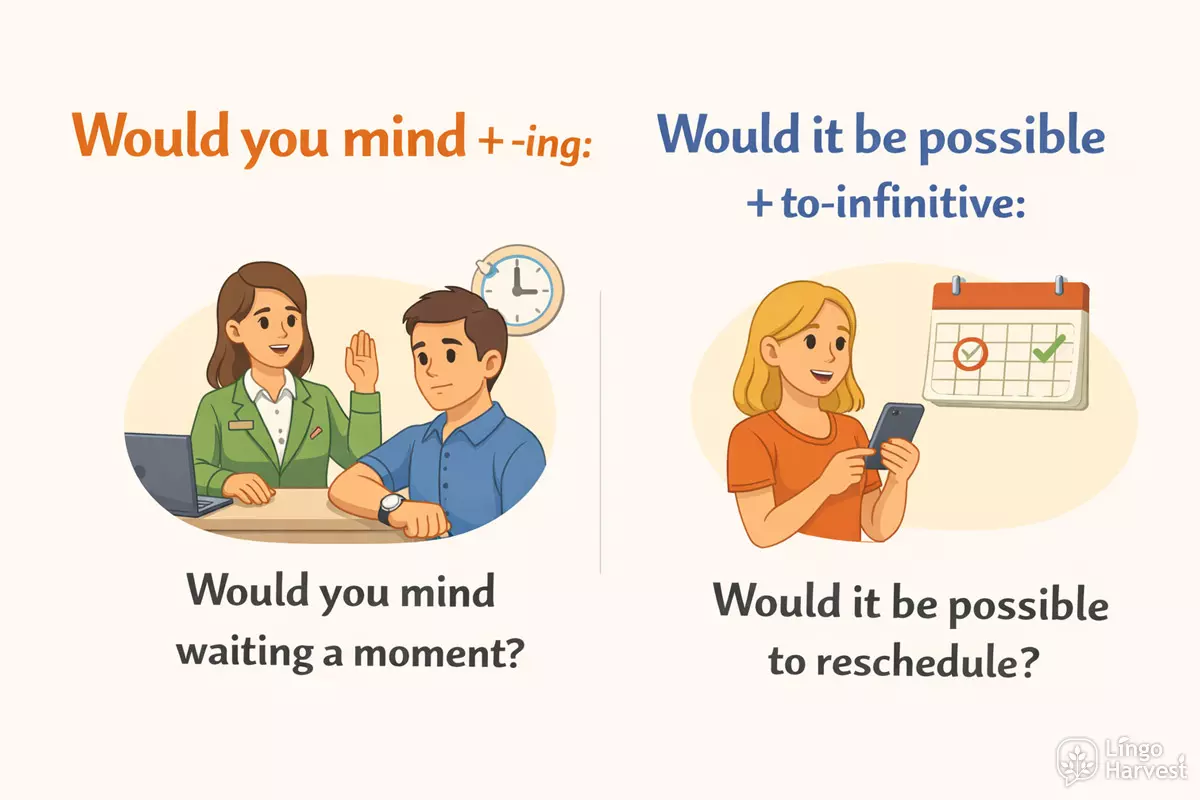
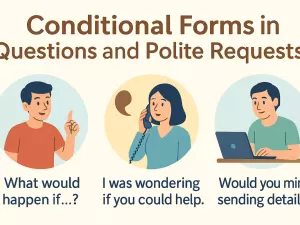
Would is a common tool for making questions and requests less forceful. It can signal respect, uncertainty, or a desire to avoid sounding demanding. This is especially useful with strangers, in customer service, or in workplace communication.
- Would you + base verb: Would you open the window?
- Would you mind + -ing: Would you mind waiting a moment?
- Would it be possible + to-infinitive: Would it be possible to reschedule?
- Would it be OK if + past simple: Would it be OK if I left early?
- Would you be able to + base verb: Would you be able to send the file today?
- I would like + noun/to-infinitive: I would like a receipt, please.
- I’d appreciate it if you could + base verb: I’d appreciate it if you could reply by Friday.
- Would you happen to know…: Would you happen to know the time?
- Would there be any chance + clause/to-infinitive: Would there be any chance to extend the deadline?
- Would you like + noun/to-infinitive (offer): Would you like some tea?
- Would you care to + base verb (formal): Would you care to comment?
- Would it help if + past simple: Would it help if I called instead?
- Would you rather + base verb: Would you rather meet online?
- Would you please + base verb (polite but firm): Would you please sign here?
When will sounds more direct
Will is common for straightforward requests, especially when the situation is casual, urgent, or the speaker has clear authority. It can be perfectly polite in friendly contexts, but it usually feels less “softened” than would.
- Will you + base verb: Will you pass the salt? (often casual)
- Will you please + base verb: Will you please stop talking? (can sound firm or irritated)
- Will you used for immediate coordination: Will you call me when you arrive?
- Will you for instructions: Will you sign at the bottom?
- Will you for strong insistence: Will you listen to me for a second?
Would in indirect questions
Indirect questions often use would to keep the tone tentative. The structure is typically introductory phrase + question word + clause, and the word order stays like a statement (no inversion).
- Could you tell me where it would be held?
- Do you know when she would arrive?
- I was wondering if you would help me with this.
- Would you mind telling me what the next step would be?
- I’d like to know how long it would take.
Reported speech: backshifting from will to would
In reported speech, will commonly changes to would when the reporting verb is in the past. This is a standard “backshift” pattern used to show that the original statement was made earlier.
- Direct: “I will call you later.” → Reported: She said she would call later.
- Direct: “We will finish today.” → Reported: They said they would finish that day.
- Direct: “It will be ready at 3.” → Reported: He said it would be ready at 3.
- Direct: “I will not agree.” → Reported: She said she wouldn’t agree.
- Direct: “Will you help?” → Reported: He asked if I would help.
Note that backshifting is a choice: if the promise or prediction is still clearly true or still relevant now, speakers sometimes keep will instead of changing to would. The more “past and distant” the situation feels, the more natural would becomes.
Negative forms and questions
To make negatives and questions with will and would, use the same auxiliary patterns as other modal verbs: place not after the modal for negatives, and move the modal before the subject for questions. In short answers, repeat the modal (not the main verb).
Core patterns
| Function | Pattern | Example |
|---|---|---|
| Negative (full form) | will/would + not + base verb | I will not agree. / She would not explain. |
| Negative (contraction) | won’t / wouldn’t + base verb | They won’t wait. / He wouldn’t listen. |
| Yes/No question | Will/Would + subject + base verb? | Will you call later? / Would you call later? |
| Wh-question | Wh-word + will/would + subject + base verb? | When will it start? / Why would she say that? |
| Negative question | Won’t/Wouldn’t + subject + base verb? | Won’t you join us? / Wouldn’t you prefer tea? |
| Short answer | Yes/No + subject + will/would (not) | Yes, I will. / No, she won’t. / No, I wouldn’t. |
Contractions and form notes
In writing and speech, contractions are common and often sound more natural. Use full forms for emphasis, formality, or clarity.
Common forms: will not → won’t; would not → wouldn’t. Avoid double negatives such as won’t never in standard English.
Usage tips for questions
Will questions often ask about willingness, intention, or a likely future event, while would questions are typically more tentative, polite, or hypothetical. The grammar is the same; the difference is the speaker’s stance.
Negative questions can sound like invitations, expectations, or mild surprise depending on context and intonation. For example, Won’t you…? can function as a warm prompt, while Wouldn’t you…? can suggest that something seems reasonable or expected.
Common mistakes with will and would
Many errors with these modals come from mixing time reference (present vs. past), confusing politeness with certainty, or using the wrong form in conditionals and reported speech. The fixes are usually pattern-based: check whether you are predicting, promising, requesting, imagining, or reporting someone’s words.
1) Using would for a real, present prediction
Would typically points to a hypothetical situation or a past viewpoint, not a straightforward prediction about now.
- ❌ It would rain tomorrow. → ✅ It will rain tomorrow. (prediction)
- ❌ I think she would be late. → ✅ I think she will be late. (likely future)
- ✅ It would rain if the wind changed. (conditional, hypothetical)
2) Using will in second conditional sentences
In the classic second conditional, the main clause uses would, not will. Use will only if you mean willingness/insistence rather than the conditional result.
- ❌ If I had more time, I will travel more. → ✅ If I had more time, I would travel more.
- ❌ If she studied, she will pass. → ✅ If she studied, she would pass.
- ✅ If he will listen for a minute, we can solve this. (meaning: “is willing to”)
3) Confusing would (polite request) with will (neutral request)
Both can be used for requests, but would usually sounds more tentative and polite, especially with strangers or formal situations.
- ✅ Will you open the window? (neutral)
- ✅ Would you open the window? (more polite)
- ❌ Would you like to open the window? (different meaning: asking about preference, not requesting action)
4) Overusing would in reported speech
In reported speech, will often shifts to would, but not always. Keep will if the future is still true/relevant, or if you are reporting a fixed schedule or a fact you still accept.
- ✅ Direct: “I will call you.” → Reported: He said he would call me. (backshift)
- ✅ She said the meeting will start at 10. (still true now / schedule)
- ❌ He said he would be 18 next month. → ✅ He said he will be 18 next month. (still in the future from now)
5) Mixing up would for past habit with would for a single past event
Would can describe repeated past behavior, but it does not normally describe a one-time past action. It also needs a clear past-time context.
- ✅ When we lived by the sea, we would walk on the beach every evening. (repeated habit)
- ❌ Yesterday, I would go to the store. → ✅ Yesterday, I went to the store. (single completed action)
- ❌ I would play tennis. (no past context) → ✅ I used to play tennis when I was younger. (clear past habit)
6) Using will in the if-clause for real conditions
For real future conditions, the if-clause usually takes present simple, not will. Use will in the if-clause mainly for willingness, refusal, or insistence.
- ❌ If it will rain, we’ll stay home. → ✅ If it rains, we’ll stay home.
- ✅ If you will wait here, I’ll get the manager. (willingness)
- ✅ If the car won’t start, call me. (refusal/“won’t” as unwillingness)
7) Forgetting that will can express intention, not only future time
Will often signals a decision made at the moment of speaking or a promise. Learners sometimes choose would and accidentally make the meaning hypothetical.
- ❌ I would help you with that. (sounds conditional/uncertain) → ✅ I will help you with that. (promise)
- ❌ I would call you now. → ✅ I will call you now. (decision now)
8) Using would where could or might is needed
Would is not the best choice for ability or weak possibility. Use could for ability/option and might for uncertain possibility.
- ❌ I would swim when I was five. → ✅ I could swim when I was five. (ability)
- ❌ It would be true. → ✅ It might be true. (uncertainty)
- ✅ It would be true if we had the full data. (conditional)
9) Misplacing not and contractions in negatives
Negatives are formed with will not / would not (often contracted). Avoid double negatives and keep the contraction meaning clear.
- ✅ I won’t agree to that. / I will not agree to that.
- ✅ She wouldn’t tell me. / She would not tell me.
- ❌ I won’t not go. → ✅ I will go. (or: I won’t stay.)
10) Treating would as “more formal future” in all contexts
Would is not simply a formal version of will. It usually signals distance: hypothetical meaning, politeness, or a past viewpoint.
- ❌ I would see you tomorrow at 3. (sounds conditional) → ✅ I will see you tomorrow at 3. (plan/arrangement)
- ✅ I would see you tomorrow at 3, but I have a meeting. (implied condition/obstacle)
Homework: will and would practice tasks
Use these tasks to build accuracy with will and would across the most common patterns: predictions, decisions, offers, requests, habits, and conditionals. Focus on meaning first, then check the grammar signals (time reference, politeness level, and whether the situation is real or imagined).
1) Choose the best modal (will / would)
Select the option that fits the context best.
- I think it will / would rain later, so take an umbrella.
- When we were kids, we will / would play outside until dark.
- “The phone’s ringing.” “I will / would get it.”
- Will / Would you mind closing the window?
- If I had more time, I will / would learn another language.
- She said she will / would call me after the meeting.
- That will / would be Tom at the door (I’m sure).
- In those days, my grandfather will / would always tell the same story.
- Will / Would you help me carry this box, please?
- I didn’t expect they will / would agree so quickly.
- Don’t worry—this pain will / would go away soon.
- She’s very private; she will / would not talk about her family.
Show answers
- will
- would
- will
- would
- would
- would
- will
- would
- will
- would
- will
- will
2) Rewrite to change tone (neutral → more polite)
Rewrite each sentence using would to make it more polite or less direct. Keep the meaning.
- Will you send me the file today?
- Will you wait here for a moment?
- Will you explain that again?
- Will you open the door?
- Will you tell me your name?
- Will you help us with this form?
- Will you turn the music down?
- Will you call me when you arrive?
Show answers
- Would you send me the file today?
- Would you wait here for a moment?
- Would you explain that again?
- Would you open the door?
- Would you tell me your name?
- Would you help us with this form?
- Would you turn the music down?
- Would you call me when you arrive?
3) Complete the conditional patterns
Fill the gaps with will or would. Pay attention to whether the condition is real (likely) or unreal (imagined).
- If you study regularly, you ______ pass the exam.
- If I see her, I ______ tell her you called.
- If I were you, I ______ talk to the manager.
- If we had a bigger budget, we ______ hire another designer.
- If it stops raining, we ______ go for a walk.
- If he knew the answer, he ______ say it.
- If you don’t leave now, you ______ miss the train.
- If I had known earlier, I ______ have helped.
Show answers
- will
- will
- would
- would
- will
- would
- will
- would
4) Error correction (find and fix the mistake)
Each sentence has one problem with will or would. Rewrite it correctly.
- If I will have time, I would visit you.
- Would you like some help? Yes, I would.
- When I was a student, I will study in the library every night.
- I think he would be late tomorrow.
- She said she will be here at 6, but she arrived at 7.
- Will you mind if I open the window?
- If you would press this button, the machine starts.
- He would not answer the email yesterday, so I called him.
Show answers
- If I have time, I will visit you. or If I had time, I would visit you.
- Would you like some help? Yes, I would like some help. or Yes, please.
- When I was a student, I would study in the library every night. or I used to study in the library every night.
- I think he will be late tomorrow.
- She said she would be here at 6, but she arrived at 7.
- Would you mind if I open the window?
- If you press this button, the machine starts. or If you press this button, the machine will start.
- He did not answer the email yesterday, so I called him. or He would not answer the email, so I called him. (refusal)
5) Production task (short writing)
Write one short paragraph (70–110 words) that includes all of the following:
- One prediction about the future using will.
- One spontaneous decision using will (made at the moment of speaking).
- One polite request using would.
- One unreal conditional using would (second conditional).
- One past habit using would (or replace it with used to if you prefer, but keep at least one would in the paragraph).
After writing, underline each modal verb and label its function (prediction, decision, request, unreal conditional, past habit).