Zero Conditional: Facts, Rules, and Daily Routines

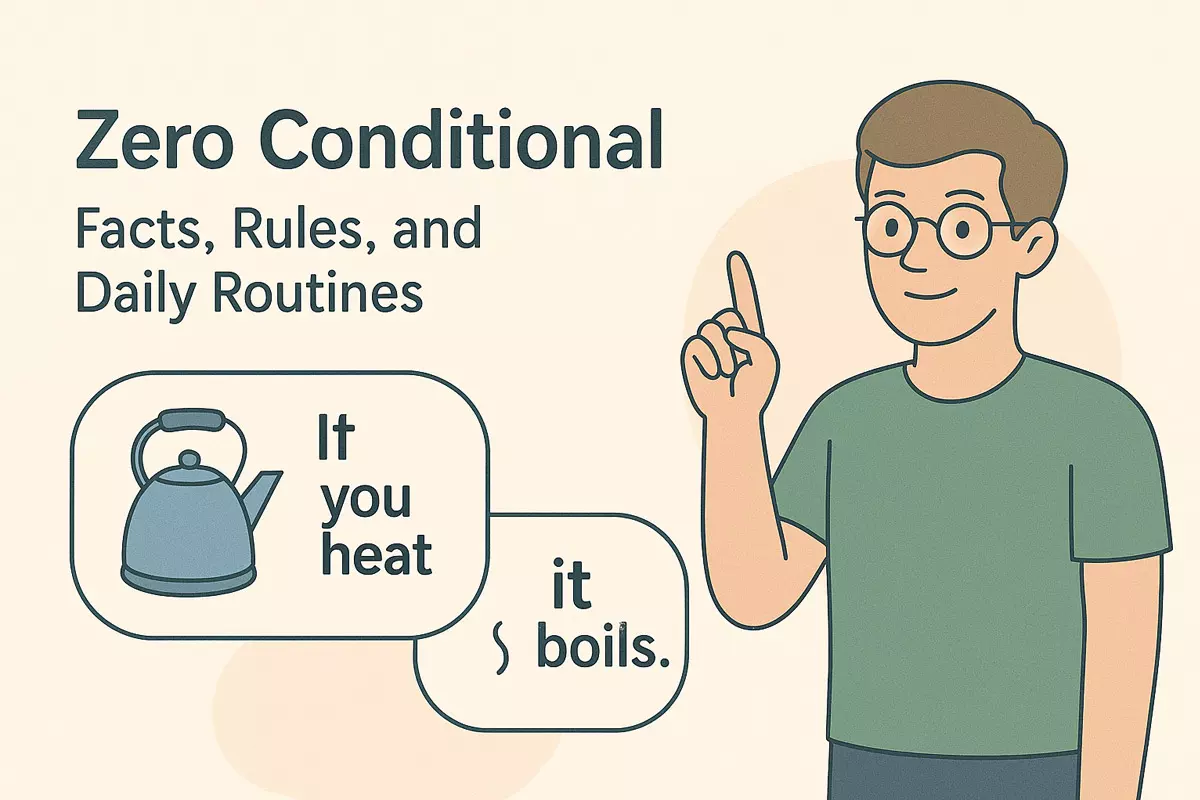 This article explains the zero conditional’s meaning, its present simple form, and how it’s used for general truths, facts, instructions, and routines. It also covers common mistakes and provides practice with zero conditional sentences.
Expressing universal truths, habits, and instructions in English becomes much easier when you understand the correct grammatical structures. This article explains how to use the simple present tense to discuss facts that are always true, describe daily routines, and give instructions clearly. By mastering this pattern, you can communicate more confidently about things that happen regularly or are universally accepted. With practice, forming these sentences will feel natural, allowing you to share information and directions effectively in everyday situations.
Meaning and purpose of the zero conditional
When we talk about facts, general truths, or things that always happen under certain conditions, English uses a specific structure called the zero conditional. This pattern is especially useful for describing cause-and-effect relationships that are always true, such as scientific facts, routines, or rules. It helps speakers express what regularly happens when something else occurs, without suggesting any uncertainty or possibility.
When do we use this structure?
The zero conditional is commonly used in the following situations:
- Stating scientific facts: If you heat water to 100°C, it boils.
- Explaining rules and instructions: If the light is red, you must stop.
- Describing habits and daily routines: If I wake up early, I drink coffee.
- Making general statements about the world: If it rains, the grass gets wet.
- Talking about things that are always true: If you mix red and blue, you get purple.
How does the zero conditional work?
This structure follows a simple pattern: both the condition and the result use the present simple tense. The “if” clause presents the condition, and the main clause shows the result. There’s no suggestion of chance or future possibility—these are statements of fact.
| Condition (If-clause) | Result (Main clause) |
|---|---|
| If you freeze water | it turns to ice. |
| If people don’t eat | they get hungry. |
| If the sun sets | it gets dark. |
| If students study hard | they do well in exams. |
| If you press this button | the machine starts. |
| If it snows | the roads become slippery. |
| If you touch fire | it burns. |
| If cats are hungry | they meow. |
| If a plant doesn’t get water | it dies. |
| If you drop a glass | it breaks. |
Main functions in communication
This form is practical for:
- Giving instructions that apply all the time
- Making classroom or workplace rules clear
- Sharing universal truths or laws of nature
- Describing routines and predictable outcomes
- Clarifying what happens in specific conditions, without exception
In summary, this conditional helps speakers express reliable, repeatable outcomes. It’s a key tool for anyone needing to talk about facts, rules, or patterns in everyday life or academic contexts.
Form: present simple + present simple
The zero conditional structure uses the present simple tense in both the if-clause and the main clause. This format is preferred when you want to express general truths, scientific facts, or routines that always happen under certain conditions. Both parts of the sentence remain in the present simple, making the pattern straightforward and consistent.
How the Structure Works
To build a zero conditional sentence, start with if followed by a subject and a verb in the present simple. The result clause also uses the present simple tense. The order of the clauses can be reversed without changing the meaning, but a comma is needed if the 'if' clause comes first.
-
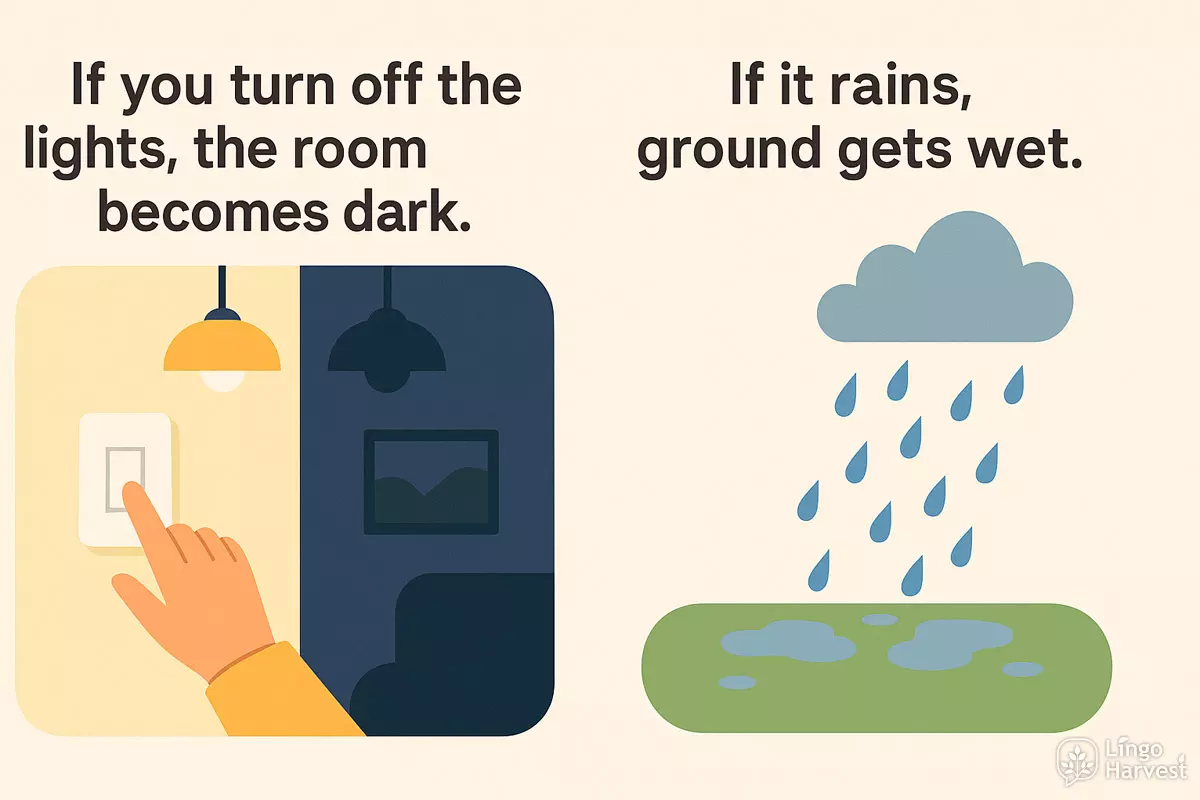
If you turn off the lights, the room becomes dark.
- If it rains, the ground gets wet.
- If people eat too much, they gain weight.
- If you mix red and blue, you get purple.
- If the sun sets, it gets dark.
- If you touch fire, you get burned.
- If you don’t water plants, they die.
- If students study, they improve.
- If I wake up late, I miss the bus.
- If cats see a bird, they chase it.
- If you press this button, the light turns on.
- If ice melts, it turns into water.
- If you drop glass, it breaks.
- If dogs are hungry, they bark.
- If you don’t exercise, you feel tired.
- If you freeze water, it becomes ice.
- If you add sugar, the tea tastes sweeter.
- If the phone rings, I answer it.
- If the alarm goes off, we leave the building.
- If you read before bed, you fall asleep faster.
Key Points to Remember
- Both clauses use the present simple tense.
- The condition and the result are always true; they are not about the future or hypothetical situations.
- You can swap the clauses: “The ground gets wet if it rains.”
- No modal verbs (like “will,” “can,” or “might”) are used in either part.
Form Comparison: If-Clause and Main Clause
| If-Clause (Condition) | Main Clause (Result) |
|---|---|
| If you heat ice | it melts. |
| If people sleep well | they feel better. |
| If you don’t water flowers | they die. |
| If children see sweets | they want them. |
| If dogs hear a noise | they bark. |
This consistent use of the present simple in both parts makes zero conditional sentences easy to construct and understand, especially when talking about facts, rules, or everyday routines.
How it expresses general truths, facts, and instructions
The zero conditional is commonly used to state things that are always or generally true. Because it relies on the present simple tense in both clauses, this structure is perfect for expressing scientific facts, habitual actions, and established rules. When you want to describe something that happens every time a condition is met, the zero conditional provides a clear and direct way to do it.
Expressing General Truths and Facts
Zero conditional sentences often describe universal truths—statements that are valid at all times for everyone. For example, scientific laws and basic realities fit this pattern. Here are some typical uses:
- If water reaches 100°C, it boils.
- If you freeze water, it turns to ice.
- If the sun sets, it gets dark.
- If iron is exposed to moisture, it rusts.
- If you mix red and blue, you get purple.
- If plants don’t get sunlight, they die.
- If you drop an object, it falls.
- If you heat ice, it melts.
- If you add sugar to tea, it becomes sweet.
- If you touch fire, it burns.
These examples show how the zero conditional is ideal for expressing facts that do not change.
Giving Instructions or Rules
This structure is also used for instructions, especially when the result always follows the condition. It’s common in manuals, recipes, and classroom rules:
- If the alarm rings, leave the building immediately.
- If you finish your work, hand it in to the teacher.
- If you want to save the file, click this button.
- If you see a spill, clean it up.
- If the phone rings, answer it.
- If the light turns red, stop.
- If you are late, sign the late sheet.
- If you don’t understand, ask for help.
- If you make a mistake, erase it and try again.
- If you’re not sure, check with a supervisor.
Daily Routines and Habits
Regular activities and routines are often described using the zero conditional to show what typically happens in certain situations:
- If I wake up late, I skip breakfast.
- If it rains, we take the bus to school.
- If she finishes early, she reads a book.
- If they have time, they call their parents.
- If I don’t set an alarm, I oversleep.
- If we go shopping, we buy fresh fruit.
- If the kids are hungry, they make sandwiches.
- If he has a meeting, he leaves home at 7.
- If my phone battery is low, I charge it at work.
- If the weather is good, we eat outside.
Structure at a Glance
To summarize how this conditional works, here’s a quick overview of its form:
| Condition (If...) | Result |
|---|---|
| If you heat ice | it melts. |
| If students are late | the teacher marks them absent. |
| If you mix yellow and blue | you get green. |
| If it rains | the grass gets wet. |
By using this structure, you can clearly communicate rules, facts, and routines that everyone understands and follows. The zero conditional makes your statements precise and universally applicable.
Examples from science, habits, and routines
Zero conditional sentences are used to state general truths, scientific facts, and patterns that always happen under certain conditions. This structure is especially common when discussing natural laws, daily behaviors, or instructions. The format is simple: if + present simple, present simple.
Scientific Facts in Zero Conditional
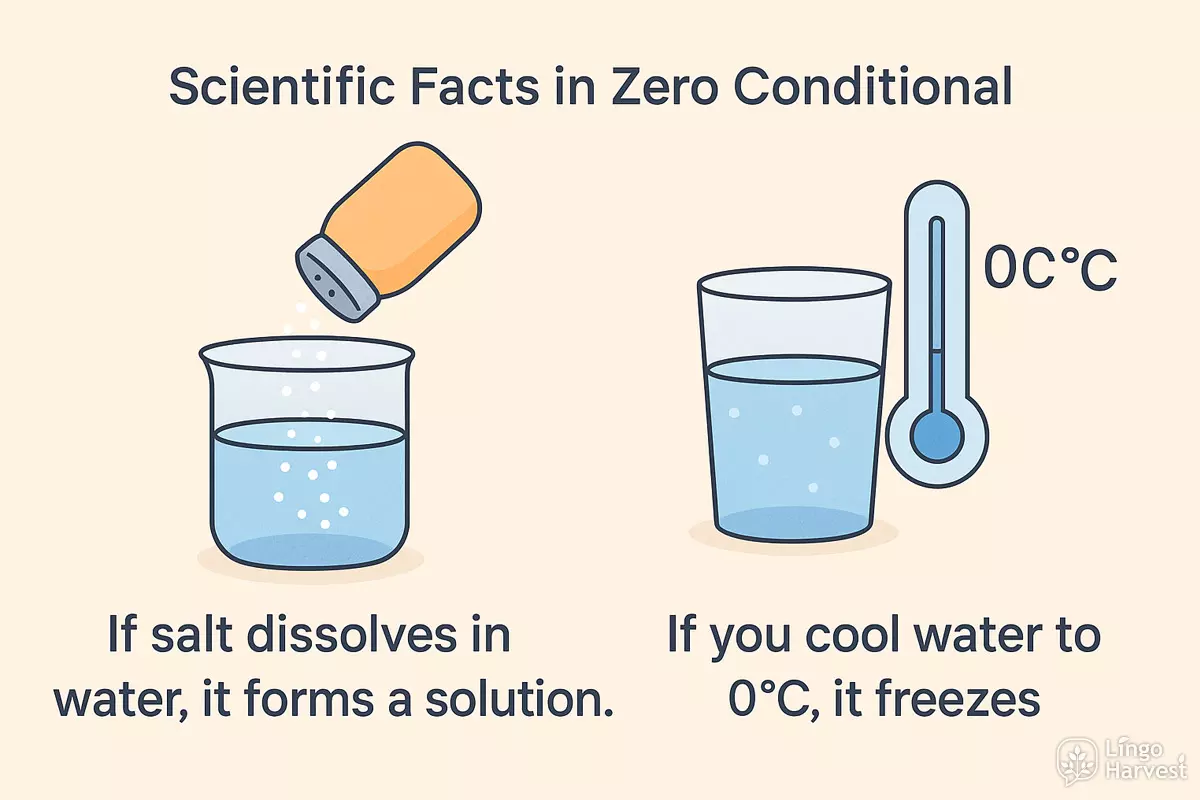
Science relies on statements that are always true under specific circumstances. Here are some classic examples:
- If salt dissolves in water, it forms a solution.
- If you cool water to 0°C, it freezes.
- If metal is exposed to water and air, it rusts.
- If plants do not get sunlight, they die.
- If vinegar touches baking soda, it foams.
These sentences express laws or results that don’t change, making the zero conditional a natural fit.
Habits and Routines
Daily routines and habits also use the zero conditional to describe what regularly happens in specific situations.
- If I wake up late, I skip breakfast.
- If she finishes work early, she goes for a walk.
- If it rains, we stay indoors.
- If my brother is hungry, he eats cereal.
- If the school bell rings, students go to class.
Each sentence shows the predictable outcome of a given situation.
Rules and Instructions
Zero conditional is often found in rules, guidelines, and instructions because these need to be clear and universally applicable.
| Situation | Result |
|---|---|
| If you press this button | The machine starts |
| If the alarm sounds | Leave the building |
| If students are late | They get a warning |
| If the traffic light is red | Cars stop |
| If you don’t water the plant | It dies |
These patterns help convey rules and consequences simply and directly. In summary, the zero conditional is essential for talking about things that are always true, whether in science, routines, or rules.
Common mistakes with tense choice and comma use
Learners often run into trouble with the zero conditional because of confusion about which verb tense to use and where to place commas. Since this structure is used to talk about facts, rules, and routines, it’s important to follow standard patterns. Let’s break down typical slip-ups and how to avoid them.
Mixing Up Verb Tenses
The zero conditional always uses the present simple tense in both clauses. Using other tenses is a frequent error. Review these examples:
- ❌ If ice will melt, it turns into water.
- ✅ If ice melts, it turns into water.
- ❌ If you will touch fire, you get burned.
- ✅ If you touch fire, you get burned.
- ❌ If metal will get wet, it rusts.
- ✅ If metal gets wet, it rusts.
- ❌ If plants will lack sunlight, they die.
- ✅ If plants lack sunlight, they die.
- ❌ If the alarm will ring, students leave the room.
- ✅ If the alarm rings, students leave the room.
Mistakes usually happen because learners confuse the zero conditional with first or second conditionals, where different tenses are used.
Incorrect Comma Placement
Comma use in conditional sentences depends on clause order. Place a comma only if the if-clause comes first. Avoid unnecessary commas when the main clause starts the sentence. Here’s how it works:
| Clause Order | Comma Needed? |
|---|---|
| If-clause first If it rains, the grass gets wet. |
Yes, use a comma after the if-clause. |
| Main clause first The grass gets wet if it rains. |
No comma needed. |
Common Patterns to Watch For
- Using will or would in either clause (incorrect for zero conditional)
- Starting with the main clause but adding a comma before the if-clause (unnecessary)
- Using past tense verbs instead of present simple
- Forgetting to use present simple in both clauses
- Changing verb forms between clauses (e.g., “If you eat chocolate, you got spots”)
- Misplacing the comma when the clause order is reversed
- Omitting the comma when the if-clause comes first
- Using continuous or perfect tenses
- Replacing “if” with “when” incorrectly (sometimes possible, but meanings differ)
- Adding extra words that change the meaning from a general fact to a specific situation
Paying close attention to verb form and punctuation will help you use zero conditional sentences accurately and naturally in English.
Practice: complete and create zero conditional sentences
Understanding how to use zero conditional sentences is crucial for expressing facts, rules, and routines in English. This section provides interactive exercises and examples to help you master this structure in everyday contexts.
Complete the sentences
Fill in the blanks with the correct form of the verbs in brackets to make zero conditional sentences. Remember: use the present simple tense in both clauses.
- If you ________ (heat) water to 100°C, it ________ (boil).
- When people ________ (touch) fire, they ________ (get) burned.
- If it ________ (rain), the grass ________ (get) wet.
- When students ________ (arrive) late, the teacher ________ (mark) them absent.
- If you ________ (mix) red and blue, you ________ (get) purple.
- If ice ________ (melt), it ________ (turn) into water.
- When cats ________ (see) a mouse, they ________ (chase) it.
- If you ________ (exercise) regularly, you ________ (feel) healthier.
- If the sun ________ (set), it ________ (get) dark.
- When the alarm ________ (go) off, people ________ (leave) the building.
Show answers
- heat, boils
- touch, get
- rains, gets
- arrive, marks
- mix, get
- melts, turns
- see, chase
- exercise, feel
- sets, gets
- goes, leave
Create your own zero conditional sentences
Write sentences about facts, scientific truths, or routines using the zero conditional structure. Try to use a variety of subjects and verbs.
- If you freeze water, it turns to ice.
- When I wake up late, I miss the bus.
- If cats see a bird, they chase it.
- When the sun sets, it gets dark.
- If you add sugar to tea, it becomes sweet.
- When dogs bark, people wake up.
- If plants get sunlight, they grow.
- When you dial 911, emergency services answer.
- If you press this button, the machine starts.
- When children eat too much candy, they feel sick.
- If you don’t water flowers, they die.
- When the bell rings, students go to class.
Identify the zero conditional pattern
Look at the sentences below. Decide which ones are zero conditional (✅) and which are not (❌).
- If you drop glass, it breaks.
- If I have time tomorrow, I will call you.
- When water boils, it turns to steam.
- If it rains tomorrow, I’ll stay home.
- If people eat too much, they gain weight.
- If metal gets wet, it rusts.
- If you press this button, the light turns on.
- If I finish early, I will meet you.
- If ice melts, it turns into water.
- If the bus is late, I will take a taxi.
Show answers
- ✅ If you drop glass, it breaks.
- ❌ If I have time tomorrow, I will call you. (First conditional)
- ✅ When water boils, it turns to steam.
- ❌ If it rains tomorrow, I’ll stay home. (First conditional)
- ✅ If people eat too much, they gain weight.
- ✅ If metal gets wet, it rusts.
- ✅ If you press this button, the light turns on.
- ❌ If I finish early, I will meet you. (First conditional)
- ✅ If ice melts, it turns into water.
- ❌ If the bus is late, I will take a taxi. (First conditional)
Zero conditional sentence structure
The table below summarizes the basic structure and variations of zero conditional statements:
| Pattern | Example |
|---|---|
| If + present simple, present simple | If you heat ice, it melts. |
| When + present simple, present simple | When people feel tired, they rest. |
| Present simple if + present simple | Plants die if they don’t get water. |
| Present simple when + present simple | It smells nice when you bake bread. |