How to Use If for Real Conditions (Beginner Guide)

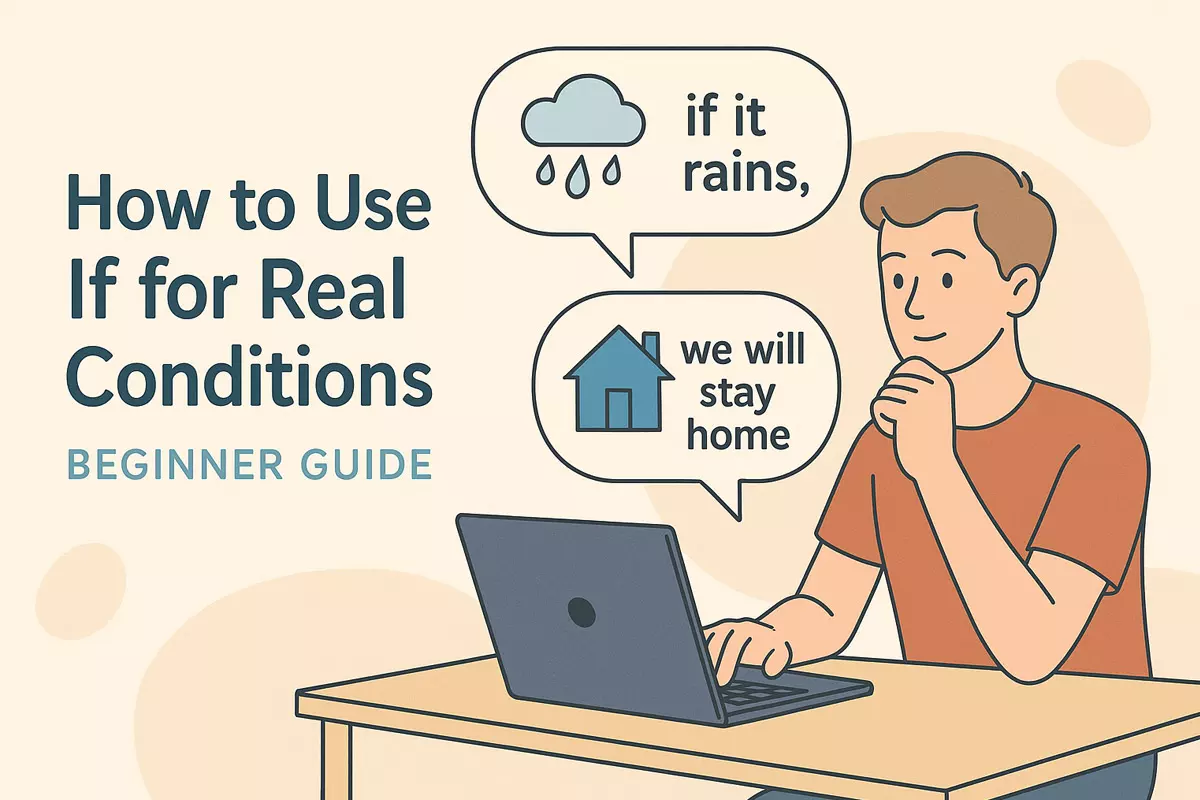 Here we how real conditional sentences work, when to use if in real-life situations, patterns for advice and predictions, sentence placement, common mistakes with will, and includes practice rewriting sentences to show correct real conditions.
- What real conditions are and how they work
- When to choose if for real-life situations
- Simple patterns for giving advice, instructions, and predictions
- Using if at the beginning vs in the middle of a sentence
- Mistakes to avoid with will in the if-clause
- Practice: rewrite sentences to show correct real conditions
Mastering conditional statements is essential for beginners who want their code to respond intelligently to different situations. This guide provides a clear and approachable introduction to the basics, explaining how conditional logic allows your programs to make decisions based on specific conditions or inputs. By learning how to use conditional statements effectively, you will be able to write code that adapts to various scenarios, making your programs more flexible and interactive. With practice, you will gain the confidence to tackle more complex problems and develop software that reacts appropriately to real-world events.
What real conditions are and how they work
Understanding "real conditions" means recognizing how decisions are made based on actual, observable facts or situations, rather than just theoretical or made-up examples. In programming or logic, a "real condition" is something that can be evaluated as true or false based on data, user actions, or system states. This is the foundation for using if statements: you check a condition, and then decide what to do next.
How conditions function in practice
When you write an if statement, you are telling the computer: "Only do this next step if a certain thing is true." The condition inside the if (like score > 50 or user_is_logged_in) is checked every time your code runs. If the condition matches what's happening in the real world (the actual data or state), then the code inside the block runs.
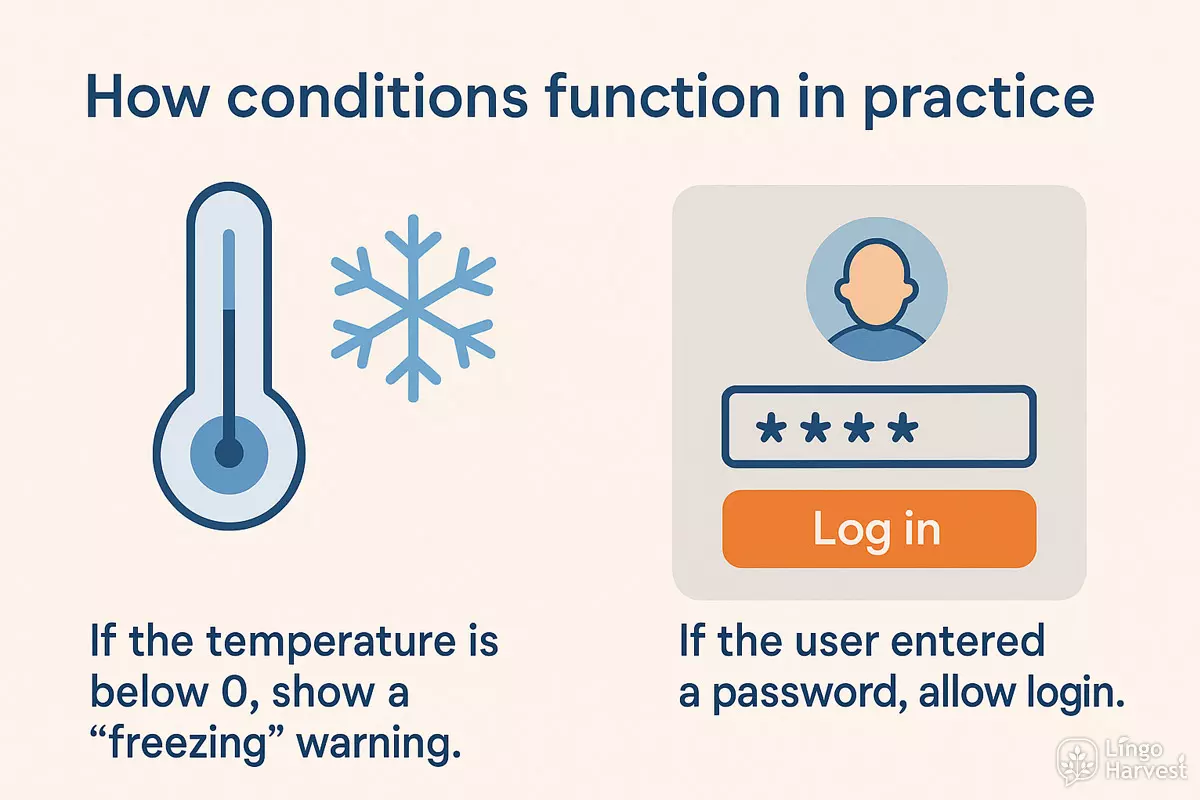
- If the temperature is below 0, show a "freezing" warning.
- If the user entered a password, allow login.
- If the file exists, open it.
- If the shopping cart is empty, hide the checkout button.
- If the battery level is low, display a battery icon.
- If the answer is correct, add points to the score.
- If the network is unavailable, switch to offline mode.
- If the current page is the homepage, show a welcome message.
- If the email address has "@", accept it as valid.
- If the number is even, color it blue.
- If the timer reaches zero, end the game.
- If the customer is a member, apply a discount.
- If the file size is too big, warn the user.
- If the checkbox is checked, enable the submit button.
- If the language is set to French, display French text.
- If the payment is complete, send a confirmation email.
Types of real conditions you might use
Real conditions can check for many different things, depending on your program's needs. Here are some common types:
- Comparisons (greater than, less than, equal to, not equal)
- Checking if something exists (file, element, value)
- Matching patterns (like email formats)
- Testing user actions (clicked, submitted, logged in)
- Monitoring system state (online/offline, battery level, memory usage)
- Validating input (is a field filled in? Is a number positive?)
How evaluation works
When your code reaches an if statement, the condition is evaluated to see if it’s true or false. If it’s true, the next set of instructions runs. If it’s false, the instructions are skipped or an else branch is followed. This process lets your program respond flexibly to what’s really happening, rather than always doing the same thing.
Examples: Condition vs. Outcome
Below is a structured view of how different real conditions influence program behavior:
| Condition Example | Possible Outcome |
|---|---|
| User age ≥ 18 | Allow access to adult content |
| Order total > $50 | Free shipping applied |
| Network status is offline | Show offline warning |
| Form field is empty | Display error message |
| Password matches confirmation | Enable account creation |
| File extension is ".jpg" | Accept upload |
| Score reaches 100 | Level up |
| Checkbox is selected | Enable submit button |
By understanding and using real conditions, you make your code responsive to genuine situations, improving both functionality and user experience.
When to choose if for real-life situations
Deciding when to use "if" in practical scenarios is about understanding conditions and outcomes. In everyday tasks, "if" helps you express choices, consequences, or checks before taking action. It's essential in planning, troubleshooting, and communication, especially when outcomes depend on specific situations.
Common contexts for using "if" in daily life
- Making decisions based on weather (e.g., "If it rains, take an umbrella.")
- Setting reminders or conditions for tasks ("If you finish early, call me.")
- Offering help or alternatives ("If you need help, let me know.")
- Planning meals or shopping ("If we have eggs, I’ll make an omelet.")
- Explaining rules ("If you break the rule, you get a penalty.")
- Giving instructions ("If the light turns red, stop walking.")
- Conditional invitations ("If you’re free, join us for dinner.")
- Checking requirements ("If you have your ID, you can enter.")
- Managing time ("If the meeting ends early, I’ll go to the gym.")
- Budgeting or spending ("If I have enough money, I’ll buy it.")
- Health or safety advice ("If you feel sick, stay home.")
- Negotiating ("If you agree, we’ll start tomorrow.")
- Parenting or teaching ("If you finish your homework, you can play.")
- Travel or routes ("If the train is late, take the bus.")
- Social scenarios ("If you’re not comfortable, you can leave early.")
- Workplace communication ("If you complete the report, send it to me.")
- Technical troubleshooting ("If your phone doesn’t turn on, charge it.")
- Planning for uncertainty ("If plans change, I’ll let you know.")
Comparing "if" with other conditional words
| Expression | When to use |
|---|---|
| If | Used for all types of conditions—possible, likely, or unlikely. Most general-purpose conditional. |
| When | Use for situations that are expected or certain to happen, not just possible. |
| Unless | Expresses a negative condition ("unless" = "if not"). Useful for exceptions. |
| Provided (that) | For formal or specific requirements that must be met for something to happen. |
In summary, use "if" whenever you need to express a condition that may or may not occur, especially when the outcome is not certain. It’s especially helpful for expressing choices, planning for alternatives, or clarifying rules and requirements in real-life contexts.
Simple patterns for giving advice, instructions, and predictions
When you want to help someone by suggesting what to do, explaining steps, or guessing what might happen, “if” sentences are a useful tool in English. These conditional patterns are easy to learn and can be used in everyday conversations, instructions, or when talking about possible future situations. Understanding the structure helps you communicate clearly and politely.
Common Ways to Use "If" for Real Situations
The most typical pattern for real conditions is: If + present simple, will + base verb. This lets you talk about likely results, instructions, or advice. You can also use imperatives or modal verbs (like “can” or “should”) in the result part to give direct advice or suggestions.
- If you are tired, take a break.
- If it rains, we will stay inside.
- If you need help, ask me.
- If you press this button, the computer will turn on.
- If you don’t understand, tell your teacher.
- If you study, you’ll pass the test.
- If you arrive early, you can choose your seat.
- If you want to improve, practice every day.
- If you feel sick, you should see a doctor.
- If you forget your keys, call me.
- If you mix blue and yellow, you get green.
- If it gets colder, wear a jacket.
- If you’re ready, let’s start.
- If the light is red, stop.
- If you water the plant, it will grow.
- If you don’t hurry, you might miss the bus.
- If you follow these steps, you will finish faster.
- If you save money, you can buy something nice later.
- If you see a mistake, correct it.
- If you hear a fire alarm, leave the building.
Choosing the Right Structure
It helps to know which verb forms to use depending on your goal. For predictions, use “will.” For advice or instructions, imperatives or modals are common. Here is a structured overview:
| Pattern | Example |
|---|---|
| If + present simple, will + verb | If you call me, I will answer. |
| If + present simple, imperative (base verb) | If you see him, say hello. |
| If + present simple, modal (can/should/might + verb) | If you’re tired, you should rest. |
| If + present simple, present simple | If water boils, it turns to steam. |
Tips for Beginners
Start with simple, everyday examples and practice both writing and speaking. Try making your own sentences for different situations: giving instructions at work, suggesting actions to friends, or predicting what could happen. The more you use these forms, the more natural they will feel.
Using if at the beginning vs in the middle of a sentence
Placing "if" at the start or in the middle of a sentence changes the structure but not the meaning of real conditionals. The position affects punctuation and sometimes the flow, but your options remain flexible in everyday English. When "if" introduces a conditional clause at the beginning, a comma usually separates it from the main clause. For example: If you study, you will pass the test. Here, the condition is clear right away, and the result follows after a pause. Switching the order, you can move the condition to the middle or end. In this case, there's typically no comma: You will pass the test if you study. Both forms are correct and common, but the choice often depends on what you want to emphasize.
Comparing sentence positions
The main differences between placing the "if" clause first or second are stylistic. Both forms are used in spoken and written English. Here are some points to consider:
- Emphasis: Starting with "if" highlights the condition. Ending with "if" keeps focus on the result.
- Punctuation: Use a comma after the condition when it comes first. No comma is needed if it comes second.
- Clarity: Both forms are clear, but starting with "if" may sound a bit more formal in writing.
Common real condition patterns
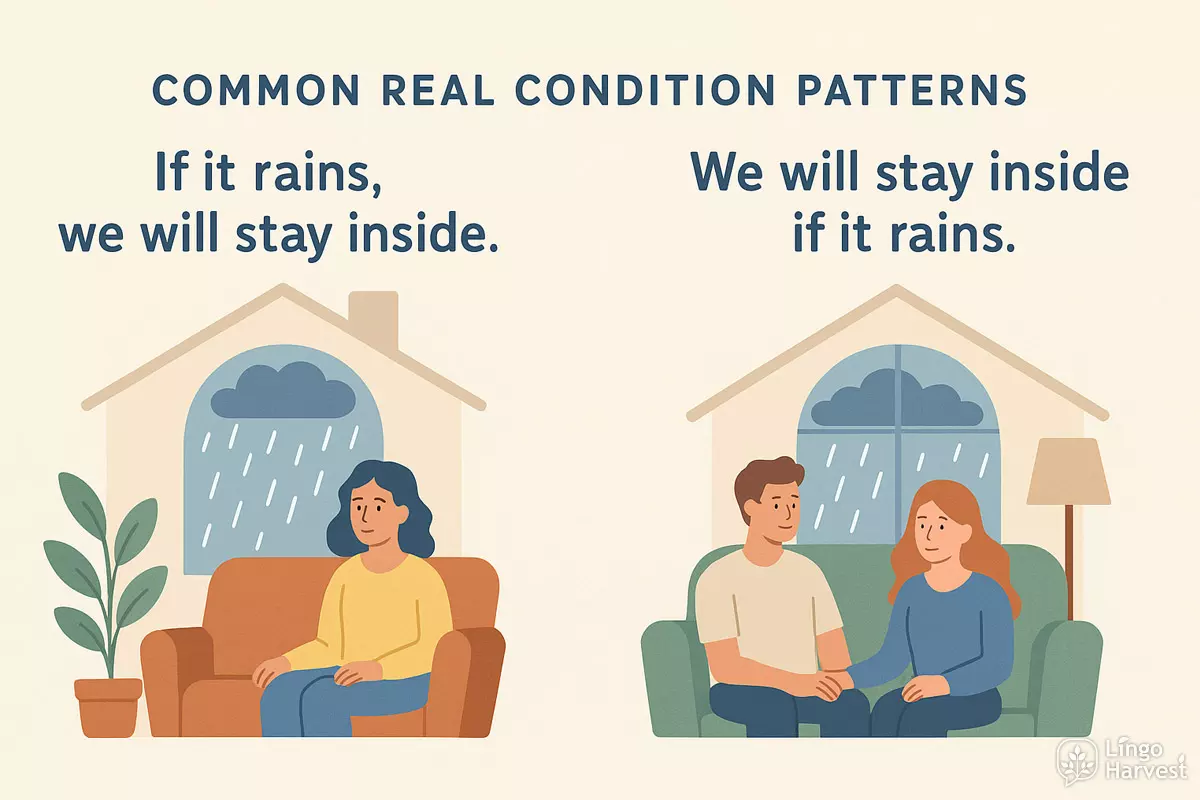
Here are several ways you might see real conditionals with "if" in different positions:
- If it rains, we will stay inside.
- We will stay inside if it rains.
- If you are hungry, I can make you a sandwich.
- I can make you a sandwich if you are hungry.
- If they call, tell them I’m busy.
- Tell them I’m busy if they call.
- If you need help, let me know.
- Let me know if you need help.
- If I see her, I will say hello.
- I will say hello if I see her.
Quick reference: structure and punctuation
| Position | Example | Punctuation |
|---|---|---|
| If-clause first | If you hurry, you’ll catch the bus. | Comma after the condition |
| If-clause second | You’ll catch the bus if you hurry. | No comma needed |
| Imperative main clause | Call me if you need anything. | No comma needed |
| Negative condition | If you don’t call, I’ll worry. | Comma after the condition |
In summary, both sentence structures are correct for real conditions. The main differences are in punctuation and emphasis. Choose the order that best fits what you want to highlight or the natural flow of your sentence.
Mistakes to avoid with will in the if-clause
One of the most common errors for English learners is using “will” in the if-part of real condition sentences. In standard real conditionals (especially the zero and first conditional), we use the present simple after “if,” not “will.” Using “will” here can sound unnatural or even change the meaning of your sentence.
Why not use "will" after "if"?
The present simple is used in the if-clause to talk about possible situations or facts. “Will” is only used in the main clause to show the result or consequence. Inserting “will” after “if” can make your sentence confusing or too formal, and sometimes it can signal willingness or a request, not a real condition.
Common incorrect patterns
Avoid these typical mistakes:
- If you will come to the party, I will be happy. ❌
- If it will rain tomorrow, we will cancel the picnic. ❌
Instead, use:
- If you come to the party, I will be happy. ✅
- If it rains tomorrow, we will cancel the picnic. ✅
When is "will" acceptable in the if-clause?
There are rare cases where “will” is correct in the if-part. This usually happens when “will” expresses willingness, not a future event. For example:
- If you will wait a moment, I’ll call him for you. (Here, “will” means “are willing to wait”)
- If he will help us, we can finish earlier. (Meaning: if he agrees to help)
But for real situations or predictions, stick to the present simple.
Quick reference: Correct vs. incorrect use
| ❌ Incorrect (do not use “will” after if) | ✅ Correct (use present simple after if) |
|---|---|
| If you will call me, I will help you. | If you call me, I will help you. |
| If she will arrive early, we will start then. | If she arrives early, we will start then. |
| If it will snow, school will close. | If it snows, school will close. |
| If they will finish on time, we will celebrate. | If they finish on time, we will celebrate. |
Summary tips for avoiding mistakes
- After “if” in real conditionals, use the present simple (not “will”).
- Use “will” in the result clause, not the condition.
- Only use “will” in the if-part for willingness or polite requests, which is rare.
- Practice with common real-life examples to build confidence.
By remembering these points, you can make your English sound more natural and accurate when talking about real conditions.
Practice: rewrite sentences to show correct real conditions
Understanding how to form real conditional sentences in English is essential for clear communication. Real conditionals describe situations that are possible or likely to happen in the present or future. In this exercise, you'll practice identifying and correcting sentences so they accurately express real conditions, using the correct structure: if + present simple, will + base verb.
Common mistakes to watch for
Non-native speakers often make errors such as:
- Using "will" in both clauses (e.g., If it will rain, I will stay home ❌)
- Using the past tense instead of present simple in the if-clause
- Incorrect word order or missing “if”
Rewrite these sentences to show correct real conditions
- If she will come early, we will start the meeting.
- I go to the park if it will be sunny tomorrow.
- If you studied hard, you will pass the exam.
- We will be late if the bus doesn't arrive soon.
- If he not finish his homework, he will not play games.
- Will you help me if I ask?
- If they will invite us, we will go to the party.
- I will call you if I will get home late.
- If it rains, we go to the museum.
- She will be happy if she get the job.
Patterns for real conditional sentences
- If + present simple, will + base verb: If you study, you will pass.
- If + present simple, imperative: If you see John, tell him.
- If + present simple, can/may/must + base verb: If you finish early, you can leave.
Quick reference: Common real conditional forms
| Incorrect Form | Correct Real Conditional |
|---|---|
| If you will call me, I will help you. | If you call me, I will help you. |
| If she studied, she will pass. | If she studies, she will pass. |
| If it will rain, we will stay inside. | If it rains, we will stay inside. |
| If I will finish early, I will go home. | If I finish early, I will go home. |
| If they comes, we will start. | If they come, we will start. |
Show answers
- If she comes early, we will start the meeting.
- I will go to the park if it is sunny tomorrow.
- If you study hard, you will pass the exam.
- We will be late if the bus doesn't arrive soon. (Already correct!)
- If he does not finish his homework, he will not play games.
- Will you help me if I ask? (Already correct!)
- If they invite us, we will go to the party.
- I will call you if I get home late.
- If it rains, we will go to the museum.
- She will be happy if she gets the job.
Keep practicing by rewriting incorrect sentences and checking your answers. This will help you master real conditionals for everyday English conversations and writing.