If vs When in Conditional Sentences (A1–A2)

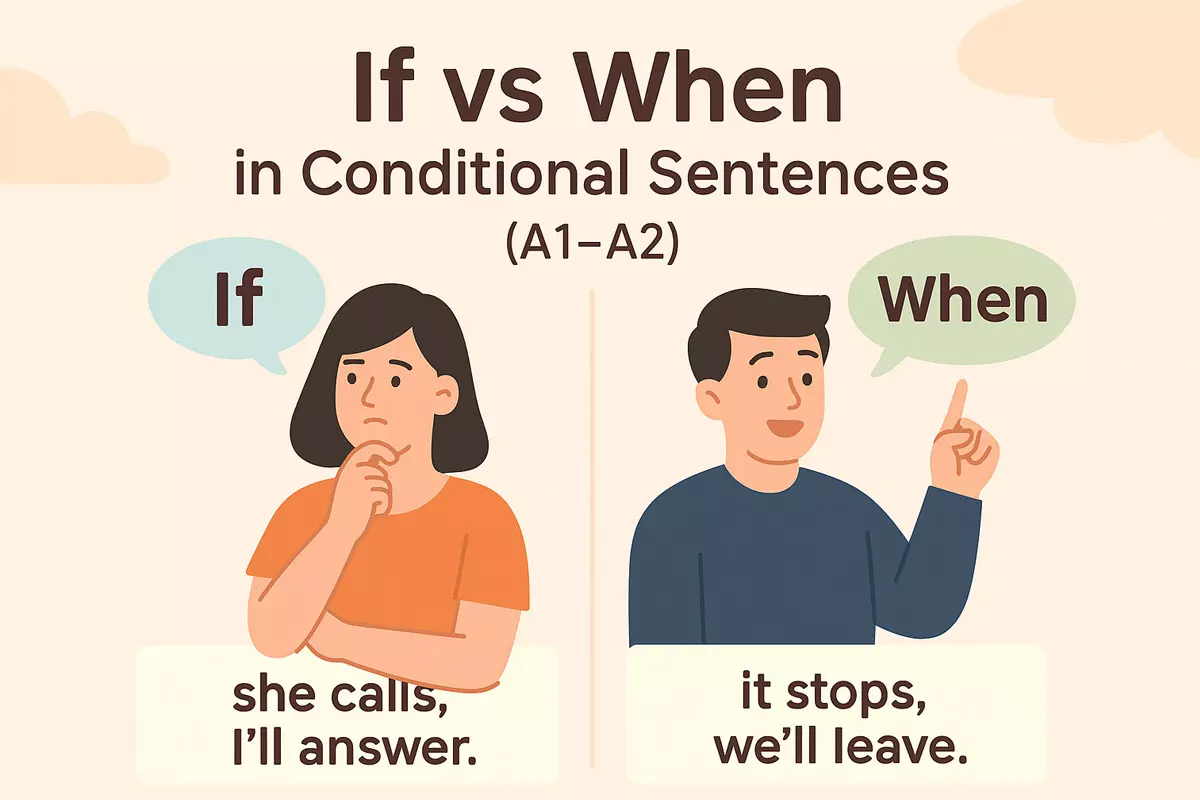 Here we the difference between if and when, explains how changing one for the other affects meaning, outlines when each is typically used, reviews tense patterns, gives daily life examples, and offers practice in choosing the right word.
Deciding whether to use "if" or "when" in basic conditional sentences can be challenging for English learners, but recognizing the difference is important for clear communication. "If" is used when the outcome is uncertain or possible, while "when" suggests that something is certain or expected to happen. By learning how each word affects the meaning of a sentence, you can express your ideas more precisely and confidently in both speaking and writing during everyday conversations.
Difference between possibility (if) and certainty (when)
Understanding how "if" and "when" are used in conditional sentences is important for expressing whether something might happen or will definitely happen. "If" suggests a situation that is possible but not guaranteed, while "when" shows that something is sure to happen, just not exactly sure about the time.
Using "if" for possibility
Use "if" when you talk about something that may or may not occur. It leaves room for uncertainty. For example, "If it rains, we will stay inside." Here, rain is only a possibility.
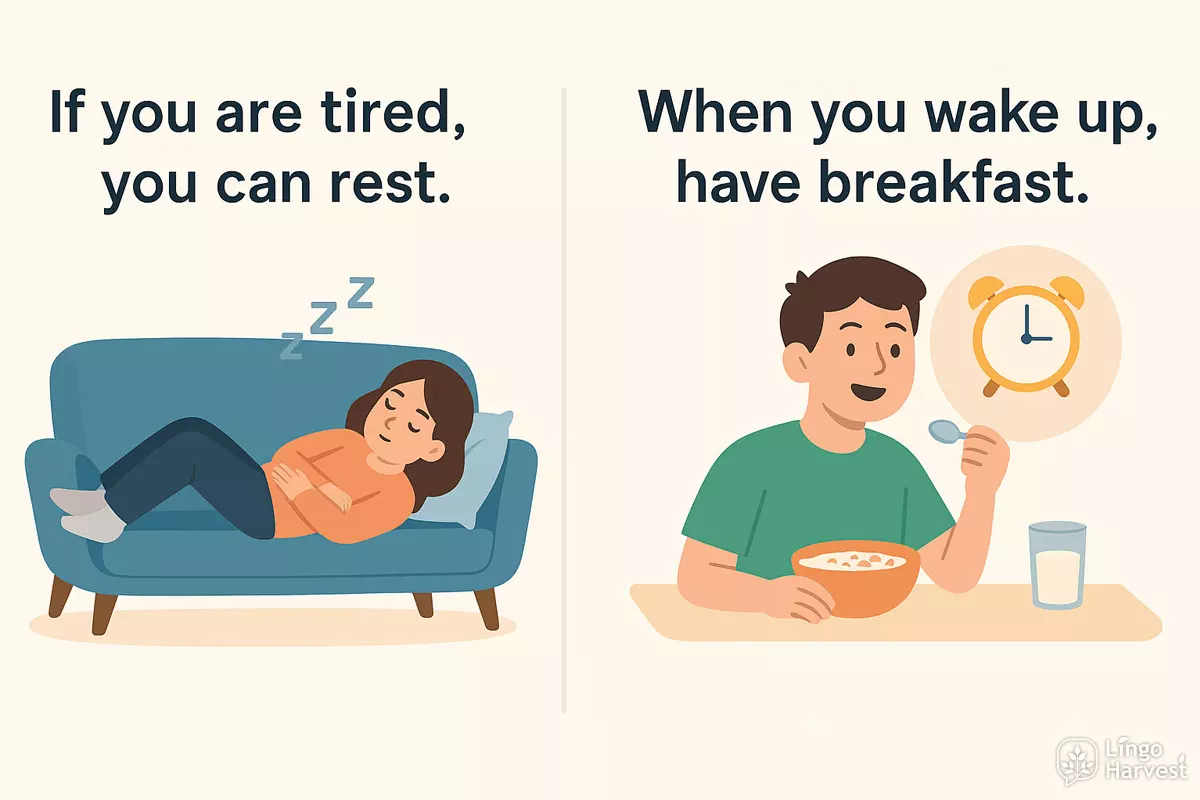
- If you are tired, you can rest. (Maybe you are tired, maybe not.)
- If she calls, tell her I’m busy. (She might call, or she might not.)
- If I finish my homework, I will watch TV. (Finishing homework is not certain.)
- If we see John, we’ll invite him. (Seeing John is not definite.)
- If you need help, ask me. (You may or may not need help.)
Using "when" for certainty
"When" is used when the speaker is sure the situation will happen at some point. It is not about possibility, but about time.
- When you wake up, have breakfast. (You will definitely wake up.)
- When the bus arrives, we will leave. (The bus will surely come.)
- When I get home, I’ll call you. (Getting home is certain.)
- When it gets dark, turn on the lights. (Darkness will come.)
- When school finishes, we’ll go to the park. (School will end for sure.)
Summary Table: Possibility vs. Certainty
| Use | Example |
|---|---|
| Possible event (not sure it will happen) if |
If it snows, we will build a snowman. |
| Certain event (will definitely happen) when |
When it snows, we will build a snowman. |
Quick Tips
- Use "if" for things that might happen. ❌ Not sure.
- Use "when" for things that will definitely happen. ✅ Sure, just don’t know the time.
- Choosing between "if" and "when" changes the meaning of your sentence.
Choosing the correct word helps your listener understand your meaning clearly—whether you are talking about a possibility or something certain in the future.
How meaning changes when switching if to when
Choosing between "if" and "when" in conditional sentences can change the meaning of what you say. "If" suggests something is possible but not sure, while "when" shows you expect it to happen. This difference affects how listeners understand your intention and confidence about the event.
Understanding the difference in certainty
- "If" introduces a condition that might or might not happen.
- "When" is used for situations you are certain will occur at some point.
For example, saying "If it rains, we will stay inside" means maybe it will rain, maybe not. But "When it rains, we will stay inside" shows you are sure it will rain.
Examples: Changing the meaning
- If you see Anna, tell her hello. (You might see Anna, or you might not.)
- When you see Anna, tell her hello. (You are sure you will see Anna.)
- If I finish my homework, I’ll go outside. (I may not finish.)
- When I finish my homework, I’ll go outside. (I will finish, just a matter of time.)
- If we move to London, we’ll buy a car. (Moving is not certain.)
- When we move to London, we’ll buy a car. (Moving is planned or definite.)
- If the bus comes, we’ll leave. (It’s possible the bus won’t come.)
- When the bus comes, we’ll leave. (The bus is expected.)
- If you need help, call me. (Maybe you won’t need help.)
- When you need help, call me. (You will need help at some time.)
- If I get a new job, I’ll celebrate. (Not sure I’ll get one.)
- When I get a new job, I’ll celebrate. (Confident it will happen.)
Quick comparison: "if" vs "when"
| Using "if" | Using "when" |
|---|---|
| Shows uncertainty or possibility | Shows certainty or expectation |
| Event may or may not happen | Event will definitely happen (sooner or later) |
| Used for hypothetical or unlikely situations | Used for planned, regular, or inevitable situations |
| Example: If it snows, schools may close. | Example: When it snows, schools may close. |
Why does this matter?
Small changes in conditional words help you sound more natural and clear in English. Using "if" or "when" correctly tells people how sure you are about the situation. This helps avoid confusion and makes your meaning precise, especially in everyday conversations and instructions.
Typical situations where each one is preferred
Understanding when to use “if” or “when” in conditional sentences can help make your meaning clearer. Both words introduce conditions, but they are not always interchangeable. Your choice depends on whether you see the action as possible or certain.
When to use “if” in conditional sentences
“If” is best when the outcome is uncertain or just a possibility. In beginner English, “if” often signals that we don’t know whether something will really happen. Some common situations include:
- Talking about possibilities: If it rains, we will stay inside.
- Making offers or suggestions: If you need help, ask me.
- Giving warnings: If you touch that, it might break.
- Describing future plans that depend on something: If I finish early, I’ll call you.
- Expressing conditions that may never happen: If I were rich, I would travel the world.
When to use “when” in conditional sentences
“When” is used when the event is expected or certain, not just a possibility. It shows that you think the condition will definitely happen at some time. You’ll often use “when” in these cases:
- Referring to routines or habits: When I get home, I eat dinner.
- Talking about future events you expect: When the bus arrives, we will leave.
- Describing sequences: When you finish, start the next task.
- Giving instructions: When the light turns green, go.
- Making predictions about certain events: When it snows, schools close.
| Use “if” | Use “when” |
|---|---|
| Uncertain events (might happen) |
Certain events (will happen sooner or later) |
| “If you see Anna, tell her.” | “When you see Anna, tell her.” |
| Possibilities (not sure) |
Routines or habits |
| “If it rains, I’ll stay home.” | “When it rains, I read books.” |
In summary, choose “if” for situations that are possible but uncertain, and “when” for actions or events you expect to happen. This small difference helps your listener understand how likely you think something is.
Tense patterns for if-clauses and when-clauses
Understanding which verb forms to use with "if" and "when" helps you make clear and natural sentences in English. These two words often introduce clauses that talk about conditions or future possibilities, but the tense you use can change the meaning. Let’s look at the typical ways we form sentences with "if" and "when" in simple, everyday English.
Present Simple for Future Meaning
In conditional sentences about the future, both "if" and "when" are usually followed by the present simple tense, not "will." This is a common point of confusion for learners, but it’s important for sounding natural.
- If it rains, we stay inside. (not will rain)
- When I finish my homework, I call my friend.
- If you are hungry, you can eat an apple.
- When the bell rings, the class ends.
Comparing "if" and "when" in Conditional Sentences
"If" is used when something is possible, but not certain. "When" is used for events that are sure or expected to happen.
| Clause Word | Example (Present Simple for Future) | Meaning |
|---|---|---|
| If | If you see Anna, tell her. | Possible event |
| When | When you see Anna, tell her. | Expected event |
| If | If it snows, the school closes. | May or may not happen |
| When | When it snows, the kids play outside. | Happens every time it snows |
Common Patterns with "if" and "when"
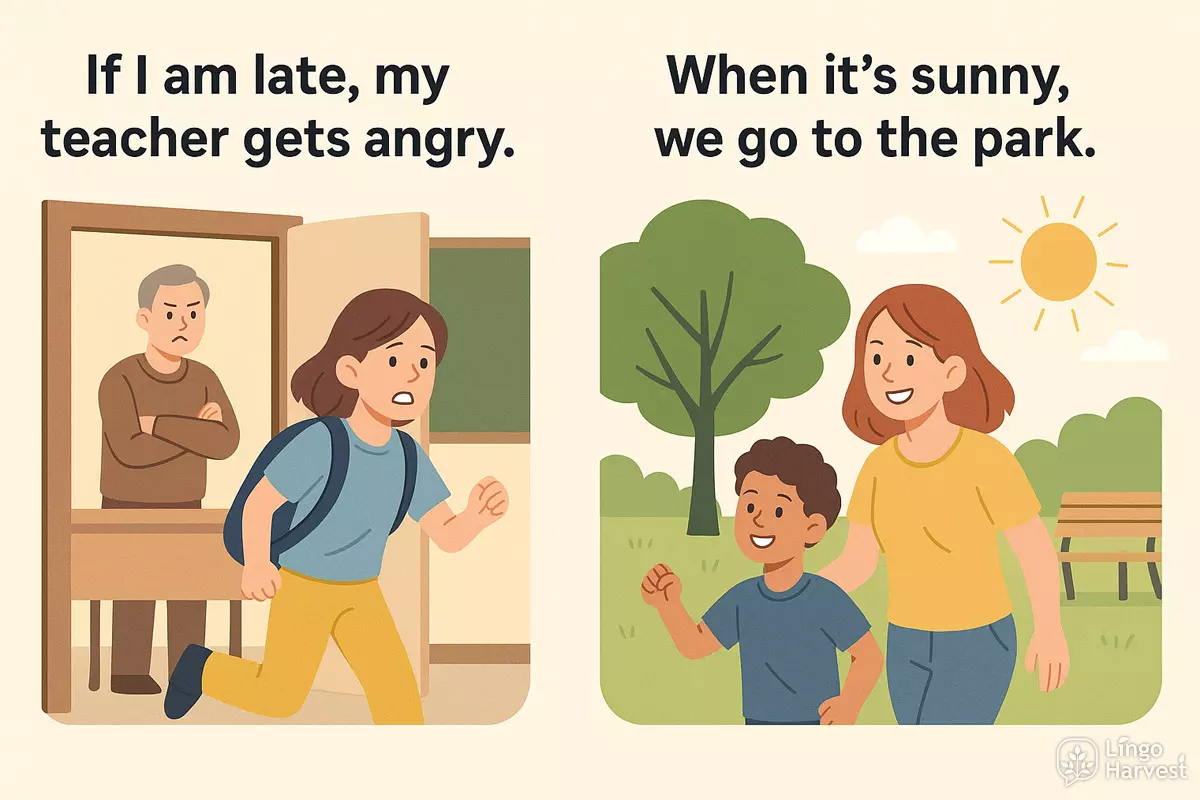
The following patterns are widely used at beginner level:
- If I am late, my teacher gets angry.
- When it’s sunny, we go to the park.
- If you press this button, the machine starts.
- When the movie ends, we go home.
- If she calls, tell her I’m busy.
- When I wake up, I brush my teeth.
- If you don’t understand, ask me.
- When you finish, let me know.
- If I have time, I help you.
- When we arrive, we send a message.
- If it gets cold, wear a jacket.
- When it’s lunchtime, we eat.
Summary of Tense Choices
Stick to the present simple after "if" and "when" when you are talking about the future or general truths. Use "will" or "can" in the main clause, not the conditional clause. This helps your English sound correct and easy to understand.
Examples from daily life for clear comparison
Understanding the difference between “if” and “when” in conditionals becomes easier with familiar situations. “If” is used when we are not sure something will happen, while “when” is for things we expect or know will happen. Here are clear examples from everyday routines, school, and home life to show how these words work in real conversations.
Everyday situations
- If it rains, I take an umbrella. (Maybe it will rain, maybe not.)
- When it rains, the streets get wet. (It always happens when it rains.)
- If I am late, my friend waits for me. (I might be late, but not always.)
- When I am late, I call my teacher. (It happens every time I am late.)
- If you finish your homework, you can watch TV. (You may or may not finish.)
- When you finish your homework, dinner will be ready. (You will finish; it’s just a matter of time.)
- If the shop is open, I’ll buy bread. (Not sure if it’s open.)
- When the shop opens, I go inside. (It always happens when the shop opens.)
- If I see Anna, I’ll say hello. (Maybe I’ll see her, maybe not.)
- When I see Anna, we talk about school. (It always happens when I see her.)
Structured comparison
| If (uncertain event) | When (certain event) |
|---|---|
| If my phone rings, I will answer it. | When my phone rings, I always answer. |
| If I get hungry, I’ll make a sandwich. | When I get home, I make a sandwich. |
| If the bus doesn’t come, I’ll walk. | When the bus arrives, I get on. |
| If you call me, I’ll help you. | When you call me, I answer quickly. |
| If I have time, I’ll read a book. | When I have time, I read before bed. |
These samples show that “if” is for things that might happen, and “when” is for things we expect to happen. In daily life, choosing the right word helps others understand how likely an event is. Try making your own sentences about your routine to practice the difference.
Practice: choose if or when to complete each sentence
To help you feel confident using “if” and “when” in conditional sentences at A1–A2 level, try these focused exercises. Read each sentence and decide which word is correct. Think about the difference: “if” shows a possibility or condition, while “when” suggests something is sure to happen.
Complete the sentences with the correct word
- ______ it rains tomorrow, we will stay at home.
- I always brush my teeth ______ I wake up.
- ______ you see Anna, tell her I called.
- Call me ______ you arrive at the station.
- ______ you are tired, take a break.
- ______ the bus is late, I walk to school.
- ______ you finish your homework, you can watch TV.
- ______ I have free time, I like to read books.
- ______ you don’t understand, ask the teacher.
- You can have dessert ______ you eat your vegetables.
- ______ I am hungry, I make a sandwich.
- ______ my friend visits, we play board games.
- ______ you press this button, the computer turns on.
- I’ll call you ______ I get home.
- ______ you want to join us, let me know.
- ______ I finish work early, I go for a walk.
Show answers
- If
- when
- If
- when
- If
- If
- When
- When
- If
- when
- When
- When
- If
- when
- If
- If
Quick tips to remember the difference
- Use “if” for situations that are possible, but not certain.
- Use “when” for things that are sure or regular.
- “If” is for conditions; “when” is for time (something will definitely happen).
More examples to practice
- If you are cold, put on a jacket.
- When the bell rings, class starts.
- If I see Tom, I will invite him.
- When we visit Paris, we eat croissants.
- If it is sunny, let’s go outside.
- When I finish this book, I’ll start another.
- If you need help, call me.
- When the movie ends, we go home.
- If you are busy, we can talk later.
- When I am tired, I sleep early.