Using Will and Won’t Correctly in First Conditional

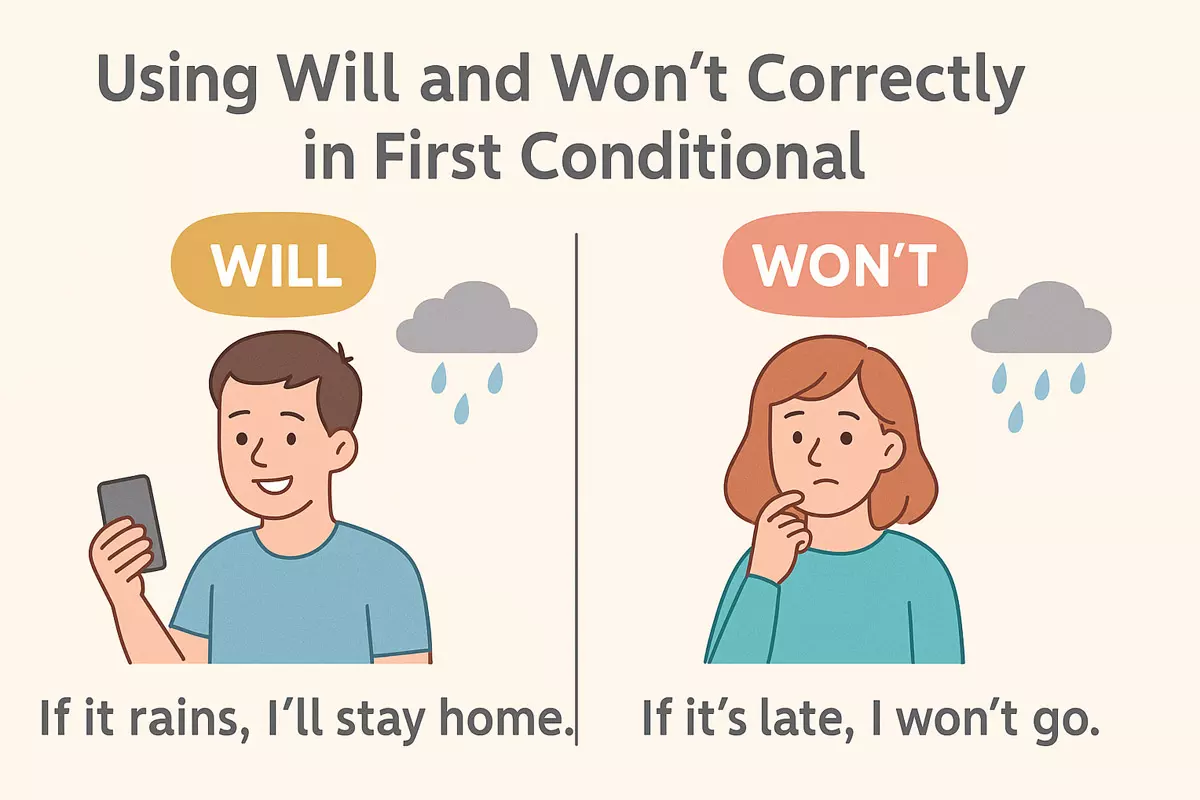 Here we how will and won’t express future results in first conditional sentences, why will can't be used in if-clauses, and how these forms signal promises, warnings, and predictions. It also discusses pronunciation, common mistakes, and offers practice.
- Role of will and won’t in expressing future results
- Why will cannot appear inside the if-clause
- How will and won’t communicate promises, warnings, and predictions
- Pronunciation and contractions in spoken English
- Common learner mistakes with future forms
- Practice: fill in will or won’t in first conditional sentences
Learning when to use future forms such as will and won’t in first conditional sentences can be challenging for English learners, but gaining this skill is essential for clear communication. The first conditional is used to talk about real and possible situations in the future, typically using if plus the present simple, followed by will or won’t and the base form of the verb. By practicing these structures, you can express possible outcomes and their consequences more naturally, which will help you sound more fluent and confident in everyday conversations.
Role of will and won’t in expressing future results
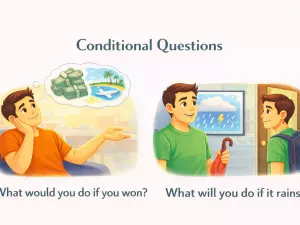
When we talk about the first conditional, we’re dealing with situations that are possible or likely to happen in the future. The auxiliary verbs will and won’t (will not) are key to showing what result can happen if a certain condition is met. In these sentences, will signals a possible outcome, while won’t expresses a negative or prevented result. This helps us make predictions, set expectations, or warn about consequences.
How “will” and “won’t” shape predictions
Using will after the if-clause describes what is expected to happen if the condition occurs. On the other hand, won’t is used when the result will not happen, even if the condition is true. This contrast gives clarity to both positive and negative outcomes.
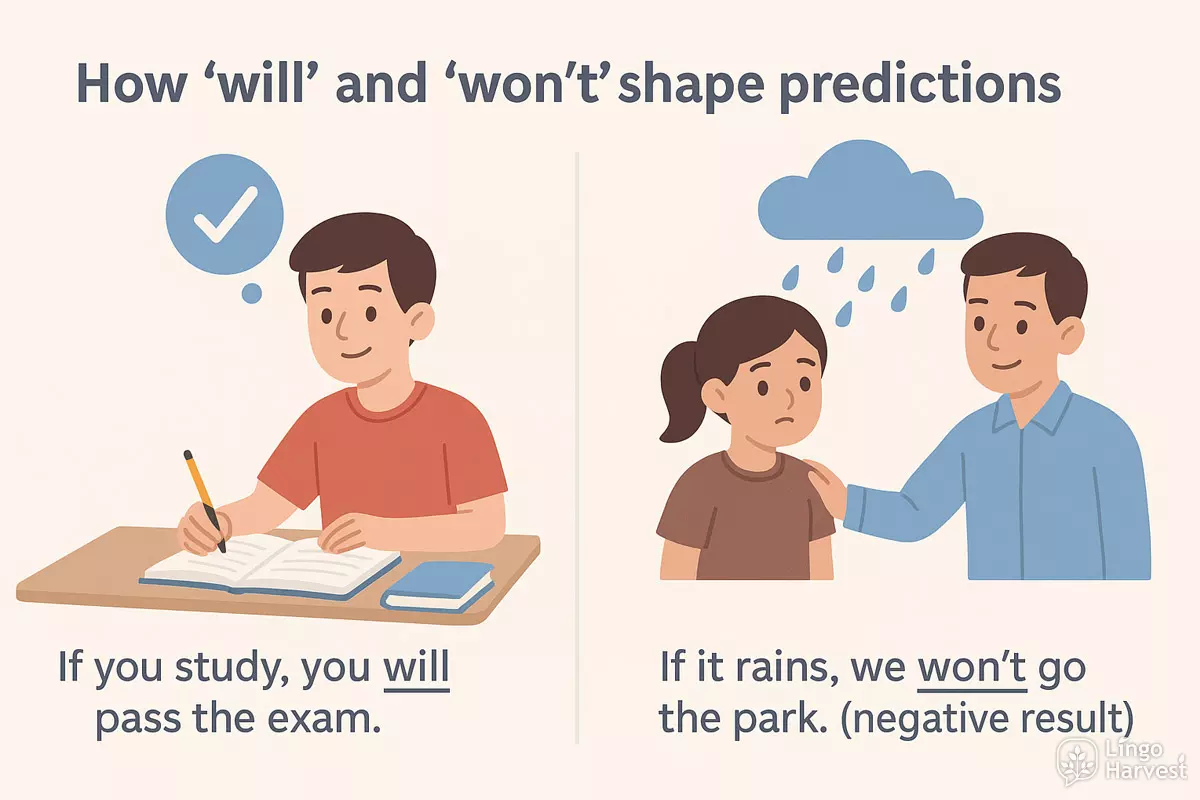
- If you study, you will pass the exam. (positive result)
- If it rains, we won’t go to the park. (negative result)
- If she calls, I will answer the phone.
- If you don’t hurry, you will miss the bus.
- If the shop is open, we will buy some bread.
- If you make a mistake, the program won’t work.
- If they invite me, I will come to the party.
- If we leave now, we won’t be late.
- If you don’t water the plant, it won’t grow.
- If you ask her, she will help you.
- If you touch that, it will break.
- If the weather improves, we will have a picnic.
- If you don’t listen, you won’t learn anything.
- If I finish early, I will call you.
- If he doesn’t study, he won’t pass the test.
- If you eat too much, you will feel sick.
- If the alarm rings, everyone will leave the building.
- If you don’t pay the bill, they won’t connect your service.
Summary of “will” vs “won’t” in results
| Form | Function | Example |
|---|---|---|
| will + base verb | States a likely or intended future outcome | If you try, you will succeed. |
| won’t + base verb | Shows a negative or prevented result | If you are late, they won’t wait for you. |
Choosing between will and won’t in first conditional sentences allows you to clearly express both positive and negative future possibilities. This distinction is essential for accurate communication about what may or may not happen, depending on certain conditions.
Why will cannot appear inside the if-clause
In standard English grammar, the first conditional structure uses the present simple tense in the if-clause and "will" (or "won’t") in the main clause. This is not just a stylistic choice—it’s a rule that keeps the meaning clear. When we use the present simple after "if," we’re talking about a real, possible situation in the future. Placing "will" directly after "if" confuses the meaning and is considered incorrect in most contexts.
Explanation: Present Simple vs. Will in Conditional Sentences
The purpose of the if-clause is to set a condition. Using the present simple here expresses a possible or likely event. "Will" is reserved for the result clause because it shows the future consequence of the condition being true. If you use "will" inside the condition, it suggests willingness or intention, which isn’t the function of a first conditional.
Common Mistakes and Their Corrections
- Incorrect: If you will come to the party, I’ll be happy. ❌
- Correct: If you come to the party, I’ll be happy. ✅
- Incorrect: If it will rain, we’ll stay inside. ❌
- Correct: If it rains, we’ll stay inside. ✅
Why "Will" in the If-Clause Causes Problems
When "will" appears in the conditional part, it can:
- Imply intention or willingness, not a real possibility
- Make the sentence sound unnatural to native speakers
- Lead to confusion about the time or certainty of the event
- Break the standard pattern, making your meaning less clear
Special Case: When "Will" Is Acceptable
There is one exception: if "will" expresses willingness or a decision, not a simple future fact. For example, "If you will help me, I’ll finish faster" (meaning "if you are willing to help"). This is rare in modern English and usually replaced with other wording.
Pattern Comparison
| Structure | Example |
|---|---|
| Correct (First Conditional) | If + present simple, will + base verb If you study, you will pass. |
| Incorrect | If + will + base verb, will + base verb If you will study, you will pass. |
| Special (Willingness/Politeness) | If you will sign here, we can begin. (Here "will" means "are willing to") |
| Zero Conditional (General Truth) | If + present simple, present simple If you heat ice, it melts. |
Summary of Usage
Remember, for real future possibilities, keep the present simple in the condition. Reserve "will" for the result. This keeps your sentences clear, natural, and easy to understand.
How will and won’t communicate promises, warnings, and predictions
In first conditional sentences, “will” and “won’t” help us express different attitudes about the future. They are not just about neutral facts—they show intention, caution, or expectation, depending on the context. Recognizing how these forms work allows you to be precise when you talk about what might happen.
Promises
When you want to assure someone about a future action, “will” is used to make a promise. In first conditional sentences, the structure is: if + present simple, will + base verb. For example:
- If you finish your homework, I will buy you ice cream.
- If you call me tonight, I will help you with the project.
- If you need a ride, I will pick you up after work.
These sentences communicate commitment or assurance, making the intention clear.
Warnings
“Will” and “won’t” are also used to warn someone about possible negative outcomes. This helps the listener understand the consequences of their actions. For instance:
- If you touch that wire, you will get a shock.
- If you don’t study, you won’t pass the test.
- If you keep being late, your boss will notice.
Warnings often use a negative result with “won’t” to highlight what someone will miss or lose.
Predictions
Predictions in the first conditional are based on likely or realistic situations. You use “will” or “won’t” to describe expected outcomes:
- If it rains tomorrow, the match will be cancelled.
- If you eat too much cake, you will feel sick.
- If they don’t hurry, they won’t catch the train.
- If she tries harder, she will succeed.
- If you ask nicely, he will probably help you.
- If we leave now, we won’t be late.
- If you forget your umbrella, you will get wet.
- If you listen, you will understand the instructions.
- If the weather improves, we will go hiking.
- If the shop is closed, we won’t buy anything.
Summary Table: Promise, Warning, Prediction
| Type | Example |
|---|---|
| Promise | If you help me, I will take you out to dinner. |
| Warning | If you don’t wear a helmet, you will get hurt. |
| Prediction | If it gets colder, the lake will freeze. |
| Negative Outcome | If you don’t lock the door, someone will steal your bike. |
Understanding the roles of “will” and “won’t” in these contexts helps you express intention, caution, and expectation more naturally in English. This makes your speech and writing both clearer and more effective in real-life situations.
Pronunciation and contractions in spoken English
When using "will" and "won’t" in first conditional sentences, native speakers almost always use contractions in everyday speech. This makes the language sound more natural and fluent. "Will" becomes 'll, and "will not" is usually contracted to won’t. These contracted forms are much easier to pronounce quickly, especially in fast conversations.
Common contracted forms with "will"
You’ll often hear these shortened forms in spoken English. Here are some frequent examples:
- I’ll (I will)
- You’ll (You will)
- He’ll (He will)
- She’ll (She will)
- It’ll (It will)
- We’ll (We will)
- They’ll (They will)
- Won’t (will not)
How contractions affect pronunciation
The contracted forms are pronounced with reduced sounds, and the 'll is often very quick and almost blends with the subject. "Won’t" is pronounced as /woʊnt/, which is quite different from simply combining "will" and "not." Pay attention to the following:
- The 'll is pronounced as a short /l/ sound, quickly attached to the subject.
- "Won’t" has a long "o" sound and a silent "l".
- In negative first conditional sentences, "won’t" replaces "will not" entirely.
Examples of first conditional sentences with contractions
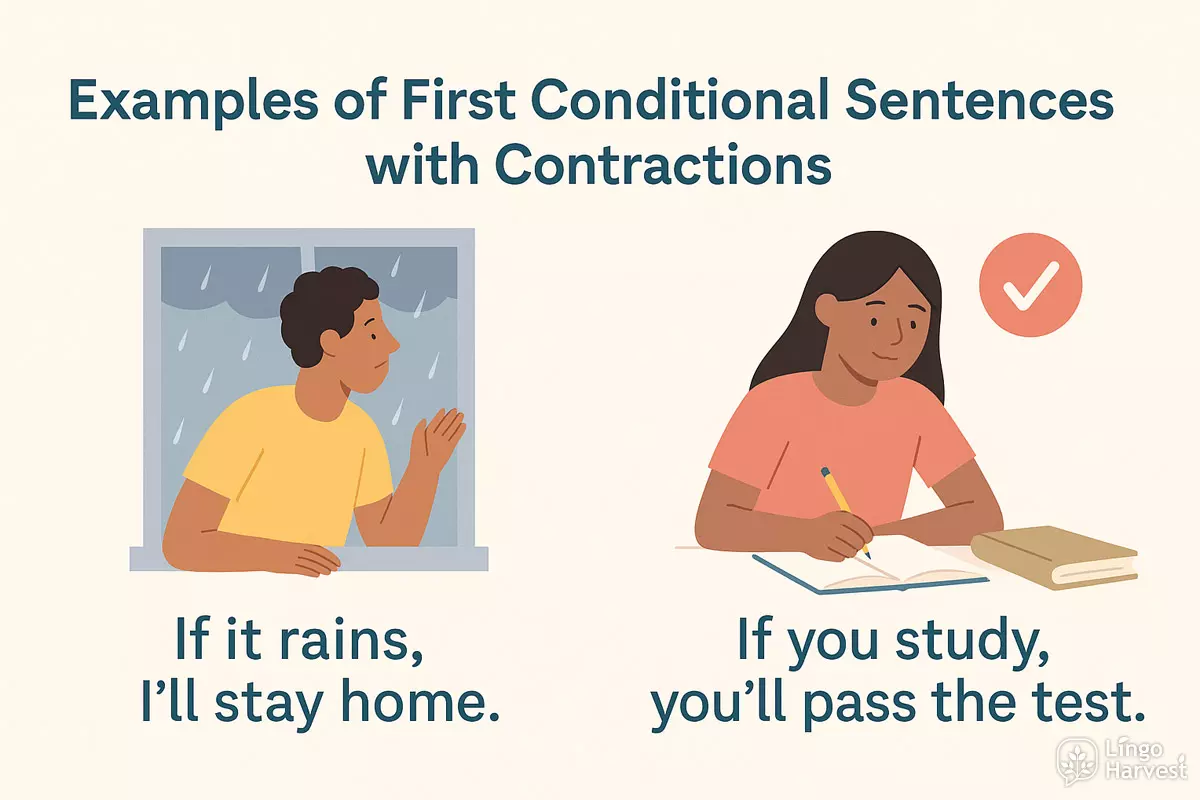
- If it rains, I’ll stay home.
- If you study, you’ll pass the test.
- If she calls, he’ll answer.
- If we hurry, we’ll catch the bus.
- If they don’t leave now, they’ll be late.
- If you don’t eat, you’ll be hungry.
- If the weather is nice, we’ll go for a walk.
- If you don’t try, you won’t succeed.
- If he doesn’t call, she won’t know the news.
- If I’m not careful, I won’t finish on time.
Quick comparison: full forms vs. contractions
| Full Form | Contracted Form |
|---|---|
| I will go | I’ll go |
| You will see | You’ll see |
| He will help | He’ll help |
| She will not come | She won’t come |
| We will try | We’ll try |
| They will not agree | They won’t agree |
Using these shorter forms is not just a matter of style; it’s essential for sounding natural in modern English. When practicing first conditional sentences, make a habit of using contractions to improve your listening and speaking skills.
Common learner mistakes with future forms
Learners frequently run into trouble when deciding how to use "will" and "won’t" within first conditional sentences. This often leads to awkward or incorrect structures that can change the meaning or clarity of what they want to say. Recognizing typical pitfalls can help you avoid them and build more natural, accurate sentences.
Mixing up verb tenses in condition and result clauses
One of the most frequent errors is putting "will" in both parts of the conditional sentence. In standard first conditional, the "if" clause uses present simple, while the result clause uses "will" or "won’t". For example:
- ❌ If it will rain, we will stay inside.
- ✅ If it rains, we will stay inside.
Using "will" after "if" is rarely correct in first conditional sentences.
Confusing "will" with other future forms
Learners sometimes use "going to" or present continuous instead of "will" in the result clause, which may not always be appropriate. "Will" is standard for predictions or spontaneous decisions in conditionals, while "going to" suggests a prior plan.
Neglecting contractions and natural speech patterns
Avoiding contractions like "won’t" or "I’ll" can make spoken English sound stiff. On the other hand, over-contracting or misplacing contractions can cause confusion.
Forgetting subject-verb agreement and word order
Mistakes with the order of words, especially in negative forms, are common. Watch out for these patterns:
- If you won’t help, I will do it myself. (Correct)
- If she don’t study, she will fail. (Incorrect – should be "doesn’t")
- If they will arrive late, we won’t wait. (Incorrect – "arrive" is correct)
Not distinguishing between real and unreal conditionals
Using "will" in both the if-clause and result clause is a sign of confusion between first and second conditionals. The first conditional is for real, possible situations; the second is for hypothetical or less likely ones.
Common incorrect patterns and corrections
Below is a table showing frequent mistakes versus their correct forms in first conditional sentences:
| Mistaken Form | Correct Usage |
|---|---|
| If you will come, I will be happy. | If you come, I will be happy. |
| If he won’t call, I won’t know. | If he doesn’t call, I won’t know. |
| If it rains, we go home. | If it rains, we will go home. |
| If she will study, she will pass. | If she studies, she will pass. |
| If I will see him, I will tell him. | If I see him, I will tell him. |
| If they comes, we will start. | If they come, we will start. |
Quick checklist to avoid mistakes
- Use present simple in the "if" clause, not "will".
- Use "will"/"won’t" only in the result clause.
- Check subject-verb agreement: "he/she/it" needs "-s" in present simple.
- Don’t mix first and second conditional forms.
- Use contractions for natural speech: "won’t", "I’ll", "you’ll".
- Remember the difference between predictions (will) and plans (going to).
- Pay attention to negatives: "doesn’t" in the "if" clause, "won’t" in the result clause.
- Avoid double "will": never use "will" in both clauses.
- Don’t use present continuous or "going to" unless the context specifically requires it.
- Review your sentences for tense consistency.
Understanding these common slip-ups will help you communicate future possibilities more clearly and accurately using the first conditional.
Practice: fill in will or won’t in first conditional sentences
Practicing the use of “will” and “won’t” in first conditional statements helps you build confidence in expressing real future possibilities and their consequences. Below, you'll find a range of sentences and exercises to test your understanding of these forms.
Complete the sentences with “will” or “won’t”
Fill in the blanks in these first conditional sentences. Think about whether the result is likely to happen (use “will”) or not (use “won’t”).
- If it rains tomorrow, we ____ stay at home.
- If you don’t hurry, you ____ catch the bus.
- If she calls me, I ____ answer the phone.
- If they invite us, we ____ go to the party.
- If you study hard, you ____ pass the exam.
- If he doesn’t apologize, I ____ forgive him.
- If the shop is open, I ____ buy some milk.
- If you eat too much cake, you ____ feel sick.
- If we leave now, we ____ be late.
- If my team wins, I ____ be happy.
- If you don’t water the plants, they ____ grow.
- If it’s sunny, we ____ have a picnic.
- If you touch that, you ____ get hurt.
- If I finish early, I ____ help you.
- If you don’t tell the truth, nobody ____ trust you.
- If I see Anna, I ____ give her your message.
- If you make a mistake, your teacher ____ help you.
- If we don’t leave soon, we ____ miss the train.
- If you don’t listen, you ____ understand the instructions.
- If they practice every day, they ____ improve.
Show answers
- will
- won’t
- will
- will
- will
- won’t
- will
- will
- won’t
- will
- won’t
- will
- will
- will
- will
- will
- will
- will
- won’t
- will
Tips for choosing “will” or “won’t” in first conditional
- Use “will” for positive, likely results or promises (e.g., “If you ask, I will help.”).
- Use “won’t” for negative expectations or refusals (e.g., “If you don’t study, you won’t pass.”).
- Remember, the condition (if-clause) uses present simple; the result (main clause) uses “will” or “won’t.”
Common errors to avoid
- Don’t use “will” in the “if” part (e.g., Incorrect: “If you will come, I will wait.”)
- Don’t forget to use present simple in the condition.
- Choose “won’t” for things that probably won’t happen or you refuse to do.
By practicing with real-life scenarios, your understanding of how to use “will” and “won’t” in first conditional sentences will improve naturally. Try creating your own examples to reinforce these patterns.