Common Mistakes with Basic Conditional Sentences

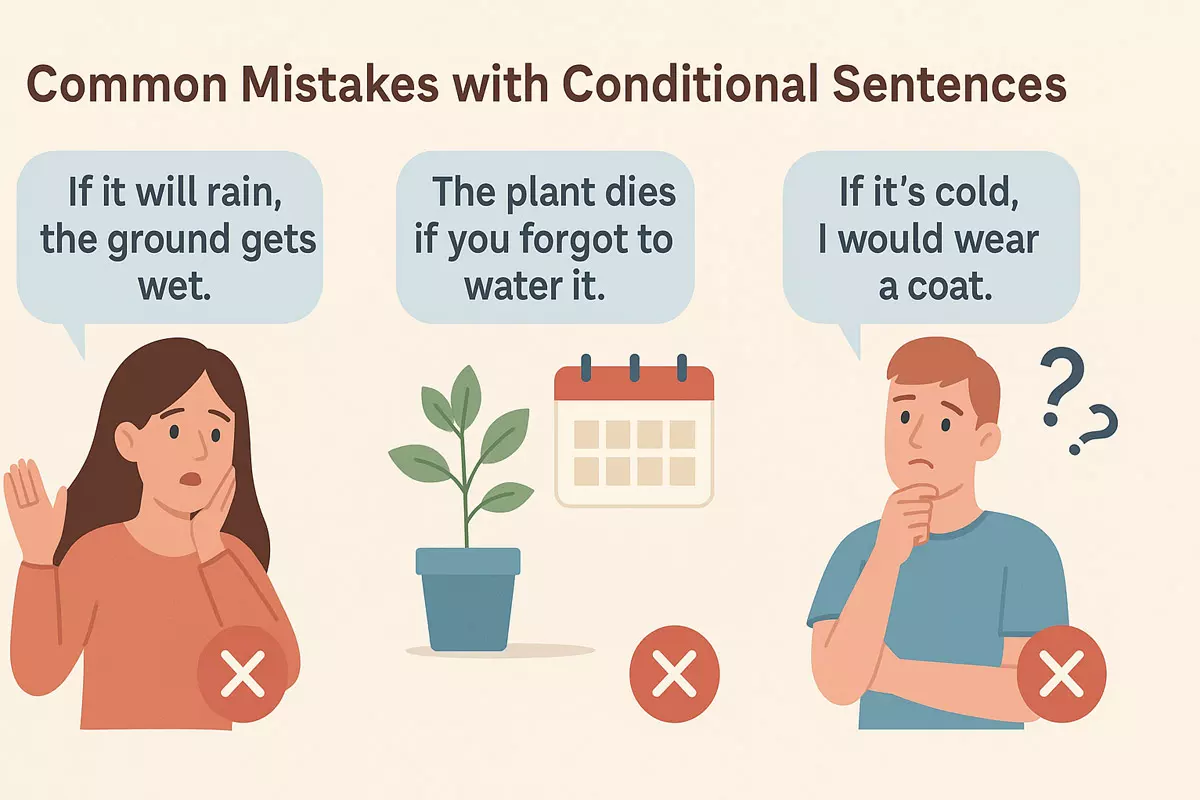 Here we frequent grammar mistakes in A1–A2 conditionals, like using will in if-clauses, word order errors, missing subjects, tense problems, and run-on sentences. It also provides practice correcting errors in sample conditional sentences.
Even experienced English learners sometimes make mistakes when forming simple if-then statements, which can result in confusion or unclear communication. These errors often occur due to misunderstandings about verb tenses, word order, or conditional structures. For instance, learners might use the wrong tense after “if,” or forget to match the verb in the “then” clause correctly. To avoid such issues, it is helpful to review basic conditional forms and practice using them in everyday situations, ensuring your intentions are clearly understood.
Typical grammar mistakes in A1–A2 conditionals
Learning to use basic if-sentences can be tricky, especially for beginners. Many learners at the A1–A2 level confuse verb forms or word order, leading to communication problems. Below are the most common issues and how to avoid them.
Incorrect verb tenses
One of the main difficulties is choosing the right verb tense in each part of a conditional sentence. For zero and first conditionals, beginners often mix up present and future forms. Here are some examples of typical errors and the correct usage:
- Wrong: If it will rain, we stay at home.
- Correct: If it rains, we stay at home.
- Wrong: If you will come, I will be happy.
- Correct: If you come, I will be happy.
Confusing word order
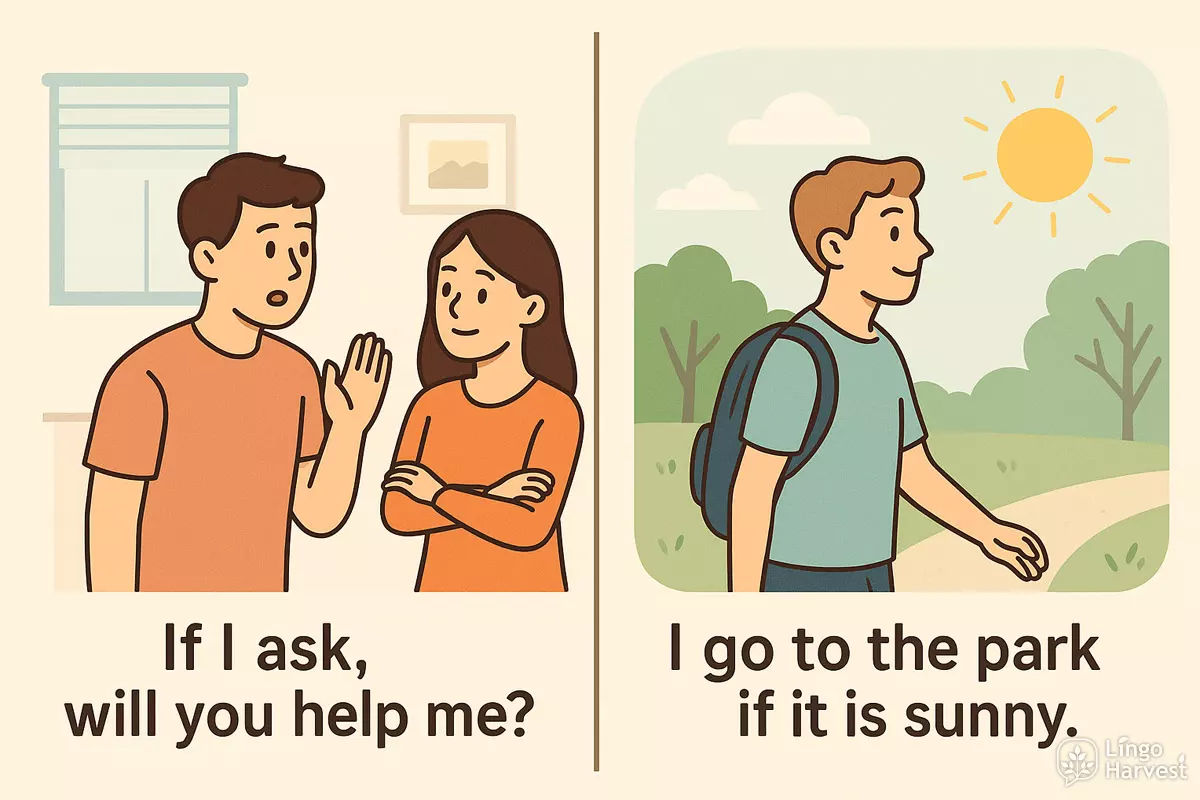
Placing words in the wrong order is a frequent issue. In English, the conditional clause ("if" part) usually comes before or after the main clause, but both need correct structure:
- Wrong: Will you help me if I ask?
- Correct: If I ask, will you help me?
- Wrong: I go to the park if is sunny.
- Correct: I go to the park if it is sunny.
Forgetting the “if”
Sometimes, learners forget to use “if” at all, which changes the meaning or makes the sentence unclear:
- Wrong: I see her, I say hello.
- Correct: If I see her, I say hello.
Mixing zero and first conditional forms
It’s easy to confuse when to use zero or first conditional. Zero is used for general facts, while first is for possible future actions. Beginners often mix these up:
| Conditional Type | Correct Example | Typical Error |
|---|---|---|
| Zero conditional | If you heat ice, it melts. | If you will heat ice, it will melt. |
| First conditional | If she calls, I will answer. | If she will call, I answer. |
Omitting subjects or auxiliary verbs
In English, the subject must be stated, and auxiliary verbs are needed in questions or negatives. Beginners sometimes leave these out:
- Wrong: If rains, we stay inside.
- Correct: If it rains, we stay inside.
- Wrong: If you not come, I sad.
- Correct: If you do not come, I am sad.
Summary of frequent errors for A1–A2 learners
- Using “will” after “if” in the if-clause (e.g. If you will go, I will go).
- Mixing present and future forms in the same sentence.
- Forgetting “if” at the start of the condition.
- Leaving out the subject or auxiliary verb.
- Incorrect word order, especially in questions.
- Applying first conditional structure to general truths.
- Using “when” instead of “if” (or vice versa) when the meaning is different.
- Omitting commas when the if-clause comes first (not always required, but can help clarity).
- Confusing “will” with “would” at this level.
- Using past tense in zero or first conditionals by mistake.
By focusing on these common stumbling blocks, beginners can form more accurate and natural conditional sentences in English.
Misuse of will in if-clauses
Many English learners mistakenly use "will" directly after "if" when talking about future possibilities. In standard conditional sentences, the present simple tense is required in the "if" part, not "will." This rule often confuses learners, especially because "will" is used to talk about the future in other types of sentences.
Why "will" is usually incorrect in if-clauses
The reason for this rule is that the "if" clause describes a possible situation, not a certain future event. Using "will" here makes the sentence sound unnatural to native speakers and can cause misunderstandings. The correct form keeps the "if" clause in the present simple, while "will" appears in the main clause.
- Correct: If it rains, we will stay inside. ✅
- Incorrect: If it will rain, we will stay inside. ❌
- Correct: If you study, you will pass the test. ✅
- Incorrect: If you will study, you will pass the test. ❌
Common situations where errors happen
This mistake often appears when learners are:
- Making predictions about the future ("If you will come, we will start.")
- Giving instructions or advice ("If you will press the button, the machine will start.")
- Talking about conditional plans ("If I will see her, I will tell her.")
Correct patterns for first conditionals
To help visualize the difference, here’s a comparison of correct and incorrect forms:
| Incorrect (with "will" in if-clause) | Correct (present simple in if-clause) |
|---|---|
| If you will help me, I will finish faster. | If you help me, I will finish faster. |
| If it will snow, the roads will be dangerous. | If it snows, the roads will be dangerous. |
| If she will call, I will answer. | If she calls, I will answer. |
| If we will arrive early, we will see the sunrise. | If we arrive early, we will see the sunrise. |
| If you will eat now, you will not be hungry later. | If you eat now, you will not be hungry later. |
Special cases: When "will" is acceptable
There are rare exceptions where "will" can be used in the "if" part, usually to express willingness or a polite request, not a future event. For example:
- If you will sign here, I can process your request. (Showing willingness)
- If he will stop shouting, we can talk. (Expressing a voluntary action)
But in most conditional sentences about real possibilities, stick to the present simple after "if" for clarity and correctness.
Incorrect word order and missing subjects
Clear sentence structure is essential when forming basic conditional sentences in English. Learners often struggle with the order of words, especially when switching between the “if” clause and the main clause. Another frequent mistake is omitting the subject, which is required in every English sentence—even in the conditional clauses. These errors can make your meaning unclear or cause confusion for listeners.
Common problems with sentence structure
When forming conditionals, English usually follows a set pattern: If + subject + verb, subject + verb. If you change this order or leave out the subject, the sentence may become ungrammatical. For example, “If rains, I stay home” is incorrect because the subject “it” is missing. Similarly, “Stay home if it rains I” has the wrong word order.
Frequent mistakes to watch for
- Omitting the subject: “If is cold, I wear a jacket.” ❌ (should be “If it is cold...”)
- Switching verb and subject: “If will you come, I cook dinner.” ❌ (should be “If you will come...”)
- Misplacing “if”: “You go if will it rain.” ❌ (correct: “If it will rain, you go.”)
- Leaving out “if”: “You come, I help you.” ❌ (should be “If you come, I help you.”)
- Combining both clauses incorrectly: “If you study pass you.” ❌ (should be “If you study, you pass.”)
- Using two main clauses: “You study, you pass.” (missing “if”)
- Forgetting inversion in formal conditionals: “Should you need help, call me.” (correct, but “If you need help, call me.” is more common in basic forms)
- Double subjects: “If it it rains, I stay home.” ❌
- Subject after verb: “If is it sunny, we go out.” ❌ (“If it is sunny, we go out.”)
- Omitting the main clause subject: “If you come, will help.” ❌ (should be “If you come, I will help.”)
Correct patterns for basic conditionals
Following the standard patterns helps you avoid confusion. Here’s a quick comparison of incorrect and correct forms:
| If-clause (incorrect) | If-clause (correct) |
|---|---|
| If raining, I stay home. | If it is raining, I stay home. |
| If go to the store, I buy milk. | If I go to the store, I buy milk. |
| If hungry, eat. | If you are hungry, eat. |
| If will rain, stay home. | If it rains, stay home. |
| If is hot, open window. | If it is hot, open the window. |
| If late, call me. | If you are late, call me. |
| If feeling tired, rest. | If you are feeling tired, rest. |
| If want help, ask. | If you want help, ask. |
| If finish early, go home. | If you finish early, go home. |
| If forget keys, call me. | If you forget your keys, call me. |
Tips for avoiding mistakes
- Always state the subject in both clauses, even if it seems obvious.
- Keep the verb immediately after the subject in each clause.
- Use a comma when the “if” clause comes first.
- Practice with simple, clear sentences before trying complex ones.
- Read your sentence aloud to spot missing words or unusual order.
By paying attention to word order and making sure every clause has a subject, you can create clear, correct conditional sentences every time.
Problems with tense consistency
One of the most frequent challenges learners face with basic conditional sentences is getting the verb tenses to match correctly. The logic of conditionals relies on a specific sequence of tenses, and mixing them up can lead to confusion or a change in meaning. This is especially true when moving between the zero, first, and second conditionals, which each use different verb patterns.
Why tense matching matters in conditionals
The meaning of a conditional sentence often depends on the time and likelihood of the event. If the verb tenses are inconsistent, the sentence may sound unnatural or even be misunderstood. For example, using a past tense in the "if" clause of a first conditional can cause confusion about whether you are talking about a real or unreal situation.
Common tense mismatches to watch for
- Mixing present and will in the "if" clause: "If you will come early, we can start." ❌ (should be: "If you come early, we can start.")
- Using past simple in the main clause of a first conditional: "If it rains, we stayed home." ❌ (should be: "If it rains, we will stay home.")
- Combining would with present simple in the "if" clause: "If I will see her, I would tell her." ❌ (should be: "If I saw her, I would tell her.")
- Mixing present perfect with will in zero conditionals: "If you have finished, the bell will ring." ❌ (should be: "If you finish, the bell rings.")
- Using will in both clauses: "If you will help me, I will finish faster." ❌ (should be: "If you help me, I will finish faster.")
- Using past continuous in the main clause of a second conditional: "If I won the lottery, I was traveling the world." ❌ (should be: "If I won the lottery, I would travel the world.")
- Present simple in second conditional: "If she knew French, she speaks to them." ❌ (should be: "If she knew French, she would speak to them.")
- Using would in "if" clause: "If you would listen, you would understand." ❌ (should be: "If you listened, you would understand.")
- Using past simple in zero conditional: "If water boiled, it evaporated." ❌ (should be: "If water boils, it evaporates.")
- Present continuous in second conditional: "If I had money, I am buying a car." ❌ (should be: "If I had money, I would buy a car.")
Correct tense patterns for basic conditionals
| Type | Form (If clause → Main clause) | Example |
|---|---|---|
| Zero Conditional | Present Simple → Present Simple | If it rains, the grass gets wet. |
| First Conditional | Present Simple → Will + Base Verb | If you study, you will pass. |
| Second Conditional | Past Simple → Would + Base Verb | If I had time, I would travel. |
Paying close attention to these patterns helps you avoid tense confusion and clearly express your intended meaning. When in doubt, double-check which conditional you are using and match the verb forms accordingly.
How to correct run-on sentences created by if
Many learners accidentally create run-on sentences when they use "if" clauses, often joining two ideas without proper punctuation or conjunctions. This usually happens because both the condition and the result are crammed into a single sentence without a pause, making it confusing for readers. To make your writing clear, it's important to separate the two parts correctly.
Recognizing common run-on patterns with "if"
A typical mistake is merging the conditional clause and the result without any comma or linking word. For example:
- If it rains bring an umbrella. ❌ (run-on)
- If you study hard you will pass the test. ❌ (run-on)
These sentences feel rushed and can cause misunderstanding.
Ways to fix run-on sentences with "if"
To correct these errors, you can use several strategies:
- Add a comma after the "if" clause when it comes first.
If it rains, bring an umbrella. ✅ - Reverse the order: Place the main clause first, and omit the comma.
Bring an umbrella if it rains. ✅ - Use a coordinating conjunction to split long or complex conditions:
If you finish early, and if you have time, call me. ✅ - Make two sentences for clarity, especially with long conditions:
If you are feeling tired, take a break. You can continue later. ✅ - Avoid blending two full independent clauses with just a comma (comma splice).
Examples: Incorrect vs. Correct Usage
| Incorrect (Run-on) | Corrected Version |
|---|---|
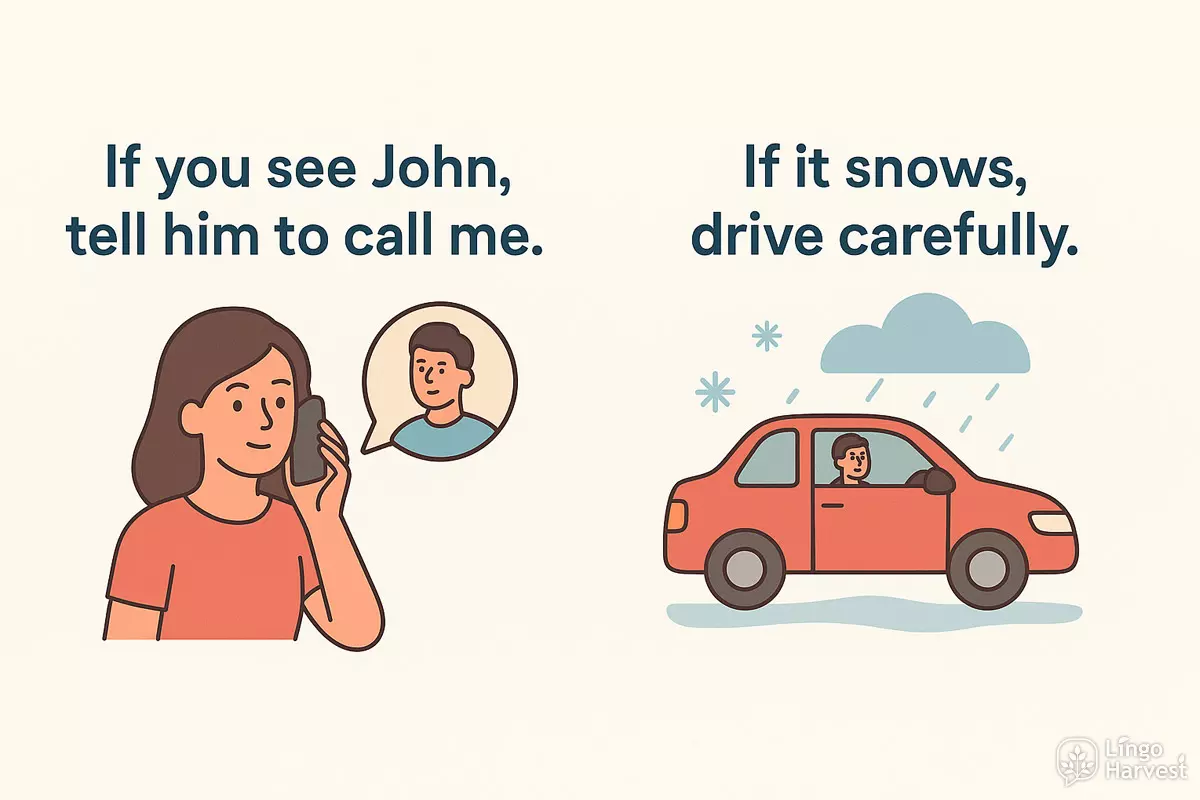
| If you see John tell him to call me. | If you see John, tell him to call me. |
| If it snows drive carefully. | If it snows, drive carefully. |
| Call me if you need help I’ll come right away. | Call me if you need help. I’ll come right away. |
| If the train is late wait at the station. | If the train is late, wait at the station. |
| She will be upset if you forget her birthday she told you last week. | She will be upset if you forget her birthday. She told you last week. |
Checklist for avoiding run-ons with "if"
- Always use a comma after the "if" clause at the start of a sentence.
- Don’t join two independent sentences with just a comma.
- Split long or complicated thoughts into two sentences if needed.
- Read your sentence aloud: if it feels rushed, add punctuation or break it up.
- Practice with real examples to get comfortable with the structure.
By following these guidelines, your sentences will be clearer, more professional, and easier to understand.
Practice: find and correct errors in sample conditionals
Understanding how to use conditional sentences correctly is essential for clear communication. Below you'll find several practice items designed to help you spot and fix common mistakes with basic "if" sentences. Each example contains an error—identify what’s wrong, then correct it. This activity covers first, second, and third conditional forms, as well as typical pitfalls such as verb tense agreement, word order, and misplaced modal verbs.
Identify and Fix the Errors
Read each sentence. Decide what kind of conditional it should be and correct any mistakes you find. Some items may have more than one error.
- If it will rain tomorrow, we will cancel the picnic.
- If she would study more, she gets better grades.
- If I had knew about the meeting, I would have come.
- If you heat ice, it will melts.
- If they arrives late, we will start without them.
- If I win the lottery, I would buy a house.
- If he had more time, he will help us.
- If you would have called, I could help you.
- If she goes to the party, she would meet new friends.
- If we left now, we will catch the train.
- If you eats too much, you feel sick.
- If the alarm rings, evacuate the building immediately.
- If he had not missed the bus, he catch the flight.
- If they finish early, they can goes home.
- If I see him, I will told you.
Quick Reference: Common Conditional Errors and Corrections
- Using "will" in the if-clause: Correct: "If it rains, we will..."
- Mixing tenses: Second conditional uses past simple + "would" (not present + "would").
- Wrong verb forms: Third conditional uses "had" + past participle + "would have" + past participle.
- Subject-verb agreement: "He eats," not "He eat."
- Incorrect modal placement: "If you had called, I could have helped," not "If you would have called..."
Show answers
- If it rains tomorrow, we will cancel the picnic.
- If she studied more, she would get better grades.
- If I had known about the meeting, I would have come.
- If you heat ice, it melts.
- If they arrive late, we will start without them.
- If I win the lottery, I will buy a house.
- If he had more time, he would help us.
- If you had called, I could have helped you.
- If she goes to the party, she will meet new friends.
- If we leave now, we will catch the train.
- If you eat too much, you will feel sick.
- If the alarm rings, evacuate the building immediately. (Correct — zero conditional imperative)
- If he had not missed the bus, he would have caught the flight.
- If they finish early, they can go home.
- If I see him, I will tell you.
Spot the Pattern: Typical Mistakes to Watch For
- Using "would" or "will" after "if" (avoid in standard conditional forms)
- Forgetting to use past participles in third conditionals
- Confusing present simple and future forms in zero and first conditionals
- Mixing second and third conditional structures
- Incorrect verb agreement with singular/plural subjects
Reviewing these examples and corrections can help you recognize and avoid frequent errors in your own writing and speech. Try creating your own sentences or correcting those you hear in daily conversation for extra practice.