Unless for Beginners: Meaning and Easy Examples

 Here we how unless works as the opposite of if not, when it sounds more natural, and how to avoid common mistakes like double negatives. It includes examples from daily life and practice exercises for using unless correctly.
Mastering the use of this important word can greatly expand your ability to express conditions and exceptions in English. Many learners find it confusing at first, but with straightforward explanations and practical examples, understanding when and how to use it becomes much simpler. By practicing in real-life contexts and paying attention to common usage, you will gradually become more confident and accurate in your communication, making your English more flexible and precise.
Meaning of unless as the opposite of if not
“Unless” is often used in English to express a condition that is the opposite of “if not.” In other words, “unless” means “except if” or “only if not.” This makes it a useful word for saying when something will not happen, except in a particular situation. It helps to make statements shorter and clearer by replacing longer phrases like “if not.”
For example, instead of saying, “I will go for a walk if it does not rain,” you can use “unless” and say, “I will go for a walk unless it rains.” Both sentences mean the same thing, but the second is more natural and direct.
How “unless” changes a sentence
Using “unless” reverses the usual condition. It sets up an exception. The action in the main part of the sentence happens in all cases except the one mentioned after “unless.” This makes it different from “if,” which can refer to any condition. Here are some more examples:
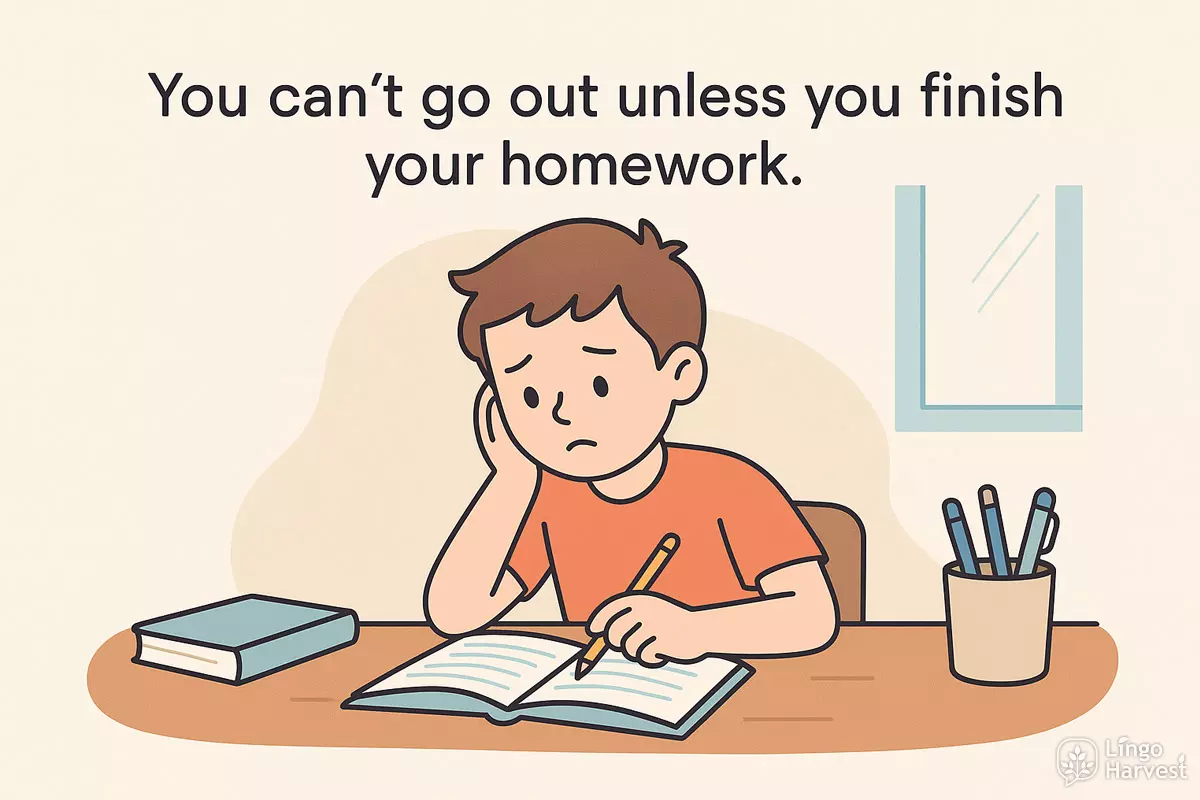
- You can’t go out unless you finish your homework. (You must finish your homework, or you can’t go out.)
- She won’t come unless you invite her. (She will only come if you invite her.)
- Unless we hurry, we’ll miss the bus. (We’ll miss the bus if we don’t hurry.)
- The plant will die unless you water it. (It will die if you do not water it.)
- I won’t pay unless you fix the problem. (I will pay only if you fix it.)
- Don’t call me unless it’s important. (Call me only if it’s important.)
- We can’t start unless everyone is here. (We will start only when everyone arrives.)
- Unless you ask, you won’t get help. (You will not get help if you do not ask.)
- He’ll be upset unless you apologize. (He will be upset if you don’t apologize.)
- The show won’t begin unless the director arrives. (It will not begin if the director does not arrive.)
- Unless you study, you won’t pass the test. (You will not pass if you do not study.)
- We won’t leave unless you’re ready. (We will leave only if you are ready.)
- Unless it’s urgent, please wait until tomorrow. (Wait unless it is urgent.)
- I won’t join unless my friend comes too. (I will join only if my friend comes.)
- Unless told otherwise, follow these instructions. (Follow them unless you are told not to.)
Comparing “unless” and “if not”
To see the relationship between these two forms, compare the following pairs. Both sentences have the same meaning, but the structure changes:
| Using “if not” | Using “unless” |
|---|---|
| If you do not hurry, you will be late. | You will be late unless you hurry. |
| If he does not call, I will be worried. | I will be worried unless he calls. |
| If they don’t finish, we can’t start. | We can’t start unless they finish. |
| If we do not leave now, we’ll miss the train. | We’ll miss the train unless we leave now. |
| If you don’t tell me, I won’t know. | I won’t know unless you tell me. |
Notice that “unless” is a simple way to express a negative condition. It’s a helpful word for making your English more fluent and natural, especially when you want to avoid double negatives or awkward phrasing.
How to replace if not with unless naturally
Switching from "if not" to "unless" can make your English sound smoother and more natural. Both phrases express a condition, but "unless" is often shorter and less awkward. The key is to recognize when "if not" means "except if," which matches the use of "unless." Let's look at the details, patterns, and examples to help you get comfortable using "unless" in place of "if not."
Understanding the difference
"If not" and "unless" can have similar meanings, but they're not always interchangeable. "Unless" works best when you're talking about a single negative condition. If the sentence gets complicated, or if "if not" means "otherwise," swapping it for "unless" may not be correct.
Common patterns to change
- "If you do not" → "Unless you"
- "If he does not" → "Unless he"
- "If it is not" → "Unless it is"
- "If they don't" → "Unless they"
- "If we don't" → "Unless we"
- "If she doesn't" → "Unless she"
- "If there isn't" → "Unless there is"
- "If I am not" → "Unless I am"
- "If you aren't" → "Unless you are"
- "If it doesn't" → "Unless it does"
Examples: Before and after
Here are several sentences showing how to swap "if not" for "unless" for a more natural flow:
- "If you do not hurry, you will miss the bus." → "Unless you hurry, you will miss the bus."
- "I won't go if he does not invite me." → "I won't go unless he invites me."
- "If it is not sunny, we will stay inside." → "Unless it is sunny, we will stay inside."
- "She will fail if she doesn't study." → "She will fail unless she studies."
- "If there isn't enough time, we'll finish tomorrow." → "Unless there is enough time, we'll finish tomorrow."
- "We can't start if everyone isn't here." → "We can't start unless everyone is here."
- "If you don't tell me, I won't know." → "Unless you tell me, I won't know."
- "If the weather is not good, we won't go camping." → "Unless the weather is good, we won't go camping."
- "If I am not busy, I'll join you." → "Unless I am busy, I'll join you."
- "If you aren't careful, you'll break it." → "Unless you are careful, you'll break it."
Quick reference comparison
| "If Not" Example | "Unless" Version |
|---|---|
| If you do not call me, I will worry. | Unless you call me, I will worry. |
| I can't help if I do not know the problem. | I can't help unless I know the problem. |
| If she is not ready, we will be late. | Unless she is ready, we will be late. |
| He won't go if he doesn't get permission. | He won't go unless he gets permission. |
| If it is not raining, we can play outside. | Unless it is raining, we can play outside. |
Tips for natural use
- Use "unless" when the meaning is "except if"
- Keep the condition simple and negative
- If the sentence has more than one condition, check carefully—"unless" may not work
- Read the sentence aloud to check if it sounds natural with "unless"
With practice, you'll find it easy to use "unless" instead of "if not" in everyday English.
Examples from daily routines, rules, and warnings
Understanding how “unless” works in everyday situations is often easier with practical examples. This word is used to show exceptions or conditions, especially when giving instructions, setting rules, or explaining what could go wrong. Below, you’ll find sample sentences and scenarios that illustrate its use in familiar settings.
Everyday Routine Scenarios
- You can’t have dessert unless you finish your vegetables.
- We won’t go to the park unless it stops raining.
- I don’t drink coffee unless I’m very tired in the morning.
- He won’t call you unless it’s important.
- Unless you set an alarm, you might oversleep.
- She doesn’t wear a jacket unless it’s cold outside.
- Unless you water the plants, they will die.
- I won’t watch the movie unless you join me.
- Unless you study, you won’t pass the test.
- The bus won’t wait unless you wave at the driver.
Common Rules and Instructions
- No pets allowed unless they are service animals.
- Do not enter unless you have permission.
- Children are not allowed in the pool unless supervised by an adult.
- Unless you have a ticket, you cannot board the train.
- Keep the door closed unless you are using the room.
- Unless the sign says “open,” the store is closed.
Warnings and Safety Notices
- Do not touch unless instructed by staff.
- Danger: Do not enter unless authorized.
- Unless you wear a helmet, you cannot ride the bike.
- Keep hands away unless the machine is stopped.
Quick Comparison: “Unless” in Rules vs. Warnings
| Situation | Sample Sentence |
|---|---|
| Routine Instruction | Don’t leave the house unless you have your keys. |
| Rule | Food not allowed unless purchased here. |
| Safety Warning | Do not operate unless trained. |
| Personal Habit | I don’t use my phone unless necessary. |
These examples show how “unless” introduces an exception or a necessary condition. In daily speech, rules, and warnings, this word helps clarify what must happen—or not happen—for something else to be true.
Common mistakes: double negatives and incorrect placement
Using "unless" can be tricky for beginners, especially when it comes to avoiding double negatives and making sure the word is in the right part of the sentence. These issues can make your sentence confusing or even change its meaning entirely.
Double negatives with "unless"
A frequent error is combining "unless" with another negative, which often leads to an unintended positive meaning. Since "unless" already introduces a negative idea ("if not"), adding words like "don't," "never," or "not" in the same clause can create confusion.
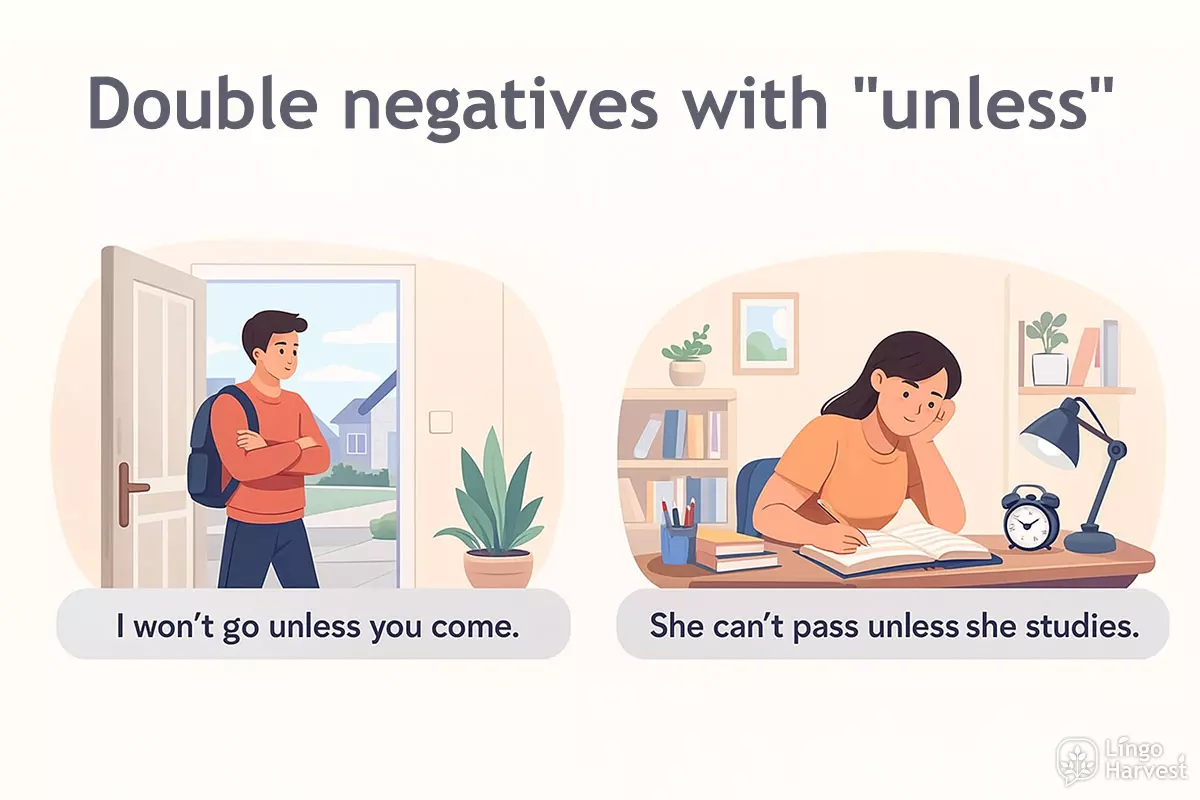
- ❌ Incorrect: I won't go unless you don't come.
- ✅ Correct: I won't go unless you come.
- ❌ Incorrect: She can't pass unless she doesn't study.
- ✅ Correct: She can't pass unless she studies.
Incorrect placement of "unless"
Placing "unless" in the wrong part of a sentence can disrupt clarity. Typically, "unless" introduces a condition at the beginning or middle, but it should not be used at the end of a sentence.
- ❌ Incorrect: You will fail the test, unless.
- ✅ Correct: Unless you study, you will fail the test.
- ✅ Also correct: You will fail the test unless you study.
Common error patterns with "unless"
Beginners can avoid confusion by watching out for these typical mistakes:
- Adding "not" after "unless" (e.g., "unless you don't...")
- Using "unless" at the end of a sentence with no condition after it
- Mixing "unless" with other negatives (never, nobody, nothing) in the same clause
- Using "unless" where "if" would be clearer
- Forgetting that "unless" means "except if" and using it with positive statements
- Writing sentences like "I will go unless not raining" instead of "unless it rains"
- Starting a sentence with "Unless" but not completing the conditional idea
- Trying to use "unless" with past perfect ("unless he had not arrived")
- Using "unless" with modal verbs incorrectly ("unless you won't come")
- Confusing "unless" with "until"
Quick comparison: Right vs. wrong usage
| ❌ Wrong Example | ✅ Corrected Version |
|---|---|
| We can't start unless everyone doesn't arrive. | We can't start unless everyone arrives. |
| I won't be happy unless she doesn't call. | I won't be happy unless she calls. |
| You can't play unless not tired. | You can't play unless you are tired. |
| He will fail, unless. | He will fail unless he studies. |
Careful attention to these patterns will help you use "unless" more naturally and accurately. Always check for hidden negatives and make sure your conditional idea is complete and clear.
When unless is more natural than if not
In many everyday situations, using unless sounds smoother and more idiomatic than rephrasing with if not. This is especially true when you want to talk about exceptions, conditions for something not happening, or set a requirement for an action. Unless often fits best when you want to state that something will happen except in one specific case.
Common scenarios where unless works better
- Stating exceptions: “You can’t go out unless you finish your homework.”
- Describing requirements: “Tickets are not valid unless signed.”
- Talking about rules: “No refunds unless you have the receipt.”
- Making warnings: “Don’t call me unless it’s urgent.”
- Offering choices: “I won’t attend unless you invite me.”
- Giving instructions: “Don’t open the door unless you know the person.”
- Explaining consequences: “You’ll fail unless you study.”
- Setting conditions: “The machine won’t work unless plugged in.”
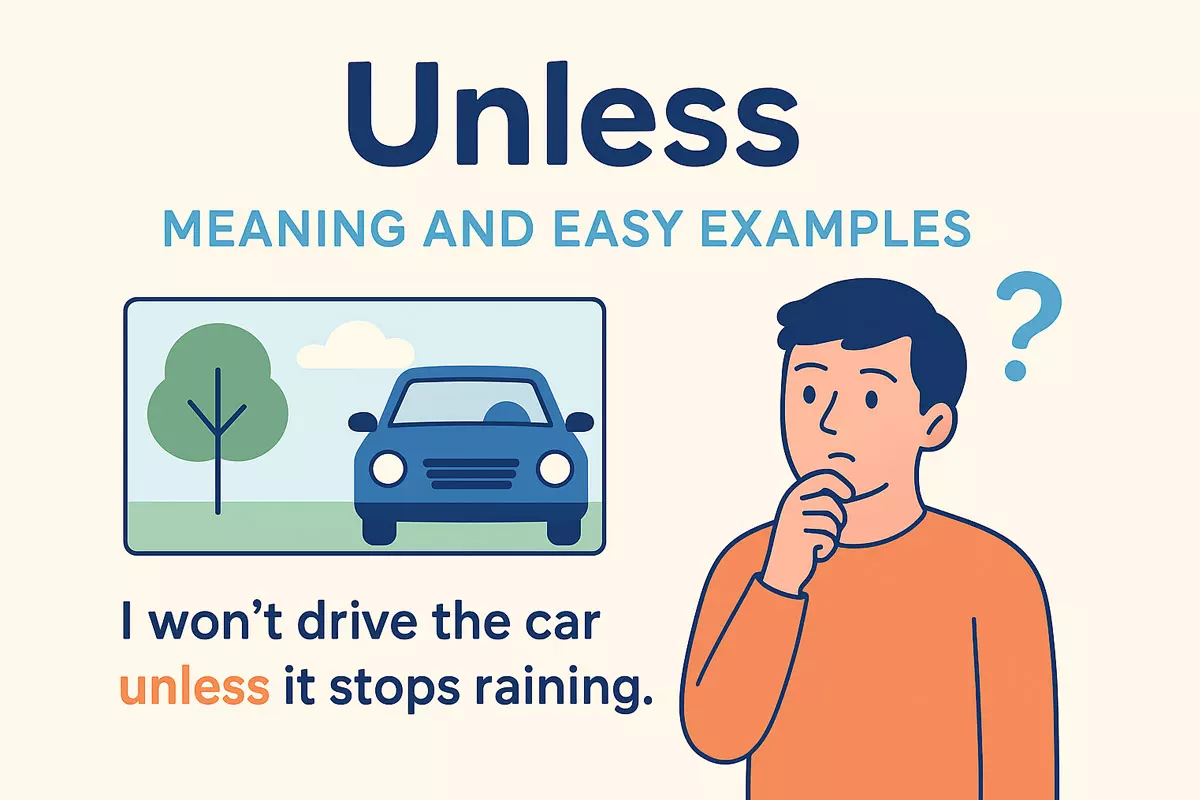
- Expressing plans: “I’ll stay home unless it stops raining.”
- Negotiating terms: “We can’t proceed unless you agree.”
- Formal disclaimers: “Warranty is void unless installed by a professional.”
- Making promises: “I won’t tell anyone unless you say I can.”
- Stating habitual actions: “He never eats breakfast unless he’s on vacation.”
- Giving permission: “No one leaves unless I say so.”
- Describing default situations: “Unless told otherwise, assume the meeting is at 10.”
Why “unless” sounds more natural in these cases
Using unless helps you avoid double negatives and awkward wording. For example, “I won’t go if you don’t invite me” sounds less direct than “I won’t go unless you invite me.” In spoken English, unless is often preferred because it’s concise and clear. It also emphasizes the exception, making your meaning easier to understand.
Comparison: unless vs. if not
| Sentence with unless | Sentence with if not |
|---|---|
| You can't enter unless you have a ticket. | You can't enter if you don't have a ticket. |
| I won’t go unless you come with me. | I won’t go if you don’t come with me. |
| We’ll start unless he calls to cancel. | We’ll start if he doesn’t call to cancel. |
| She won’t pass unless she studies. | She won’t pass if she doesn’t study. |
| Don’t touch it unless I say so. | Don’t touch it if I don’t say so. |
In summary, unless is usually the best choice when you want to sound natural, especially for clear exceptions or requirements. It keeps your sentences straightforward and helps avoid confusion.
Practice: rewrite sentences using unless correctly
Understanding how to use "unless" can make your English sound more natural and fluent. Below, you’ll find practical exercises where you change negative "if" statements into sentences using "unless." This helps you get used to the structure and meaning of "unless" in real contexts.
Instructions
Read each sentence. Rephrase it using "unless" to express the same idea. This will help you master common patterns and spot typical mistakes.
- If you don’t hurry, you will miss the bus.
- If he doesn’t call, we won’t go.
- You can’t enter if you don’t have a ticket.
- If it doesn’t rain, we’ll go for a walk.
- If she isn’t careful, she’ll break the vase.
- If you don’t study, you will fail the test.
- If they don’t invite us, we won’t come.
- If you don’t tell me the truth, I can’t help you.
- If the shop isn’t open, I can’t buy bread.
- If I don’t get a raise, I’ll look for another job.
Show answers
- You will miss the bus unless you hurry.
- We won’t go unless he calls.
- You can’t enter unless you have a ticket.
- We’ll go for a walk unless it rains.
- She’ll break the vase unless she’s careful.
- You will fail the test unless you study.
- We won’t come unless they invite us.
- I can’t help you unless you tell me the truth.
- I can’t buy bread unless the shop is open.
- I’ll look for another job unless I get a raise.
Common mistakes to avoid with "unless"
- Don’t use "unless" with negative verbs. For example, avoid: “Unless you don’t hurry, you will miss the bus.” The correct form is: “Unless you hurry, you will miss the bus.”
- "Unless" means "if not," so double negatives are confusing or incorrect.
- Use "unless" for real conditions, not hypothetical or impossible ones.
More practice: choose the correct use of "unless"
Which sentence is correct?
- ✅ I won’t go unless you come with me.
- ❌ I won’t go unless you don’t come with me.
Show answers
The first sentence is correct: "I won’t go unless you come with me."
Practicing these transformations will help you use "unless" more accurately in both writing and conversation.