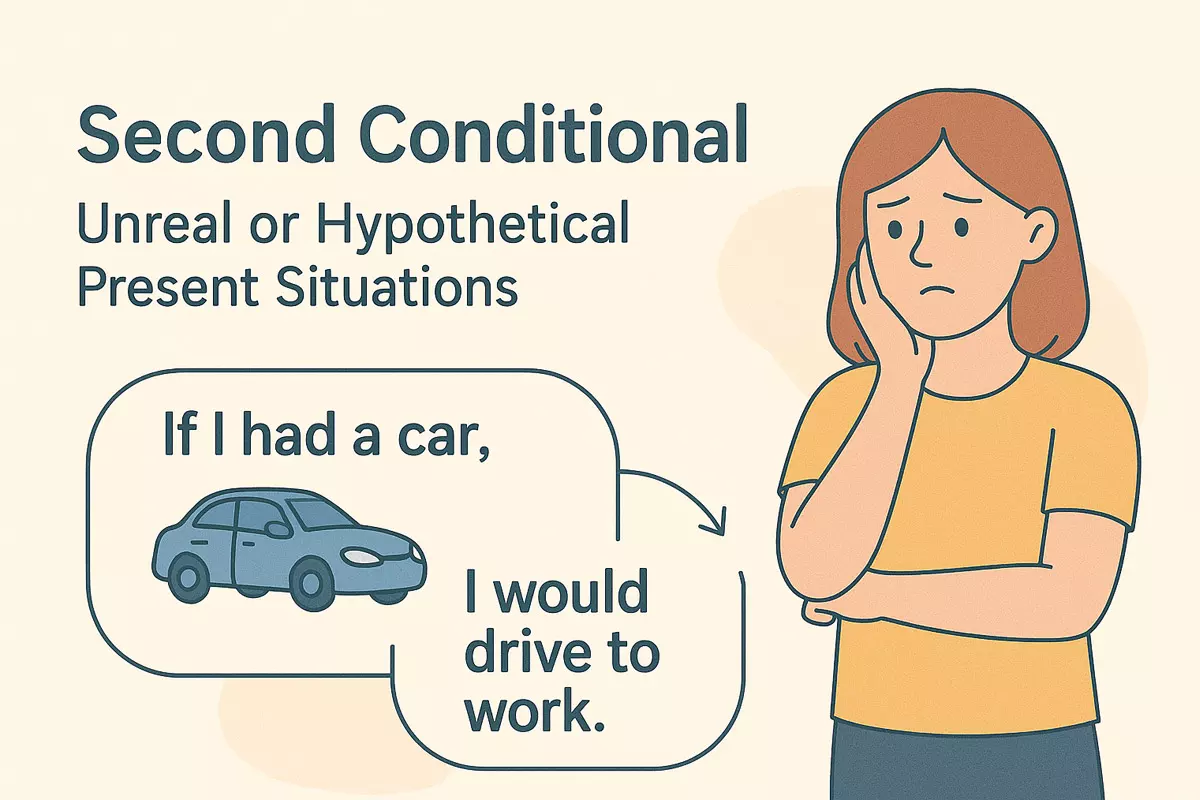
Second Conditional: Unreal or Hypothetical Present Situations

 Here we how the second conditional describes unreal or hypothetical present situations, its structure with if and past simple plus would, differences from real future meaning, use of could and might, typical contexts, common tense mistakes, and practice…
- Meaning of unreal or hypothetical present conditions
- Form: if + past simple, would + base verb
- Difference between real vs unreal future meaning
- Using could and might in second conditional structures
- Typical contexts: dreams, advice, imaginary situations
- Common mistakes with verb tense choice
- Practice: complete and create second conditional sentences
When we talk about situations that are not happening in reality but could occur under different circumstances, we use specific grammatical structures to express these imaginary or hypothetical scenarios. In English, this often involves using conditional sentences, such as those starting with "if," to discuss what might happen if the present or past were different. For example, we say "If I had more time, I would travel more," to imagine a situation that is not currently true. This approach allows us to explore possibilities, make polite requests, or reflect on how things could change based on different conditions.
Meaning of unreal or hypothetical present conditions
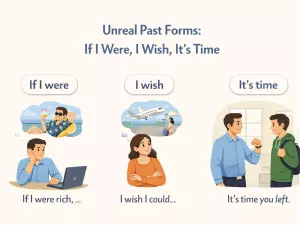
When we use the second conditional in English, we’re talking about situations that are not true now or are unlikely to happen at this moment. These are scenarios where we imagine different circumstances in the present, even though we know they do not reflect reality. This construction allows speakers to discuss wishes, dreams, regrets, or advice about the present, often focusing on outcomes that are impossible or improbable. The second conditional typically follows the pattern: if + past simple, would + base verb. Despite using the past tense, it doesn’t refer to a real past event. Instead, the past simple signals that the condition is unreal or hypothetical.
Typical Uses
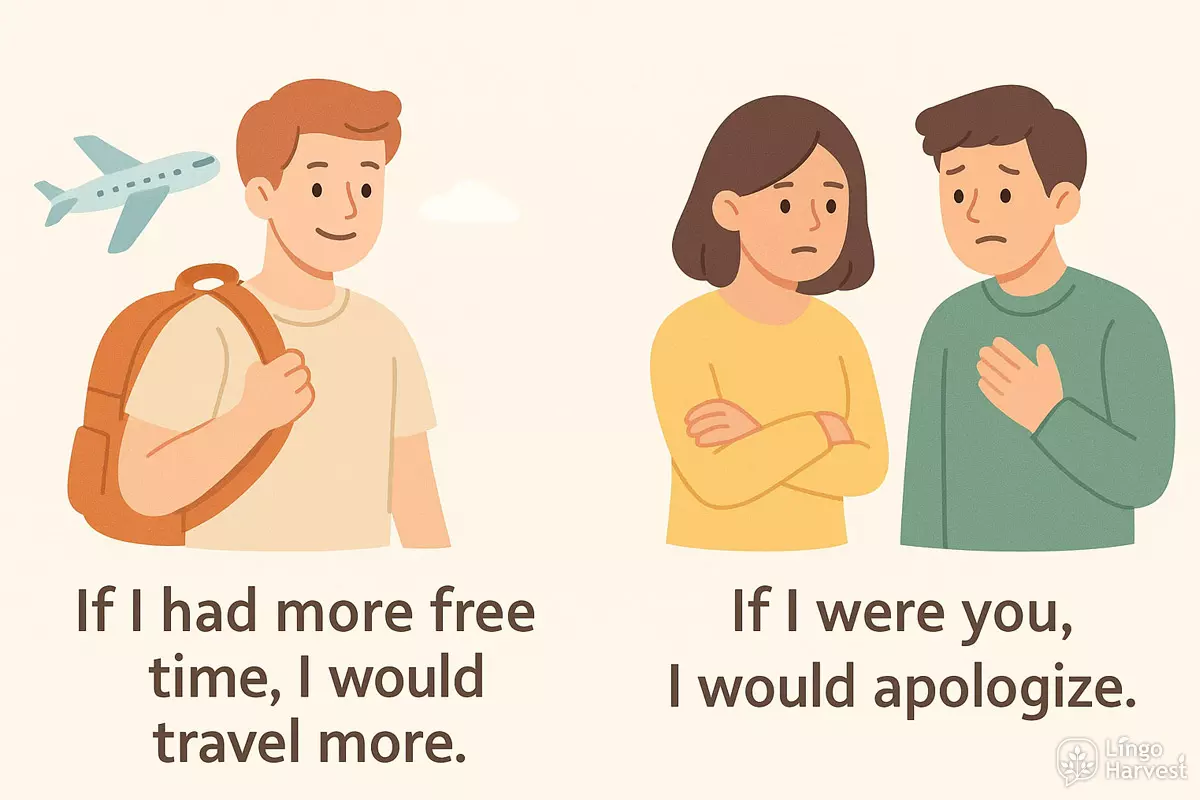
- Imagining different present realities: “If I had more free time, I would travel more.”
- Giving advice in hypothetical terms: “If I were you, I would apologize.”
- Expressing wishes or desires: “If he knew her name, he would call her.”
- Considering unlikely possibilities: “If it snowed in July, people would be surprised.”
- Discussing consequences of unreal situations: “If they spoke Spanish, they would understand the film.”
- Suggesting alternatives: “If we lived closer, we would visit often.”
- Describing dreams: “If I were famous, I would travel the world.”
- Giving polite advice: “If you needed help, I would be happy to assist.”
- Speculating about current abilities: “If she could drive, she would commute by car.”
- Making polite requests: “If you had a moment, would you check this for me?”
How It Works
The second conditional is not used for real or likely present situations. It helps us discuss what would happen if things were different right now, but we know they are not. This form often expresses a sense of distance from reality.
| Unreal Present Condition | Imagined Result |
|---|---|
| If I knew the answer | I would tell you |
| If she had a car | She would drive to work |
| If we were at home | We would watch a movie |
| If he spoke French | He would understand the book |
| If it rained today | We would stay inside |
Key Points to Remember
- These sentences are not about real events happening now.
- The structure helps convey distance from reality or current facts.
- “Were” is often used instead of “was” after “if” (especially in formal writing): “If I were taller, I would play basketball.”
- It’s a useful way to talk about dreams, advice, and imaginary scenarios in the present.
Form: if + past simple, would + base verb
Understanding how to build sentences about unreal or hypothetical situations in the present is essential for expressing wishes, regrets, or imagining different realities. This structure involves using the past simple after "if," and "would" followed by the base form of the verb in the other clause. It’s a key part of the second conditional, which is commonly used to talk about things that are not true now or are unlikely to happen. This construction helps speakers talk about imaginary scenarios, offer advice, or express dreams and ambitions. For example, you might use it to say what you would do if you had more free time or what would happen if you lived somewhere else.
Sentence Pattern
The typical pattern looks like this:
- If + subject + past simple, subject + would + base verb.
- Subject + would + base verb + if + subject + past simple.
The order of the clauses can be switched without changing the meaning. Remember, a comma is used when the "if" clause comes first.
Examples in Context
To make this structure clear, here are some common examples:
- If I won the lottery, I would travel the world.
- If she knew the answer, she would tell you.
- We would buy a house if we had enough money.
- If he were taller, he would play basketball.
- If you studied more, you would get better grades.
- If they lived closer, we would visit them often.
- I would help you if I could.
- If it rained, we would stay inside.
- If my phone worked, I would call you.
- She would join us if she felt better.
- If you spoke Spanish, you would understand the film.
- If I were you, I would take the job.
- We would go for a walk if it weren’t so cold.
- If he had more time, he would learn to cook.
- If the train arrived on time, we would be happy.
- If I didn’t have to work, I would sleep in.
- If the weather improved, we would have a picnic.
- She would buy that dress if it were cheaper.
- If they invited us, we would definitely go.
- If you listened carefully, you would understand.
Special Notes on Usage
- Use "were" for all subjects in the "if" clause when using the verb "to be" (e.g., If I were, If he were), especially in formal English.
- Do not use "would" in the "if" part; only use it in the result clause.
- This form is not used for real or likely situations; it's for imagined, unreal, or unlikely present events.
Comparing Real vs. Unreal Situations
| Real Present (First Conditional) | Unreal Present (Second Conditional) |
|---|---|
| If it rains, we will stay inside. | If it rained, we would stay inside. |
| If I have time, I will help you. | If I had time, I would help you. |
| If she studies, she will pass. | If she studied, she would pass. |
| If they invite us, we will go. | If they invited us, we would go. |
This structure allows English speakers to discuss possibilities that are not true now, or that are unlikely to happen, offering a flexible way to explore alternative realities in conversation.
Difference between real vs unreal future meaning
When talking about the future in English, it's important to distinguish between situations that are possible (real) and those that are imaginary or unlikely (unreal). The second conditional is used for unreal or hypothetical situations, often about the present or future. In contrast, the first conditional is for real, likely events in the future.
How real and unreal future meanings differ
The main distinction lies in how likely the event is to happen. Real future possibilities are those that could actually occur, while unreal future situations are imagined or contrary to fact.
- First conditional: Used for real, possible future actions (If it rains tomorrow, I will stay home.)
- Second conditional: Used for hypothetical or unlikely future scenarios (If I won the lottery, I would travel the world.)
Key features of real vs. unreal future
- Real: Expresses a genuine possibility or prediction.
- Unreal: Describes a dream, wish, or something that's not expected to happen.
- Real: Uses if + present simple and will + base verb.
- Unreal: Uses if + past simple and would + base verb.
Common examples
Here are some sentences showing the contrast:
- If I get the job, I will celebrate. (Real, possible future)
- If I got the job, I would celebrate. (Unreal or unlikely future)
- If she studies, she will pass the test. (Real)
- If she studied, she would pass the test. (Unreal)
Summary of differences
| Real Future (First Conditional) | Unreal/Hypothetical Future (Second Conditional) |
|---|---|
| Possible, likely to happen | Imaginary, unlikely or impossible |
| If + present simple will + base verb |
If + past simple would + base verb |
| If it rains, I will take an umbrella. | If it rained, I would take an umbrella. |
| Plans, predictions, offers | Dreams, wishes, advice, regrets |
When to use each conditional
Use the first conditional when you think the situation might really happen. Choose the second conditional to talk about things you don't expect to happen, or to imagine different realities. Understanding this difference helps you communicate your intentions and expectations more clearly in English.
Using could and might in second conditional structures
When talking about imaginary or unlikely present situations, "could" and "might" are often used instead of "would" in the result clause. These modal verbs help express different levels of possibility or ability, making your sentences more precise and nuanced. While "would" is the default choice for hypothetical results, "could" suggests ability or possibility, and "might" indicates a smaller chance or uncertainty.
How "could" functions in the second conditional
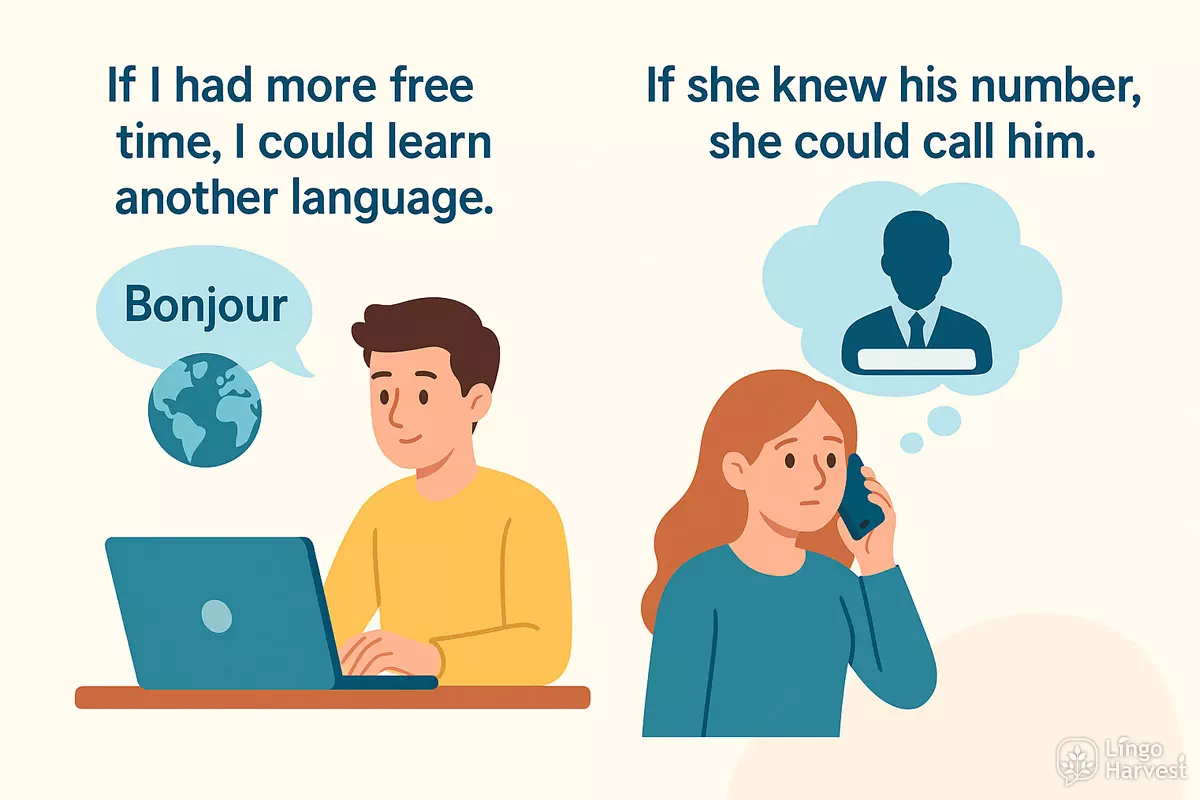
"Could" is used to show that someone would be able to do something if the situation were different. It emphasizes capability or potential, not certainty. For example:
- If I had more free time, I could learn another language.
- If she knew his number, she could call him.
- If they lived closer, we could visit them more often.
- If we had a car, we could drive to the beach.
How "might" changes the meaning
"Might" expresses a possible, but not definite, outcome. It adds an element of uncertainty to the result. These sentences often suggest that the result is only one possible outcome among others:
- If you studied harder, you might pass the exam. → (possible, not guaranteed)
- If it rained tomorrow, we might stay home.
- If I won the lottery, I might buy a new house.
- If she tried, she might succeed.
Comparing "would," "could," and "might" in use
The following table highlights the differences between these modals when forming hypothetical present situations:
| Modal | Meaning | Example |
|---|---|---|
| would | Definite result or intention in the unreal situation | If I had time, I would travel more. |
| could | Ability or possibility in the unreal situation | If I had time, I could travel more. |
| might | Possible, but not certain, result in the unreal situation | If I had time, I might travel more. |
Quick reference: more sample sentences
- If it were sunny, we could have a picnic.
- If I were taller, I might play basketball.
- If they studied more, they could get better grades.
- If she spoke French, she might work in Paris.
- If we had tickets, we could see the show.
- If he were here, he might help us.
- If I had a dog, I could take walks every day.
- If you practiced, you might win the competition.
- If it snowed, we could build a snowman.
- If I knew the answer, I might tell you.
By choosing between "could" and "might" in conditional sentences, you can express the exact degree of possibility, ability, or uncertainty you want to convey in hypothetical present scenarios.
Typical contexts: dreams, advice, imaginary situations
The second conditional is frequently used when we want to talk about present or future situations that are not real, but imagined, unlikely, or just hypothetical. This structure helps us express how things might be different if circumstances were not as they actually are. It’s common in storytelling, giving advice, or when speculating about alternate realities.
Dreams and Unreal Wishes
Talking about dreams or desires often involves imagining a world that doesn’t exist. The second conditional allows speakers to express these fantasies clearly:
- If I were a bird, I would fly around the world.
- If she had a million dollars, she would buy a house by the sea.
- If we lived on Mars, we would see two moons in the sky.
- If it rained chocolate, children would be very happy.
Giving Advice
When offering advice, especially in a hypothetical or polite way, this structure is especially useful. It helps soften suggestions, making them sound less direct:
- If I were you, I would talk to my boss.
- If he needed help, I would recommend asking his teacher.
- If they were more careful, they would avoid mistakes.
- If you studied harder, you would pass the exam.
Imaginary or Unreal Situations
Speculating about scenarios that are not true in the present is another typical use. This is helpful when discussing improbable events or making generalizations about impossible conditions.
- If cats could talk, conversations would be interesting.
- If I didn’t have to work, I would travel more.
- If water boiled at 50°C, cooking would be faster.
- If he knew the answer, he would tell us.
Common Patterns and Vocabulary
The following expressions are often used with second conditional statements:
- If I were/was… → If I were you, I would take the job.
- If you had… → If you had more time, you could learn Spanish.
- If she/he/it could… → If she could drive, she would buy a car.
- Would you… if…? → Would you help me if I asked?
- If only I… → If only I had saved more money.
- Suppose you… → Suppose you won a million dollars, what would you do?
- Imagine if… → Imagine if we lived on Mars.
- If we didn’t… → If we didn’t have electricity, life would be harder.
- If they were… → If they were taller, they could reach the shelf.
- What would happen if…? → What would happen if gravity disappeared?
- If I knew… → If I knew the answer, I would tell you.
- If she felt… → If she felt better, she would go outside.
- If there were… → If there were more parks, cities would be greener.
- If it snowed in July… → If it snowed in July, everyone would be shocked.
- If prices fell… → If prices fell, more people would travel.
- If people listened… → If people listened more, misunderstandings would decrease.
Summary of Uses
The second conditional is essential for expressing unreal present or future situations, whether you’re dreaming, giving advice, or imagining an alternative reality. It is a flexible structure that helps speakers explore possibilities, make polite recommendations, and discuss events that are not currently true.
Common mistakes with verb tense choice
Choosing the right verb tenses in the second conditional can be tricky, especially for learners who are used to different structures in their native language. This often leads to errors that make sentences sound unnatural or change the intended meaning. The second conditional is used for unreal or hypothetical present situations, so the tense pattern is very specific: the if-clause uses the simple past, and the main clause uses would + base verb. However, people often mix these up, causing confusion.
Mixing up verb tenses
One of the most frequent problems is using the present simple instead of the past simple in the if-clause, or inserting "will" instead of "would" in the main clause. These errors can make your sentence sound like a first conditional (real, possible situations), not a second conditional (unreal, hypothetical situations).
- ❌ If I have more time, I will travel more. (incorrect for hypothetical/unreal present)
- ✅ If I had more time, I would travel more. (correct)
- ❌ If she is taller, she will play basketball.
- ✅ If she were taller, she would play basketball.
Confusing "was" and "were"
In formal English, "were" is used with all subjects in the second conditional for the verb "to be". However, many speakers mistakenly use "was" after "if" with "I," "he," "she," or "it." While "was" is sometimes accepted in casual speech, "were" is the standard form.
- ❌ If I was rich, I would travel the world.
- ✅ If I were rich, I would travel the world.
Using modal verbs incorrectly
Sometimes learners substitute "would" with "could" or "might" in the main clause. While these can be correct if you want to express possibility or ability, using "will" is never appropriate for the second conditional.
- ❌ If you studied harder, you will pass.
- ✅ If you studied harder, you would pass.
- ✅ If you studied harder, you might/could pass. (possible, but meaning changes slightly)
Summary table: Correct vs. incorrect second conditional forms
| Incorrect Form | Correct Second Conditional |
|---|---|
| If I have a car, I will drive to work. | If I had a car, I would drive to work. |
| If he is here, he will help us. | If he were here, he would help us. |
| If we know the answer, we will tell you. | If we knew the answer, we would tell you. |
| If she was my boss, I will be happy. | If she were my boss, I would be happy. |
Common error patterns to watch for
- Present simple in the if-clause instead of past simple
- Using "will" in the main clause
- Incorrect use of "was" instead of "were"
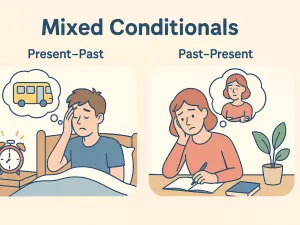
- Mixing first and second conditional structures
- Forgetting to use a base verb after "would"
- Using present continuous in the if-clause ("If I am having time...")
- Using "will" in both clauses
- Omitting "would" entirely ("If I won the lottery, I buy a house.")
- Adding unnecessary "to" after "would" ("I would to go")
- Confusing "would have" (third conditional) with "would" (second conditional)
Mastering the second conditional requires careful attention to verb forms and sentence structure. By avoiding these tense-related pitfalls, your English will sound much more natural and accurate when describing unreal or hypothetical present situations.
Practice: complete and create second conditional sentences
Practicing the second conditional is essential for mastering hypothetical or unreal present situations. This exercise section includes a variety of tasks designed to help you recognize and construct sentences expressing imagined scenarios and their possible results.
Complete the sentences
Finish each sentence using the correct second conditional structure. Consider the hypothetical nature of each idea.
- If I (have) more free time, I (learn) to play the guitar.
- If she (be) taller, she (play) basketball.
- If they (know) about the meeting, they (come).
- If we (win) the lottery, we (travel) the world.
- If you (not be) so busy, you (join) us for dinner.
- If he (study) more, he (get) better grades.
- If I (see) her today, I (tell) her the news.
- If the house (be) bigger, we (invite) more guests.
- If you (drive) slower, you (be) safer.
- If they (have) a map, they (find) the place.
Show answers
- had, would learn
- were, would play
- knew, would come
- won, would travel
- weren't / were not, would join
- studied, would get
- saw, would tell
- were, would invite
- drove, would be
- had, would find
Make your own second conditional sentences
Now, create original sentences using the model: If + past simple, would + base verb. Try using different verbs and situations to express hypothetical outcomes.
- If I lived in another country, I would...
- If my phone worked, I would...
- If we had more money, we would...
- If it rained today, I would...
- If you knew the answer, you would...
- If I spoke three languages, I would...
- If my friend invited me, I would...
- If she studied harder, she would...
- If they offered me the job, I would...
- If I saw a celebrity, I would...
Common mistakes to avoid
Learners often confuse verb forms or mix up conditionals. Here’s a summary of typical errors and correct alternatives:
| Incorrect Form | Correct Form |
|---|---|
| If I will see her, I will tell her. | If I saw her, I would tell her. |
| If he would have time, he would help. | If he had time, he would help. |
| If we know the answer, we would tell you. | If we knew the answer, we would tell you. |
| If you would listen, you would understand. | If you listened, you would understand. |
Challenge: Match the halves
Match the beginning of each hypothetical statement with its logical ending.
- If I had a car, ...
- If you spoke Spanish, ...
- If it snowed tomorrow, ...
- If they invited us, ...
- If she knew the truth, ...
- If we lived near the beach, ...
- If he studied more, ...
- If I won a million dollars, ...
- If you were older, ...
- If the city were quieter, ...
- a) I would drive to work.
- b) we would definitely go.
- c) you would travel easily in Spain.
- d) I would build a snowman.
- e) she would be shocked.
- f) we would swim every day.
- g) he would get better grades.
- h) I would travel around the world.
- i) you would have more freedom.
- j) people would sleep better.
Show answers
- If I had a car, I would drive to work.
- If you spoke Spanish, you would travel easily in Spain..
- If it snowed tomorrow, I would build a snowman.
- If they invited us, we would definitely go.
- If she knew the truth, she would be shocked.
- If we lived near the beach, we would swim every day.
- If he studied more, he would get better grades.
- If I won a million dollars, I would travel around the world.
- If you were older, you would have more freedom.
- If the city were quieter, people would sleep better.
By completing these exercises, you’ll gain a stronger sense of how to express unreal present situations and improve your fluency with the second conditional structure.